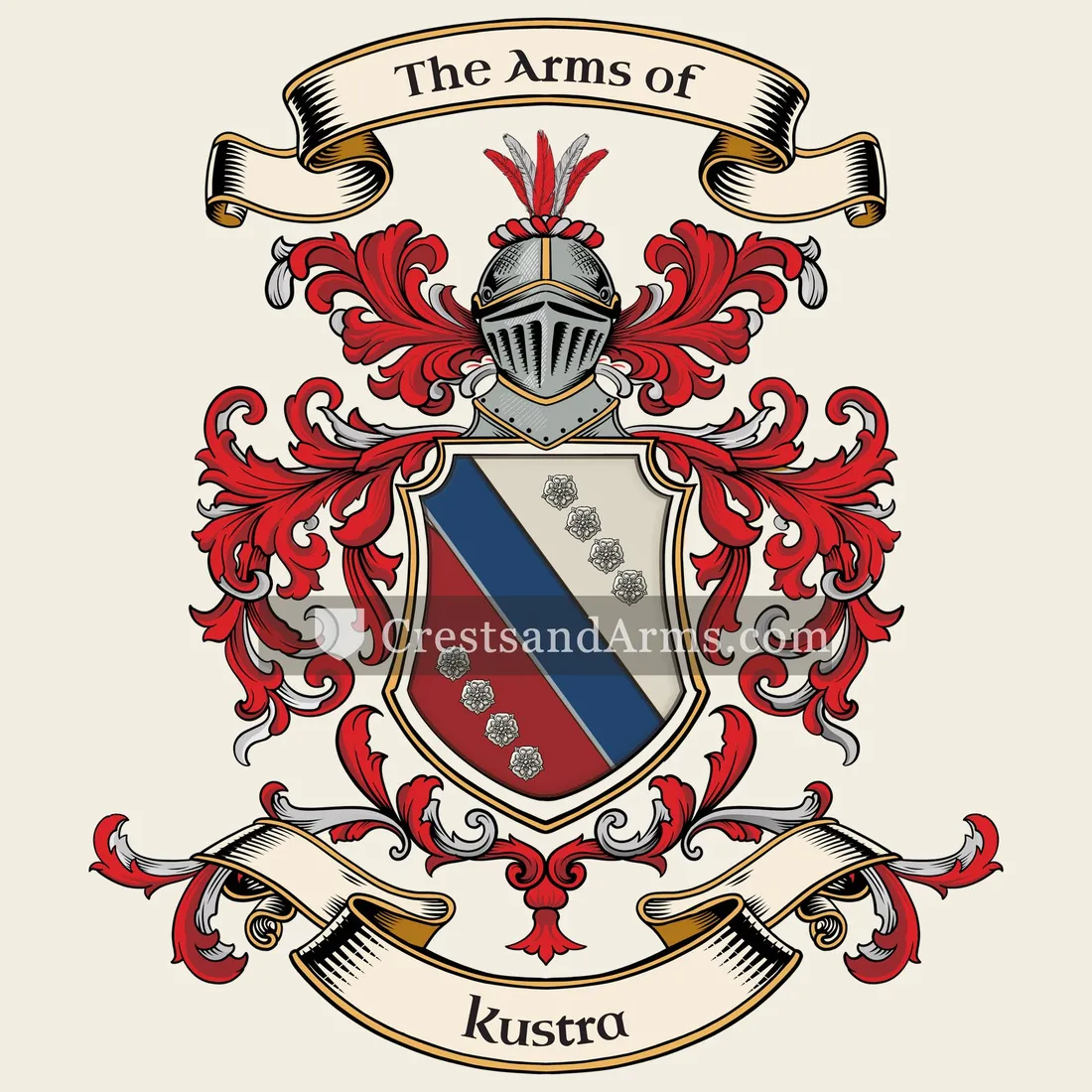
A record of documented arms, meaning and origin, researched for the Kustra family of Germany.
Reg. 5906 · German, J–L
Meaning of the Kustra family crest colors & symbols
Symbols on this shield
bendDefence, and the scarf of a commander
roseThe seventh son, and beauty with grace
Colours
Red (Gules)Means: Military strength
Silver (Argent)Means: Peace and sincerity
Blue (Azure)Means: Loyalty and truth
Historical info
Source
J. B. Rietstap, Armorial Général, Gouda: G. B. van Goor Zonen, 1884–87
Blazon (the actual original written record)
“Tranché de gu. sur arg.; à dix roses de l'un à l'autre, rangées en orle; à la bande d'azur, br. sur le tranché. C.: un vol, aux armes de l'écu (sur l'aile dextre, l'ordre des meubles est interverti). L. d'arg. et de gu.”
GermanyBrunswick, c. 1765
Digital archive packCoat of arms PNG, gold border print PDF, vector SVG and the certificate of authenticity. Sent to your email in minutes.
Map of Germany showing where the Kustra arms are recorded
The Kustra arms were recorded in Brunswick, c. 1765.
This is where the arms were entered in the register. Families often moved to other parts of the country, so the same name can turn up in more than one region.
The body that granted and recorded arms in Germany in this period.
Francis I, Holy Roman Emperor
Sovereign of the period
Francis I, Holy Roman Emperor
1745–1765
Reigning in Germany when the Kustra arms are first recorded.
How Arms Worked in Germany
In the Holy Roman Empire, coats of arms were often granted to individuals by the Emperor or his representatives. These arms were then passed down through the generations to all legitimate descendants of the original holder. Younger branches of a family usually kept the same shield design without needing to change it, as the arms belonged to the entire lineage.
Granting authority
The Holy Roman Emperor held the sole power to grant new coats of arms throughout his vast imperial territories.
How they got arms
Families typically obtained their coats of arms through a formal imperial grant or by proving their noble status to the authorities.
Where arms were recorded
These grants were officially recorded in the Imperial Chancery registers, which began keeping formal records of such honors during the Middle Ages.
The family's standing
Recorded among the armigerous families of Germany.
Origin & History of the Kustra Family in Germany
The Kustra family name has deep roots in the historical region of Brunswick, where records confirm the presence of family members as early as 1765. The name is believed to be of Slavic origin, likely derived from words related to brushwood or thickets, which suggests that the earliest ancestors may have been people who lived near or worked within forested areas. During the eighteenth century, Brunswick served as a significant hub for trade and administration, drawing families into the region to participate in the growing local economy. As these early Kustras settled into the community, they became part of a complex social landscape defined by craftsmanship and agricultural labor. Over generations, the family name became a permanent fixture in the local records, reflecting the steady migration and integration of families across the German territories during this transformative era.
Kustra Meaning & Related Branches
Root word
Kust
A German variant of the word for a chest or box.
This name
KustraRefers to a person who made or sold chests, boxes, or small containers.
also spelled
Kuester
Kester
Documented Sources
J. B. Rietstap, Armorial Général, Gouda: G. B. van Goor Zonen, 1884–87
Braunschweigisches Landesmuseum, Personenstandsregister der Stadt Braunschweig, 1765
Bahlow, Hans, Deutsches Namenlexikon: Familien- und Vornamen nach Ursprung und Sinn erklärt, 1967
Stadtarchiv Braunschweig, Bürger- und Einwohnerverzeichnisse der Stadt Braunschweig, 1765
Digital archive packCoat of arms PNG, gold border print PDF, vector SVG and the certificate of authenticity. Sent to your email in minutes.


 bendDefence, and the scarf of a commander
 roseThe seventh son, and beauty with grace
 bendDefence, and the scarf of a commander
 roseThe seventh son, and beauty with grace