Map of Belgium showing where the Lacroix arms are recorded
The Lacroix arms were recorded in Liege, c. 1737.
Liege was a prosperous town and its surrounding country, living on metalworking and trade. Merchant families grew rich, bought land outside the walls, and took arms as landowners rather than tradesmen.
This is where the arms were entered in the register. Families often moved to other parts of the country, so the same name can turn up in more than one region.
The body that granted and recorded arms in Belgium in this period.
Charles VI, Holy Roman Emperor
Sovereign of the period
Charles VI, Holy Roman Emperor
1711–1740
Reigning in Belgium when the Lacroix arms are first recorded.
How Arms Worked in Belgium
In Belgium, a coat of arms is considered personal property that is passed down through the male line to legitimate descendants. Families often use the same shield design across generations to show their shared heritage. If a branch of the family wants to change the design, they must apply for an official update to their specific version of the arms.
Granting authority
The Conseil héraldique is the official body that regulates and approves all coats of arms in Belgium.
How they got arms
Families obtain their coats of arms through formal royal grants or by confirming their historical right to use existing designs.
Where arms were recorded
All approved coats of arms are officially recorded in the public registers of the Conseil héraldique since 1844.
The family's standing
Recorded among the armigerous families of Liege.
Origin & History of the Lacroix Family in Belgium
The surname Lacroix is a classic example of a topographical name, which means it was originally given to people based on where they lived. In French, the name translates to "the cross," and it likely identified families who resided near a prominent roadside cross, a village crossroads, or a place of religious significance. By the time members of the family were documented in Liège in 1737, the name had already become well-established across French-speaking regions. In the context of 18th-century Liège, which was a major industrial and cultural hub, families with this name were often integrated into the local urban fabric as skilled tradespeople or merchants. Because Liège served as a crossroads for trade between the German states and the Low Countries, the presence of the Lacroix family there reflects the broader movement of people who settled in growing cities to seek new economic opportunities. These early ancestors were part of a society that valued community location as a primary way to distinguish one family from another in official records.
Coat of Arms & Family Crest Details
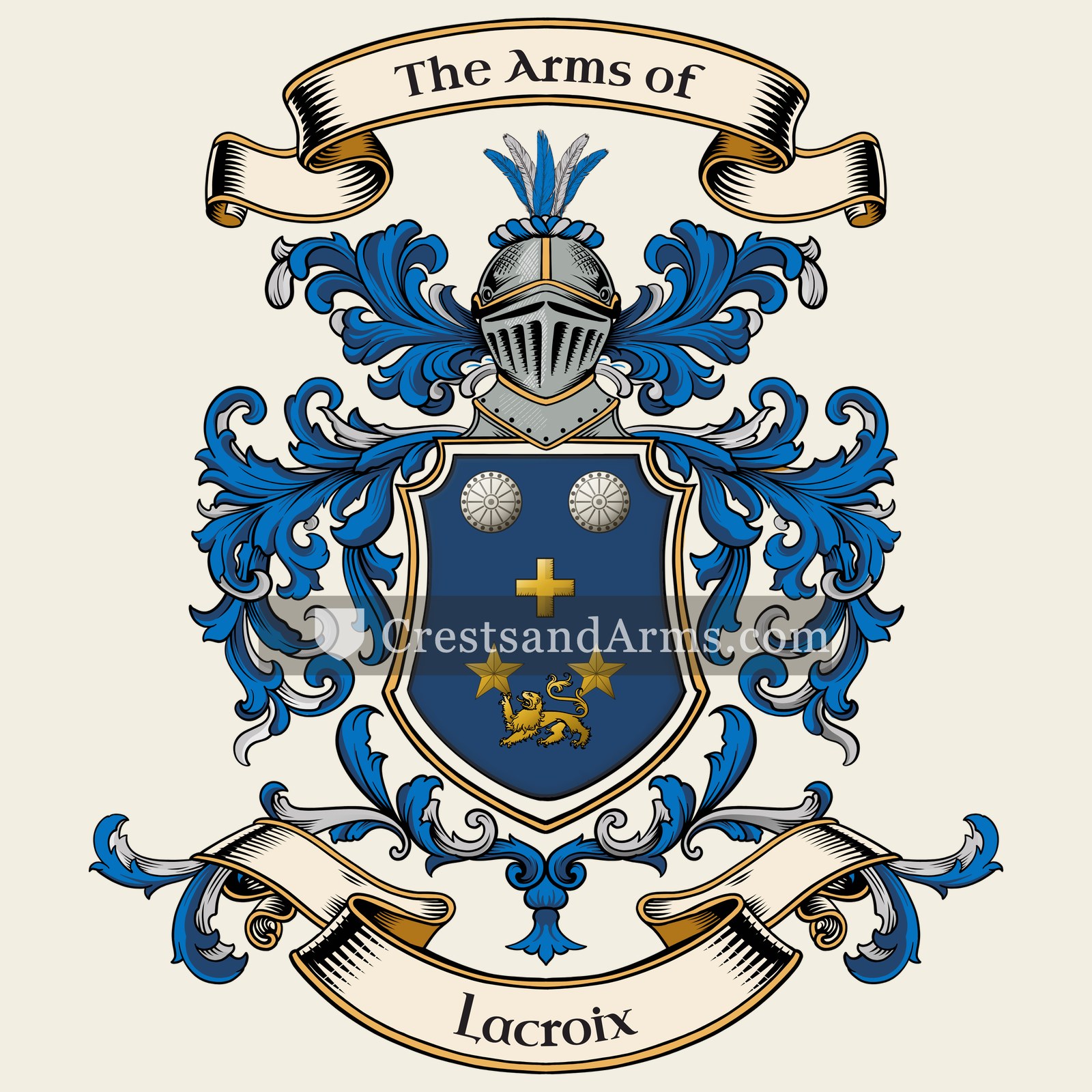
Symbols on this shield
cross symbolChristian faith and service
roundelA coin, and one who has been to the crusades
mulletThe third son, and a divine quality from above
lionCourage, strength and royalty
Colours
Blue (Azure)Means: Loyalty and truth
Gold (Or)Means: Generosity
Silver (Argent)Means: Peace and sincerity
Historical info
Source
J. B. Rietstap, Armorial Général, Gouda: G. B. van Goor Zonen, 1884–87
Blazon (the actual original written record)
“D'azur à une croix alésée et pommetée d'or, acc. aux 1 et 4 d'un besant d'arg. et aux 2 et 3 d'une étoile d'or; le tout acc. en p. d'un lion couché d'or.”
FranceToulouse, c. 1663
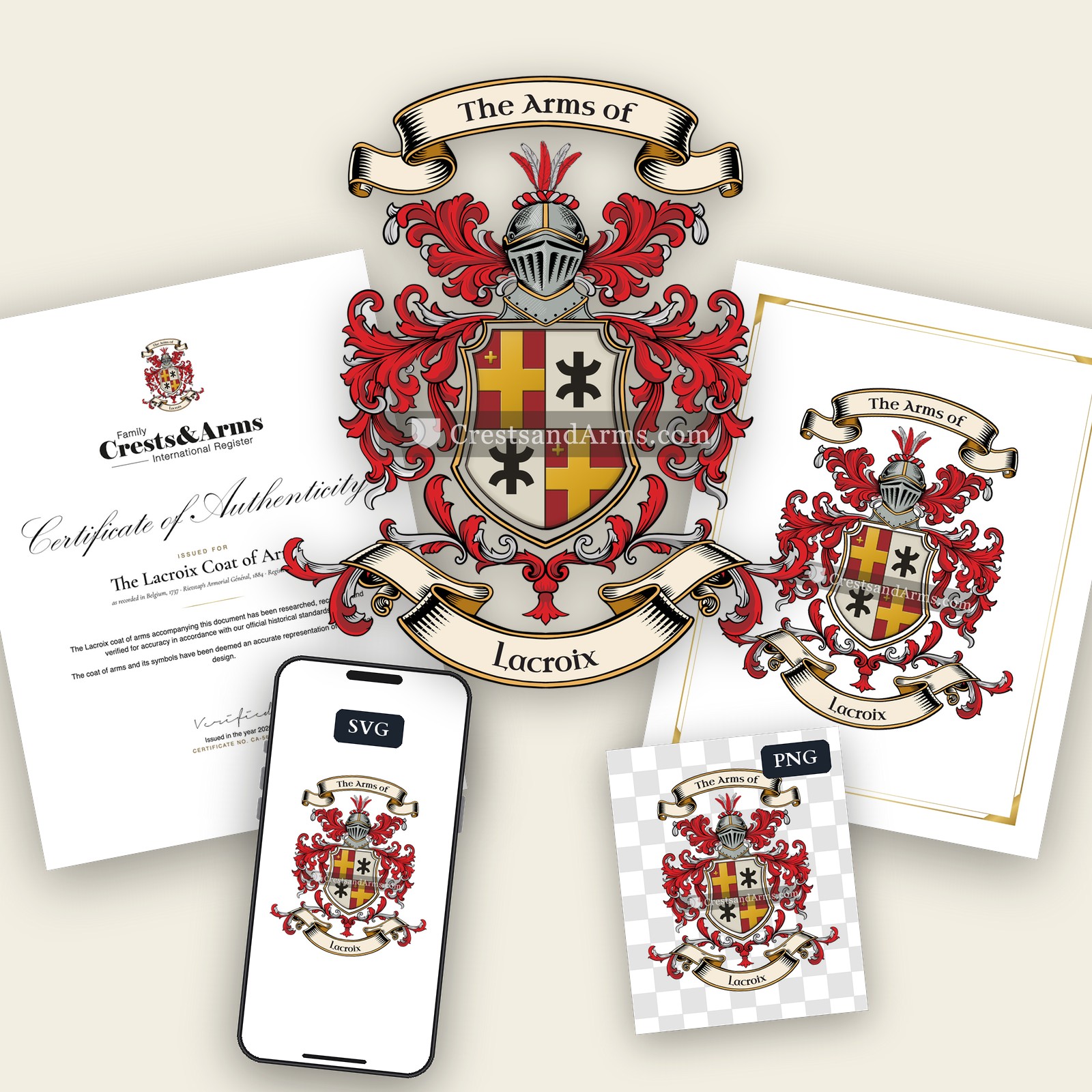
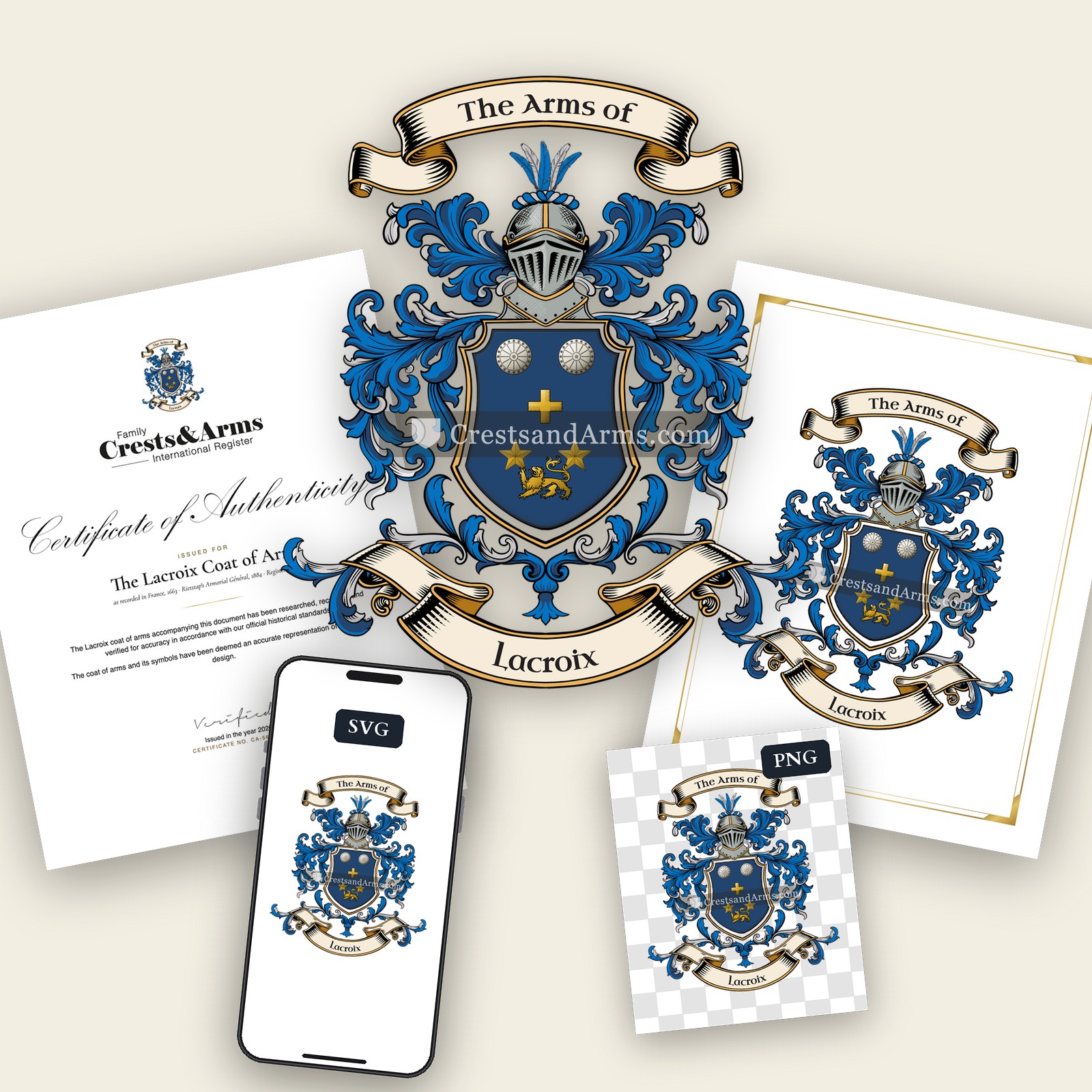
Digital archive packCoat of arms PNG, gold border print PDF, vector SVG and the certificate of authenticity. Sent to your email in minutes.
Map of France showing where the Lacroix arms are recorded
The Lacroix arms were recorded in Toulouse, c. 1663.
This is where the arms were entered in the register. Families often moved to other parts of the country, so the same name can turn up in more than one region.
The body that granted and recorded arms in France in this period.
Louis XIV of France
Sovereign of the period
Louis XIV of France
1643–1715
Reigning in Belgium when the Lacroix arms are first recorded.
How Arms Worked in France
In France, a coat of arms was a mark of honor that passed down through the male line to all legitimate descendants. Families often used the same shield without changes to show their shared heritage. If a branch wanted to stand out, they could add a small mark to their shield to show their specific place in the family tree.
Granting authority
The Juge d'armes de France acted as the official authority that regulated and verified coats of arms across the country.
How they got arms
Families typically inherited their arms from ancestors, though they could also receive them through royal grants or by proving their noble status.
Where arms were recorded
Coats of arms were officially recorded in the Armorial Général de France, which began its main collection in the year 1696.
The family's standing
Recorded among the armigerous families of France.
Origin & History of the Lacroix Family in France
The surname Lacroix is a classic example of a topographic name, which means it was originally given to people based on where they lived. In medieval France, the name identified families who resided near a prominent cross, such as a roadside crucifix, a village market cross, or a church landmark. By the time members of the family were documented in Toulouse in 1663, the name had already become a well-established identifier for local citizens. During the seventeenth century, Toulouse was a major center for trade and legal administration, and families with this name were often integrated into the urban fabric of the city. As the name spread across different French provinces, it evolved from a simple way to describe a neighbor into a permanent family legacy that connected individuals to the geography of their home regions.
Lacroix Meaning & Related Branches
Root word
Crux
Latin word meaning a cross or a gibbet.
This name
LacroixRefers to a person who lived near a prominent roadside cross or crucifix.
also spelled
Lacroy
Documented Sources
J. B. Rietstap, Armorial Général, Gouda: G. B. van Goor Zonen, 1884–87
Dauzat, Albert, Dictionnaire étymologique des noms de famille et prénoms de France, 1951
State Archives in Liège, Registres paroissiaux de la ville de Liège, 1737
Herbillon, Jules and Germain, Jean, Dictionnaire des noms de famille en Belgique romane et dans les régions limitrophes, 1996
Digital archive packCoat of arms PNG, gold border print PDF, vector SVG and the certificate of authenticity. Sent to your email in minutes.


 cross symbolChristian faith and service
 millrind / fer de molineThe mill's iron, and the grinding of grain
 cross symbolChristian faith and service
 millrind / fer de molineThe mill's iron, and the grinding of grain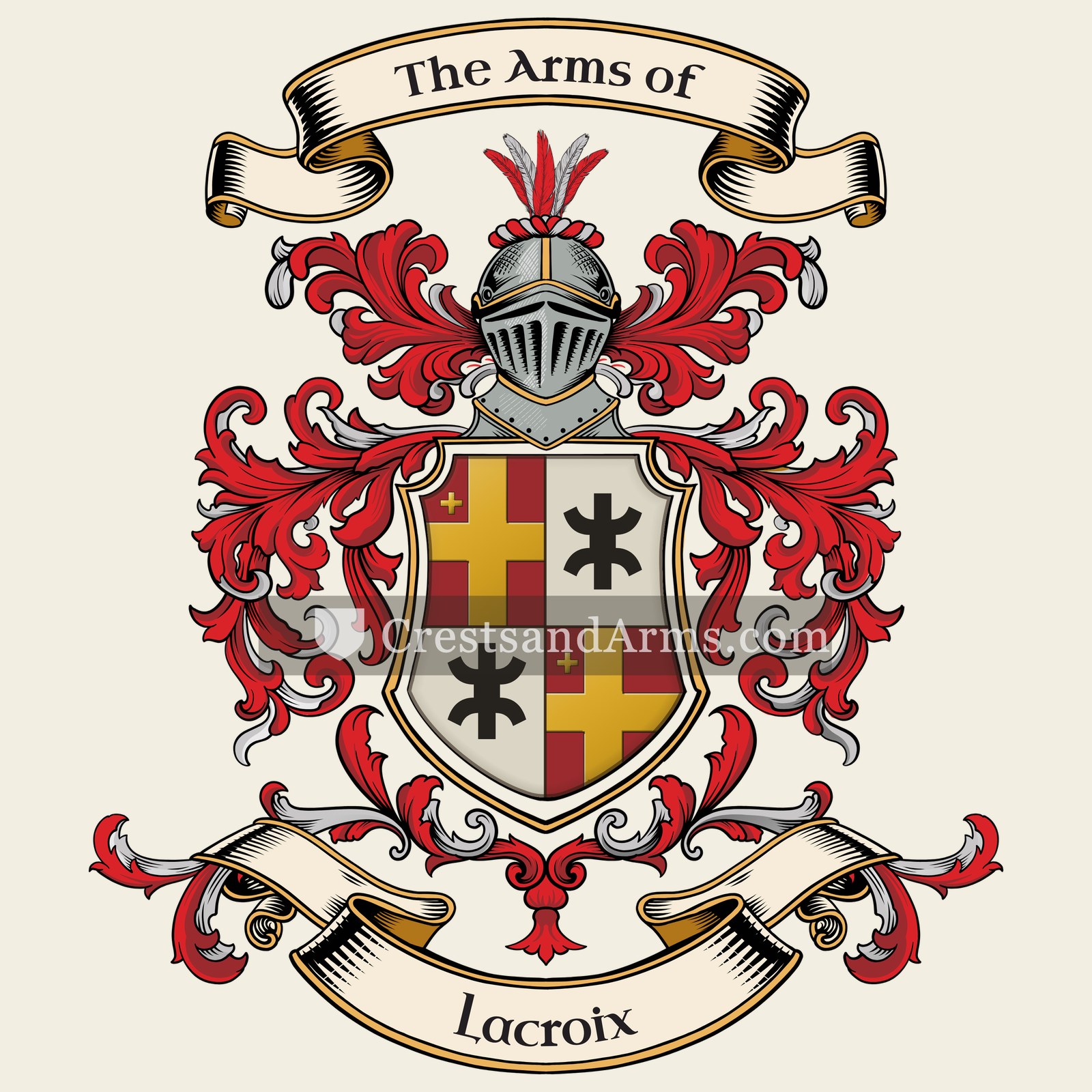


 roundelA coin, and one who has been to the crusades
 mulletThe third son, and a divine quality from above
 lionCourage, strength and royalty