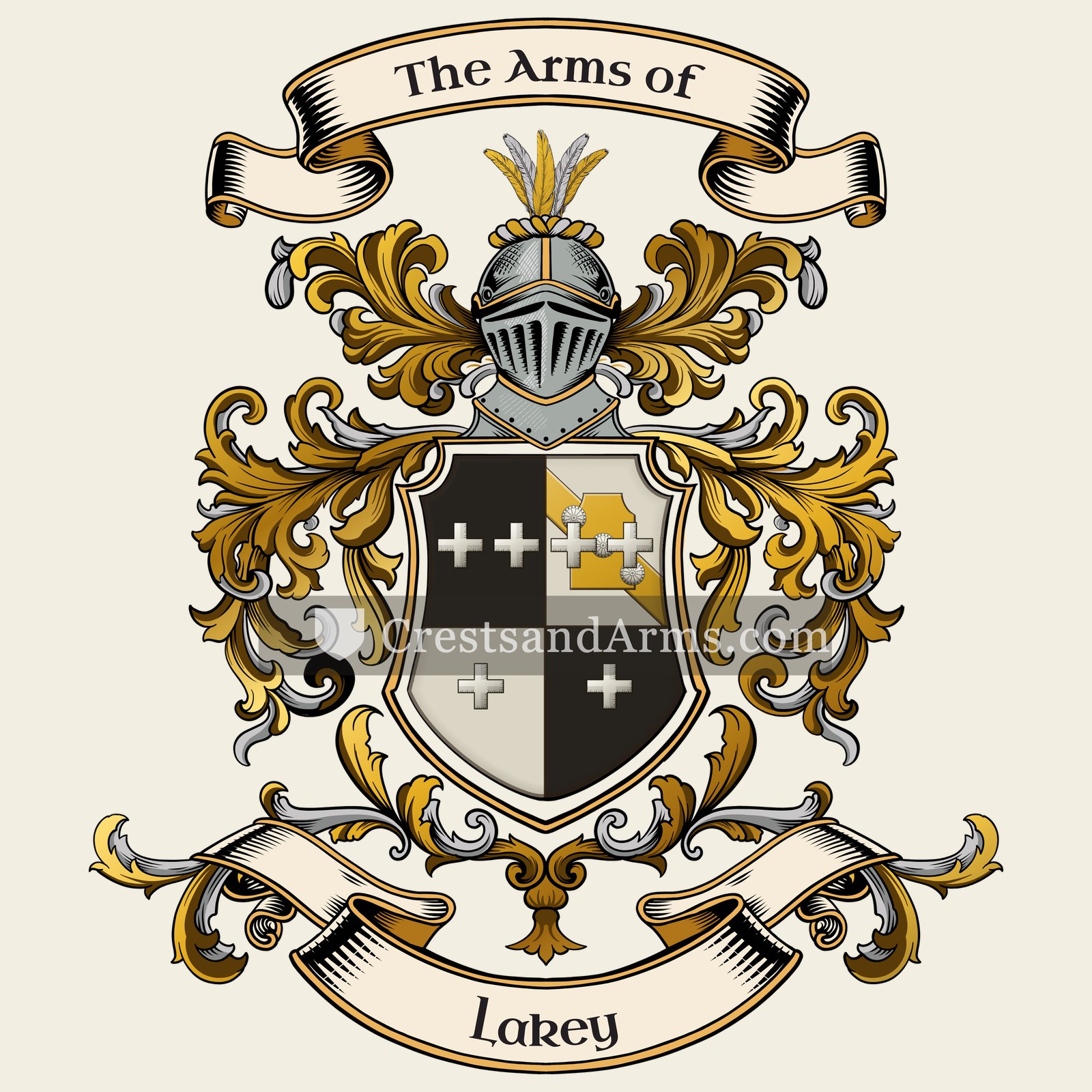
A record of documented arms, meaning and origin, researched for the Lakey family lines. Documented in 2 countries.
Reg. 9021 · Swedish, J–L
Coat of Arms & Family Crest Details
Symbols on this shield
bendDefence, and the scarf of a commander
cross symbolChristian faith and service
chiefAuthority, wisdom and dominion
fishA true and generous mind, and Christian faith
arrowReadiness for battle, and affliction endured
crescentHonour by the sovereign, and the second son
ringFidelity, and a promise kept
Colours
Black (Sable)Means: Constancy
Silver (Argent)Means: Peace and sincerity
Gold (Or)Means: Generosity
Historical info
Source
J. B. Rietstap, Armorial Général, Gouda: G. B. van Goor Zonen, 1884–87
Blazon (the actual original written record)
“De sa. à la bande d'arg., acc. de six croix recr. au pied fiché du même, rangées en orle; au chef d'arg., ch. d'un poisson nageant bariolé d'or, de gu. et de sin., percé de flèches ornées de croissants, d'annelets, etc. C.: une tête de cheval d'arg., coll. d'une jumelle de gu. T.: à dextre une grenadier, à sen. un soldat malai.”
Swedenc. 1700
Digital archive packCoat of arms PNG, gold border print PDF, vector SVG and the certificate of authenticity. Sent to your email in minutes.
Map of Sweden showing where the Lakey arms are recorded
The Lakey arms were recorded in Sweden, c. 1700.
Arms such as these were typically recorded in Stockholm.
Stockholm held the Swedish court and the House of Nobility, where every noble family's arms were entered and kept. Families ennobled for service registered there, which is why so many are recorded around the city.
This is where the arms were entered in the register. Families often moved to other parts of the country, so the same name can turn up in more than one region.
The body that granted and recorded arms in Sweden in this period.
Carl XII of Sweden
Sovereign of the period
Carl XII of Sweden
1697–1718
Reigning in Sweden when the Lakey arms are first recorded.
How Arms Worked in Sweden
In Sweden, a coat of arms belonged to a noble family as a whole rather than just one individual. These arms were passed down through the generations to all legitimate descendants. Younger branches of the family used the same shield without needing to change it. This system ensured that the entire lineage shared the same identity and status under the law.
Granting authority
The Riddarhuset, or House of Nobility, regulated all noble coats of arms in Sweden under royal authority.
How they got arms
Families received their coats of arms through royal grants of nobility which were then officially registered with the House.
Where arms were recorded
Coats of arms were officially recorded in the Swedish House of Nobility register starting in the year 1626.
The family's standing
Recorded among the armigerous families of Sweden.
Origin & History of the Lakey Family in Sweden
The family name Lakey in Sweden traces its roots back to the bustling urban environment of Stockholm in the early 1700s. During this period, Sweden was a major power in Northern Europe, and Stockholm served as a central hub for trade, military administration, and craft guilds. Families living in the capital at this time were often connected to the rapid expansion of the city or the professional networks that supported the Swedish monarchy. Because the name appears in records during this era, it is likely that early family members were part of the growing class of tradespeople or civil servants who helped maintain the city’s infrastructure. These individuals lived through a time of significant social change, as Sweden transitioned from a period of imperial dominance to a more domestic focus on industry and urban development. By establishing themselves in Stockholm, the early Lakey family became part of the historical fabric of a city that was rapidly modernizing at the dawn of the eighteenth century.
Coat of Arms & Family Crest Details
Symbols on this shield
bendDefence, and the scarf of a commander
cross symbolChristian faith and service
roundelA coin, and one who has been to the crusades
Colours
Black (Sable)Means: Constancy
Silver (Argent)Means: Peace and sincerity
Gold (Or)Means: Generosity
Historical info
Source
Sir Bernard Burke, The General Armory of England, Scotland, Ireland and Wales, London: Harrison & Sons, 1884
Blazon (the actual original written record)
“Sa. a bend betw. six crosslets fitchée ar., quartering BISHOP, ar. on a bend sa. cotised gu. three bezants”
KentSmarden · Kent, c. 1595
Digital archive packCoat of arms PNG, gold border print PDF, vector SVG and the certificate of authenticity. Sent to your email in minutes.
Map of England showing where the Lakey arms are recorded
The Lakey arms were recorded in Kent, c. 1595.
Kent sits between London and the short crossing to Europe, and the trade passing through made it wealthy. Merchant families bought land with that money, and it was landowners who took coats of arms.
This is where the arms were entered in the register. Families often moved to other parts of the country, so the same name can turn up in more than one region.
The body that granted and recorded arms in England in this period.
Elizabeth I of England
Sovereign of the period
Elizabeth I of England
1558–1603
Reigning in Sweden when the Lakey arms are first recorded.
How Arms Worked in England
English heraldry allowed arms to be shared by all legitimate descendants of the original owner. These symbols were treated as personal property that moved through the generations to all children. While the eldest son kept the original design, other family members could use the same shield without needing to change it or register their own unique versions.
Granting authority
The College of Arms in London has regulated the use of coats of arms throughout England and Wales since 1484.
How they got arms
Families typically obtained their coats of arms through a formal grant from the Crown or by proving their ancient right to them.
Where arms were recorded
All official coats of arms are recorded in the registers kept at the College of Arms, which date back to the fifteenth century.
The family's standing
Recorded among the armigerous families of Kent.
Origin & History of the Lakey Family in England
The surname Lakey is deeply rooted in the historical landscape of Kent, England, where records confirm the family was established by at least 1595. The name is generally considered a topographic surname, which means it was likely given to people who lived near a specific geographical feature, such as a lake or a small body of water. During the late sixteenth century, Kent was a region defined by its agricultural prosperity and its proximity to the busy shipping lanes of the English Channel. Families like the Lakeys often lived in small, tight-knit rural parishes where they worked the land or engaged in local trades. As the name spread through the county, it became a permanent part of the local identity, reflecting the way English surnames evolved from simple descriptions of a person’s home into lasting family markers that were passed down through generations.
Related Branches & Arms
Root word
Lacus
A Latin term referring to a body of water or lake.
This name
LakeyA topographic surname identifying someone who lived near a lake or water body.
also spelled
Laake
Lakke
Layke
Documented Sources
J. B. Rietstap, Armorial Général, Gouda: G. B. van Goor Zonen, 1884–87
Stockholms stadsarkiv (Stockholm City Archives), Mantalslängder för Stockholms stad (Tax census records for the city of Stockholm)
Riksarkivet (National Archives of Sweden), Kyrkoarkiv (Parish records for Stockholm parishes)
Lundin, Claës, Nya Stockholm (1890)
Nilsson, Göran B., Den svenska historien: Stormaktstiden (1992)
Digital archive packCoat of arms PNG, gold border print PDF, vector SVG and the certificate of authenticity. Sent to your email in minutes.


 bendDefence, and the scarf of a commander
 cross symbolChristian faith and service
 chiefAuthority, wisdom and dominion
 fishA true and generous mind, and Christian faith
 arrowReadiness for battle, and affliction endured
 crescentHonour by the sovereign, and the second son
 ringFidelity, and a promise kept
 bendDefence, and the scarf of a commander
 cross symbolChristian faith and service
 chiefAuthority, wisdom and dominion
 fishA true and generous mind, and Christian faith
 arrowReadiness for battle, and affliction endured
 crescentHonour by the sovereign, and the second son
 ringFidelity, and a promise kept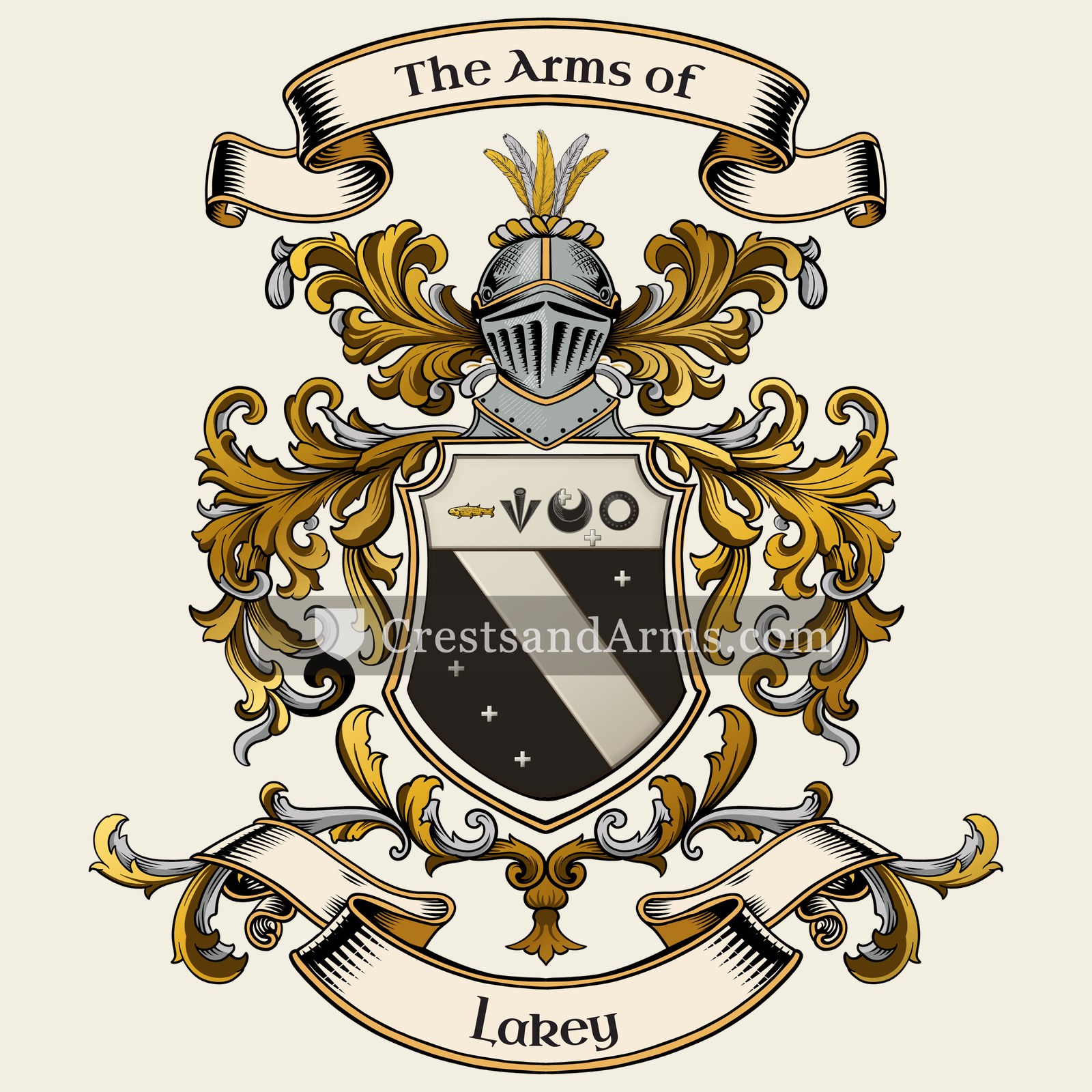


 roundelA coin, and one who has been to the crusades