Map of Ireland showing where the Lalor arms are recorded
The Lalor arms were recorded in Tipperary, c. 1645.
Tipperary was the best grazing land in Ireland, held by a small number of powerful families. Land of that value stayed in the same hands, and unbroken holding is what puts a name in the records.
This is where the arms were entered in the register. Families often moved to other parts of the country, so the same name can turn up in more than one region.
The body that granted and recorded arms in Ireland in this period.
Charles I of England
Sovereign of the period
Charles I of England
1625–1649
Reigning in Ireland when the Lalor arms are first recorded.
How Arms Worked in Ireland
The Ulster King of Arms granted coats of arms to individuals who proved their social standing and good character. These symbols were typically inherited by all legitimate descendants of the original holder. If a family branch wanted a unique look, they could apply for a specific change to their design through the office to ensure their identity remained distinct.
Granting authority
The Ulster King of Arms acted as the official body that regulated and issued all coats of arms throughout Ireland.
How they got arms
Families obtained their arms through formal grants issued by the office after proving their eligibility and paying the required fees.
Where arms were recorded
All official grants were recorded in the registers held by the Ulster King of Arms starting from the year 1552.
The family's standing
Recorded among the armigerous families of Tipperary.
Origin & History of the Lalor Family in Ireland
The family name Lalor originates from the Irish Gaelic name Ó Leathlobhair, which translates to descendant of the half-leper or the sickly person. While this meaning may sound unusual today, it likely referred to a specific ancestor who was known for his physical condition or a particular trait. By the mid-seventeenth century, the family had firmly established itself in County Tipperary. Records from 1645 confirm their presence in this region during a time of significant political upheaval in Ireland. As members of the Gaelic nobility, the Lalors were deeply connected to the land and the local power structures of the province of Munster. Over the following decades, the family navigated the complex social changes brought about by land confiscations and shifting political loyalties, ensuring that the name remained a recognized part of the Tipperary landscape for generations.
Related Branches & Arms
Root word
leathlobhar
derived from the Gaelic words for half and leper or sick person
This name
Lalorrefers to a descendant of a person afflicted with a physical ailment or infirmity
also spelled
Lawlor
Laler
Lollar
Documented Sources
Sir Bernard Burke, The General Armory of England, Scotland, Ireland and Wales, London: Harrison & Sons, 1884
Woulfe, Patrick, Sloinnte Gaedheal is Gall: Irish Names and Surnames, 1923
MacLysaght, Edward, The Surnames of Ireland, 1985
National Archives of Ireland, Civil Survey of the County of Tipperary, 1654–1656
Digital archive packCoat of arms PNG, gold border print PDF, vector SVG and the certificate of authenticity. Sent to your email in minutes.


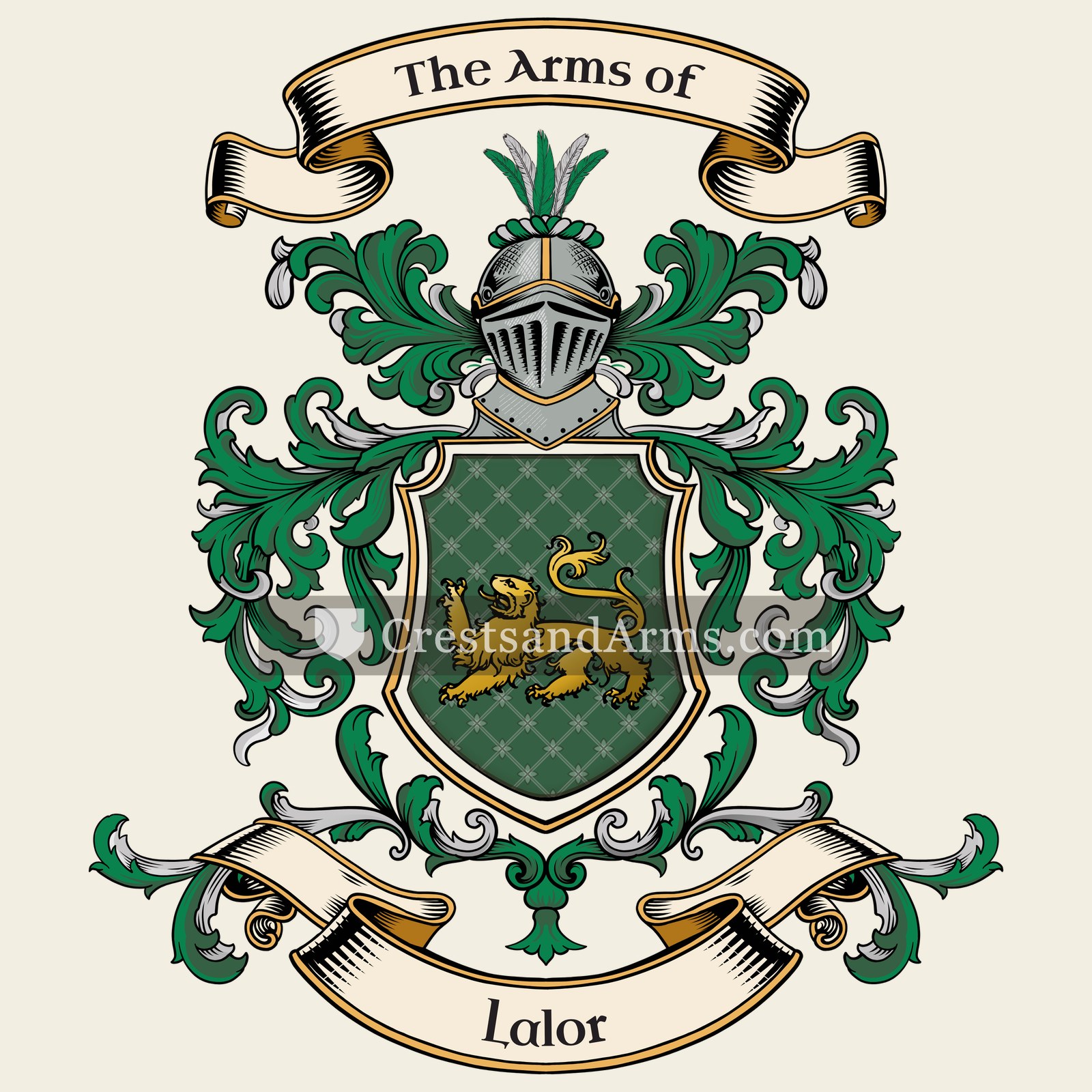
 lionCourage, strength and royalty
 lionCourage, strength and royalty