Map of England showing where the Lamb arms are recorded
The Lamb arms were recorded in Suffolk, c. 1559.
Suffolk was wool country, and its cloth towns were among the wealthiest in England. Clothier families bought manors with their profits, and holding a manor was the ordinary route to a coat of arms.
This is where the arms were entered in the register. Families often moved to other parts of the country, so the same name can turn up in more than one region.
The body that granted and recorded arms in England in this period.
Elizabeth I of England
Sovereign of the period
Elizabeth I of England
1558–1603
Reigning in England when the Lamb arms are first recorded.
How Arms Worked in England
English heraldry allowed arms to be shared by all legitimate descendants of the original owner. These symbols were treated as personal property that moved through the generations to all children. While the eldest son kept the original design, other family members could use the same shield without needing to change it or register their own unique versions.
Granting authority
The College of Arms in London has regulated the use of coats of arms throughout England and Wales since 1484.
How they got arms
Families typically obtained their coats of arms through a formal grant from the Crown or by proving their ancient right to them.
Where arms were recorded
All official coats of arms are recorded in the registers kept at the College of Arms, which date back to the fifteenth century.
The family's standing
Recorded among the armigerous families of Suffolk.
Origin & History of the Lamb Family in England
The surname Lamb originated in England as a descriptive nickname, likely given to someone who possessed a gentle or mild temperament. During the medieval period, it was common for people to be identified by their personality traits or physical characteristics, and this name became a permanent family identifier as surnames grew more popular. By the mid-sixteenth century, the family had established a notable presence in the county of Suffolk. Parish records confirm that members of the Lamb family were living and participating in community life there by 1559. These early ancestors were typically part of the agrarian society that defined the region, likely working as farmers or tradespeople who helped shape the local economy. Over the generations, the family name became deeply rooted in the rural landscape of East Anglia, reflecting the steady and quiet history of many English families from that era.
Meaning of the Lamb family crest colors & symbols
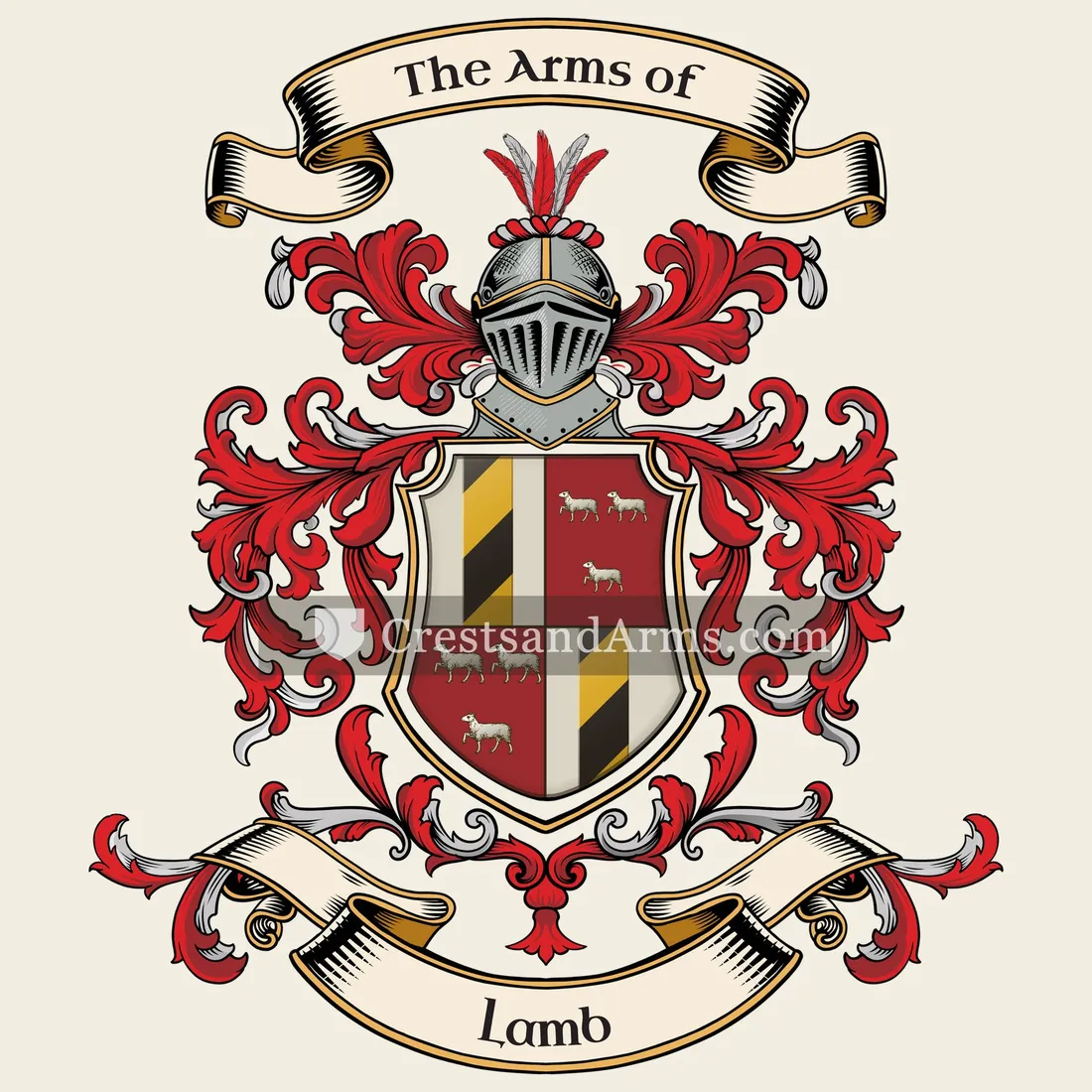
Symbols on this shield
paleMilitary strength, and a fortified defence
lambGentleness, patience and faith
Colours
Silver (Argent)Means: Peace and sincerity
Red (Gules)Means: Military strength
Gold (Or)Means: Generosity
Black (Sable)Means: Constancy
Historical info
Source
Sir Bernard Burke, The General Armory of England, Scotland, Ireland and Wales, London: Harrison & Sons, 1884
Blazon (the actual original written record)
“Quarterly, 1st and 4th, ar. on a pale or, four bendlets sa., for Audouin; 2nd and 3rd, gu. three holy lambs pass. ar. each bearing a banner of the second charged with a cross gu., for Lamb”
WicklowAudouin-Lamb · Wicklow, c. 1801
Digital archive packCoat of arms PNG, gold border print PDF, vector SVG and the certificate of authenticity. Sent to your email in minutes.
Map of Ireland showing where the Lamb arms are recorded
The Lamb arms were recorded in Wicklow, c. 1801.
Wicklow was mountain country immediately south of Dublin, the last part of the east coast brought under control. Families granted land there held it under arms, and those grants were recorded.
This is where the arms were entered in the register. Families often moved to other parts of the country, so the same name can turn up in more than one region.
The body that granted and recorded arms in Ireland in this period.
George III of Great Britain
Sovereign of the period
George III of Great Britain
1760–1801
Reigning in England when the Lamb arms are first recorded.
How Arms Worked in Ireland
The Ulster King of Arms granted coats of arms to individuals who proved their social standing and good character. These symbols were typically inherited by all legitimate descendants of the original holder. If a family branch wanted a unique look, they could apply for a specific change to their design through the office to ensure their identity remained distinct.
Granting authority
The Ulster King of Arms acted as the official body that regulated and issued all coats of arms throughout Ireland.
How they got arms
Families obtained their arms through formal grants issued by the office after proving their eligibility and paying the required fees.
Where arms were recorded
All official grants were recorded in the registers held by the Ulster King of Arms starting from the year 1552.
The family's standing
Recorded among the armigerous families of Wicklow.
Origin & History of the Lamb Family in Ireland
The surname Lamb has roots in Ireland that stretch back several centuries, often appearing in records as a name associated with both English settlers and native Irish families who adopted Anglicized versions of their original Gaelic surnames. By the time the family was firmly established in County Wicklow in 1801, they were part of a complex social landscape shaped by agricultural life and local trade. In the rugged terrain of Wicklow, families with this name were frequently involved in farming and small-scale commerce, contributing to the development of the region during a period of significant political and social change. The presence of the Lamb family in this area suggests they were well-integrated into the local community, living through the aftermath of the 1798 Rebellion and the subsequent Act of Union. Their history in Ireland reflects the broader story of families who navigated the challenges of the nineteenth century by maintaining deep ties to the land and their local parishes.
Lamb Meaning & Related Branches
Root word
Lambe
Old English word for a young sheep.
This name
LambA nickname for a gentle or innocent person, or an occupational name for a shepherd.
also spelled
Lamm
Related arms
Birchetrecorded with Lamb, same area
Dixwellrecorded with Lamb, same area
Dunyngrecorded with Lamb, same area
Elsonrecorded with Lamb, same area
Documented Sources
Sir Bernard Burke, The General Armory of England, Scotland, Ireland and Wales, London: Harrison & Sons, 1884
Bardsley, Charles Wareing, A Dictionary of English and Welsh Surnames, 1901
Reaney, P.H., A Dictionary of British Surnames, 1958
Suffolk Archives, Parish Registers for the County of Suffolk, 1559
Digital archive packCoat of arms PNG, gold border print PDF, vector SVG and the certificate of authenticity. Sent to your email in minutes.


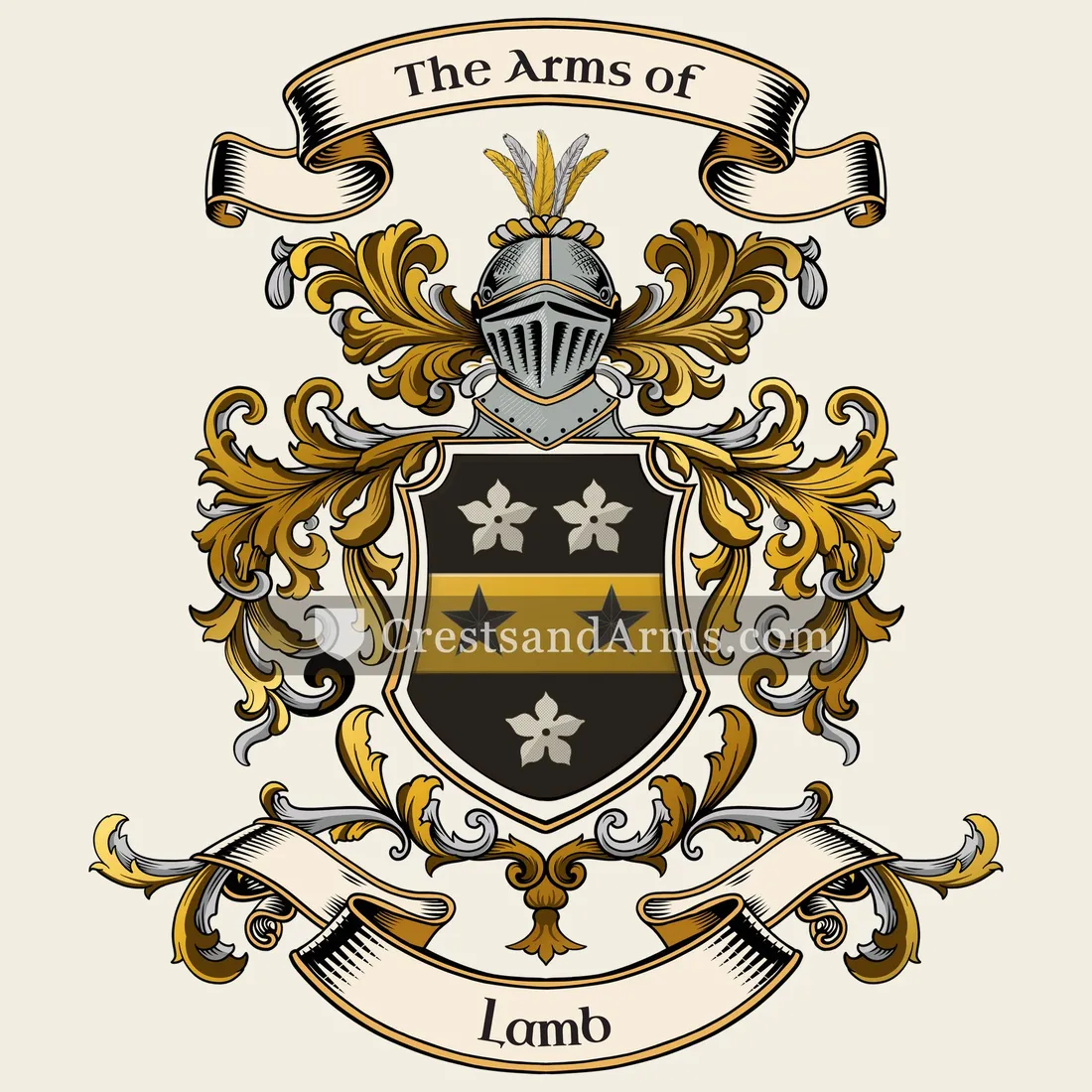
 fessThe military belt, and readiness to serve
 cinquefoilHope and joy
 mulletThe third son, and a divine quality from above
 fessThe military belt, and readiness to serve
 cinquefoilHope and joy
 mulletThe third son, and a divine quality from above


 paleMilitary strength, and a fortified defence
 lambGentleness, patience and faith