Map of England showing where the Lambe arms are recorded
The Lambe arms were recorded in Suffolk, c. 1620.
Suffolk was wool country, and its cloth towns were among the wealthiest in England. Clothier families bought manors with their profits, and holding a manor was the ordinary route to a coat of arms.
This is where the arms were entered in the register. Families often moved to other parts of the country, so the same name can turn up in more than one region.
The body that granted and recorded arms in England in this period.
James VI and I
Sovereign of the period
James VI and I
1603–1625
Reigning in England when the Lambe arms are first recorded.
How Arms Worked in England
English heraldry allowed arms to be shared by all legitimate descendants of the original owner. These symbols were treated as personal property that moved through the generations to all children. While the eldest son kept the original design, other family members could use the same shield without needing to change it or register their own unique versions.
Granting authority
The College of Arms in London has regulated the use of coats of arms throughout England and Wales since 1484.
How they got arms
Families typically obtained their coats of arms through a formal grant from the Crown or by proving their ancient right to them.
Where arms were recorded
All official coats of arms are recorded in the registers kept at the College of Arms, which date back to the fifteenth century.
The family's standing
Recorded among the armigerous families of Suffolk.
Origin & History of the Lambe Family in England
The surname Lambe has deep roots in the English landscape, functioning originally as a descriptive nickname for a person with a gentle or mild temperament. By the early 17th century, the name was well-established in the county of Suffolk, where families bearing this title were active members of local rural communities. During this period, the name was often associated with families involved in agriculture and the wool trade, which were the primary economic drivers of the East Anglian region. These early Lambe families lived through a time of significant social change, as many individuals began to solidify their family identities through parish records and land ownership. The presence of the Lambe name in Suffolk by 1620 reflects a long history of settlement in the English countryside, where the family name became a permanent part of the local social fabric.
Coat of Arms & Family Crest Details
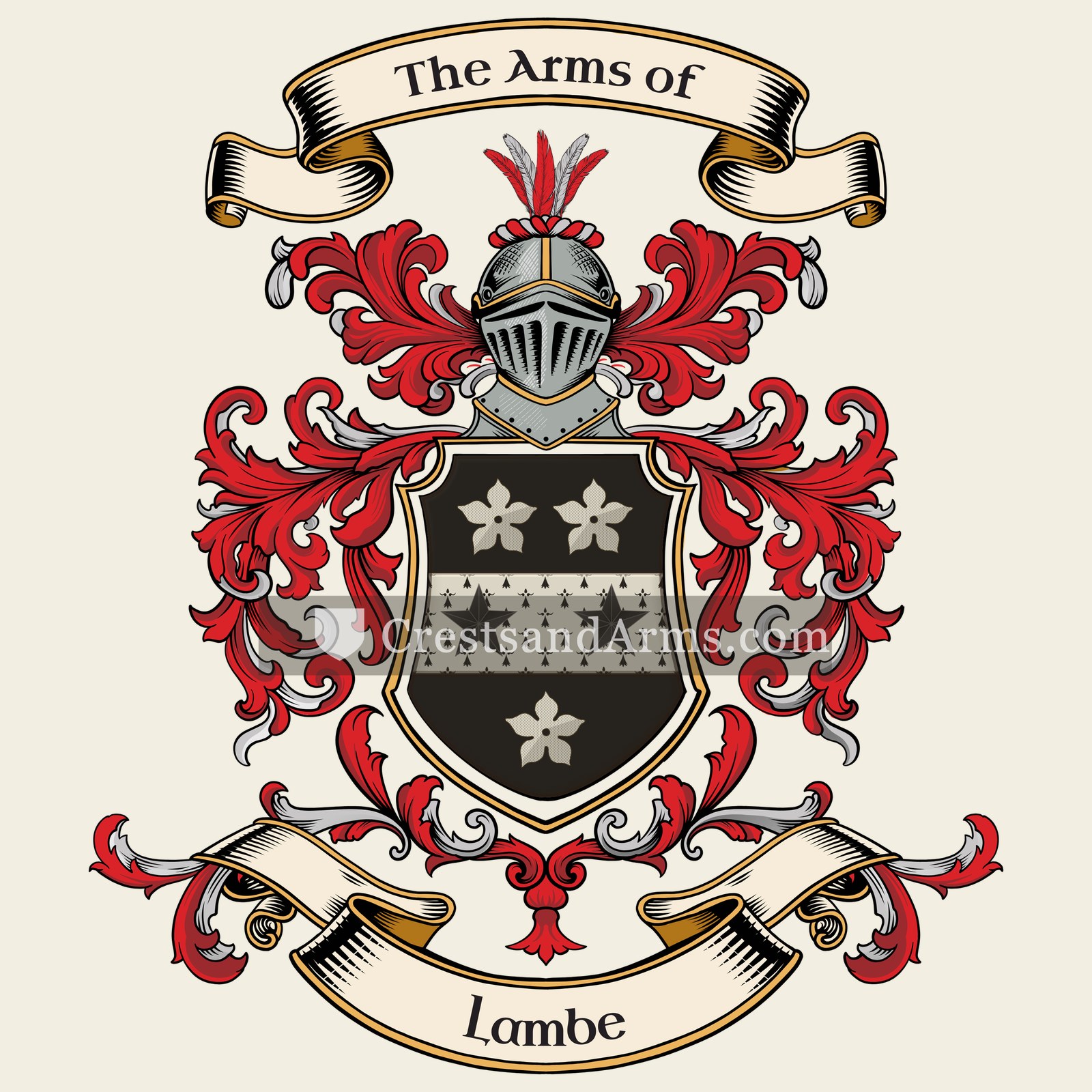
Symbols on this shield
fessThe military belt, and readiness to serve
cinquefoilHope and joy
mulletThe third son, and a divine quality from above
Colours
Black (Sable)Means: Constancy
ErmineMeans: Dignity
Historical info
Source
Sir Bernard Burke, The General Armory of England, Scotland, Ireland and Wales, London: Harrison & Sons, 1884
Blazon (the actual original written record)
“Sa. on a fesse betw. three cinquefoils pierced erm. two mullets pierced of the field”
SussexSussex, c. 1601
Digital archive packCoat of arms PNG, gold border print PDF, vector SVG and the certificate of authenticity. Sent to your email in minutes.
Map of Ireland showing where the Lambe arms are recorded
The Lambe arms were recorded in Sussex, c. 1601.
Sussex had ironworks in its woods and good farmland on its downs. Both made money, and families who made it bought manors, which is what put their names in the heraldic records.
This is where the arms were entered in the register. Families often moved to other parts of the country, so the same name can turn up in more than one region.
The body that granted and recorded arms in Ireland in this period.
Elizabeth I of England
Sovereign of the period
Elizabeth I of England
1558–1603
Reigning in England when the Lambe arms are first recorded.
How Arms Worked in Ireland
The Ulster King of Arms granted coats of arms to individuals who proved their social standing and good character. These symbols were typically inherited by all legitimate descendants of the original holder. If a family branch wanted a unique look, they could apply for a specific change to their design through the office to ensure their identity remained distinct.
Granting authority
The Ulster King of Arms acted as the official body that regulated and issued all coats of arms throughout Ireland.
How they got arms
Families obtained their arms through formal grants issued by the office after proving their eligibility and paying the required fees.
Where arms were recorded
All official grants were recorded in the registers held by the Ulster King of Arms starting from the year 1552.
The family's standing
Recorded among the armigerous families of Sussex.
Origin & History of the Lambe Family in Ireland
The history of the Lambe family in Ireland is deeply connected to the movement of settlers from England during the early seventeenth century. While the family had established roots in Sussex by 1601, the political climate of the time encouraged many English families to relocate to Ireland to manage land and support the crown. As these families settled, they often integrated into the local administration and agricultural systems of the Irish provinces. Over several generations, the name shifted from its English origins to become part of the diverse social fabric of Ireland. By moving across the Irish Sea, the Lambe family transitioned from their regional life in Sussex to become landowners and participants in the developing economy of seventeenth-century Ireland.
Related Branches & Arms
Root word
Lamb
A young sheep or a gentle, innocent person.
This name
LambeA nickname for a gentle person or an occupational name for a shepherd.
also spelled
Lamm
Related arms
Lofftrecorded with Lambe, same area
Documented Sources
Sir Bernard Burke, The General Armory of England, Scotland, Ireland and Wales, London: Harrison & Sons, 1884
Reaney, P.H. and Wilson, R.M., A Dictionary of English Surnames, 1991
Domesday Book, Suffolk, 1086
The National Archives, Probate Records of the Prerogative Court of Canterbury, 1620
Suffolk Archives, Parish Registers of Suffolk, 1620
Digital archive packCoat of arms PNG, gold border print PDF, vector SVG and the certificate of authenticity. Sent to your email in minutes.


 lionCourage, strength and royalty
 lionCourage, strength and royalty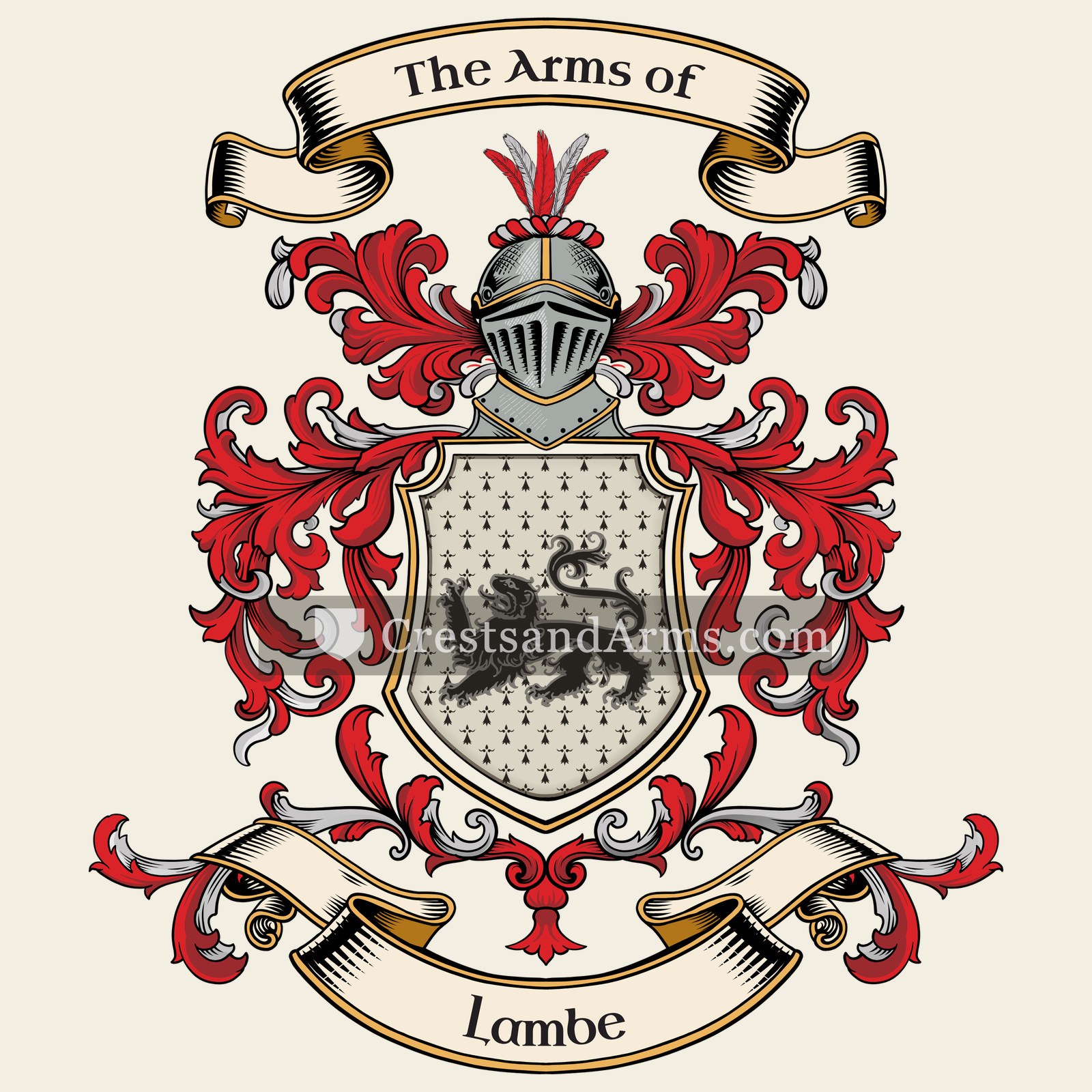


 fessThe military belt, and readiness to serve
 cinquefoilHope and joy
 mulletThe third son, and a divine quality from above