Map of France showing where the Lamberton arms are recorded
The Lamberton arms were recorded in Besançon, c. 1559.
This is where the arms were entered in the register. Families often moved to other parts of the country, so the same name can turn up in more than one region.
The body that granted and recorded arms in France in this period.
Henry II of France
Sovereign of the period
Henry II of France
1547–1559
Reigning in France when the Lamberton arms are first recorded.
How Arms Worked in France
In France, a coat of arms was a mark of honor that passed down through the male line to all legitimate descendants. Families often used the same shield without changes to show their shared heritage. If a branch wanted to stand out, they could add a small mark to their shield to show their specific place in the family tree.
Granting authority
The Juge d'armes de France acted as the official authority that regulated and verified coats of arms across the country.
How they got arms
Families typically inherited their arms from ancestors, though they could also receive them through royal grants or by proving their noble status.
Where arms were recorded
Coats of arms were officially recorded in the Armorial Général de France, which began its main collection in the year 1696.
The family's standing
Recorded among the armigerous families of France.
Origin & History of the Lamberton Family in France
The history of the Lamberton name in France is deeply rooted in the Franche-Comté region, specifically within the city of Besançon. By the middle of the sixteenth century, the family had established a notable presence in this area, which was then a strategic crossroads between the French kingdom and the Holy Roman Empire. The name likely evolved from Germanic roots, reflecting the cultural blending common in the borderlands of eastern France. Records from 1559 confirm that family members were active participants in the civic and social life of Besançon during a time of significant religious and political transition. As the family navigated the complexities of life in a fortified administrative center, they became part of the local fabric, contributing to the development of the region through their involvement in trade and community governance. Their early history illustrates how a family name can serve as a marker of movement and stability within the shifting borders of early modern Europe.
Coat of Arms & Family Crest Details
Symbols on this shield
chevronProtection, and faithful service completed
martletA younger son, who must win his own land
Colours
Silver (Argent)Means: Peace and sincerity
Red (Gules)Means: Military strength
Historical info
Source
Sir Bernard Burke, The General Armory of England, Scotland, Ireland and Wales, London: Harrison & Sons, 1884
Blazon (the actual original written record)
“Ar. a chev. engr. gu. betw. three Cornish choughs ppr”
WiltsLondon · Wilts, c. 1532
Digital archive packCoat of arms PNG, gold border print PDF, vector SVG and the certificate of authenticity. Sent to your email in minutes.
Map of England showing where the Lamberton arms are recorded
The Lamberton arms were recorded in Wilts, c. 1532.
Wiltshire was sheep country, and wool made money steadily for hundreds of years. Families who made it bought manors on the downs, and holding a manor was the usual reason to take arms.
This is where the arms were entered in the register. Families often moved to other parts of the country, so the same name can turn up in more than one region.
The body that granted and recorded arms in England in this period.
Henry VIII of England
Sovereign of the period
Henry VIII of England
1509–1547
Reigning in France when the Lamberton arms are first recorded.
How Arms Worked in England
English heraldry allowed arms to be shared by all legitimate descendants of the original owner. These symbols were treated as personal property that moved through the generations to all children. While the eldest son kept the original design, other family members could use the same shield without needing to change it or register their own unique versions.
Granting authority
The College of Arms in London has regulated the use of coats of arms throughout England and Wales since 1484.
How they got arms
Families typically obtained their coats of arms through a formal grant from the Crown or by proving their ancient right to them.
Where arms were recorded
All official coats of arms are recorded in the registers kept at the College of Arms, which date back to the fifteenth century.
The family's standing
Recorded among the armigerous families of Wilts.
Origin & History of the Lamberton Family in England
The family name Lamberton has deep roots in the English landscape, with historical evidence placing members of the family in the county of Wiltshire as early as 1532. During the sixteenth century, the name was closely tied to the social and economic shifts of rural England. Families like the Lambertons often lived in small parish communities where they worked as landowners or skilled tradespeople. Because surnames were still becoming standardized during this period, the spelling of the name often changed based on how a local clerk heard it spoken. By settling in Wiltshire, the early Lambertons became part of a regional history defined by the wool trade and the growth of local market towns. Their presence in official records from this time highlights how the family established a stable life in the English countryside long before the modern era.
Coat of Arms & Family Crest Details
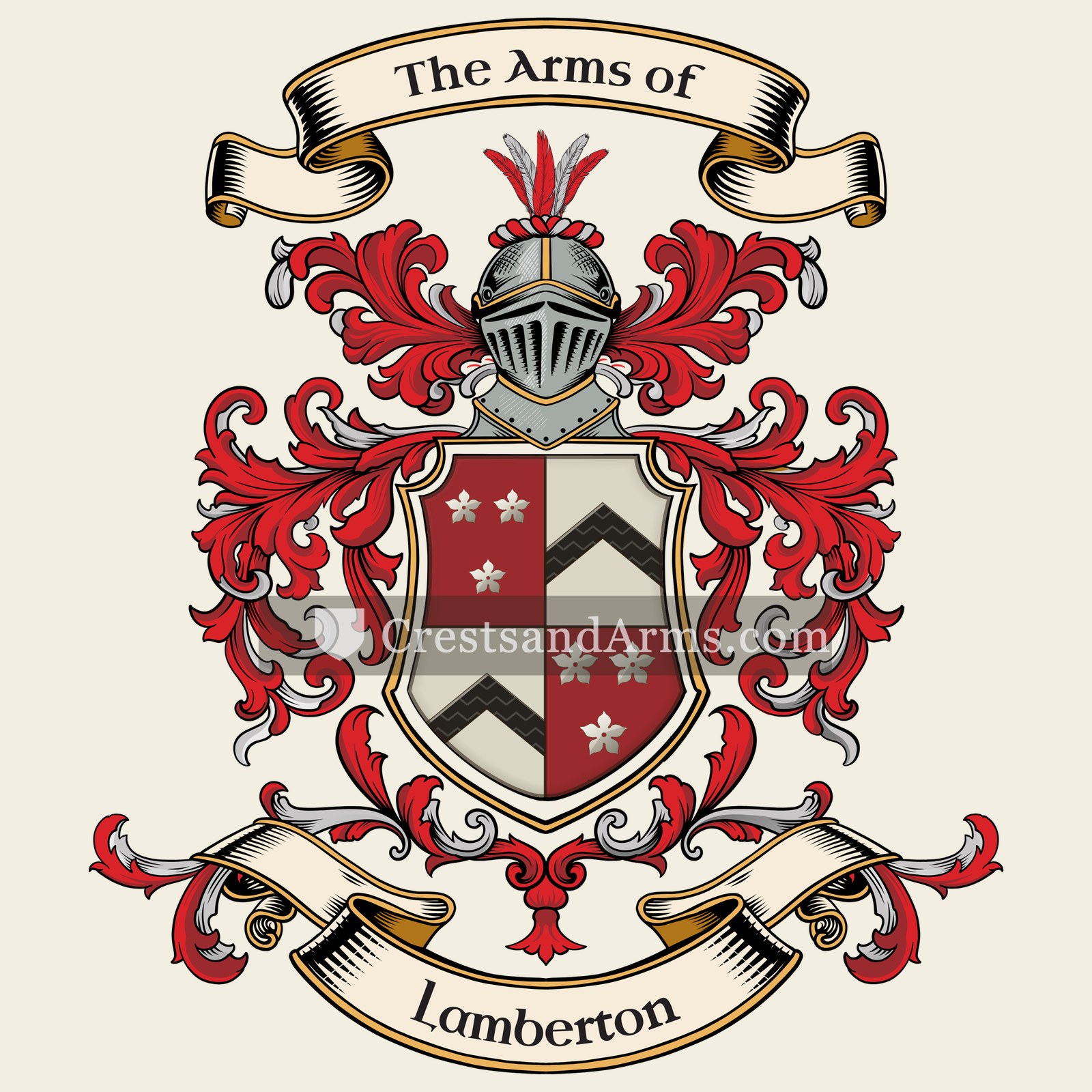
Symbols on this shield
chevronProtection, and faithful service completed
cinquefoilHope and joy
Colours
Red (Gules)Means: Military strength
Silver (Argent)Means: Peace and sincerity
Historical info
Source
Sir Bernard Burke, The General Armory of England, Scotland, Ireland and Wales, London: Harrison & Sons, 1884
Blazon (the actual original written record)
“Quarterly, 1st and 4th, gu. three cinquefoils pierced ar., for LAMBERT; 2nd and 3rd, ar. two chev. sa., for STAUNTON”
GalwayWaterdale · Galway, c. 1630
Digital archive packCoat of arms PNG, gold border print PDF, vector SVG and the certificate of authenticity. Sent to your email in minutes.
Map of Ireland showing where the Lamberton arms are recorded
The Lamberton arms were recorded in Galway, c. 1630.
Galway was western Irish country of poor land and a rich port. A small group of merchant families ran the town for centuries and held estates around it, and both kinds of property carried arms.
This is where the arms were entered in the register. Families often moved to other parts of the country, so the same name can turn up in more than one region.
The body that granted and recorded arms in Ireland in this period.
Charles I of England
Sovereign of the period
Charles I of England
1625–1649
Reigning in France when the Lamberton arms are first recorded.
How Arms Worked in Ireland
The Ulster King of Arms granted coats of arms to individuals who proved their social standing and good character. These symbols were typically inherited by all legitimate descendants of the original holder. If a family branch wanted a unique look, they could apply for a specific change to their design through the office to ensure their identity remained distinct.
Granting authority
The Ulster King of Arms acted as the official body that regulated and issued all coats of arms throughout Ireland.
How they got arms
Families obtained their arms through formal grants issued by the office after proving their eligibility and paying the required fees.
Where arms were recorded
All official grants were recorded in the registers held by the Ulster King of Arms starting from the year 1552.
The family's standing
Recorded among the armigerous families of Galway.
Origin & History of the Lamberton Family in Ireland
The Lamberton family name in Ireland is deeply connected to the social and political shifts of the seventeenth century. While the name has roots in the British Isles, records confirm that members of the family were established in Galway by 1630. During this period, Galway was a bustling center of trade and commerce, often referred to as the City of the Tribes. Families like the Lambertons were part of a complex landscape where local merchants and settlers navigated the changing influence of the English Crown. As the century progressed, the family faced the challenges of the Cromwellian era and the subsequent land redistributions that altered the structure of Irish society. Their presence in Galway suggests they were likely involved in the urban life of the port city, adapting to the economic realities of a region caught between traditional Gaelic customs and colonial administration.
Related Branches & Arms
Root word
Lambert
Derived from the Germanic elements land meaning land and beraht meaning bright.
This name
LambertonA locative surname referring to a settlement or town associated with someone named Lambert.
also spelled
Lamberth
Lambertt
Lamberte
Lambart
Lamberd
Documented Sources
J. B. Rietstap, Armorial Général, Gouda: G. B. van Goor Zonen, 1884–87
Archives départementales du Doubs, Série B (Cours et juridictions)
Fester, Richard, Die Augsburger Fugger-Handlung in Besançon, 1910
Gauthier, Jules, Histoire de la ville de Besançon, 1881
Digital archive packCoat of arms PNG, gold border print PDF, vector SVG and the certificate of authenticity. Sent to your email in minutes.


 lionCourage, strength and royalty
 lionCourage, strength and royalty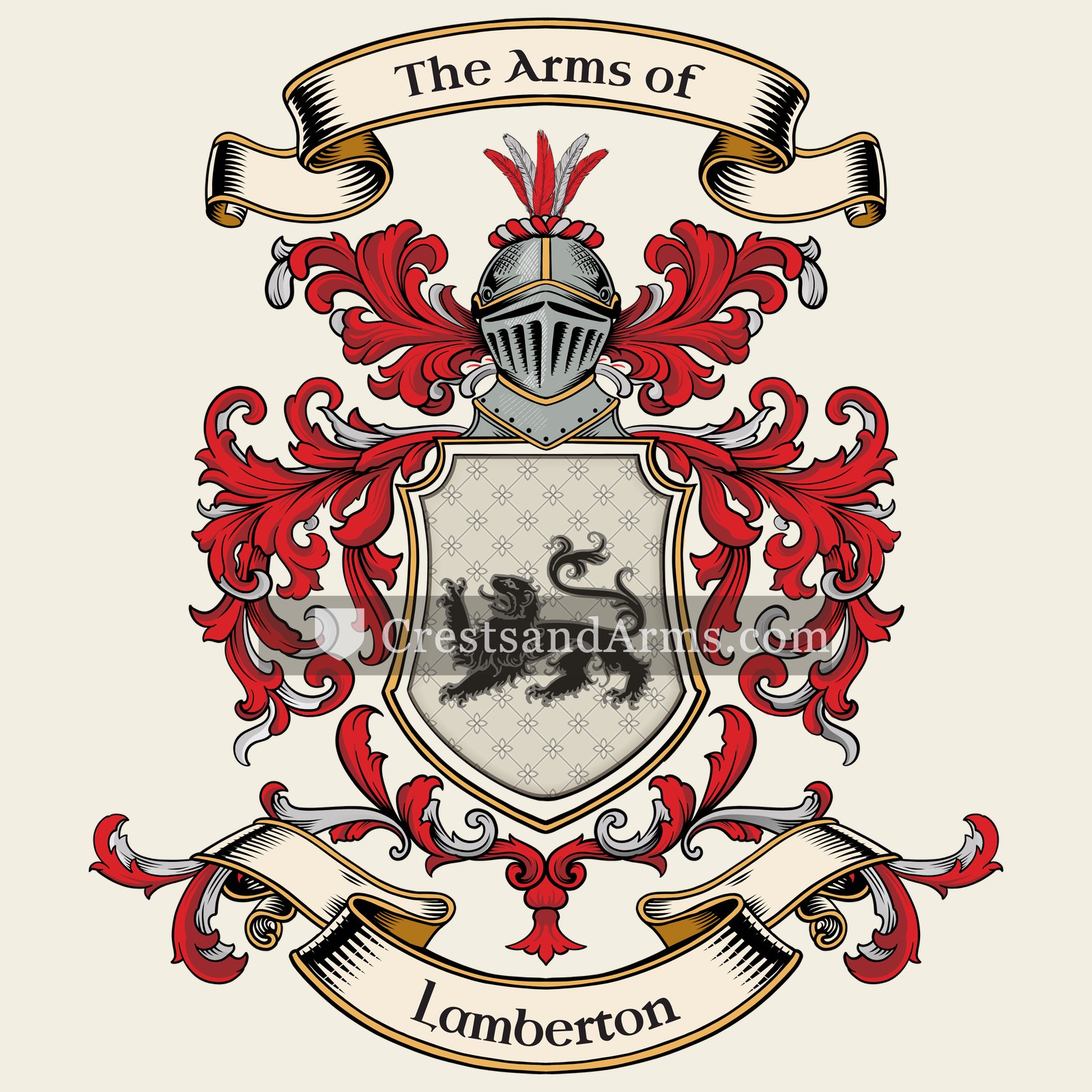


 chevronProtection, and faithful service completed
 martletA younger son, who must win his own land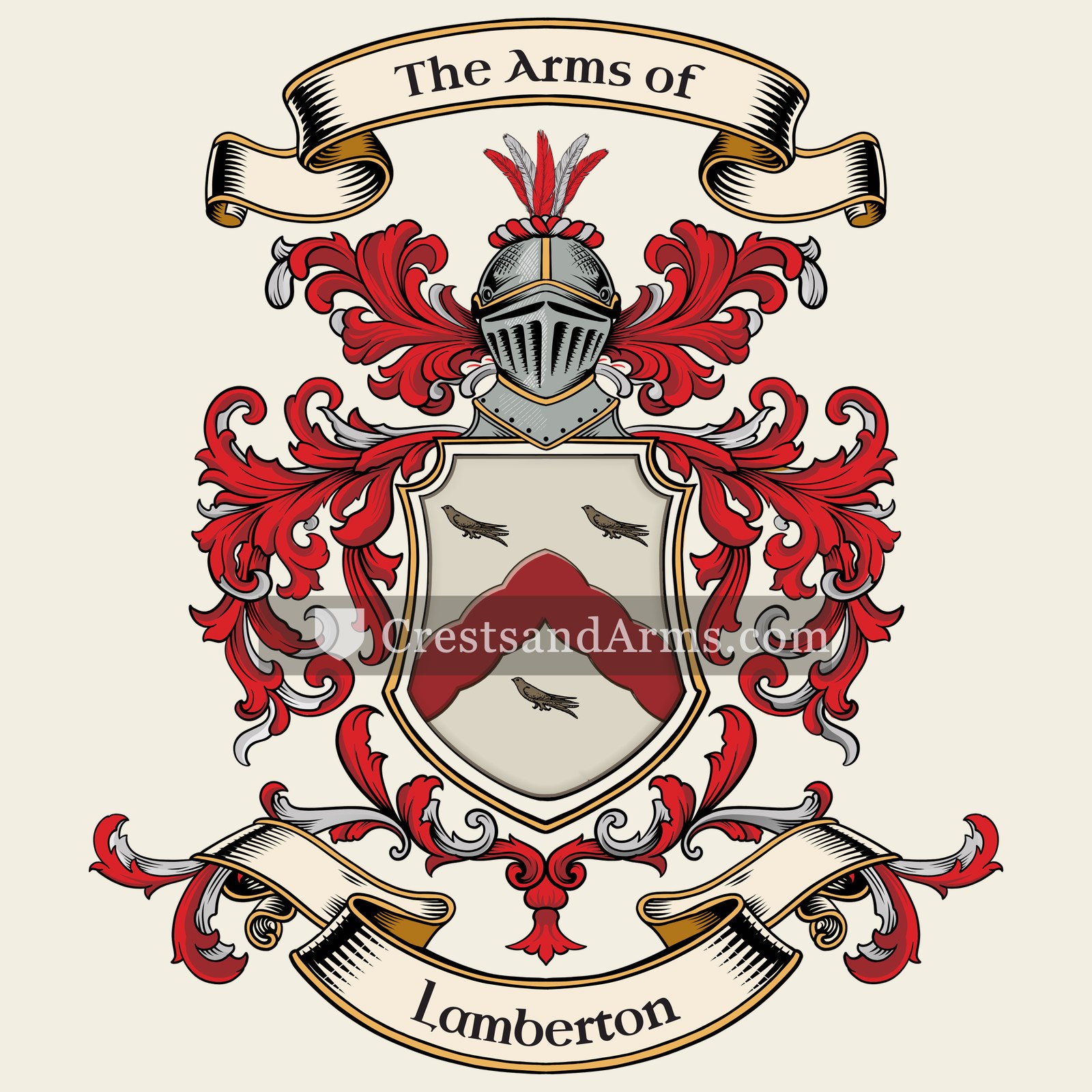


 cinquefoilHope and joy