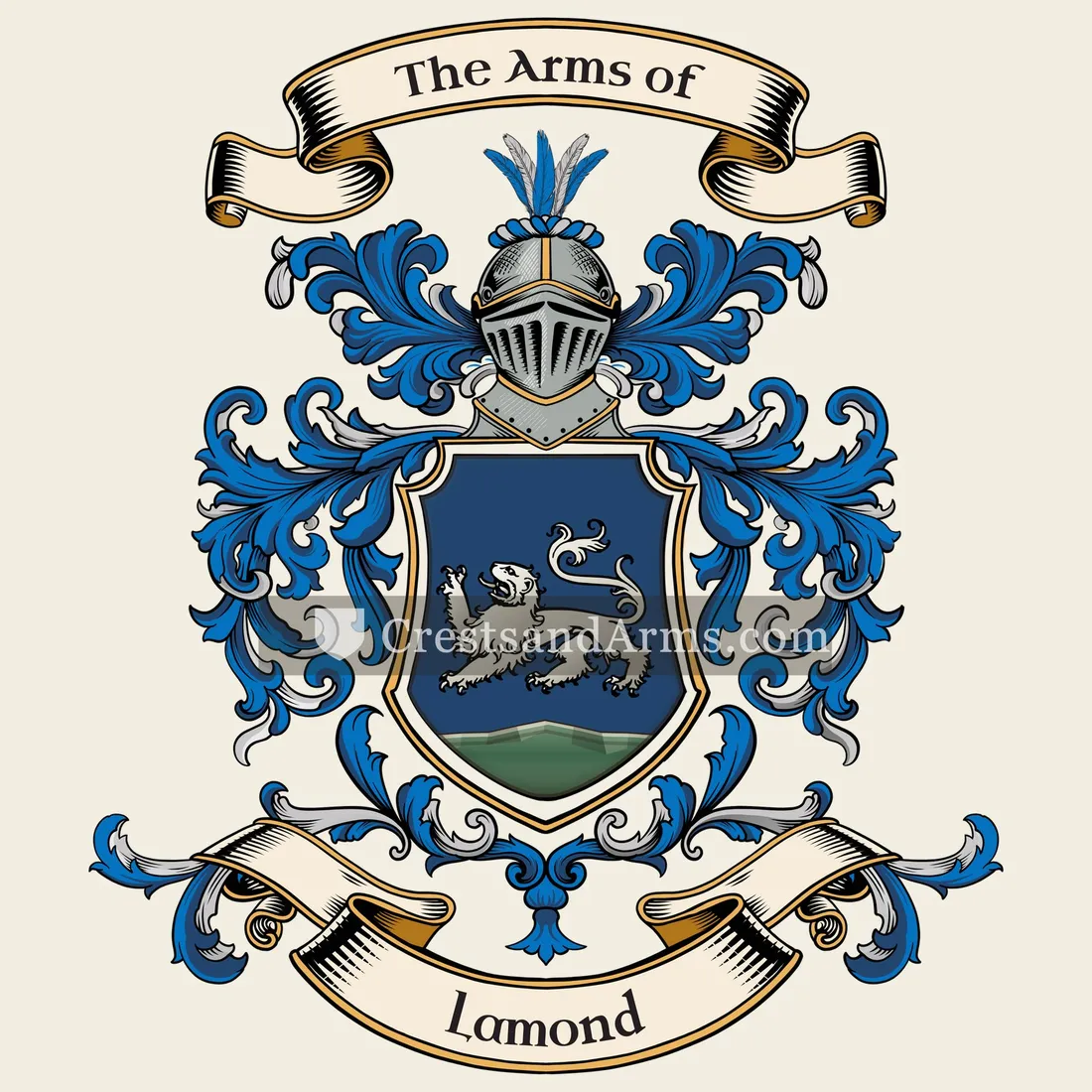
A record of documented arms, meaning and origin, researched for the Lamond family lines. Documented in 2 countries.
Reg. 8580 · French, J–L
Meaning of the Lamond family crest colors & symbols
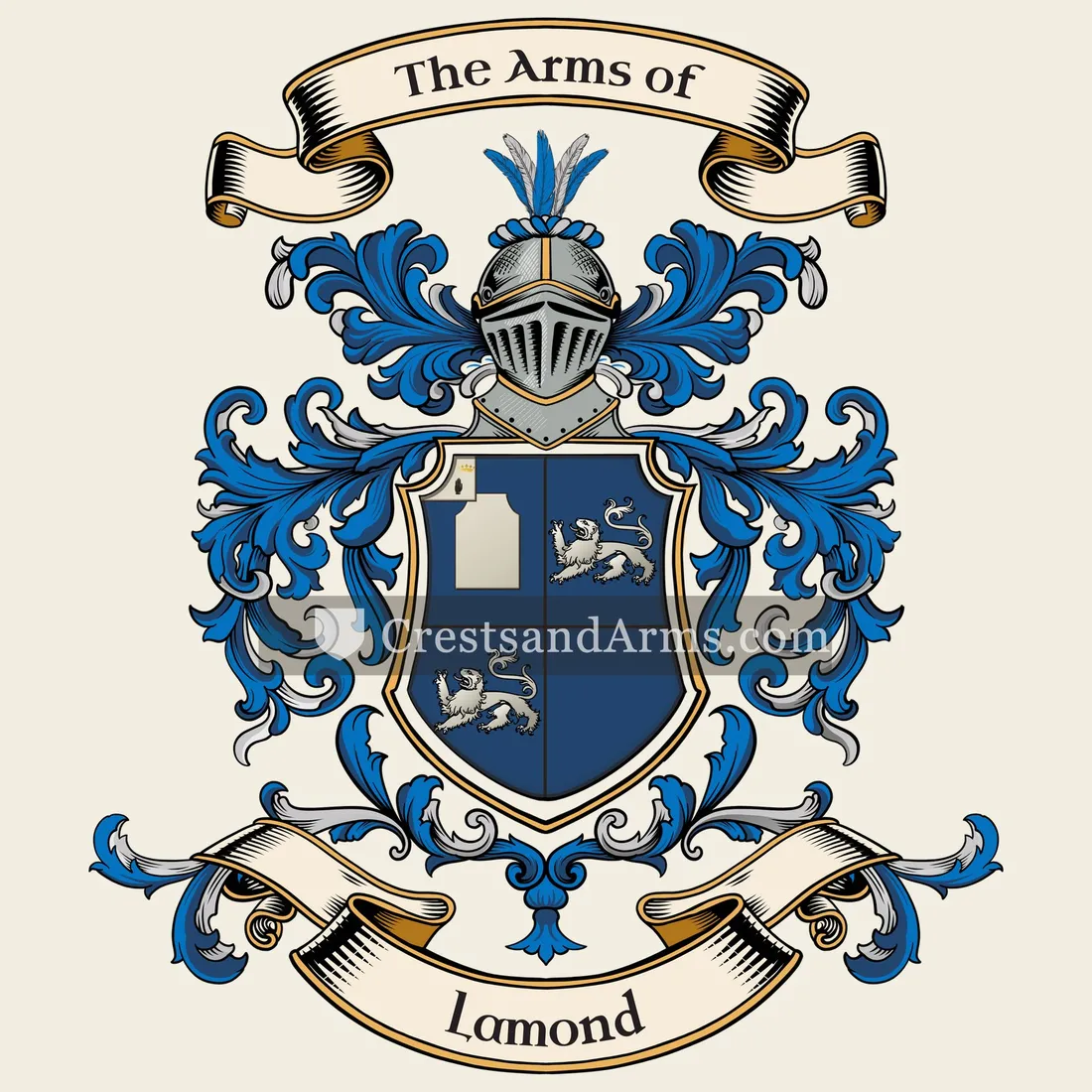
Symbols on this shield
cantonA mark of honour granted by the sovereign
handFaith, sincerity and justice
crownSovereignty, authority and just reward
lionCourage, strength and royalty
Colours
Blue (Azure)Means: Loyalty and truth
Silver (Argent)Means: Peace and sincerity
Black (Sable)Means: Constancy
Gold (Or)Means: Generosity
Historical info
Source
J. B. Rietstap, Armorial Général, Gouda: G. B. van Goor Zonen, 1884–87
Blazon (the actual original written record)
“Ec.: aux 1 et 4 d'azur à un monde d'arg., cintré et croisé d'or, le premier quartier ch. au canton sen. du chef d'un écusson ovale d'arg., surch. d'une main dextre appaumée de sa. et surm. d'une couronne d'or; aux 2 et 3 d'azur au lion d'arg., arm. et lamp. de sa.”
FranceEcosse, c. 1663
Digital archive packCoat of arms PNG, gold border print PDF, vector SVG and the certificate of authenticity. Sent to your email in minutes.
Map of France showing where the Lamond arms are recorded
The Lamond arms were recorded in Ecosse, c. 1663.
Arms such as these were typically recorded in Bretagne.
More families held coats of arms in Bretagne than anywhere else in France. The land was divided into many small estates rather than a few large ones, so far more households counted as gentry, and each needed a shield of its own to be told apart.
This is where the arms were entered in the register. Families often moved to other parts of the country, so the same name can turn up in more than one region.
The body that granted and recorded arms in France in this period.
Louis XIV of France
Sovereign of the period
Louis XIV of France
1643–1715
Reigning in France when the Lamond arms are first recorded.
How Arms Worked in France
In France, a coat of arms was a mark of honor that passed down through the male line to all legitimate descendants. Families often used the same shield without changes to show their shared heritage. If a branch wanted to stand out, they could add a small mark to their shield to show their specific place in the family tree.
Granting authority
The Juge d'armes de France acted as the official authority that regulated and verified coats of arms across the country.
How they got arms
Families typically inherited their arms from ancestors, though they could also receive them through royal grants or by proving their noble status.
Where arms were recorded
Coats of arms were officially recorded in the Armorial Général de France, which began its main collection in the year 1696.
The family's standing
Recorded among the armigerous families of France.
Origin & History of the Lamond Family in France
The history of the Lamond name in France is deeply rooted in the cultural landscape of the Brittany region during the seventeenth century. By 1663, records confirm that members of the family were established within this coastal province, a time when the area was known for its distinct linguistic traditions and strong maritime connections. The name likely evolved as a descriptive identifier, potentially linked to the French term for the world or a specific geographic location, which was a common way for families to distinguish themselves in local parish registers. As these early ancestors settled into the Breton countryside, they became part of a society defined by agricultural life and regional autonomy. Their presence in the historical documents of the era suggests they were integrated into the local community, participating in the daily social and economic life of a province that maintained a unique identity separate from the rest of the French kingdom.
Meaning of the Lamond family crest colors & symbols
Symbols on this shield
mountThe ground held, and steadfastness upon it
lionCourage, strength and royalty
Colours
Blue (Azure)Means: Loyalty and truth
Green (Vert)Means: Hope
Silver (Argent)Means: Peace and sincerity
Historical info
Source
Sir Bernard Burke, The General Armory of England, Scotland, Ireland and Wales, London: Harrison & Sons, 1884
Blazon (the actual original written record)
“Az. a lion ramp. ar. Another Coat—Az. a mound ensigned with a cross or”
ArgyllArgyll, c. 1748
Digital archive packCoat of arms PNG, gold border print PDF, vector SVG and the certificate of authenticity. Sent to your email in minutes.
Map of Scotland showing where the Lamond arms are recorded
The Lamond arms were recorded in Argyll, c. 1748.
Argyll was Highland sea country of islands and long lochs, held by clan families. Chiefs recorded arms to mark the head of a line, and the branches recorded their own to show where they stood.
This is where the arms were entered in the register. Families often moved to other parts of the country, so the same name can turn up in more than one region.
The body that granted and recorded arms in Scotland in this period.
George II of Great Britain
Sovereign of the period
George II of Great Britain
1727–1760
Reigning in France when the Lamond arms are first recorded.
How Arms Worked in Scotland
Scottish heraldry is unique because it treats a coat of arms as a piece of personal property protected by law. Only one person can own a specific design at any given time. When a family grows, the head keeps the original shield while other relatives must apply for their own distinct version with slight changes to prove their specific identity.
Granting authority
The Court of the Lord Lyon acts as the official body that regulates and controls all heraldic matters throughout Scotland.
How they got arms
Individuals obtain a legal right to their arms through a formal petition process that confirms their identity and family connection.
Where arms were recorded
All valid coats of arms are officially entered into the Public Register of All Arms and Bearings starting from 1672.
The family's standing
Recorded among the armigerous families of Argyll.
Origin & History of the Lamond Family in Scotland
The name Lamond, often spelled Lamont, traces its deep roots to the rugged landscape of Argyll in western Scotland. Historians believe the name comes from the Old Norse word *lögmaðr*, which translates to lawman. This suggests that early ancestors may have held positions of authority or legal responsibility within their communities. By the mid-eighteenth century, the family was well-established in the Argyll region, where they lived among the hills and sea lochs that defined the area. Life during this period was shaped by the clan system, where families relied on strong local ties and shared traditions to survive in a challenging environment. The presence of the Lamond name in official records from 1748 confirms their long-standing connection to this specific part of the Scottish Highlands, marking them as a family deeply woven into the history of the region.
Lamond Meaning & Related Branches
Root word
Lagman
Old Norse term for a lawman or legal expert.
This name
LamondDerived from a title for a person who interprets and administers the law.
also spelled
Lamonte
Lamond
Lamontt
Documented Sources
J. B. Rietstap, Armorial Général, Gouda: G. B. van Goor Zonen, 1884–87
Archives départementales d'Ille-et-Vilaine, Série B (Fonds de la juridiction de Rennes)
Poterie, Michel, Histoire de la Bretagne et des Bretons, 1977
Tanguy, Bernard, Dictionnaire des noms de communes, trèves et paroisses des Côtes-d'Armor, 1992
Digital archive packCoat of arms PNG, gold border print PDF, vector SVG and the certificate of authenticity. Sent to your email in minutes.


 cantonA mark of honour granted by the sovereign
 handFaith, sincerity and justice
 crownSovereignty, authority and just reward
 lionCourage, strength and royalty
 cantonA mark of honour granted by the sovereign
 handFaith, sincerity and justice
 crownSovereignty, authority and just reward
 lionCourage, strength and royalty


 mountThe ground held, and steadfastness upon it