Map of France showing where the Lamy arms are recorded
The Lamy arms were recorded in Lorraine, c. 1663.
Lorraine sat on the border between France and the German lands, and border country bred soldiers. Families here held small estates and served in arms, and a fighting man was exactly the sort who carried a shield of his own.
This is where the arms were entered in the register. Families often moved to other parts of the country, so the same name can turn up in more than one region.
The body that granted and recorded arms in France in this period.
Louis XIV of France
Sovereign of the period
Louis XIV of France
1643–1715
Reigning in France when the Lamy arms are first recorded.
How Arms Worked in France
In France, a coat of arms was a mark of honor that passed down through the male line to all legitimate descendants. Families often used the same shield without changes to show their shared heritage. If a branch wanted to stand out, they could add a small mark to their shield to show their specific place in the family tree.
Granting authority
The Juge d'armes de France acted as the official authority that regulated and verified coats of arms across the country.
How they got arms
Families typically inherited their arms from ancestors, though they could also receive them through royal grants or by proving their noble status.
Where arms were recorded
Coats of arms were officially recorded in the Armorial Général de France, which began its main collection in the year 1696.
The family's standing
Recorded among the armigerous families of Lorraine.
Origin & History of the Lamy Family in France
The surname Lamy is a traditional French name that likely originated as a descriptive nickname, derived from the Old French phrase "l'ami," which translates to "the friend." During the medieval period, such names were often given to individuals who were known for their sociable nature or their role as a helpful neighbor within a village. By the time the family was firmly established in the Lorraine region in 1663, the name had become a stable hereditary surname passed down through generations. The Lorraine area was a culturally rich and complex borderland during the seventeenth century, and families living there were often deeply connected to the local agricultural and trade communities. As the name spread across France, it became associated with families who played active roles in the development of their local parishes and regional economies.
Coat of Arms & Family Crest Details
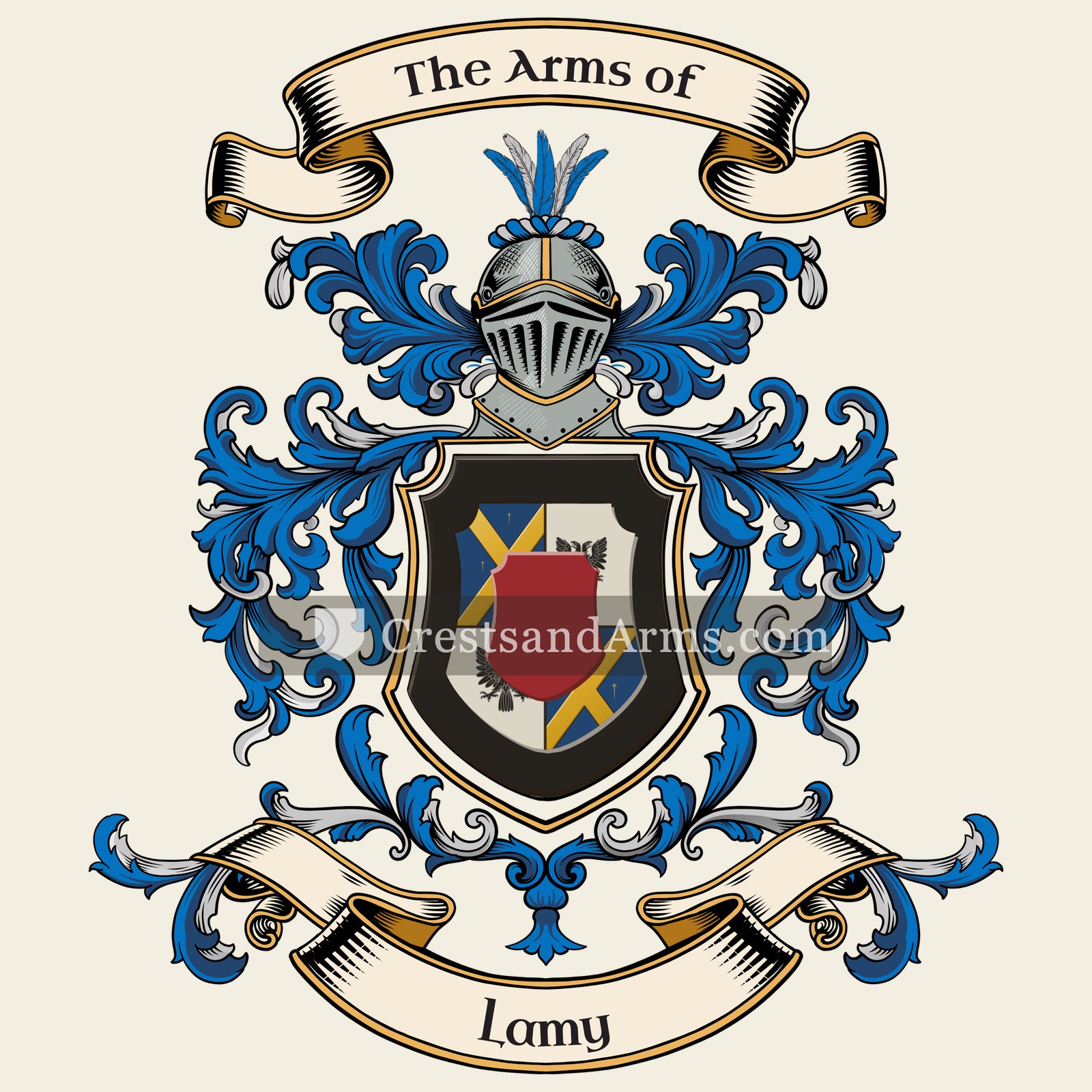
Symbols on this shield
saltireResolution, and St Andrew's cross
bordureA difference between branches of one family
batonAuthority and office held under the crown
eagleNobility, strength and a keen mind
Colours
Blue (Azure)Means: Loyalty and truth
Silver (Argent)Means: Peace and sincerity
Red (Gules)Means: Military strength
Black (Sable)Means: Constancy
Gold (Or)Means: Generosity
Historical info
Source
Sir Bernard Burke, The General Armory of England, Scotland, Ireland and Wales, London: Harrison & Sons, 1884
Blazon (the actual original written record)
“Quarterly, 1st and 4th, az. three crosiers paleways in fess or, in base a saltire couped ar., for L'AMY; 2nd and 3rd, ar. an eagle displ. sa. beaked and membered gu. charged in the breast with an inescutcheon of the last, a bordure of the second”
ForfarDunkenny · Forfar, c. 1748
Digital archive packCoat of arms PNG, gold border print PDF, vector SVG and the certificate of authenticity. Sent to your email in minutes.
Map of Scotland showing where the Lamy arms are recorded
The Lamy arms were recorded in Forfar, c. 1748.
Forfar, now called Angus, was farming country on Scotland's east coast between the hills and the sea. Its landed families were long-settled, and long settlement is exactly what fills a register of arms.
This is where the arms were entered in the register. Families often moved to other parts of the country, so the same name can turn up in more than one region.
The body that granted and recorded arms in Scotland in this period.
George II of Great Britain
Sovereign of the period
George II of Great Britain
1727–1760
Reigning in France when the Lamy arms are first recorded.
How Arms Worked in Scotland
Scottish heraldry is unique because it treats a coat of arms as a piece of personal property protected by law. Only one person can own a specific design at any given time. When a family grows, the head keeps the original shield while other relatives must apply for their own distinct version with slight changes to prove their specific identity.
Granting authority
The Court of the Lord Lyon acts as the official body that regulates and controls all heraldic matters throughout Scotland.
How they got arms
Individuals obtain a legal right to their arms through a formal petition process that confirms their identity and family connection.
Where arms were recorded
All valid coats of arms are officially entered into the Public Register of All Arms and Bearings starting from 1672.
The family's standing
Recorded among the armigerous families of Forfar.
Origin & History of the Lamy Family in Scotland
The history of the Lamy family in Scotland is deeply rooted in the region of Forfar, where records confirm their presence by the middle of the eighteenth century. While the name itself has strong connections to French origins, the Scottish branch established itself as a distinct part of the local community in Angus. By 1748, members of the family were integrated into the social and economic life of this burgh, which served as an important center for trade and agriculture. During this era, families in Forfar often worked in the growing linen industry or participated in the local governance of the town. The Lamy family likely contributed to the development of this area through their involvement in these local trades and their participation in the daily life of the parish. Their presence in Forfar highlights how families moved across borders and settled into new regions, eventually becoming a lasting part of the Scottish landscape.
Related Branches & Arms
Root word
l'ami
The friend derived from the Old French word for friend.
This name
LamyA nickname for a friendly or sociable person, or a term of endearment.
also spelled
Lamie
Lammie
Lamey
Related arms
Lamivariant spelling
Lamisvariant spelling
Bertrand de Bouchepornrecorded with Lamy, same area
Heurecorded with Lamy, same area
Documented Sources
J. B. Rietstap, Armorial Général, Gouda: G. B. van Goor Zonen, 1884–87
Dauzat, Albert, Dictionnaire étymologique des noms et prénoms de France, 1951
Morlet, Marie-Thérèse, Dictionnaire étymologique des noms de famille, 1991
Archives départementales de Meurthe-et-Moselle, Registres paroissiaux et d'état civil de Lorraine, 1663
Digital archive packCoat of arms PNG, gold border print PDF, vector SVG and the certificate of authenticity. Sent to your email in minutes.


 chiefAuthority, wisdom and dominion
 crescentHonour by the sovereign, and the second son
 chiefAuthority, wisdom and dominion
 crescentHonour by the sovereign, and the second son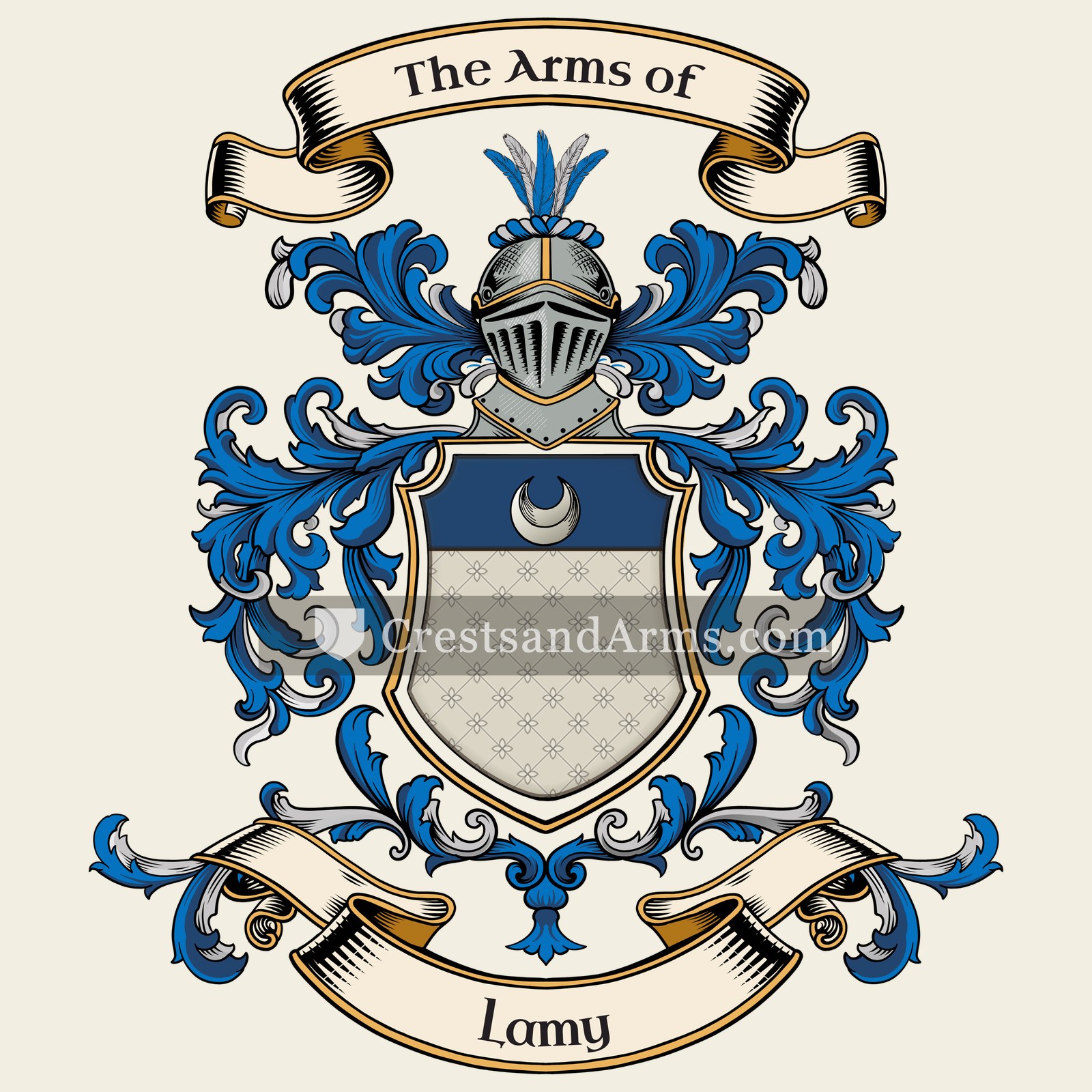


 saltireResolution, and St Andrew's cross
 bordureA difference between branches of one family
 batonAuthority and office held under the crown
 eagleNobility, strength and a keen mind