Map of Britain showing where the Lancaster arms are recorded
The Lancaster arms were recorded in Britain, c. 1700.
Arms such as these were typically recorded in Kent.
Kent sits between London and the short crossing to Europe, and the trade passing through made it wealthy. Merchant families bought land with that money, and it was landowners who took coats of arms.
This is where the arms were entered in the register. Families often moved to other parts of the country, so the same name can turn up in more than one region.
The body that granted and recorded arms in Britain in this period.
William III of England
Sovereign of the period
William III of England
1694–1702
Reigning in Britain when the Lancaster arms are first recorded.
How Arms Worked in Britain
English heraldry allowed arms to be shared by all legitimate descendants of the original owner. These symbols were treated as personal property that moved through the generations to all children. While the eldest son kept the original design, other family members could use the same shield without needing to change it or register their own unique versions.
Granting authority
The College of Arms in London has regulated the use of coats of arms throughout England and Wales since 1484.
How they got arms
Families typically obtained their coats of arms through a formal grant from the Crown or by proving their ancient right to them.
Where arms were recorded
All official coats of arms are recorded in the registers kept at the College of Arms, which date back to the fifteenth century.
The family's standing
Recorded among the armigerous families of Britain.
Origin & History of the Lancaster Family in Britain
The name Lancaster is a locational surname that originated in the historic town of Lancaster in Lancashire, England. During the Middle Ages, people often took the name of their home town as a way to identify themselves when they traveled to new regions. The name itself comes from a combination of the Roman name for the local river, the Lune, and the Old English word "ceaster," which refers to a Roman fort or walled city. As families moved away from the north of England over the centuries, they carried this name with them across the country. By the time members of the family were recorded in Kent in the year 1700, the name had long since evolved from a simple geographic description into a permanent family identity. This movement of people helped spread the name from its northern roots into the southern counties, where it became established as a distinct part of the local population.
Meaning of the Lancaster family crest colors & symbols
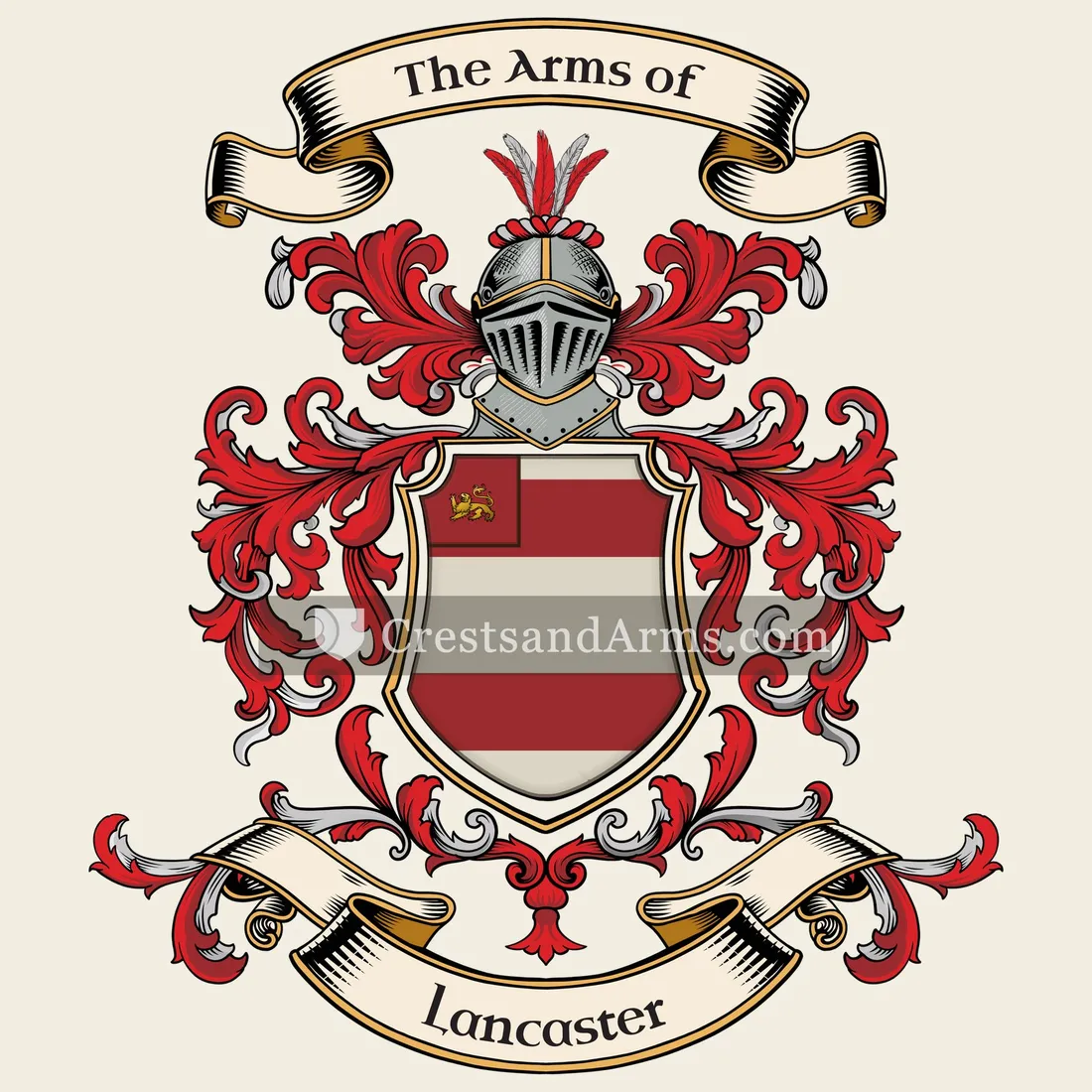
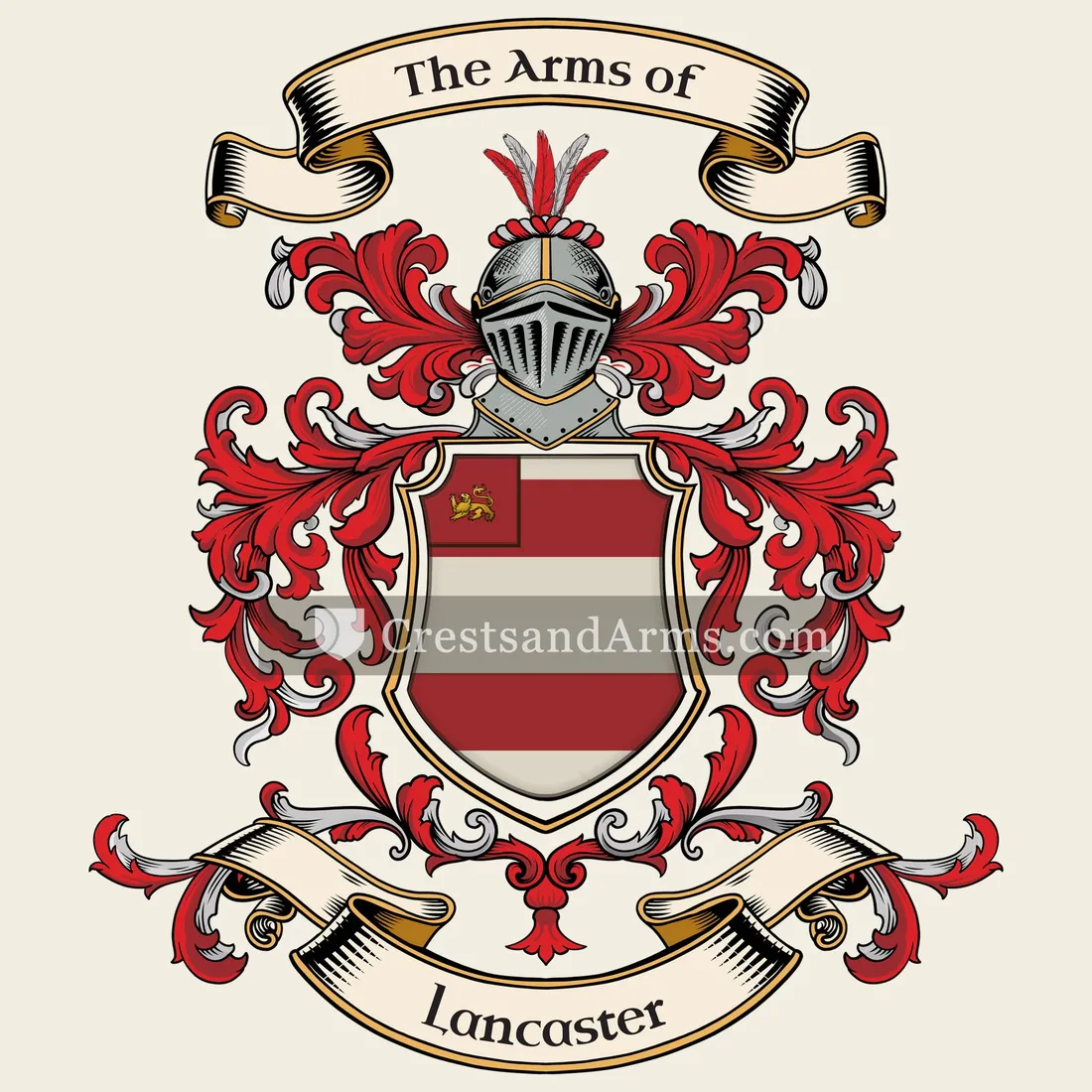
Symbols on this shield
cantonA mark of honour granted by the sovereign
lionCourage, strength and royalty
Colours
Silver (Argent)Means: Peace and sincerity
Red (Gules)Means: Military strength
Gold (Or)Means: Generosity
Historical info
Source
Sir Bernard Burke, The General Armory of England, Scotland, Ireland and Wales, London: Harrison & Sons, 1884
Blazon (the actual original written record)
“Ar. two bars gu. on a canton of the second a lion pass. guard. or”
Englandc. 1299
Digital archive packCoat of arms PNG, gold border print PDF, vector SVG and the certificate of authenticity. Sent to your email in minutes.
Map of England showing where the Lancaster arms are recorded
The Lancaster arms were recorded in England, c. 1299.
Arms such as these were typically recorded in York.
Yorkshire is the largest of the English counties, and it held more gentry families than any other. Land there was split among a great many households rather than a few, so a great many of them carried arms.
This is where the arms were entered in the register. Families often moved to other parts of the country, so the same name can turn up in more than one region.
The body that granted and recorded arms in England in this period.
Edward I of England
Sovereign of the period
Edward I of England
1272–1307
Reigning in Britain when the Lancaster arms are first recorded.
How Arms Worked in England
English heraldry allowed arms to be shared by all legitimate descendants of the original owner. These symbols were treated as personal property that moved through the generations to all children. While the eldest son kept the original design, other family members could use the same shield without needing to change it or register their own unique versions.
Granting authority
The College of Arms in London has regulated the use of coats of arms throughout England and Wales since 1484.
How they got arms
Families typically obtained their coats of arms through a formal grant from the Crown or by proving their ancient right to them.
Where arms were recorded
All official coats of arms are recorded in the registers kept at the College of Arms, which date back to the fifteenth century.
The family's standing
Recorded among the armigerous families of England.
Origin & History of the Lancaster Family in England
The family name Lancaster originates from the ancient town of Lancaster in Lancashire, England. During the medieval period, people often adopted the name of their home town as a way to identify themselves when they traveled or moved to new regions. By the year 1299, records confirm that members of the family were established in York, which suggests that the name had already begun to spread across Northern England by the late thirteenth century. As the name became more common, it moved away from being a simple description of a person’s birthplace and became a permanent family identifier passed down through generations. This transition reflects the broader social changes in medieval England, where surnames became necessary to distinguish between individuals in growing urban centers like York. While the name is deeply tied to the geography of the northwest, the presence of the family in major administrative hubs like York shows how early Lancastrians integrated into the wider political and economic life of the country.
Meaning of the Lancaster family crest colors & symbols
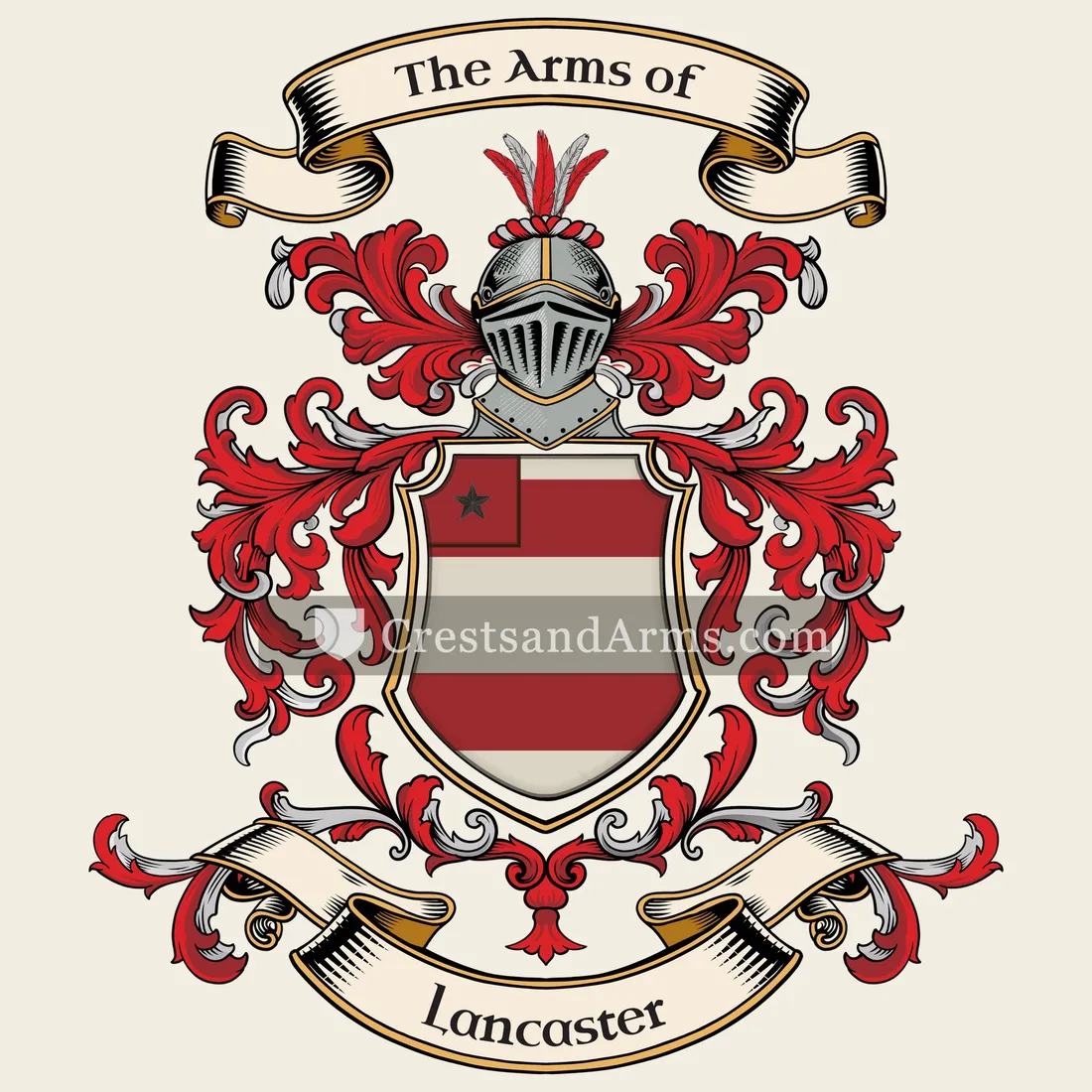
Symbols on this shield
cantonA mark of honour granted by the sovereign
mulletThe third son, and a divine quality from above
Colours
Silver (Argent)Means: Peace and sincerity
Red (Gules)Means: Military strength
Historical info
Source
Sir Bernard Burke, The General Armory of England, Scotland, Ireland and Wales, London: Harrison & Sons, 1884
Blazon (the actual original written record)
“Ar. two bars gu. on a canton of the last a mullet of the first”
Irelandc. 1566
Digital archive packCoat of arms PNG, gold border print PDF, vector SVG and the certificate of authenticity. Sent to your email in minutes.
Map of Ireland showing where the Lancaster arms are recorded
The Lancaster arms were recorded in Ireland, c. 1566.
Arms such as these were typically recorded in Dublin.
Dublin was the seat of government in Ireland and the place where grants were sought and recorded. Families with business at the castle or the courts settled nearby, and settling there put their arms on record.
This is where the arms were entered in the register. Families often moved to other parts of the country, so the same name can turn up in more than one region.
The body that granted and recorded arms in Ireland in this period.
Elizabeth I of England
Sovereign of the period
Elizabeth I of England
1558–1603
Reigning in Britain when the Lancaster arms are first recorded.
How Arms Worked in Ireland
The Ulster King of Arms granted coats of arms to individuals who proved their social standing and good character. These symbols were typically inherited by all legitimate descendants of the original holder. If a family branch wanted a unique look, they could apply for a specific change to their design through the office to ensure their identity remained distinct.
Granting authority
The Ulster King of Arms acted as the official body that regulated and issued all coats of arms throughout Ireland.
How they got arms
Families obtained their arms through formal grants issued by the office after proving their eligibility and paying the required fees.
Where arms were recorded
All official grants were recorded in the registers held by the Ulster King of Arms starting from the year 1552.
The family's standing
Recorded among the armigerous families of Ireland.
Origin & History of the Lancaster Family in Ireland
The Lancaster family name arrived in Ireland as part of the broader movement of English settlers during the sixteenth century. While the name originates from the city of Lancaster in England, records confirm that members of the family were firmly established in Dublin by 1566. During this period, the family integrated into the administrative and social life of the Pale, which was the area around Dublin under direct English control. Many early Lancasters in Ireland served in positions related to the church or local government, reflecting the family's role in the political transition of the era. Over time, these individuals became part of the merchant and professional classes that helped shape the development of Dublin. Their presence in the city during the mid-1500s marks the beginning of a long history of the family name within the Irish landscape.
Lancaster Meaning & Related Branches
Root word
Lancastria
A Roman fort on the River Lune
This name
LancasterRefers to a person who originated from the city of Lancaster in Lancashire, England.
also spelled
Lankaster
Lancastre
Lankester
Related arms
Beckinghamsimilar arms
Derwentwatersimilar arms
Prestonsimilar arms
Cobbrecorded with Lancaster, same area
Documented Sources
J. B. Rietstap, Armorial Général, Gouda: G. B. van Goor Zonen, 1884–87
Reaney, P. H. and Wilson, R. M., A Dictionary of English Surnames, 1991
Ekwall, Eilert, The Concise Oxford Dictionary of English Place-Names, 1960
The National Archives, Parish registers of Kent, series reference P200
Digital archive packCoat of arms PNG, gold border print PDF, vector SVG and the certificate of authenticity. Sent to your email in minutes.


 fessThe military belt, and readiness to serve
 cantonA mark of honour granted by the sovereign
 lionCourage, strength and royalty
 fessThe military belt, and readiness to serve
 cantonA mark of honour granted by the sovereign
 lionCourage, strength and royalty



 mulletThe third son, and a divine quality from above