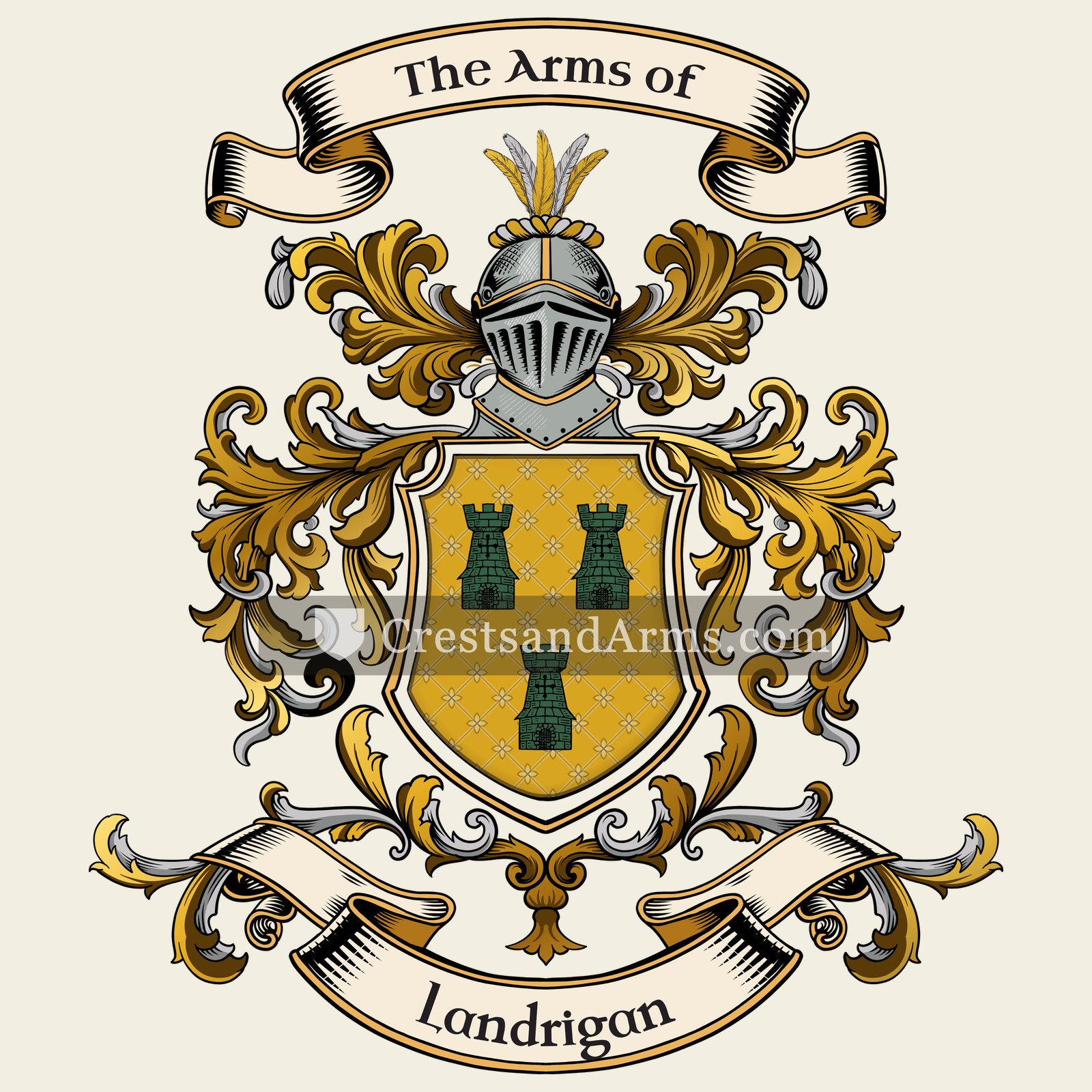
A record of documented arms, meaning and origin, researched for the Landrigan family of France.
Reg. 9443 · French, J–L
Coat of Arms & Family Crest Details
Symbols on this shield
towerGrandeur and solidity, and a stronghold defended
Colours
Gold (Or)Means: Generosity
Green (Vert)Means: Hope
Historical info
Source
J. B. Rietstap, Armorial Général, Gouda: G. B. van Goor Zonen, 1884–87
Blazon (the actual original written record)
“D'or à un château de sin., flanqué de deux tours crén. du même, surm. d'une aigle ép. de sa., bq., arm. et diadémée de gu., appuyant ses serres sur l'une et l'autre tour. C.: l'aigle de l'écu. S.: deux aigles, pareilles à celle de l'écu. D.: LOYALTÉ N'A CRAINTE.”
LorraineMilanais · Lorraine, c. 1374
Digital archive packCoat of arms PNG, gold border print PDF, vector SVG and the certificate of authenticity. Sent to your email in minutes.
Map of France showing where the Landrigan arms are recorded
The Landrigan arms were recorded in Lorraine, c. 1374.
Lorraine sat on the border between France and the German lands, and border country bred soldiers. Families here held small estates and served in arms, and a fighting man was exactly the sort who carried a shield of his own.
This is where the arms were entered in the register. Families often moved to other parts of the country, so the same name can turn up in more than one region.
The body that granted and recorded arms in France in this period.
Charles V of France
Sovereign of the period
Charles V of France
1364–1380
Reigning in France when the Landrigan arms are first recorded.
How Arms Worked in France
In France, a coat of arms was a mark of honor that passed down through the male line to all legitimate descendants. Families often used the same shield without changes to show their shared heritage. If a branch wanted to stand out, they could add a small mark to their shield to show their specific place in the family tree.
Granting authority
The Juge d'armes de France acted as the official authority that regulated and verified coats of arms across the country.
How they got arms
Families typically inherited their arms from ancestors, though they could also receive them through royal grants or by proving their noble status.
Where arms were recorded
Coats of arms were officially recorded in the Armorial Général de France, which began its main collection in the year 1696.
The family's standing
Recorded among the armigerous families of Lorraine.
Origin & History of the Landrigan Family in France
The history of the Landrigan family name traces back to the region of Lorraine in eastern France during the late fourteenth century. Records from 1374 place the family within this territory, which served as a vital crossroads between Germanic and French cultures during the Middle Ages. The name likely developed from local linguistic roots that described the geographical or social status of the family members living in this borderland. As the family established their presence in the region, they became part of the complex social fabric of the Holy Roman Empire. Over time, the family name evolved alongside the shifting borders and political changes that defined the history of Lorraine. This early foundation in such a significant European province suggests that the ancestors of the family were deeply involved in the agricultural and community life of the era.
Related Branches & Arms
Root word
Landri
Derived from the Germanic elements land meaning land and ric meaning ruler.
This name
LandriganA patronymic surname indicating descent from a person named Landri, signifying a ruler of the land.
also spelled
Landriant
Landrien
Landreean
Documented Sources
J. B. Rietstap, Armorial Général, Gouda: G. B. van Goor Zonen, 1884–87
Archives départementales de Meurthe-et-Moselle, Série B (Cours et juridictions)
Cabourdin, Guy, Histoire de la Lorraine, 1991
Schneider, Jean, La ville de Metz aux XIIIe et XIVe siècles, 1950
Digital archive packCoat of arms PNG, gold border print PDF, vector SVG and the certificate of authenticity. Sent to your email in minutes.


 towerGrandeur and solidity, and a stronghold defended
 towerGrandeur and solidity, and a stronghold defended