Map of France showing where the Lange arms are recorded
The Lange arms were recorded in Nivernais, c. 1663.
Nivernais was central French country of woods, ironworks and river trade. Its landed families were modest but numerous, and each holding brought its own claim to a coat of arms.
This is where the arms were entered in the register. Families often moved to other parts of the country, so the same name can turn up in more than one region.
The body that granted and recorded arms in France in this period.
Louis XIV of France
Sovereign of the period
Louis XIV of France
1643–1715
Reigning in France when the Lange arms are first recorded.
How Arms Worked in France
In France, a coat of arms was a mark of honor that passed down through the male line to all legitimate descendants. Families often used the same shield without changes to show their shared heritage. If a branch wanted to stand out, they could add a small mark to their shield to show their specific place in the family tree.
Granting authority
The Juge d'armes de France acted as the official authority that regulated and verified coats of arms across the country.
How they got arms
Families typically inherited their arms from ancestors, though they could also receive them through royal grants or by proving their noble status.
Where arms were recorded
Coats of arms were officially recorded in the Armorial Général de France, which began its main collection in the year 1696.
The family's standing
Recorded among the armigerous families of Nivernais.
Origin & History of the Lange Family in France
The family name Lange carries a rich history that reflects the linguistic shifts of early modern France. In the region of Nivernais, where records confirm the family’s presence by 1663, the name functioned as a descriptive nickname. It is derived from the Old French word "lange," which meant long or tall. During this era, surnames were often assigned to distinguish individuals based on their physical traits or stature. As the family established their roots in the Nivernais countryside, they became part of the local social fabric, likely working in agriculture or trade within the provincial economy. Over time, the name transitioned from a simple descriptor into a formal hereditary surname that identified the family across generations. This evolution highlights how common descriptive terms became the permanent markers of identity for families living in rural French provinces during the seventeenth century.
Coat of Arms & Family Crest Details
Symbols on this shield
roseThe seventh son, and beauty with grace
Colours
Silver (Argent)Means: Peace and sincerity
Red (Gules)Means: Military strength
Historical info
Source
J. B. Rietstap, Armorial Général, Gouda: G. B. van Goor Zonen, 1884–87
Blazon (the actual original written record)
“D'Arg. à une rose de gu. C.: la rose; entre deux prob., coupées alt. de gu. et d'arg”
Denmarkc. 1572
Digital archive packCoat of arms PNG, gold border print PDF, vector SVG and the certificate of authenticity. Sent to your email in minutes.
Map of Denmark showing where the Lange arms are recorded
The Lange arms were recorded in Denmark, c. 1572.
Arms such as these were typically recorded in Sjaælland.
Zealand held the Danish court, the crown's offices and Copenhagen itself. Families who served the king kept estates within reach of it, and royal service was the ordinary route to a coat of arms.
This is where the arms were entered in the register. Families often moved to other parts of the country, so the same name can turn up in more than one region.
The body that granted and recorded arms in Denmark in this period.
Frederick II of Denmark
Sovereign of the period
Frederick II of Denmark
1559–1588
Reigning in France when the Lange arms are first recorded.
How Arms Worked in Denmark
Danish heraldry during this period was closely tied to noble status and royal favor rather than being open to all citizens. Arms were typically granted by the monarch to individuals, and these symbols were then shared by all members of the noble house. If a family line died out, the right to use those specific arms ended with them.
Granting authority
The Danish royal chancery held the power to issue and regulate official coats of arms for the kingdom.
How they got arms
Families usually received their arms through a formal royal grant that confirmed their noble status and rights.
Where arms were recorded
These grants were officially recorded in the Danish Royal Chancery records starting in the sixteenth century.
The family's standing
Recorded among the armigerous families of Denmark.
Origin & History of the Lange Family in Denmark
The history of the Lange family in Denmark is deeply rooted in the island of Sjaælland, where records confirm their presence as early as 1572. The name itself is a descriptive surname, derived from the Old Danish word "lang," which translates to "long" or "tall." During the sixteenth century, such names were commonly used to identify individuals based on their physical appearance or stature. As the family established themselves in the region, they became part of the social fabric of rural and urban Danish life. Because surnames were not strictly regulated at that time, the name likely served as a practical way for neighbors and local officials to distinguish members of the family from others in the community. Over the decades, the family integrated into the local economy, with early members often appearing in parish registers and tax documents that tracked the movement and property ownership of residents across the Danish landscape.
Coat of Arms & Family Crest Details
Symbols on this shield
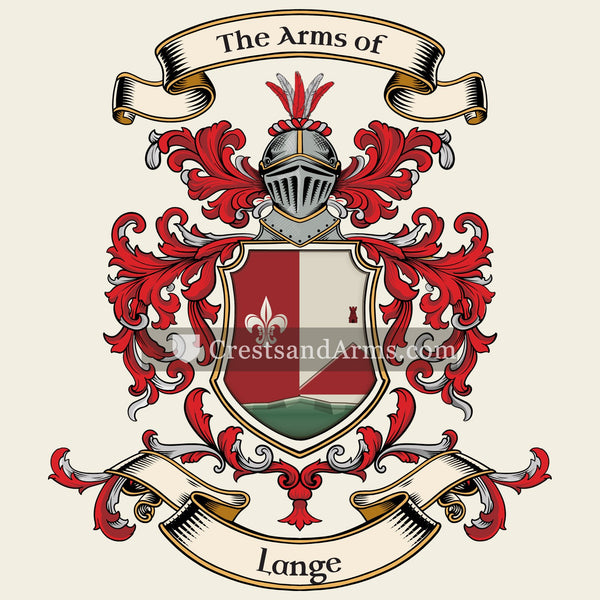
mountThe ground held, and steadfastness upon it
fleur de lisPurity, light, and the sixth son
towerGrandeur and solidity, and a stronghold defended
Colours
Red (Gules)Means: Military strength
Silver (Argent)Means: Peace and sincerity
Green (Vert)Means: Hope
Historical info
Source
J. B. Rietstap, Armorial Général, Gouda: G. B. van Goor Zonen, 1884–87
Blazon (the actual original written record)
“Parti: au 1 de gu. à une demi-fleur-de-lis d'arg., mouv. du parti; au 2 d'arg. à un demi-château sommé d'une tour et demie de gu., maconné de sa., mouv. du parti et soutenu d'une terrasse de sin. C.: deux cornes de buffle de gu. L. d'arg. et de gu.”
GermanyHambourg, c. 1765
Digital archive packCoat of arms PNG, gold border print PDF, vector SVG and the certificate of authenticity. Sent to your email in minutes.
Map of Germany showing where the Lange arms are recorded
The Lange arms were recorded in Hambourg, c. 1765.
This is where the arms were entered in the register. Families often moved to other parts of the country, so the same name can turn up in more than one region.
The body that granted and recorded arms in Germany in this period.
Francis I, Holy Roman Emperor
Sovereign of the period
Francis I, Holy Roman Emperor
1745–1765
Reigning in France when the Lange arms are first recorded.
How Arms Worked in Germany
In the Holy Roman Empire, coats of arms were often granted to individuals by the Emperor or his representatives. These arms were then passed down through the generations to all legitimate descendants of the original holder. Younger branches of a family usually kept the same shield design without needing to change it, as the arms belonged to the entire lineage.
Granting authority
The Holy Roman Emperor held the sole power to grant new coats of arms throughout his vast imperial territories.
How they got arms
Families typically obtained their coats of arms through a formal imperial grant or by proving their noble status to the authorities.
Where arms were recorded
These grants were officially recorded in the Imperial Chancery registers, which began keeping formal records of such honors during the Middle Ages.
The family's standing
Recorded among the armigerous families of Germany.
Origin & History of the Lange Family in Germany
The surname Lange is a classic example of a descriptive German name that originated during the Middle Ages. It was originally a nickname given to people who were noticeably tall, derived from the Middle High German word "lanc." As populations grew and people began to move into towns, these descriptive nicknames became permanent family names to help identify individuals in official records. By the time members of the family were documented in Hamburg in 1765, the name was already well-established across German-speaking regions. Hamburg served as a major center for trade and commerce during this era, and families like the Langes often played roles in the city's growing merchant class. Because the name was based on a common physical trait, it emerged independently in many different locations rather than coming from a single ancestor. This meant that families named Lange were often spread across various social and professional groups throughout northern Germany.
Lange Meaning & Related Branches
Root word
Longus
Latin term meaning long or tall.
This name
LangeA descriptive nickname for a person of significant height or stature.
also spelled
Lang
Related arms
Bilefeldsimilar arms
Eisensimilar arms
Furersimilar arms
Langvariant spelling
Documented Sources
J. B. Rietstap, Armorial Général, Gouda: G. B. van Goor Zonen, 1884–87
Dauzat, Albert. Les noms de famille de France. 1945
Morlet, Marie-Thérèse. Dictionnaire étymologique des noms de famille. 1991
Archives départementales de la Nièvre. Registres paroissiaux et d'état civil de la commune de Nevers. 1663
Digital archive packCoat of arms PNG, gold border print PDF, vector SVG and the certificate of authenticity. Sent to your email in minutes.


 crescentHonour by the sovereign, and the second son
 mulletThe third son, and a divine quality from above
 crescentHonour by the sovereign, and the second son
 mulletThe third son, and a divine quality from above


 roseThe seventh son, and beauty with grace


 mountThe ground held, and steadfastness upon it
 fleur de lisPurity, light, and the sixth son
 towerGrandeur and solidity, and a stronghold defended