Map of France showing where the Langham arms are recorded
The Langham arms were recorded in Northamptonshire, c. 1660.
This is where the arms were entered in the register. Families often moved to other parts of the country, so the same name can turn up in more than one region.
The body that granted and recorded arms in France in this period.
Louis XIV of France
Sovereign of the period
Louis XIV of France
1643–1715
Reigning in France when the Langham arms are first recorded.
How Arms Worked in France
In France, a coat of arms was a mark of honor that passed down through the male line to all legitimate descendants. Families often used the same shield without changes to show their shared heritage. If a branch wanted to stand out, they could add a small mark to their shield to show their specific place in the family tree.
Granting authority
The Juge d'armes de France acted as the official authority that regulated and verified coats of arms across the country.
How they got arms
Families typically inherited their arms from ancestors, though they could also receive them through royal grants or by proving their noble status.
Where arms were recorded
Coats of arms were officially recorded in the Armorial Général de France, which began its main collection in the year 1696.
The family's standing
Recorded among the armigerous families of Northamptonshire.
Origin & History of the Langham Family in France
The family name Langham is rooted in the Old English language, specifically referring to a homestead or settlement located on a long stretch of land. While the family became firmly established in Northamptonshire by 1660, the name likely emerged from the movement of people across the English Channel following the Norman Conquest of 1066. Many families with similar locational surnames originated from small villages in northern France before settling in England to serve under the new Norman administration. Over several centuries, these families integrated into the local English landscape, eventually rising to prominence in regional government and land ownership. By the mid-seventeenth century, the Langham family had become a well-known name in Northamptonshire, reflecting a long process of migration and social development that began in the medieval period.
Coat of Arms & Family Crest Details
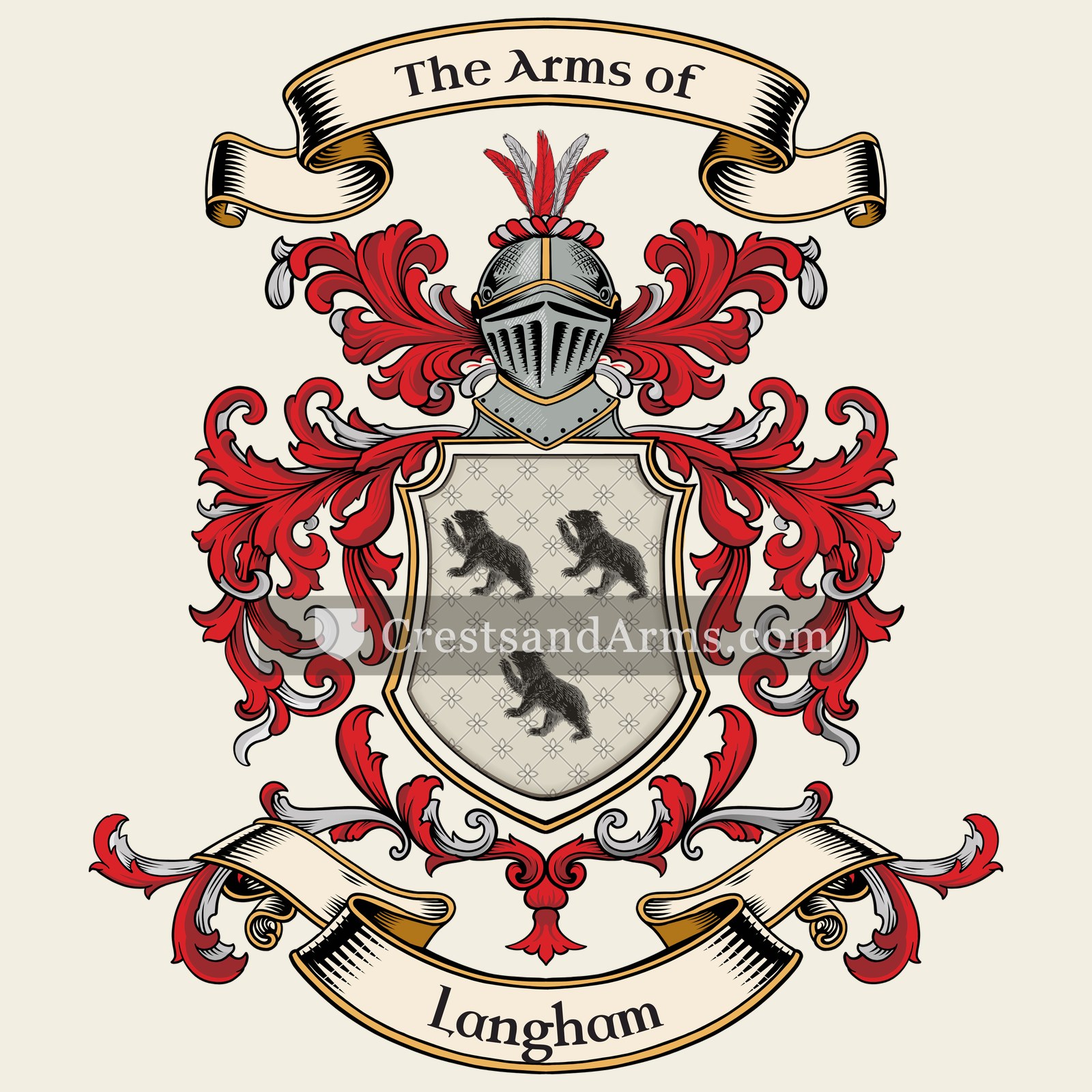
Symbols on this shield
bearStrength, cunning and protection of kin
Colours
Silver (Argent)Means: Peace and sincerity
Black (Sable)Means: Constancy
Historical info
Source
Sir Bernard Burke, The General Armory of England, Scotland, Ireland and Wales, London: Harrison & Sons, 1884
Blazon (the actual original written record)
“Ar. three bears' heads couped sa. muzzled or”
LeicesterGopsall · Leicester, c. 1395
Digital archive packCoat of arms PNG, gold border print PDF, vector SVG and the certificate of authenticity. Sent to your email in minutes.
Map of England showing where the Langham arms are recorded
The Langham arms were recorded in Leicester, c. 1395.
Leicestershire was grazing country, and wool and cattle made steady money rather than spectacular fortunes. Steady money bought manors, and manors are what brought families into the registers.
This is where the arms were entered in the register. Families often moved to other parts of the country, so the same name can turn up in more than one region.
The body that granted and recorded arms in England in this period.
Richard II of England
Sovereign of the period
Richard II of England
1377–1399
Reigning in France when the Langham arms are first recorded.
How Arms Worked in England
English heraldry allowed arms to be shared by all legitimate descendants of the original owner. These symbols were treated as personal property that moved through the generations to all children. While the eldest son kept the original design, other family members could use the same shield without needing to change it or register their own unique versions.
Granting authority
The College of Arms in London has regulated the use of coats of arms throughout England and Wales since 1484.
How they got arms
Families typically obtained their coats of arms through a formal grant from the Crown or by proving their ancient right to them.
Where arms were recorded
All official coats of arms are recorded in the registers kept at the College of Arms, which date back to the fifteenth century.
The family's standing
Recorded among the armigerous families of Leicester.
Origin & History of the Langham Family in England
The surname Langham originates from a place name in England, specifically referring to settlements known as "the long homestead" or "the long village." By the late fourteenth century, the family had established a notable presence in the county of Leicestershire. Records from 1395 confirm that members of the Langham family were active in Leicester during this period, likely participating in the local trade and agricultural life that defined the region. As the family grew, they became deeply connected to the local landscape and the evolving social structure of medieval England. Through their work and community involvement, the early Langhams helped shape the history of their home county, leaving behind a legacy that is still tied to the geography of the English Midlands.
Related Branches & Arms
Root word
Lang-ham
Old English elements meaning long or tall and a homestead or village.
This name
LanghamRefers to a person who lived at a long or extended settlement or village.
also spelled
Langhame
Langeham
Documented Sources
J. B. Rietstap, Armorial Général, Gouda: G. B. van Goor Zonen, 1884–87
Reaney, P.H., A Dictionary of English Surnames, 1991
Ekwall, Eilert, The Concise Oxford Dictionary of English Place-names, 1960
The National Archives, State Papers Domestic: Charles II, 1660
Northamptonshire Archives, Langham Family Papers, 1660–1800
Digital archive packCoat of arms PNG, gold border print PDF, vector SVG and the certificate of authenticity. Sent to your email in minutes.


 bearStrength, cunning and protection of kin
 bearStrength, cunning and protection of kin