Map of France showing where the Langlitz arms are recorded
The Langlitz arms were recorded in Beauvoisis, c. 1663.
This is where the arms were entered in the register. Families often moved to other parts of the country, so the same name can turn up in more than one region.
The body that granted and recorded arms in France in this period.
Louis XIV of France
Sovereign of the period
Louis XIV of France
1643–1715
Reigning in France when the Langlitz arms are first recorded.
How Arms Worked in France
In France, a coat of arms was a mark of honor that passed down through the male line to all legitimate descendants. Families often used the same shield without changes to show their shared heritage. If a branch wanted to stand out, they could add a small mark to their shield to show their specific place in the family tree.
Granting authority
The Juge d'armes de France acted as the official authority that regulated and verified coats of arms across the country.
How they got arms
Families typically inherited their arms from ancestors, though they could also receive them through royal grants or by proving their noble status.
Where arms were recorded
Coats of arms were officially recorded in the Armorial Général de France, which began its main collection in the year 1696.
The family's standing
Recorded among the armigerous families of France.
Origin & History of the Langlitz Family in France
The Langlitz family name has deep roots in the Beauvoisis region of northern France, where records confirm their presence as early as 1663. During the seventeenth century, this area was a hub of agricultural activity and textile production, which likely shaped the daily lives of the family members living there. The name itself suggests a connection to the Germanic linguistic influences that moved through the border regions of France over many generations. Families in this part of the country often lived in small rural parishes where they worked as skilled laborers or farmers. By establishing themselves in the Beauvoisis, the early Langlitz ancestors became part of a long-standing community tradition that relied on local land ownership and parish records to document their growth. Their history reflects the broader movement of families who settled in the fertile plains of the Oise department during the reign of King Louis XIV.
Langlitz Meaning & Related Branches
Root word
Lang
A Germanic descriptor meaning long or tall.
This name
LanglitzA diminutive form referring to a person of tall stature or long limbs.
also spelled
Langlett
Langle
Langlay
Documented Sources
J. B. Rietstap, Armorial Général, Gouda: G. B. van Goor Zonen, 1884–87
Archives départementales de l'Oise, Registres paroissiaux et d'état civil du Beauvaisis, 1663
Léopold Delisle, Études sur la condition de la classe agricole et l'état de l'agriculture en Normandie au Moyen Âge, 1903
Pierre Goubert, Beauvais et le Beauvaisis de 1600 à 1730, 1960
Digital archive packCoat of arms PNG, gold border print PDF, vector SVG and the certificate of authenticity. Sent to your email in minutes.


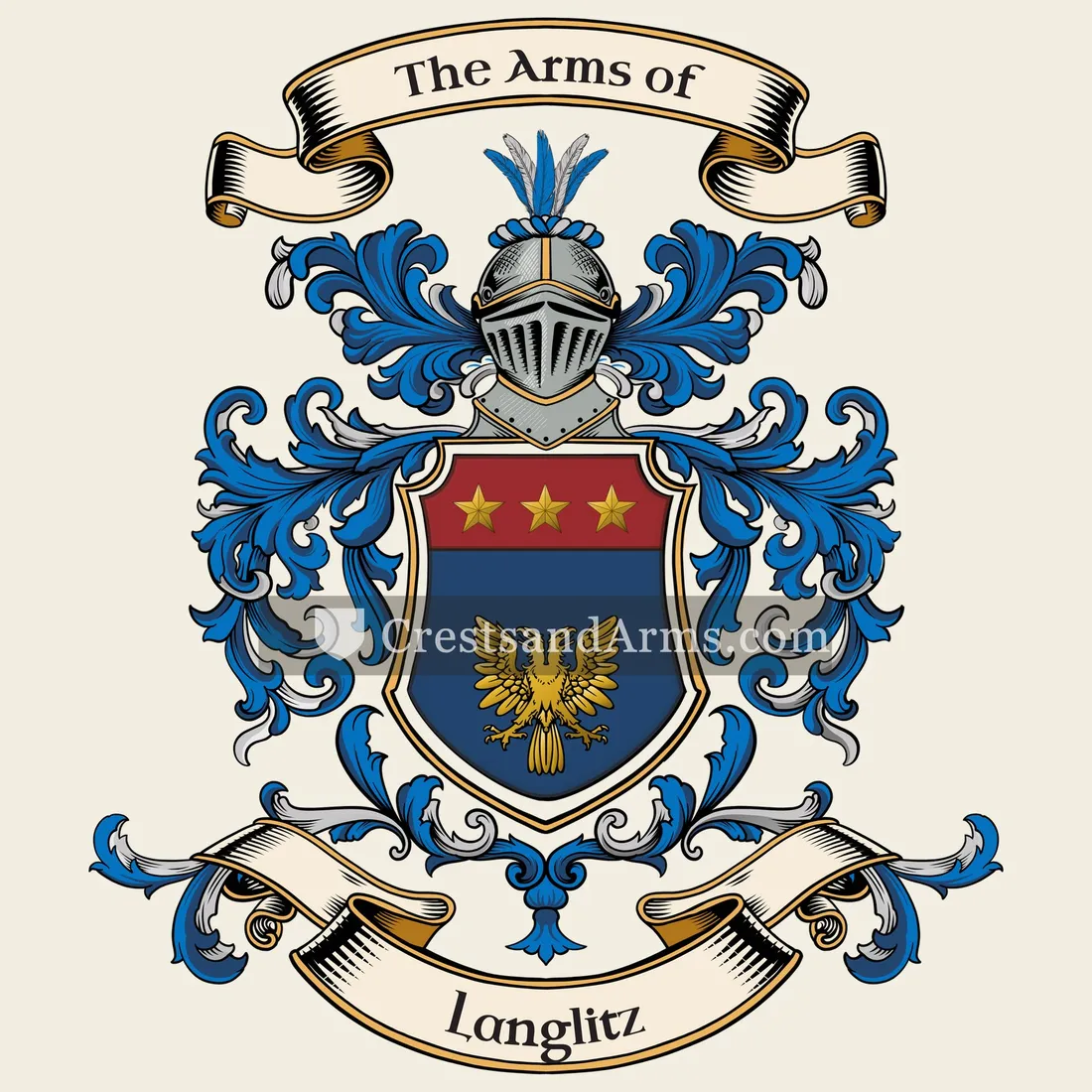
 chiefAuthority, wisdom and dominion
 eagleNobility, strength and a keen mind
 mulletThe third son, and a divine quality from above
 chiefAuthority, wisdom and dominion
 eagleNobility, strength and a keen mind
 mulletThe third son, and a divine quality from above