Map of France showing where the Langlois arms are recorded
The Langlois arms were recorded in Picardie, c. 1663.
Picardie lay on the northern road into France and saw armies pass through it repeatedly. Its landowners were soldiers as often as farmers, and a soldier needed a shield he could be recognised by.
This is where the arms were entered in the register. Families often moved to other parts of the country, so the same name can turn up in more than one region.
The body that granted and recorded arms in France in this period.
Louis XIV of France
Sovereign of the period
Louis XIV of France
1643–1715
Reigning in France when the Langlois arms are first recorded.
How Arms Worked in France
In France, a coat of arms was a mark of honor that passed down through the male line to all legitimate descendants. Families often used the same shield without changes to show their shared heritage. If a branch wanted to stand out, they could add a small mark to their shield to show their specific place in the family tree.
Granting authority
The Juge d'armes de France acted as the official authority that regulated and verified coats of arms across the country.
How they got arms
Families typically inherited their arms from ancestors, though they could also receive them through royal grants or by proving their noble status.
Where arms were recorded
Coats of arms were officially recorded in the Armorial Général de France, which began its main collection in the year 1696.
The family's standing
Recorded among the armigerous families of Picardie.
Origin & History of the Langlois Family in France
The surname Langlois is a classic example of a descriptive name that originated in medieval France. It translates literally to "the English" or "the Englishman," and it was likely used as a nickname for someone who had traveled to England, traded with the English, or perhaps lived in a region where English influence was present. By the 17th century, the name was well-established across northern France, particularly in the province of Picardie. Records show that families bearing this name were deeply rooted in the local agricultural and social fabric of the region by 1663. During this period, the Langlois family lived through a time of significant transition in French history, as the central government worked to consolidate power and standardize record-keeping in rural parishes. As members of the common citizenry, these early ancestors were part of the backbone of Picardie, contributing to the local economy and community life long before many of their descendants began to migrate to other parts of the world.
Coat of Arms & Family Crest Details
Symbols on this shield
anchorHope, and steadfastness in trouble
Colours
Blue (Azure)Means: Loyalty and truth
Silver (Argent)Means: Peace and sincerity
Historical info
Source
J. B. Rietstap, Armorial Général, Gouda: G. B. van Goor Zonen, 1884–87
Blazon (the actual original written record)
“D'azur à une ancre d'arg. Cq. cour. C.: trois pl. d'aut. d'arg.”
BavariaBavaria, c. 1857
Digital archive packCoat of arms PNG, gold border print PDF, vector SVG and the certificate of authenticity. Sent to your email in minutes.
Map of Germany showing where the Langlois arms are recorded
The Langlois arms were recorded in Bavaria, c. 1857.
Bavaria was a country of old landed families and walled market towns. Estates passed down the same line for centuries, and both the landowners and the leading townsmen kept arms, which is why so many Bavarian names sit in the registers.
This is where the arms were entered in the register. Families often moved to other parts of the country, so the same name can turn up in more than one region.
The body that granted and recorded arms in Germany in this period.
Frederick William IV of Prussia
Sovereign of the period
Frederick William IV of Prussia
1840–1861
Reigning in France when the Langlois arms are first recorded.
How Arms Worked in Germany
Prussian heraldry was strictly tied to social rank and noble status rather than being a free choice for every citizen. These symbols were treated as permanent family property that moved through the generations to all legitimate heirs. If a family branch wanted to change their design to stand out, they had to apply for official permission to alter their specific version of the shield.
Granting authority
The Prussian Heroldsamt acted as the central state office that managed and strictly controlled all noble titles and coats of arms.
How they got arms
Families usually obtained their arms through formal royal grants or by proving their long-standing noble status to the state authorities.
Where arms were recorded
All official coats of arms were kept in the rolls of the Prussian Heroldsamt, which functioned from 1706 until 1918.
The family's standing
Recorded among the armigerous families of Bavaria.
Origin & History of the Langlois Family in Germany
The name Langlois is traditionally associated with French origins, as it translates to "the Englishman," but its presence in Germany highlights the complex movement of families across European borders. By the mid-19th century, members of the Langlois family had established a documented presence in the region of Bavaria. During this era, Bavaria was undergoing significant social and economic changes as it transitioned into a modern industrial state. Families living in this area often worked in skilled trades or agriculture, contributing to the local economy while maintaining their distinct cultural identity. The presence of the family in Bavaria by 1857 suggests they were part of the broader migration patterns that saw individuals moving between neighboring European powers for work, trade, or political stability. This period in Bavarian history was defined by a strong focus on community development and regional growth, providing a stable environment for families to settle and grow their roots.
Coat of Arms & Family Crest Details
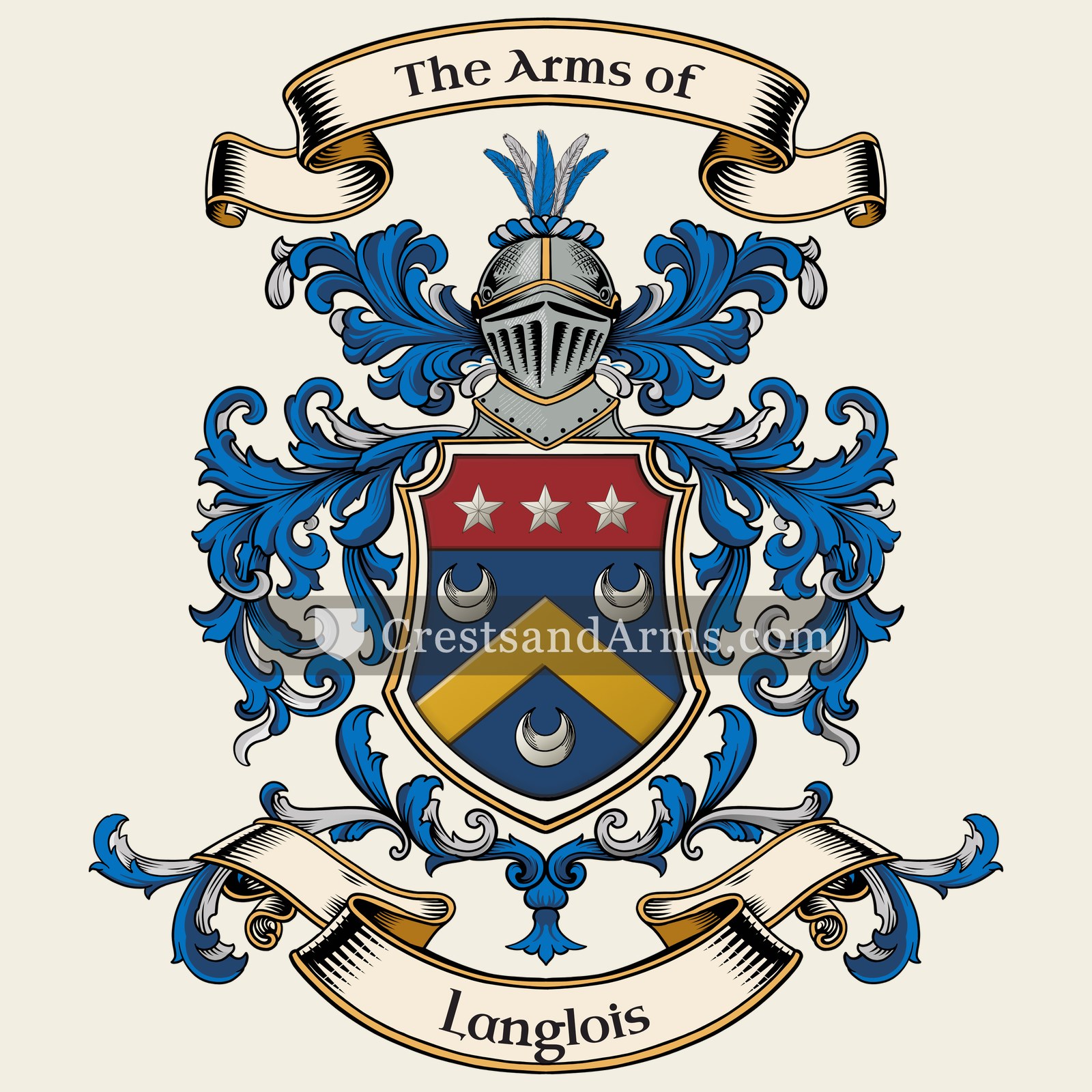
Symbols on this shield
chevronProtection, and faithful service completed
chiefAuthority, wisdom and dominion
crescentHonour by the sovereign, and the second son
mulletThe third son, and a divine quality from above
Colours
Blue (Azure)Means: Loyalty and truth
Gold (Or)Means: Generosity
Red (Gules)Means: Military strength
Silver (Argent)Means: Peace and sincerity
Historical info
Source
Sir Bernard Burke, The General Armory of England, Scotland, Ireland and Wales, London: Harrison & Sons, 1884
Blazon (the actual original written record)
“Az. a chev. or, betw. three crescents ar. on a chief gu. as many mullets of six points pierced of the second”
JerseyHamptonne, c. 1688
Digital archive packCoat of arms PNG, gold border print PDF, vector SVG and the certificate of authenticity. Sent to your email in minutes.
The body that granted and recorded arms in Jersey in this period.
James II of England
Sovereign of the period
James II of England
1685–1688
Reigning in France when the Langlois arms are first recorded.
How Arms Worked in Jersey
Arms in the Channel Islands were granted and recorded by the College of Arms in London, under the same law of arms as England. They could be used by all legitimate descendants of the original owner: the eldest son kept the original design, and other family members used the same shield without registering a version of their own.
Granting authority
The College of Arms in London has regulated the use of coats of arms for Jersey and the other Channel Islands since 1484.
How they got arms
Families typically obtained their coats of arms through a formal grant from the Crown or by proving their ancient right to them.
Where arms were recorded
All official coats of arms are recorded in the registers kept at the College of Arms, which date back to the fifteenth century.
The family's standing
Recorded among the armigerous families of Jersey.
Origin & History of the Langlois Family in Jersey
The Langlois family name has deep roots in the island of Jersey, where it has been established for centuries as a prominent part of the local community. By the late seventeenth century, the family had firmly settled in the parish of Saint Lawrence, specifically within the historic area of Hamptonne. Records from 1688 confirm their presence in this region, where they were deeply involved in the agricultural and social life of the island. The name itself is of French origin, reflecting the strong cultural and linguistic ties between Jersey and Normandy. Over the generations, members of the Langlois family became well-known for their contributions to island governance and land management. Their long history in Hamptonne serves as a testament to the family's endurance and their role in shaping the rural identity of Jersey during the early modern period.
Related Branches & Arms
Root word
Anglus
A member of the Germanic tribe known as the Angles.
This name
LangloisRefers to an individual of English origin or someone who had connections to England.
also spelled
Langloys
Langloy
Langley
Related arms
Barraultsimilar arms
Mottevillesimilar arms
Widmann d'Ottersbergsimilar arms
Documented Sources
J. B. Rietstap, Armorial Général, Gouda: G. B. van Goor Zonen, 1884–87
Dauzat, Albert. Dictionnaire étymologique des noms et prénoms de France, 1951
Morlet, Marie-Thérèse. Dictionnaire étymologique des noms de famille, 1991
Archives départementales de la Somme. Registres paroissiaux et d'état civil, 1663
Digital archive packCoat of arms PNG, gold border print PDF, vector SVG and the certificate of authenticity. Sent to your email in minutes.


 chevronProtection, and faithful service completed
 trefoilPerpetuity, and the Trinity
 chevronProtection, and faithful service completed
 trefoilPerpetuity, and the Trinity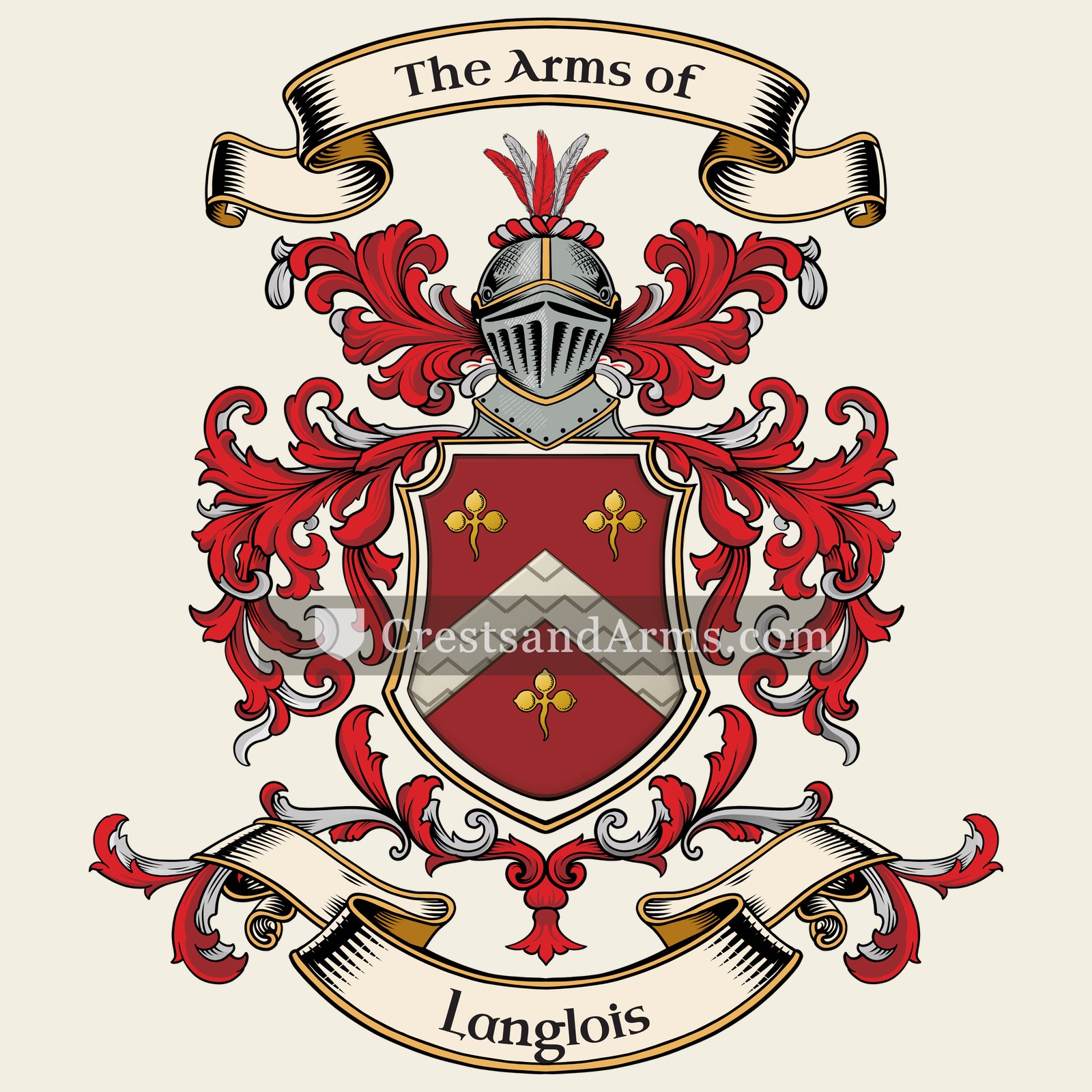


 anchorHope, and steadfastness in trouble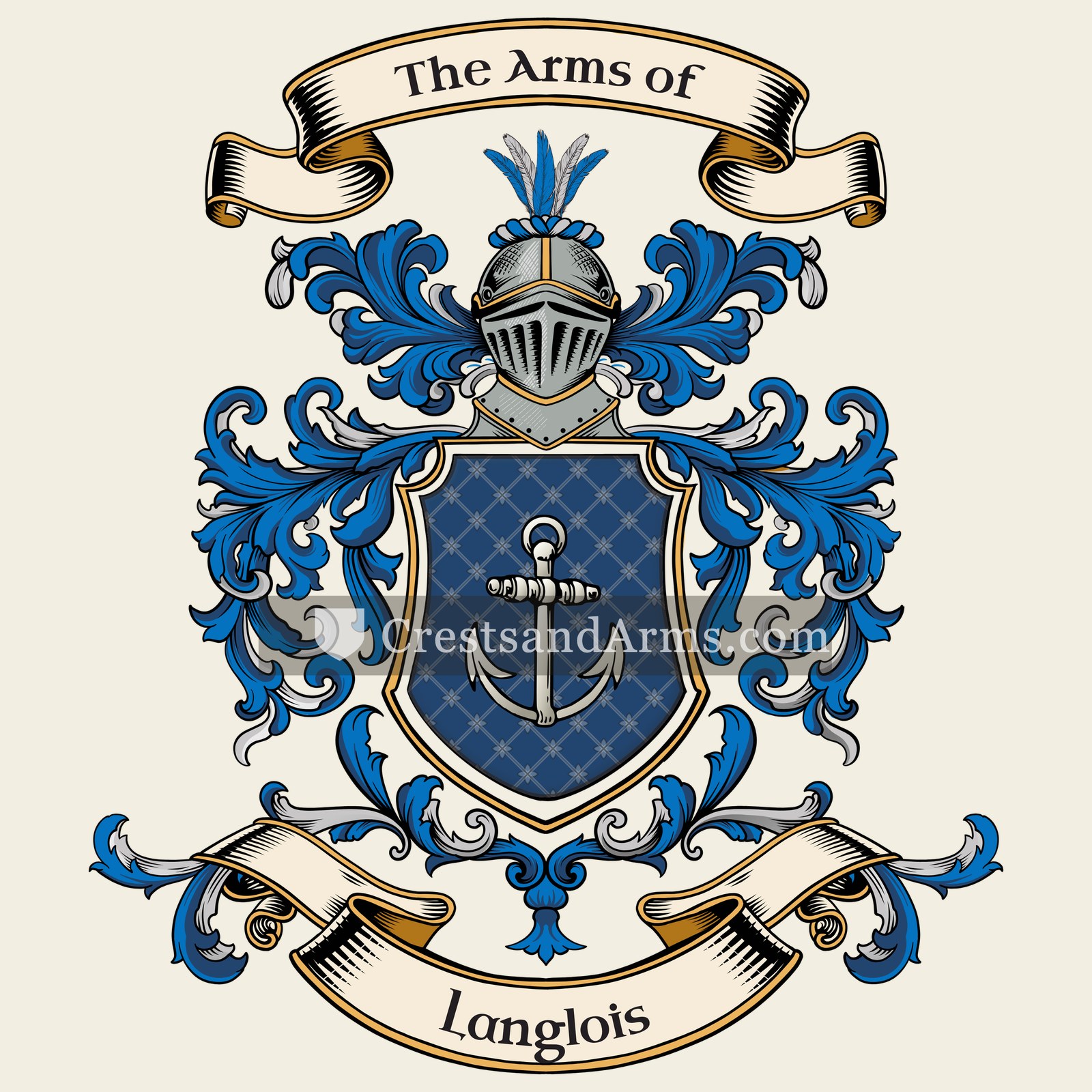


 chiefAuthority, wisdom and dominion
 crescentHonour by the sovereign, and the second son
 mulletThe third son, and a divine quality from above