Map of Netherlands showing where the Lasater arms are recorded
The Lasater arms were recorded in Netherlands, c. 1815.
Arms such as these were typically recorded in Friesland.
Friesland was low, wet country on the northern coast of the Netherlands, farmed by families who had held the same land for centuries. Free landholders were unusually common there, and a free landholder could carry arms.
This is where the arms were entered in the register. Families often moved to other parts of the country, so the same name can turn up in more than one region.
Region
Friesland
First recorded
1815
Granting Authority for the Lasater Arms
Hoge Raad van Adel
Photograph made by me · CC BY-SA 3.0
The body that granted and recorded arms in Netherlands in this period.
William I of the Netherlands
Sovereign of the period
William I of the Netherlands
1815–1840
Reigning in Netherlands when the Lasater arms are first recorded.
How Arms Worked in Netherlands
In the Netherlands, coats of arms were often used by noble families and those who held specific public offices. These arms were passed down through the generations to legitimate descendants. Younger branches of a family usually kept the original design without needing to add special marks. This system ensured that the family identity remained clear and consistent over many years.
Granting authority
The Hoge Raad van Adel is the official body that regulates and manages noble titles and coats of arms in the Netherlands.
How they got arms
Families typically obtained their coats of arms through official royal grants or by proving their long-standing historical use of the symbols.
Where arms were recorded
Coats of arms are officially recorded in the registers held by the Hoge Raad van Adel, which began its work in 1814.
The family's standing
Recorded among the armigerous families of Netherlands.
Origin & History of the Lasater Family in Netherlands
The roots of the Lasater name in the Netherlands are deeply connected to the northern province of Friesland, where family members were officially recorded in 1815. During this period, the Netherlands underwent significant social changes as the country transitioned into a unified kingdom following the Napoleonic era. The name likely evolved from regional naming customs where individuals were identified by their occupation or their specific location within the Frisian landscape. Because the Frisian language and culture remained distinct from the rest of the Netherlands, families in this region often maintained unique naming traditions that reflected their local heritage. By the early nineteenth century, the formal registration of surnames became a standard government requirement, which helped solidify the spelling and lineage of the Lasater family as they integrated into the broader Dutch society of the time.
Meaning of the Lasater family crest colors & symbols
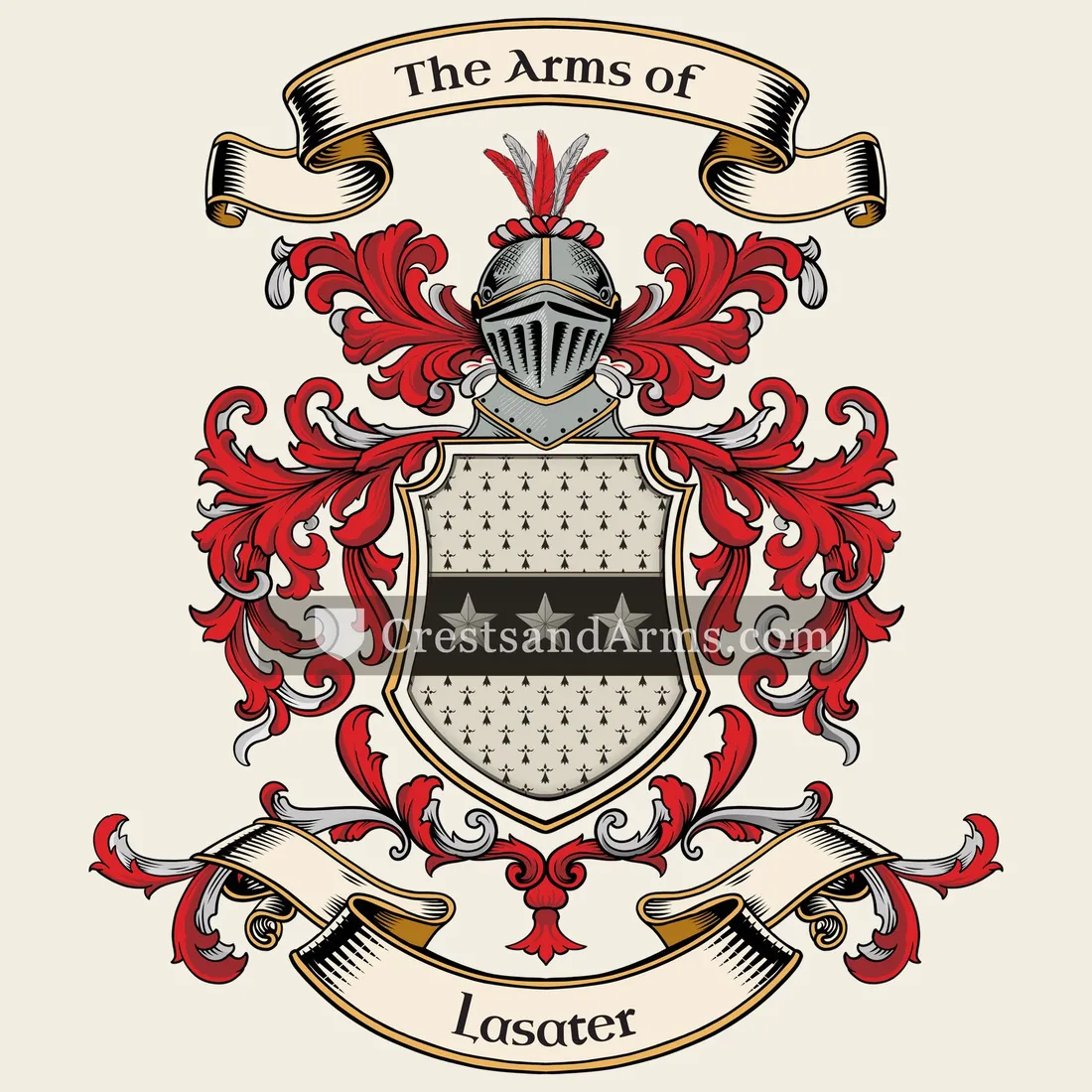
Symbols on this shield
fessThe military belt, and readiness to serve
mulletThe third son, and a divine quality from above
Colours
ErmineMeans: Dignity
Black (Sable)Means: Constancy
Silver (Argent)Means: Peace and sincerity
Historical info
Source
Sir Bernard Burke, The General Armory of England, Scotland, Ireland and Wales, London: Harrison & Sons, 1884
Blazon (the actual original written record)
“Erm. on a fesse sa. three mullets ar”
SalopRowton Castle · Salop, c. 1451
Digital archive packCoat of arms PNG, gold border print PDF, vector SVG and the certificate of authenticity. Sent to your email in minutes.
Map of England showing where the Lasater arms are recorded
The Lasater arms were recorded in Salop, c. 1451.
Shropshire lay on the Welsh border, and border country needed men who could fight. Families held their land in return for service, and service in arms is what a coat of arms was originally for.
This is where the arms were entered in the register. Families often moved to other parts of the country, so the same name can turn up in more than one region.
The body that granted and recorded arms in England in this period.
Henry VI of England
Sovereign of the period
Henry VI of England
1422–1461
Reigning in Netherlands when the Lasater arms are first recorded.
How Arms Worked in England
English heraldry allowed arms to be shared by all legitimate descendants of the original owner. These symbols were treated as personal property that moved through the generations to all children. While the eldest son kept the original design, other family members could use the same shield without needing to change it or register their own unique versions.
Granting authority
The College of Arms in London has regulated the use of coats of arms throughout England and Wales since 1484.
How they got arms
Families typically obtained their coats of arms through a formal grant from the Crown or by proving their ancient right to them.
Where arms were recorded
All official coats of arms are recorded in the registers kept at the College of Arms, which date back to the fifteenth century.
The family's standing
Recorded among the armigerous families of Salop.
Origin & History of the Lasater Family in England
The family name Lasater finds its early roots in the English county of Shropshire, historically known as Salop. Records confirm that members of the family were established in this region by 1451. The name likely evolved from a locative origin, meaning it was used to identify people based on the specific place where they lived or held land. During the fifteenth century, Shropshire was a bustling area defined by its proximity to the Welsh border and its growing wool trade. Families living in this region often moved between small manors and market towns to manage agricultural interests or participate in local commerce. By settling in Salop, the early Lasaters became part of a complex social structure where land ownership and local administrative roles helped define a family’s standing within the community. Over time, the spelling of the name shifted as it was recorded by local clerks, eventually stabilizing into the form recognized today.
Meaning of the Lasater family crest colors & symbols
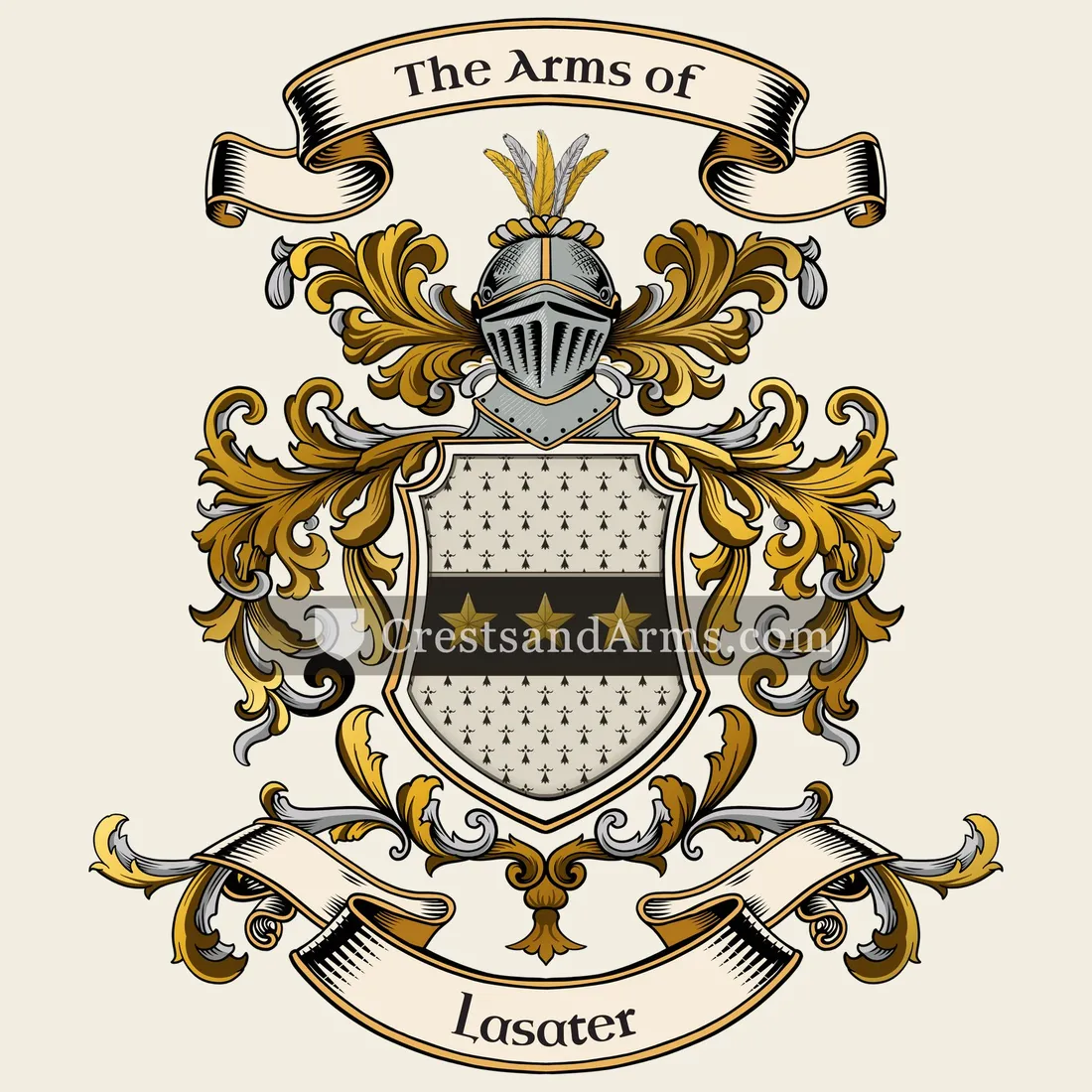
Symbols on this shield
fessThe military belt, and readiness to serve
mulletThe third son, and a divine quality from above
Colours
ErmineMeans: Dignity
Black (Sable)Means: Constancy
Gold (Or)Means: Generosity
Historical info
Source
Sir Bernard Burke, The General Armory of England, Scotland, Ireland and Wales, London: Harrison & Sons, 1884
Blazon (the actual original written record)
“Erm. on a fess sa. three mullets or”
RoscommonRoscommon, c. 1805
Digital archive packCoat of arms PNG, gold border print PDF, vector SVG and the certificate of authenticity. Sent to your email in minutes.
Map of Ireland showing where the Lasater arms are recorded
The Lasater arms were recorded in Roscommon, c. 1805.
Roscommon was midland Irish grazing country, held by old Irish families before the plantations and by settlers after. Both sorts held land, and holding land is what brought arms.
This is where the arms were entered in the register. Families often moved to other parts of the country, so the same name can turn up in more than one region.
The body that granted and recorded arms in Ireland in this period.
George III of Great Britain
Sovereign of the period
George III of Great Britain
1801–1820
Reigning in Netherlands when the Lasater arms are first recorded.
How Arms Worked in Ireland
The Ulster King of Arms granted coats of arms to individuals who proved their social standing and good character. These symbols were typically inherited by all legitimate descendants of the original holder. If a family branch wanted a unique look, they could apply for a specific change to their design through the office to ensure their identity remained distinct.
Granting authority
The Ulster King of Arms acted as the official body that regulated and issued all coats of arms throughout Ireland.
How they got arms
Families obtained their arms through formal grants issued by the office after proving their eligibility and paying the required fees.
Where arms were recorded
All official grants were recorded in the registers held by the Ulster King of Arms starting from the year 1552.
The family's standing
Recorded among the armigerous families of Roscommon.
Origin & History of the Lasater Family in Ireland
The family name Lasater is historically rooted in the rugged landscape of County Roscommon, where records confirm the presence of family members by the early nineteenth century. While the name is often associated with broader migrations, its specific history in Ireland suggests a connection to the local rural communities that defined the region during the late 1700s and early 1800s. During this period, families in Roscommon were deeply involved in agricultural life, navigating the complex social and economic shifts that characterized Irish society before the Great Famine. The name likely evolved as a variation of older surnames found in the British Isles, eventually taking on its distinct form as it integrated into the local parish records of the west of Ireland. By 1805, the Lasater family was already established as part of the fabric of Roscommon, contributing to the local workforce and community life during a time of significant transition for the Irish population.
Lasater Meaning & Related Branches
Root word
Lasseter
An occupational name for a lace maker or lace seller.
This name
LasaterDerived from the Middle English term for a maker or merchant of lace.
also spelled
Lister
Lystre
Lystar
Documented Sources
J. B. Rietstap, Armorial Général, Gouda: G. B. van Goor Zonen, 1884–87
Tresoar (Fries Historisch en Letterkundig Centrum), Burgerlijke Stand van Friesland (1811–1950)
Meertens Instituut, Nederlandse Familienamenbank
Digital archive packCoat of arms PNG, gold border print PDF, vector SVG and the certificate of authenticity. Sent to your email in minutes.


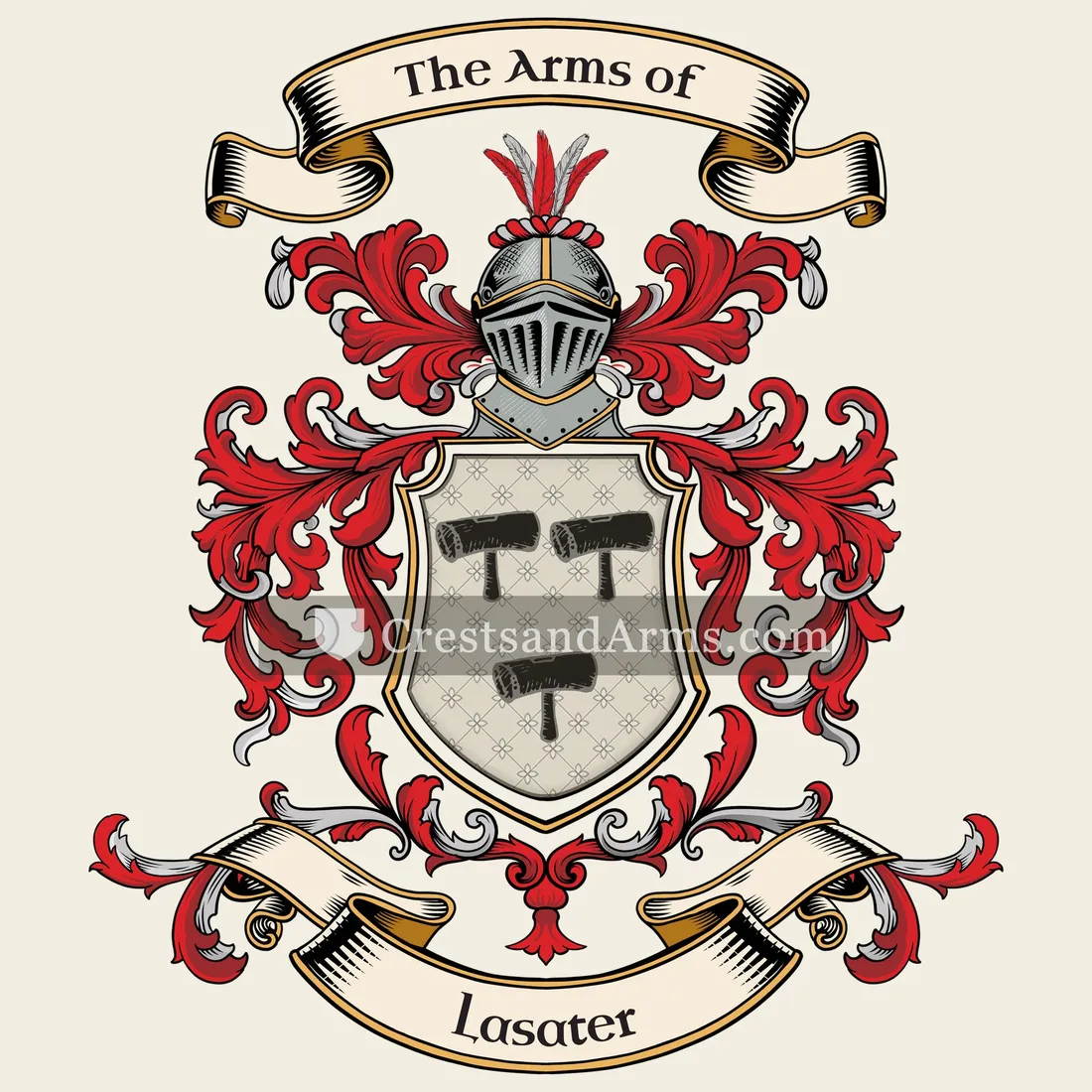
 hammerHonest labour, and the smith's craft
 hammerHonest labour, and the smith's craft


 fessThe military belt, and readiness to serve
 mulletThe third son, and a divine quality from above