Map of Spain showing where the Lasker arms are recorded
The Lasker arms were recorded in Aragon, c. 1722.
Aragon was mountain and river country in north-eastern Spain, with a strong tradition of small independent landholders. A great many families counted as gentry there, and each one needed a shield to be told apart.
This is where the arms were entered in the register. Families often moved to other parts of the country, so the same name can turn up in more than one region.
The body that granted and recorded arms in Spain in this period.
Philip V of Spain
Sovereign of the period
Philip V of Spain
1714–1724
Reigning in Spain when the Lasker arms are first recorded.
How Arms Worked in Spain
In Spain, a coat of arms was considered a form of property that belonged to the entire family line. These arms were passed down from a father to all his children equally. Younger branches of the family usually kept the original design without needing to add any special marks to distinguish their specific line.
Granting authority
The Cronista Rey de Armas was the official body that regulated and granted coats of arms throughout Spain.
How they got arms
Families often obtained their arms through royal grants or by proving their noble status to the official heraldic authority.
Where arms were recorded
Coats of arms were officially recorded in the registers of the Cronista Rey de Armas starting in 1496.
The family's standing
Recorded among the armigerous families of Aragon.
Origin & History of the Lasker Family in Spain
The family name Lasker is deeply rooted in European history, with records confirming the presence of family members in the Kingdom of Aragon by 1722. During this period, the name was often associated with families living in or originating from the town of Łask in present-day Poland. It is likely that the name was adopted as a topographic surname, which was a common practice for families moving across borders during the eighteenth century. As these individuals migrated from Central Europe toward the Iberian Peninsula, they carried the name as a way to maintain a connection to their ancestral origins. This movement reflects the broader patterns of migration and trade that defined life in Europe during the early modern era. By establishing themselves in Aragon, the family became part of the diverse cultural landscape of the region while preserving their unique linguistic heritage.
Lasker Meaning & Related Branches
Root word
Lascar
Derived from the Persian word lashkar meaning an army or soldier.
This name
LaskerAn occupational surname historically referring to a soldier or a member of an armed force.
also spelled
Llasar
Yaser
Documented Sources
J. B. Rietstap, Armorial Général, Gouda: G. B. van Goor Zonen, 1884–87
Bahlow, Hans, Deutsches Namenlexikon: Familien- und Vornamen nach Ursprung und Sinn erklärt, 1967
Kohlheim, Rosa and Volker Kohlheim, Duden Familiennamen: Herkunft und Bedeutung, 2005
Archivo de la Corona de Aragón, Registro General del Sello
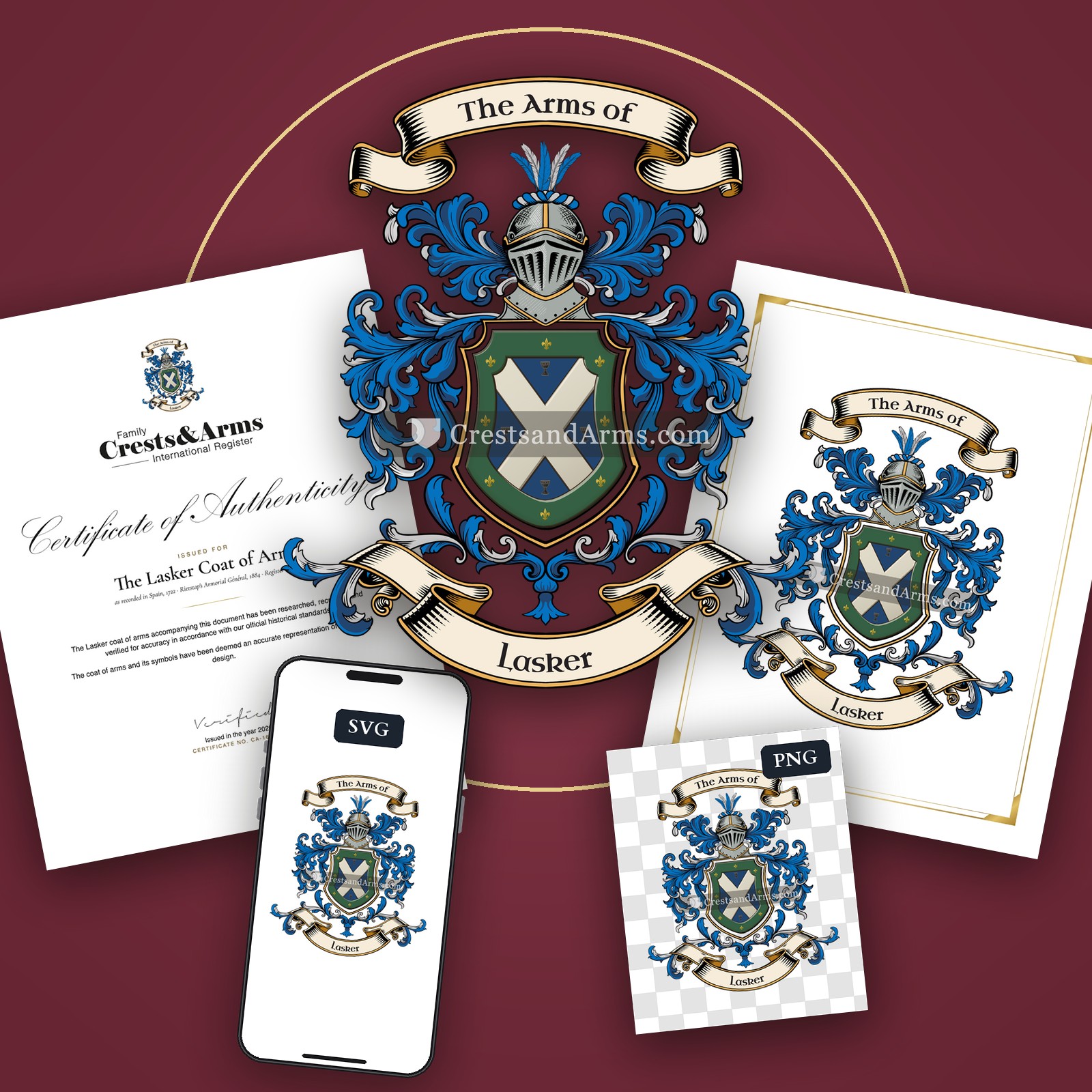
Digital archive packCoat of arms PNG, gold border print PDF, vector SVG and the certificate of authenticity. Sent to your email in minutes.


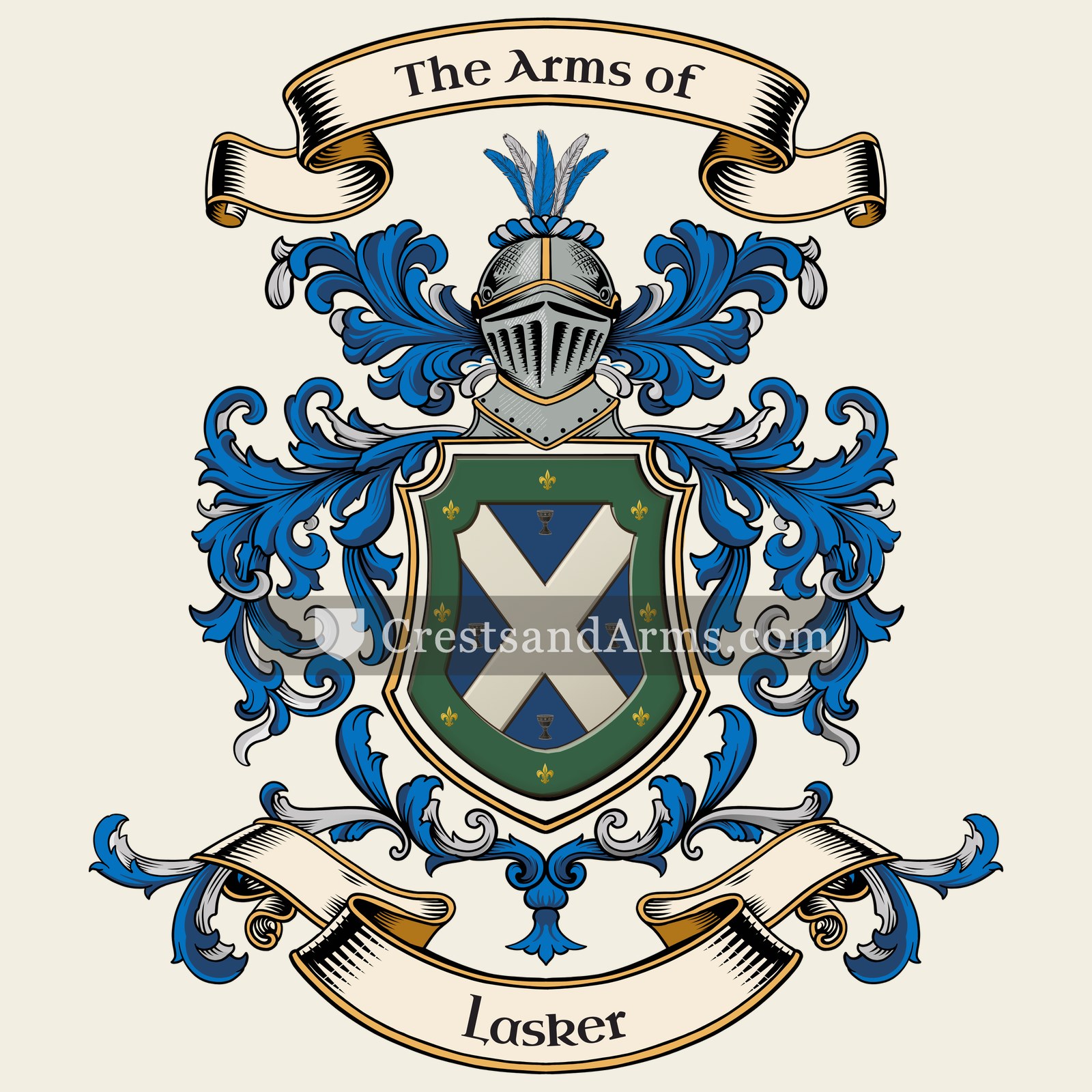
 saltireResolution, and St Andrew's cross
 cupFaith, office, and a trust discharged
 fleur de lisPurity, light, and the sixth son
 saltireResolution, and St Andrew's cross
 cupFaith, office, and a trust discharged
 fleur de lisPurity, light, and the sixth son