A record of documented arms, meaning and origin, researched for the Latham family lines. Documented in 2 countries.
Reg. 7215 · Britain, J–L
Coat of Arms & Family Crest Details
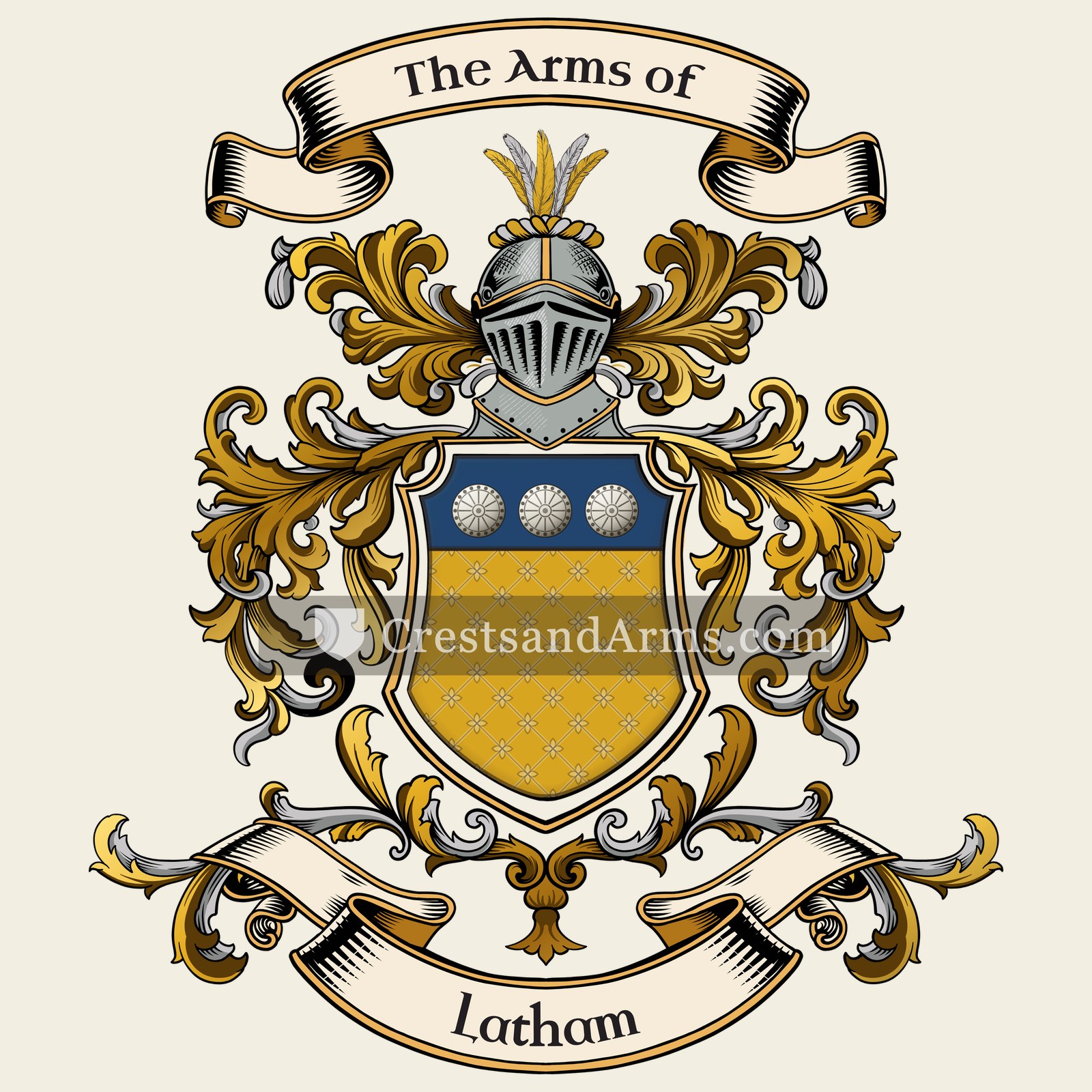
Symbols on this shield
chiefAuthority, wisdom and dominion
roundelA coin, and one who has been to the crusades
Colours
Gold (Or)Means: Generosity
Blue (Azure)Means: Loyalty and truth
Silver (Argent)Means: Peace and sincerity
Historical info
Source
J. B. Rietstap, Armorial Général, Gouda: G. B. van Goor Zonen, 1884–87
Blazon (the actual original written record)
“D'or; au chef denché d'azur, ch. de trois bes. d'arg. C.: une aigle de profil, au vol abaissé, posée sur un tronc de chêne en fasce, coupé aux deux bouts et muni à l'extrémité dextre d'un rameau feuillé; le tout d'or. D.: ÆQUANIMITATE.”
NormandieNormandie, c. 1700
Digital archive packCoat of arms PNG, gold border print PDF, vector SVG and the certificate of authenticity. Sent to your email in minutes.
Map of Britain showing where the Latham arms are recorded
The Latham arms were recorded in Normandie, c. 1700.
Normandie held a dense crowd of knightly families on some of the best farmland in France. Its men had fought and settled abroad for generations, and a family that sent sons to war needed a shield they could be recognised by.
This is where the arms were entered in the register. Families often moved to other parts of the country, so the same name can turn up in more than one region.
The body that granted and recorded arms in Britain in this period.
William III of England
Sovereign of the period
William III of England
1694–1702
Reigning in Britain when the Latham arms are first recorded.
How Arms Worked in Britain
English heraldry allowed arms to be shared by all legitimate descendants of the original owner. These symbols were treated as personal property that moved through the generations to all children. While the eldest son kept the original design, other family members could use the same shield without needing to change it or register their own unique versions.
Granting authority
The College of Arms in London has regulated the use of coats of arms throughout England and Wales since 1484.
How they got arms
Families typically obtained their coats of arms through a formal grant from the Crown or by proving their ancient right to them.
Where arms were recorded
All official coats of arms are recorded in the registers kept at the College of Arms, which date back to the fifteenth century.
The family's standing
Recorded among the armigerous families of Normandie.
Origin & History of the Latham Family in Britain
The surname Latham originates from a place name in Lancashire, England, derived from the Old Norse word "hlaðum," which refers to a barn or storehouse. While the family name became firmly established in Northern England during the medieval period, the movement of people across the English Channel meant that branches of the family also developed roots in France. By the year 1700, records confirm that members of the family were living in Normandy. This presence in France likely resulted from the historical ties between the English nobility and the Norman region, which encouraged families to hold property and maintain households on both sides of the water. Over time, the name evolved through various spellings as it spread from its rural English origins into the broader European landscape, reflecting the migration patterns of families who moved between Britain and the continent for trade, marriage, and land management.
Coat of Arms & Family Crest Details
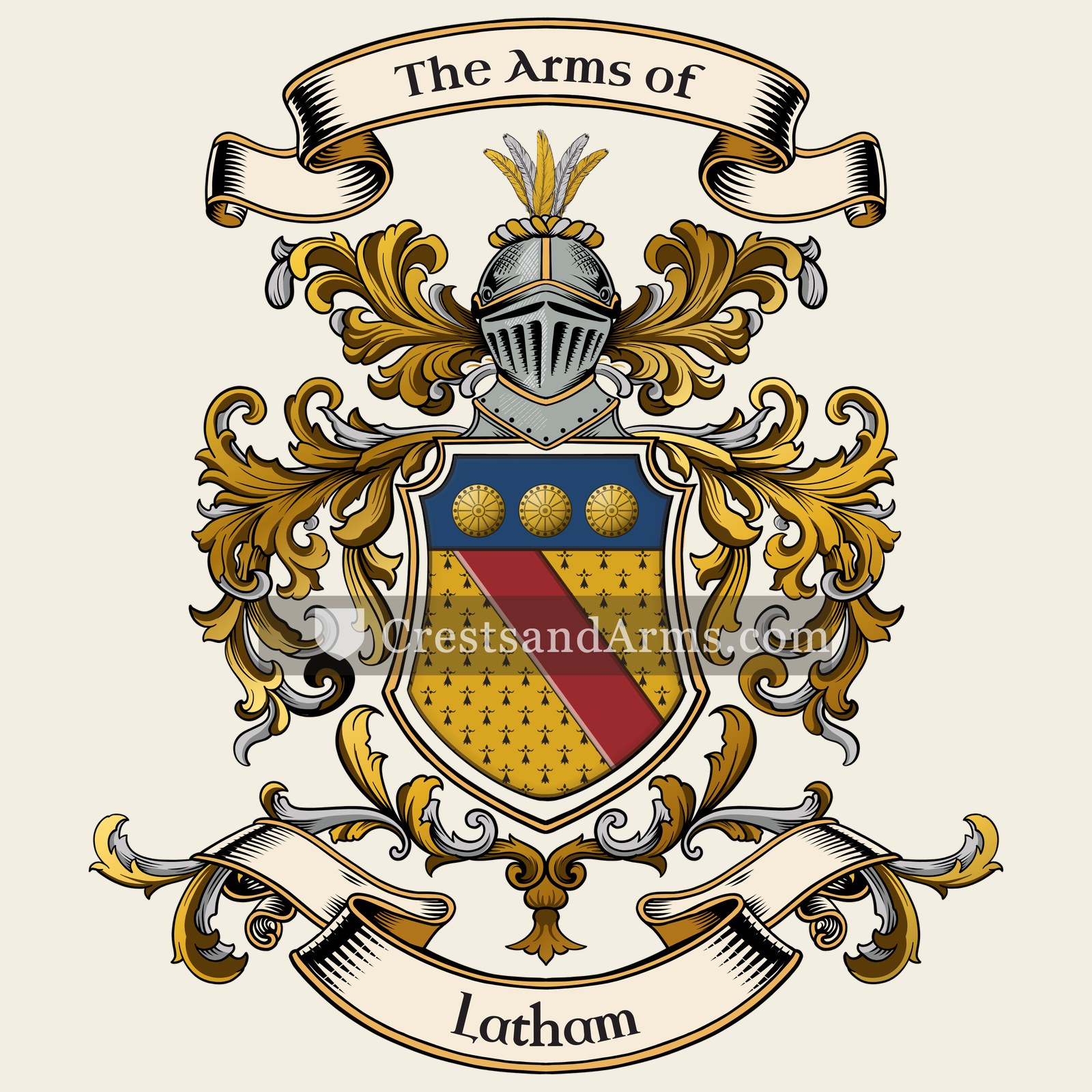
Symbols on this shield
chiefAuthority, wisdom and dominion
bendDefence, and the scarf of a commander
roundelA coin, and one who has been to the crusades
Colours
ErmineMeans: Dignity
Red (Gules)Means: Military strength
Blue (Azure)Means: Loyalty and truth
Gold (Or)Means: Generosity
Historical info
Source
Sir Bernard Burke, The General Armory of England, Scotland, Ireland and Wales, London: Harrison & Sons, 1884
Blazon (the actual original written record)
“Erminois on a chief indented az. three bezants, over all a bend gu”
ChesterBradwall · Chester, c. 1620
Digital archive packCoat of arms PNG, gold border print PDF, vector SVG and the certificate of authenticity. Sent to your email in minutes.
Map of England showing where the Latham arms are recorded
The Latham arms were recorded in Chester, c. 1620.
Cheshire was governed apart from the rest of England for much of its history, with its own courts and its own gentry. That separateness bred a strong local landed class, and landed families carried arms.
This is where the arms were entered in the register. Families often moved to other parts of the country, so the same name can turn up in more than one region.
The body that granted and recorded arms in England in this period.
James VI and I
Sovereign of the period
James VI and I
1603–1625
Reigning in Britain when the Latham arms are first recorded.
How Arms Worked in England
English heraldry allowed arms to be shared by all legitimate descendants of the original owner. These symbols were treated as personal property that moved through the generations to all children. While the eldest son kept the original design, other family members could use the same shield without needing to change it or register their own unique versions.
Granting authority
The College of Arms in London has regulated the use of coats of arms throughout England and Wales since 1484.
How they got arms
Families typically obtained their coats of arms through a formal grant from the Crown or by proving their ancient right to them.
Where arms were recorded
All official coats of arms are recorded in the registers kept at the College of Arms, which date back to the fifteenth century.
The family's standing
Recorded among the armigerous families of Chester.
Origin & History of the Latham Family in England
The surname Latham originates from the Old Norse word *hlaða*, which refers to a barn or a storehouse. In England, the name is a locational surname, meaning it was originally taken by families living in or near a place called Lathom in Lancashire. By the early 17th century, the family had established a notable presence in the city of Chester. During this period, Chester served as a vital hub for trade and administration in the northwest of England. Families living in this area were often involved in the merchant guilds or local government, which helped them integrate into the growing urban society of the time. Records from 1620 confirm that the Latham name was well-established in the region, reflecting a long history of families moving from rural settlements into the bustling commercial centers of the English countryside.
Latham Meaning & Related Branches
Root word
Lathum
Old Norse term for barns or storehouses.
This name
LathamRefers to a person who lived near or worked at a barn or granary.
also spelled
Lathum
Lathom
Related arms
Lathomvariant spelling
Lathumvariant spelling
Leathamvariant spelling
Averyrecorded with Latham, same area
Documented Sources
J. B. Rietstap, Armorial Général, Gouda: G. B. van Goor Zonen, 1884–87
Ekwall, Eilert. The Concise Oxford Dictionary of English Place-names. 1960
Reaney, P.H. and Wilson, R.M. A Dictionary of English Surnames. 1991
Archives départementales de la Seine-Maritime. Registres paroissiaux et d'état civil. 1700
Digital archive packCoat of arms PNG, gold border print PDF, vector SVG and the certificate of authenticity. Sent to your email in minutes.


 chiefAuthority, wisdom and dominion
 roundelA coin, and one who has been to the crusades
 chiefAuthority, wisdom and dominion
 roundelA coin, and one who has been to the crusades


 bendDefence, and the scarf of a commander