Map of France showing where the Laval arms are recorded
The Laval arms were recorded in Bretagne, c. 1663.
More families held coats of arms in Bretagne than anywhere else in France. The land was divided into many small estates rather than a few large ones, so far more households counted as gentry, and each needed a shield of its own to be told apart.
This is where the arms were entered in the register. Families often moved to other parts of the country, so the same name can turn up in more than one region.
The body that granted and recorded arms in France in this period.
Louis XIV of France
Sovereign of the period
Louis XIV of France
1643–1715
Reigning in France when the Laval arms are first recorded.
How Arms Worked in France
In France, a coat of arms was a mark of honor that passed down through the male line to all legitimate descendants. Families often used the same shield without changes to show their shared heritage. If a branch wanted to stand out, they could add a small mark to their shield to show their specific place in the family tree.
Granting authority
The Juge d'armes de France acted as the official authority that regulated and verified coats of arms across the country.
How they got arms
Families typically inherited their arms from ancestors, though they could also receive them through royal grants or by proving their noble status.
Where arms were recorded
Coats of arms were officially recorded in the Armorial Général de France, which began its main collection in the year 1696.
The family's standing
Recorded among the armigerous families of Bretagne.
Origin & History of the Laval Family in France
The name Laval originates from the French word for a valley, which suggests that the earliest ancestors likely lived in or near a low-lying area. By the time the family was documented in the Brittany region of France in 1663, the name had already become established as a way to identify people based on their local geography. During the seventeenth century, families in this part of France were often deeply connected to the land and the specific parishes where they resided. Many individuals bearing this name were part of the rural population that helped shape the agricultural and social landscape of the province. As the family grew, they became part of the long history of migration and community building that defined life in western France during the early modern period. Their presence in the historical record during the 1660s provides a clear link to the traditional way of life that existed before the major political changes of the following centuries.
Meaning of the Laval family crest colors & symbols
Symbols on this shield
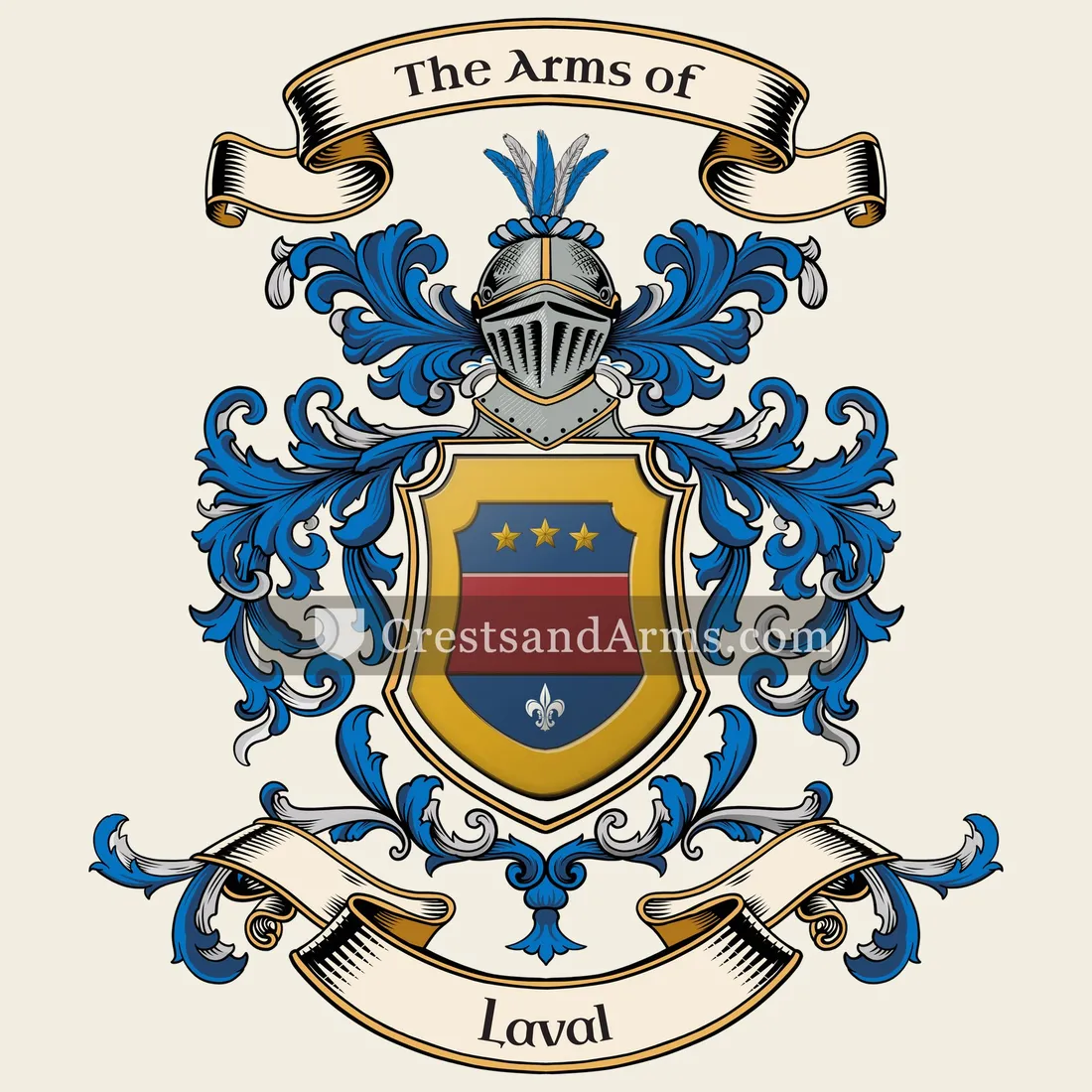
fessThe military belt, and readiness to serve
mulletThe third son, and a divine quality from above
fleur de lisPurity, light, and the sixth son
Colours
Blue (Azure)Means: Loyalty and truth
Red (Gules)Means: Military strength
Gold (Or)Means: Generosity
Silver (Argent)Means: Peace and sincerity
Historical info
Source
J. B. Rietstap, Armorial Général, Gouda: G. B. van Goor Zonen, 1884–87
Blazon (the actual original written record)
“D'azur à la fasce de gu., acc. en chef de trois étoiles (3) rangées d'or et en p. d'une fleur-de-lis d'arg.; l'écu bordé d'or. C.: trois pl. d'aut., de gu., d'or et d'azur, entre une ramure de cerf au nat. L.: à dextre d'or et d'azur, à sen. d'arg. et de gu.”
Swedenc. 1642
Digital archive packCoat of arms PNG, gold border print PDF, vector SVG and the certificate of authenticity. Sent to your email in minutes.
Map of Sweden showing where the Laval arms are recorded
The Laval arms were recorded in Sweden, c. 1642.
Arms such as these were typically recorded in Stockholm.
Stockholm held the Swedish court and the House of Nobility, where every noble family's arms were entered and kept. Families ennobled for service registered there, which is why so many are recorded around the city.
This is where the arms were entered in the register. Families often moved to other parts of the country, so the same name can turn up in more than one region.
The body that granted and recorded arms in Sweden in this period.
Christina of Sweden
Sovereign of the period
Christina of Sweden
1632–1654
Reigning in France when the Laval arms are first recorded.
How Arms Worked in Sweden
In Sweden, a coat of arms belonged to a noble family as a whole rather than just one individual. These arms were passed down through the generations to all legitimate descendants. Younger branches of the family used the same shield without needing to change it. This system ensured that the entire lineage shared the same identity and status under the law.
Granting authority
The Riddarhuset, or House of Nobility, regulated all noble coats of arms in Sweden under royal authority.
How they got arms
Families received their coats of arms through royal grants of nobility which were then officially registered with the House.
Where arms were recorded
Coats of arms were officially recorded in the Swedish House of Nobility register starting in the year 1626.
The family's standing
Recorded among the armigerous families of Sweden.
Origin & History of the Laval Family in Sweden
The Laval family history in Sweden begins in the mid-seventeenth century, with records confirming their presence in Stockholm by 1642. During this era, Sweden was a rising power in Europe, and the capital city served as a hub for skilled professionals and merchants arriving from across the continent. The name Laval is of French origin, suggesting that the family likely migrated to Sweden during a period when the Swedish monarchy actively recruited foreign experts to help modernize the nation’s administration and economy. Once established in Stockholm, the family integrated into the urban social structure, moving through the ranks of the city’s growing middle class. By settling in the capital during this formative time, the early members of the Laval family positioned themselves within the heart of Swedish political and commercial life, setting the stage for their descendants to contribute to the country's industrial and cultural development in later centuries.
Laval Meaning & Related Branches
Root word
Vallum
Latin word meaning a wall, rampart, or defensive earthwork.
This name
LavalRefers to someone who lived near a valley or a fortified defensive structure.
also spelled
Leaval
Related arms
Bachellisimilar arms
Pellicionisimilar arms
Léavalvariant spelling
Documented Sources
J. B. Rietstap, Armorial Général, Gouda: G. B. van Goor Zonen, 1884–87
Archives départementales d’Ille-et-Vilaine, Registres paroissiaux et d'état civil, 1663
Dauzat, Albert, Dictionnaire étymologique des noms et prénoms de France, 1951
Morvan, Françoise, Bretagne est une province, 2007
Digital archive packCoat of arms PNG, gold border print PDF, vector SVG and the certificate of authenticity. Sent to your email in minutes.


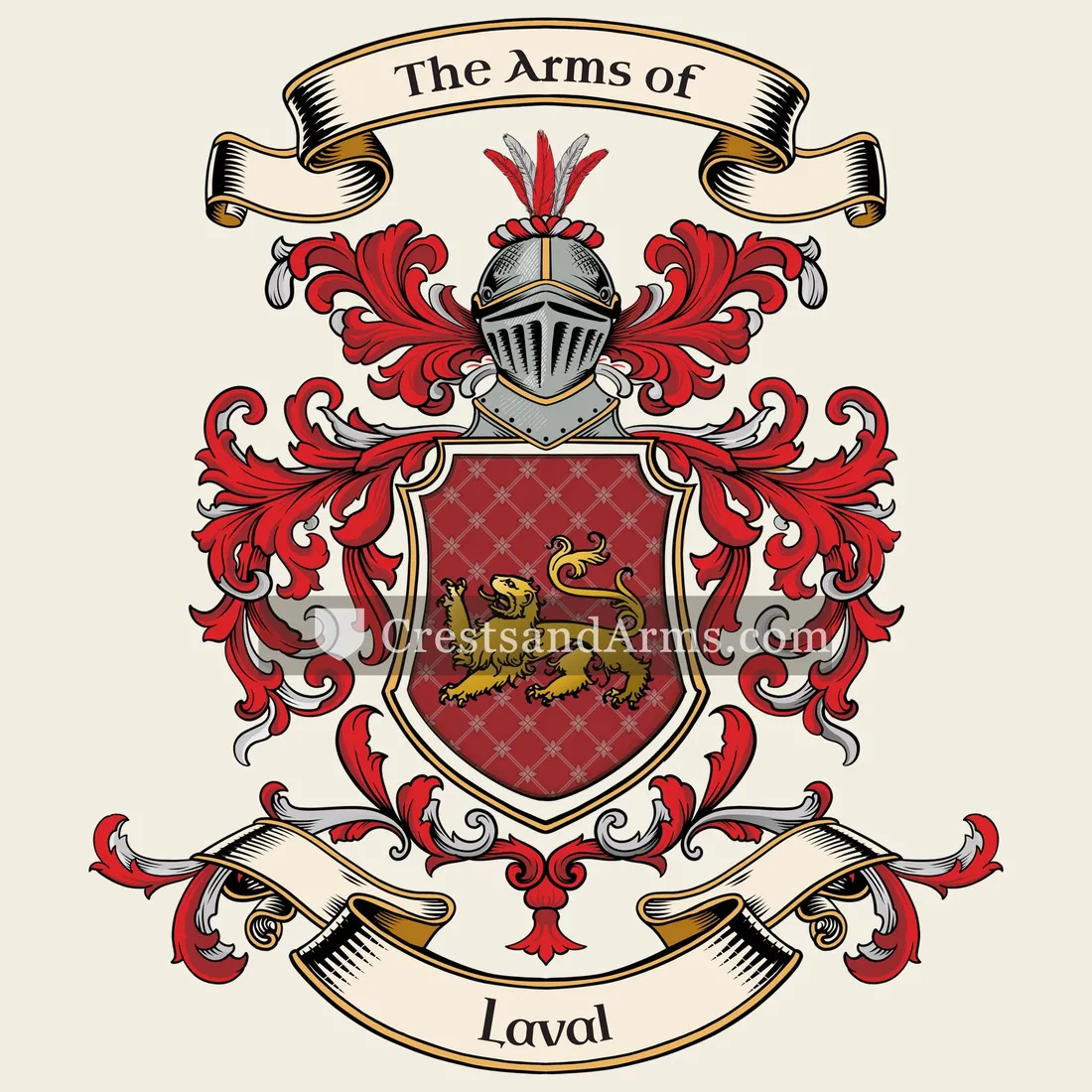
 lionCourage, strength and royalty
 lionCourage, strength and royalty


 fessThe military belt, and readiness to serve
 mulletThe third son, and a divine quality from above
 fleur de lisPurity, light, and the sixth son