A record of documented arms, meaning and origin, researched for the Law family lines. Documented in 3 countries.
Reg. 5514 · French, J–L
Coat of Arms & Family Crest Details
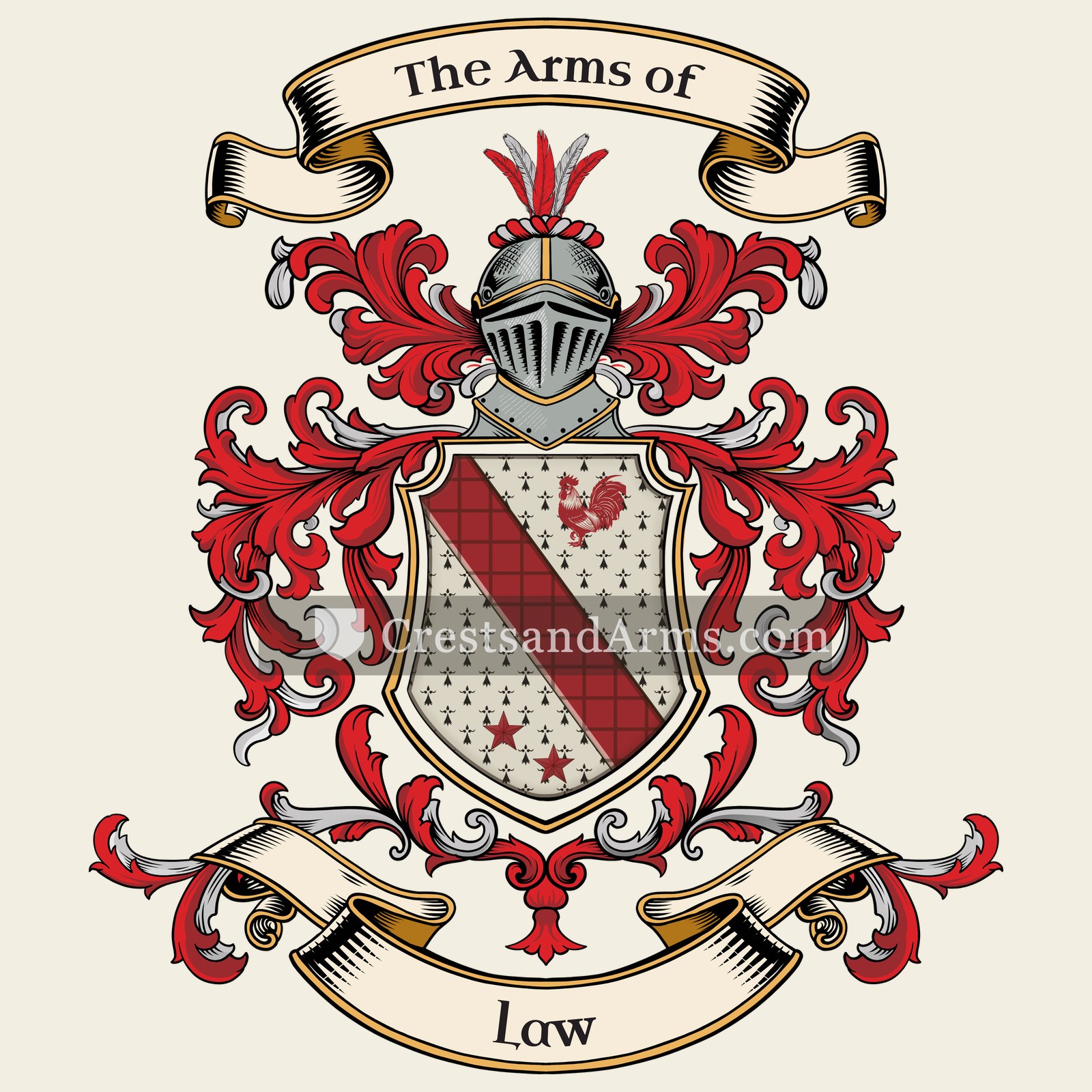
Symbols on this shield
bendDefence, and the scarf of a commander
cockCourage, vigilance and readiness for battle
Colours
ErmineMeans: Dignity
Red (Gules)Means: Military strength
Historical info
Source
J. B. Rietstap, Armorial Général, Gouda: G. B. van Goor Zonen, 1884–87
Blazon (the actual original written record)
“D'herm. à la bande engr. de gu., acc. de deux coqs du même et ch. de trois molettes (3) d'or. C.: un coq de gu., coll. d'une chaîne d'or, l'épaule ch. d'un mitre du même. S.: deux aigles de sa., coll. de chaînes d'or, auxquelles sont suspendus, à dextre un mitre d'or et à sen. une coupe couverte du même. D.: COMPOSITUM JUS FASQUE ANIMI.”
Francec. 1802
Digital archive packCoat of arms PNG, gold border print PDF, vector SVG and the certificate of authenticity. Sent to your email in minutes.
Map of France showing where the Law arms are recorded
The Law arms were recorded in France, c. 1802.
Arms such as these were typically recorded in Bretagne.
More families held coats of arms in Bretagne than anywhere else in France. The land was divided into many small estates rather than a few large ones, so far more households counted as gentry, and each needed a shield of its own to be told apart.
This is where the arms were entered in the register. Families often moved to other parts of the country, so the same name can turn up in more than one region.
The body that granted and recorded arms in France in this period.
How Arms Worked in France
In France, a coat of arms was a mark of honor that passed down through the male line to all legitimate descendants. Families often used the same shield without changes to show their shared heritage. If a branch wanted to stand out, they could add a small mark to their shield to show their specific place in the family tree.
Granting authority
The Juge d'armes de France acted as the official authority that regulated and verified coats of arms across the country.
How they got arms
Families typically inherited their arms from ancestors, though they could also receive them through royal grants or by proving their noble status.
Where arms were recorded
Coats of arms were officially recorded in the Armorial Général de France, which began its main collection in the year 1696.
The family's standing
Recorded among the armigerous families of France.
Origin & History of the Law Family in France
The history of the Law family in France is deeply connected to the movement of people across the English Channel and the North Sea during times of political and social change. While the name itself has roots in Northern England and Scotland, families carrying this surname established a distinct presence in the Brittany region by the early nineteenth century. By 1802, records show that members of the Law family were integrated into the local community, likely drawn to the area by trade opportunities or the shifting borders of the Napoleonic era. These early settlers adapted to the French language and legal systems, often finding roles in commerce or local administration. Their presence in Brittany highlights how families moved between nations to seek new beginnings, eventually becoming a part of the long-standing cultural fabric of the French coast.
Coat of Arms & Family Crest Details
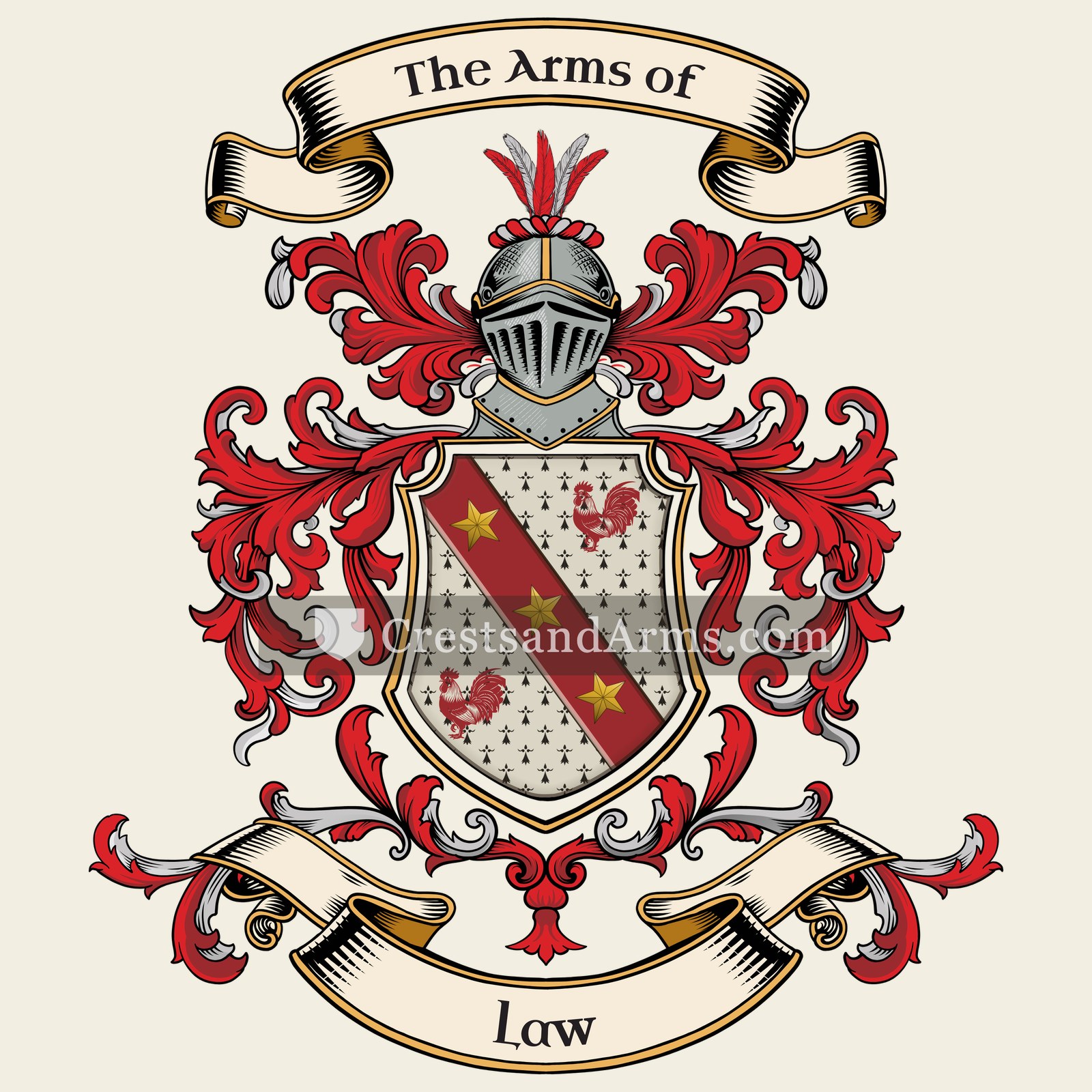
Symbols on this shield
bendDefence, and the scarf of a commander
cockCourage, vigilance and readiness for battle
mulletThe third son, and a divine quality from above
Colours
ErmineMeans: Dignity
Red (Gules)Means: Military strength
Historical info
Source
Sir Bernard Burke, The General Armory of England, Scotland, Ireland and Wales, London: Harrison & Sons, 1884
Blazon (the actual original written record)
“Erm. a bend betw. a cock in chief and two mullets in base gu”
FifeAnstruther · Fife, c. 1672
Digital archive packCoat of arms PNG, gold border print PDF, vector SVG and the certificate of authenticity. Sent to your email in minutes.
Map of Scotland showing where the Law arms are recorded
The Law arms were recorded in Fife, c. 1672.
Fife was farming country between two firths, with royal palaces and old burghs along its coast. Its landed families were numerous and close to the court, and closeness to the court brought arms.
This is where the arms were entered in the register. Families often moved to other parts of the country, so the same name can turn up in more than one region.
The body that granted and recorded arms in Scotland in this period.
Charles II of England
Sovereign of the period
Charles II of England
1660–1685
Reigning in France when the Law arms are first recorded.
How Arms Worked in Scotland
Scottish heraldry is unique because it treats a coat of arms as a piece of personal property protected by law. Only one person can own a specific design at any given time. When a family grows, the head keeps the original shield while other relatives must apply for their own distinct version with slight changes to prove their specific identity.
Granting authority
The Court of the Lord Lyon acts as the official body that regulates and controls all heraldic matters throughout Scotland.
How they got arms
Individuals obtain a legal right to their arms through a formal petition process that confirms their identity and family connection.
Where arms were recorded
All valid coats of arms are officially entered into the Public Register of All Arms and Bearings starting from 1672.
The family's standing
Recorded among the armigerous families of Fife.
Origin & History of the Law Family in Scotland
The surname Law is deeply rooted in the history of Scotland, where it originated as a topographical name for people who lived near a prominent hill or mound. In the Scots language, the word law refers to a rounded hill, and many early families adopted this name to identify their connection to the landscape. By the late 17th century, the family had established a notable presence in the region of Fife. Records from 1672 confirm that members of the Law family were active in this area, likely working as landowners or tradespeople who contributed to the local economy. As the family grew, they became part of the social fabric of the Scottish Lowlands, where their name served as a link to both the geography of their home and their ancestral roots.
Coat of Arms & Family Crest Details
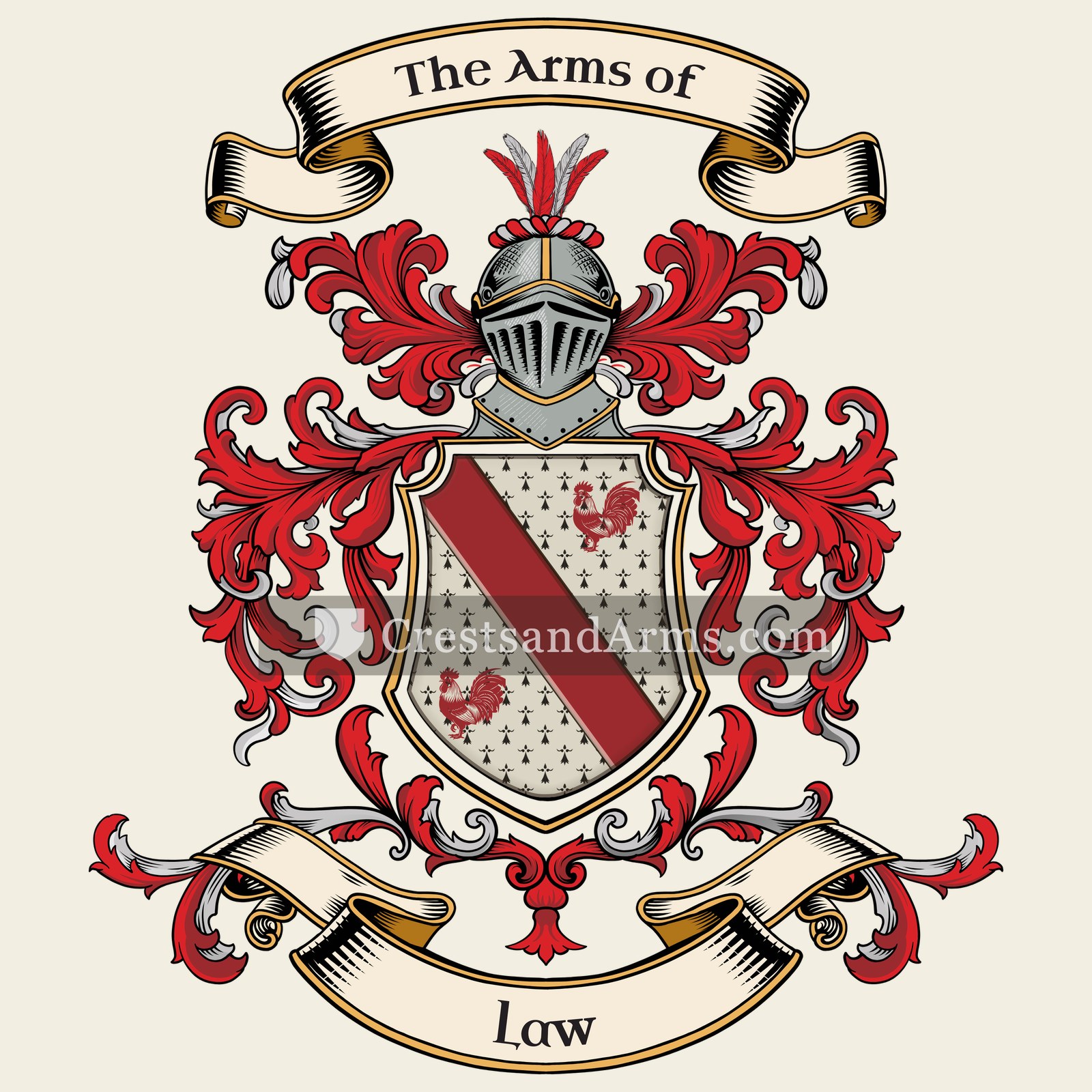
Symbols on this shield
bendDefence, and the scarf of a commander
cockCourage, vigilance and readiness for battle
mulletThe third son, and a divine quality from above
Colours
ErmineMeans: Dignity
Red (Gules)Means: Military strength
Gold (Or)Means: Generosity
Historical info
Source
Sir Bernard Burke, The General Armory of England, Scotland, Ireland and Wales, London: Harrison & Sons, 1884
Blazon (the actual original written record)
“Erm. on a bend engr. betw. two cocks gu. three mullets or”
BerksCannon Hill · Berks, c. 1620
Digital archive packCoat of arms PNG, gold border print PDF, vector SVG and the certificate of authenticity. Sent to your email in minutes.
Map of England showing where the Law arms are recorded
The Law arms were recorded in Berks, c. 1620.
Berkshire sat on the road west from London with the royal castle at Windsor in the middle of it. Court families bought estates within reach, and an estate near the court almost always came with a coat of arms.
This is where the arms were entered in the register. Families often moved to other parts of the country, so the same name can turn up in more than one region.
The body that granted and recorded arms in England in this period.
James VI and I
Sovereign of the period
James VI and I
1603–1625
Reigning in France when the Law arms are first recorded.
How Arms Worked in England
English heraldry allowed arms to be shared by all legitimate descendants of the original owner. These symbols were treated as personal property that moved through the generations to all children. While the eldest son kept the original design, other family members could use the same shield without needing to change it or register their own unique versions.
Granting authority
The College of Arms in London has regulated the use of coats of arms throughout England and Wales since 1484.
How they got arms
Families typically obtained their coats of arms through a formal grant from the Crown or by proving their ancient right to them.
Where arms were recorded
All official coats of arms are recorded in the registers kept at the College of Arms, which date back to the fifteenth century.
The family's standing
Recorded among the armigerous families of Berks.
Origin & History of the Law Family in England
The surname Law is an ancient English name that likely originated as a descriptive term for someone who lived near a prominent hill or mound. In Old English, the word "hlaw" referred to a burial mound or a small hill, and it eventually evolved into the modern word "law." By the early 17th century, the family had established a notable presence in the county of Berkshire. Records from 1620 confirm that members of the Law family were settled in this region, where they likely participated in the local agricultural economy that defined life in rural England at the time. As the name became more common, it spread across various parishes, reflecting the typical movement of families seeking land and trade opportunities during the transition into the Stuart period. This early history highlights how a simple geographical feature could become a lasting family identifier that connected individuals to their local landscape for generations.
Law Meaning & Related Branches
Root word
Lagus
Latin term for a lake or body of water.
This name
LawA topographic surname for someone who lived near a lake or water source.
also spelled
Lau
Lawe
Laue
Lawse
Related arms
Lauvariant spelling
Brucerecorded with Law, same area
Clutterbuckrecorded with Law, same area
D'Altonrecorded with Law, same area
Documented Sources
J. B. Rietstap, Armorial Général, Gouda: G. B. van Goor Zonen, 1884–87
Archives départementales d'Ille-et-Vilaine, État civil de Bretagne
Lart, Charles E., The Huguenots in France and America, 1928
Mollat, Michel, Histoire de la Bretagne, 1953
Digital archive packCoat of arms PNG, gold border print PDF, vector SVG and the certificate of authenticity. Sent to your email in minutes.


 bendDefence, and the scarf of a commander
 cockCourage, vigilance and readiness for battle
 bendDefence, and the scarf of a commander
 cockCourage, vigilance and readiness for battle

 mulletThe third son, and a divine quality from above