Map of France showing where the Layne arms are recorded
The Layne arms were recorded in Paris, c. 1663.
This is where the arms were entered in the register. Families often moved to other parts of the country, so the same name can turn up in more than one region.
The body that granted and recorded arms in France in this period.
Louis XIV of France
Sovereign of the period
Louis XIV of France
1643–1715
Reigning in France when the Layne arms are first recorded.
How Arms Worked in France
In France, a coat of arms was a mark of honor that passed down through the male line to all legitimate descendants. Families often used the same shield without changes to show their shared heritage. If a branch wanted to stand out, they could add a small mark to their shield to show their specific place in the family tree.
Granting authority
The Juge d'armes de France acted as the official authority that regulated and verified coats of arms across the country.
How they got arms
Families typically inherited their arms from ancestors, though they could also receive them through royal grants or by proving their noble status.
Where arms were recorded
Coats of arms were officially recorded in the Armorial Général de France, which began its main collection in the year 1696.
The family's standing
Recorded among the armigerous families of France.
Origin & History of the Layne Family in France
The name Layne traces its roots to the vibrant social landscape of seventeenth-century France, where records confirm the family was established in Paris by 1663. During this period, the name was closely associated with the bustling urban environment of the capital city, which served as a center for trade, craftsmanship, and administrative growth. Families living in Paris at this time often navigated a society defined by strict social hierarchies and the expansion of royal influence under the reign of Louis XIV. Because the name appears in official documentation during this era, it suggests that these early ancestors were likely integrated into the professional or merchant classes that kept the city functioning. By maintaining a presence in such a significant cultural hub, the family became part of the long history of Parisian residents who witnessed the rapid modernization of France during the late seventeenth century.
Coat of Arms & Family Crest Details
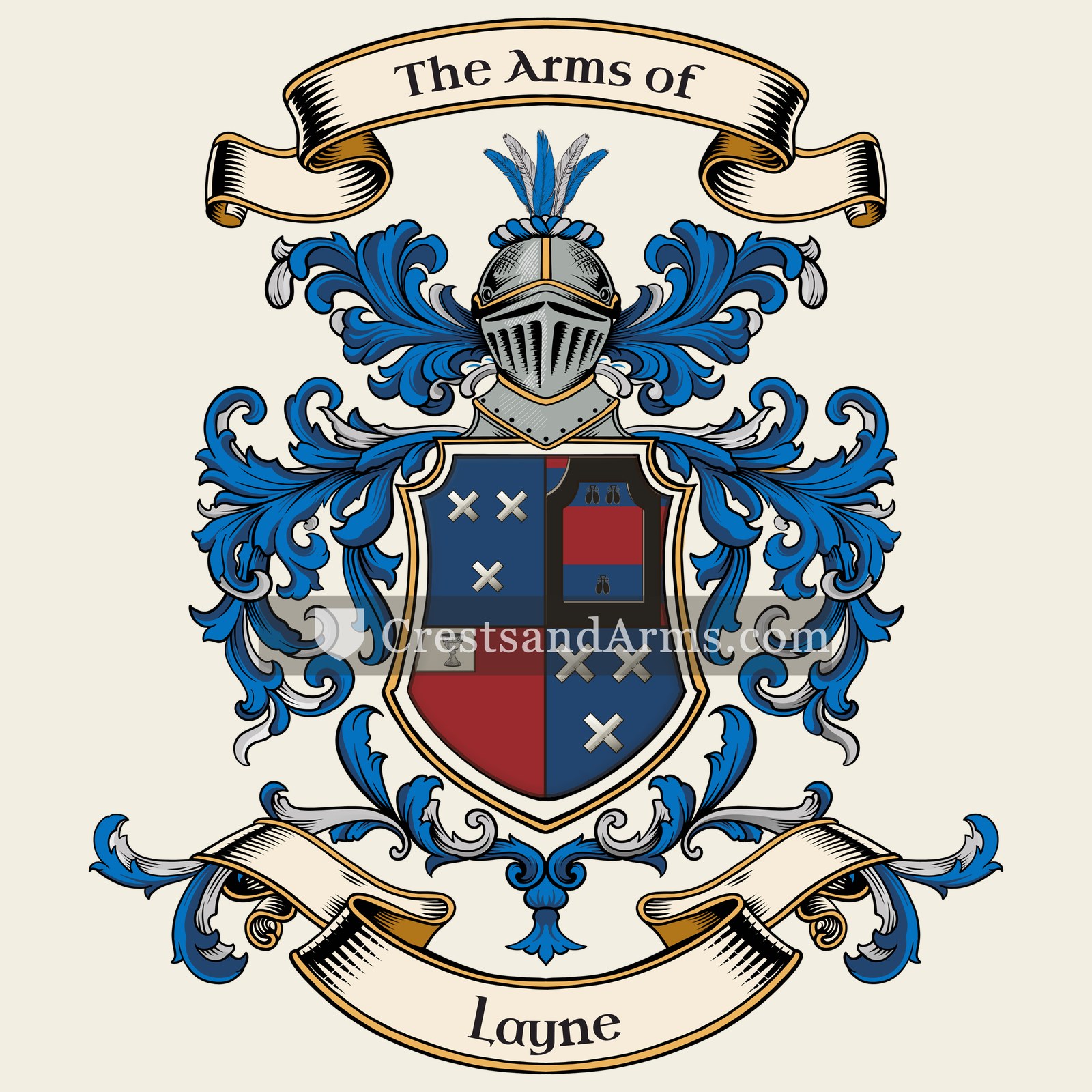
Symbols on this shield
paleMilitary strength, and a fortified defence
saltireResolution, and St Andrew's cross
Colours
Silver (Argent)Means: Peace and sincerity
Red (Gules)Means: Military strength
Blue (Azure)Means: Loyalty and truth
Historical info
Source
Sir Bernard Burke, The General Armory of England, Scotland, Ireland and Wales, London: Harrison & Sons, 1884
Blazon (the actual original written record)
“Per pale ar. and gu. three saltires couped, that in the dexter chief az., that in sinister of the first, and that in base per pale of the third and first”
NorthamptonNorthampton, c. 1597
Digital archive packCoat of arms PNG, gold border print PDF, vector SVG and the certificate of authenticity. Sent to your email in minutes.
Map of England showing where the Layne arms are recorded
The Layne arms were recorded in Northampton, c. 1597.
Northamptonshire was grazing and hunting country in the middle of England, thick with manor houses. Its families were numerous and long-settled, and a settled landed family almost always ended up with arms.
This is where the arms were entered in the register. Families often moved to other parts of the country, so the same name can turn up in more than one region.
The body that granted and recorded arms in England in this period.
Elizabeth I of England
Sovereign of the period
Elizabeth I of England
1558–1603
Reigning in France when the Layne arms are first recorded.
How Arms Worked in England
English heraldry allowed arms to be shared by all legitimate descendants of the original owner. These symbols were treated as personal property that moved through the generations to all children. While the eldest son kept the original design, other family members could use the same shield without needing to change it or register their own unique versions.
Granting authority
The College of Arms in London has regulated the use of coats of arms throughout England and Wales since 1484.
How they got arms
Families typically obtained their coats of arms through a formal grant from the Crown or by proving their ancient right to them.
Where arms were recorded
All official coats of arms are recorded in the registers kept at the College of Arms, which date back to the fifteenth century.
The family's standing
Recorded among the armigerous families of Northampton.
Origin & History of the Layne Family in England
The surname Layne is a topographic name that originated in medieval England, typically used to describe someone who lived near a lane or a narrow path. By the late sixteenth century, the family had established a notable presence in the county of Northamptonshire. Records confirm that members of the Layne family were living in Northampton by 1597, placing them in a region that served as a significant hub for trade and local governance during the Elizabethan era. During this period, families often took their names from the specific physical features of their homesteads or the roads they traveled daily. As the family grew, they became part of the local social fabric, contributing to the agricultural and civic life of the English Midlands. This connection to the landscape helped define their identity as they moved from simple rural origins into the documented history of the town.
Coat of Arms & Family Crest Details
Symbols on this shield
paleMilitary strength, and a fortified defence
saltireResolution, and St Andrew's cross
bordureA difference between branches of one family
cantonA mark of honour granted by the sovereign
water bougetThe crusader's water carrier, and a journey made
cupFaith, office, and a trust discharged
Colours
Blue (Azure)Means: Loyalty and truth
Red (Gules)Means: Military strength
Black (Sable)Means: Constancy
Silver (Argent)Means: Peace and sincerity
Historical info
Source
Sir Bernard Burke, The General Armory of England, Scotland, Ireland and Wales, London: Harrison & Sons, 1884
Blazon (the actual original written record)
“Quarterly, 1st and 4th, per pale az. and gu. three saltires couped ar. ; 2nd, quarterly, 1st and 4th, ar. two bars az. a border engr. sa., 2nd and 3rd, or, three water bougets sa.; 3rd, gyronny of eight or and sa. on a canton gu. a covered cup ar”
Irelandc. 1588
Digital archive packCoat of arms PNG, gold border print PDF, vector SVG and the certificate of authenticity. Sent to your email in minutes.
Map of Ireland showing where the Layne arms are recorded
The Layne arms were recorded in Ireland, c. 1588.
Arms such as these were typically recorded in Dublin.
Dublin was the seat of government in Ireland and the place where grants were sought and recorded. Families with business at the castle or the courts settled nearby, and settling there put their arms on record.
This is where the arms were entered in the register. Families often moved to other parts of the country, so the same name can turn up in more than one region.
The body that granted and recorded arms in Ireland in this period.
Elizabeth I of England
Sovereign of the period
Elizabeth I of England
1558–1603
Reigning in France when the Layne arms are first recorded.
How Arms Worked in Ireland
The Ulster King of Arms granted coats of arms to individuals who proved their social standing and good character. These symbols were typically inherited by all legitimate descendants of the original holder. If a family branch wanted a unique look, they could apply for a specific change to their design through the office to ensure their identity remained distinct.
Granting authority
The Ulster King of Arms acted as the official body that regulated and issued all coats of arms throughout Ireland.
How they got arms
Families obtained their arms through formal grants issued by the office after proving their eligibility and paying the required fees.
Where arms were recorded
All official grants were recorded in the registers held by the Ulster King of Arms starting from the year 1552.
The family's standing
Recorded among the armigerous families of Ireland.
Origin & History of the Layne Family in Ireland
The history of the Layne family in Ireland is deeply connected to the shifting social landscape of the late sixteenth century. By 1588, records confirm that members of the family were already established in Dublin, a city that served as the primary administrative and economic hub of the island. During this period, families with this name were often integrated into the urban merchant class or served in official capacities within the city walls. As Dublin grew into a center of trade and political influence, the Laynes navigated the complex legal and social structures of the time. Their presence in the capital suggests they were part of the growing population of settlers and administrators who helped shape the city during a time of significant transition. This early foothold in Dublin provided the family with a stable foundation that allowed them to participate in the civic life of the region for generations to come.
Related Branches & Arms
Root word
Lanus
A Latin term referring to wool or a wool-worker.
This name
LayneAn occupational surname for someone who worked with wool or lived near a moor.
also spelled
Layne
Lenay
Lane
Documented Sources
J. B. Rietstap, Armorial Général, Gouda: G. B. van Goor Zonen, 1884–87
Archives Nationales de France, Minutier central des notaires de Paris, Series Y
Favier, Jean, Paris: deux mille ans d'histoire, 1997
Sauval, Henri, Histoire et recherches des antiquités de la ville de Paris, 1724
Digital archive packCoat of arms PNG, gold border print PDF, vector SVG and the certificate of authenticity. Sent to your email in minutes.


 chiefAuthority, wisdom and dominion
 wingSwiftness, and protection under a raised wing
 crescentHonour by the sovereign, and the second son
 chiefAuthority, wisdom and dominion
 wingSwiftness, and protection under a raised wing
 crescentHonour by the sovereign, and the second son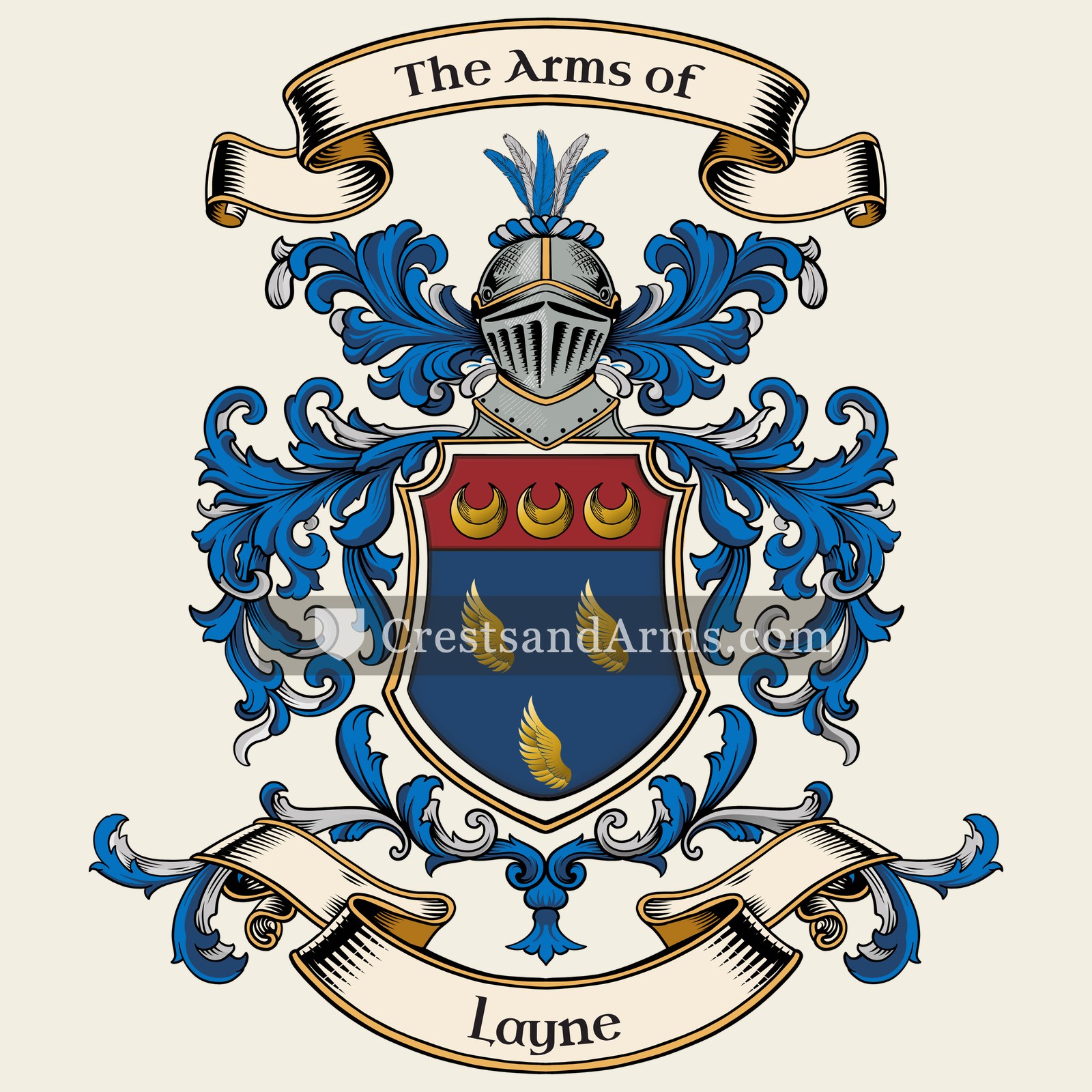


 paleMilitary strength, and a fortified defence
 saltireResolution, and St Andrew's cross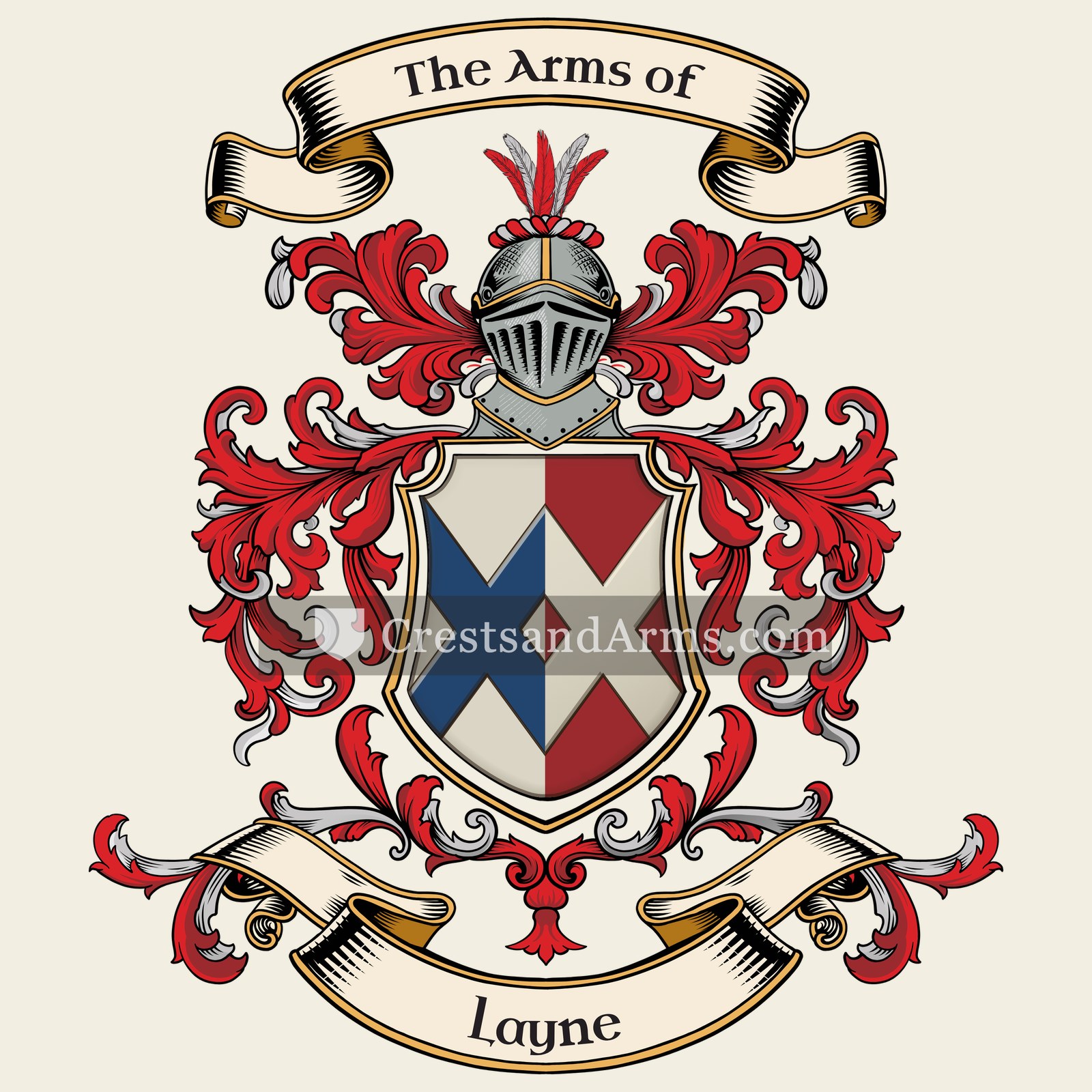


 bordureA difference between branches of one family
 cantonA mark of honour granted by the sovereign
 water bougetThe crusader's water carrier, and a journey made
 cupFaith, office, and a trust discharged