A record of documented arms, meaning and origin, researched for the le Blanc family lines. Documented in 3 countries.
Reg. 3670 · French, J–L
Coat of Arms & Family Crest Details
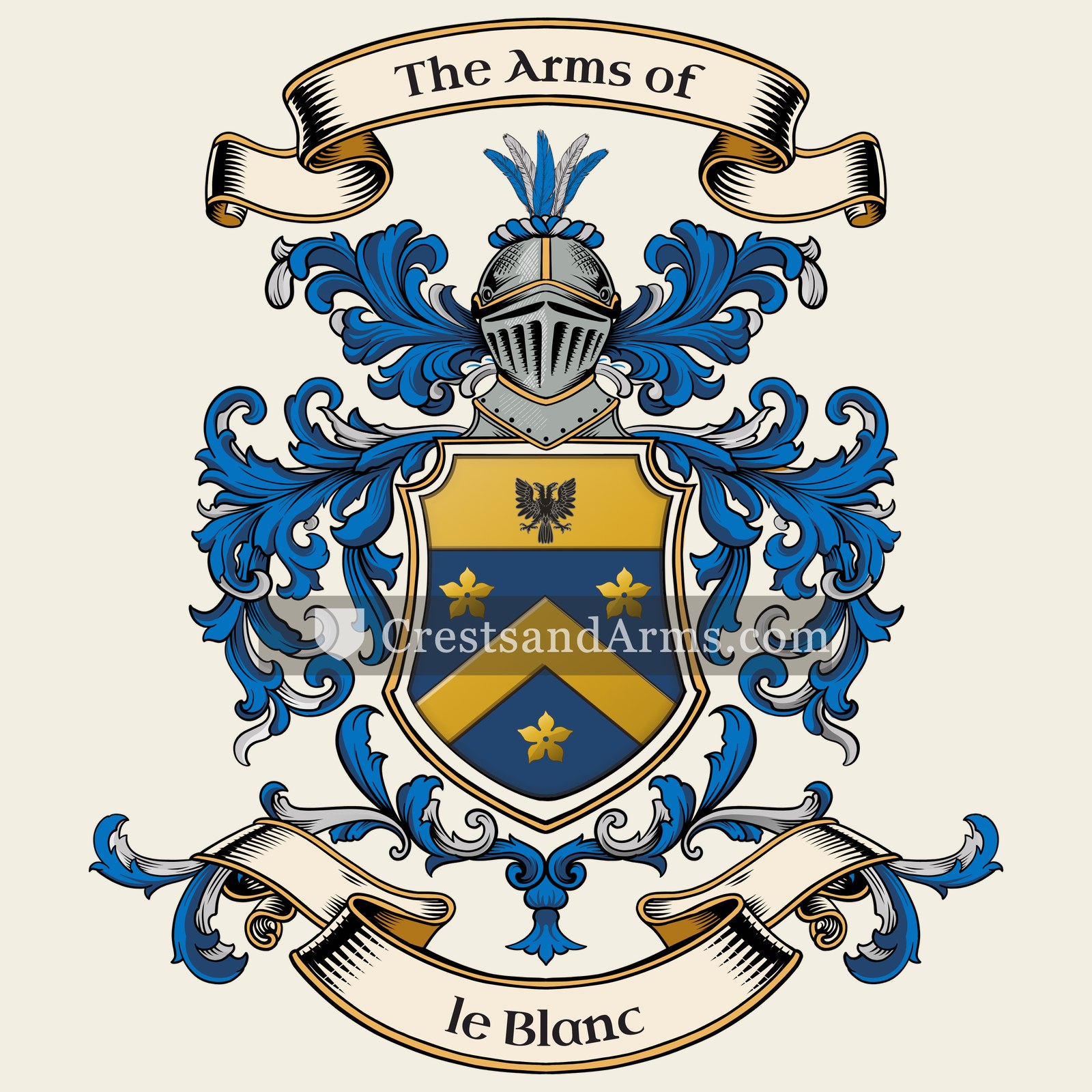
Symbols on this shield
chevronProtection, and faithful service completed
chiefAuthority, wisdom and dominion
cinquefoilHope and joy
eagleNobility, strength and a keen mind
Colours
Blue (Azure)Means: Loyalty and truth
Gold (Or)Means: Generosity
Black (Sable)Means: Constancy
Historical info
Source
J. B. Rietstap, Armorial Général, Gouda: G. B. van Goor Zonen, 1884–87
Blazon (the actual original written record)
“D'azur au chev. d'or, acc. de trois quintefeuilles du même; au chef du sec., ch. d'une aigle de sa., cour. d'or. C.: une licorne iss. d'arg., accornée, barbée et crinée d'or; entre un vol d'azur [La branche établie en Angl., au comté de Middlesex, porte en C.: l'aigle du chef, ch. sur sa poitrine d'une quinte feuille d'or, et pour D.: SANS TACHE.]”
Francec. 1529
Digital archive packCoat of arms PNG, gold border print PDF, vector SVG and the certificate of authenticity. Sent to your email in minutes.
Map of France showing where the le Blanc arms are recorded
The le Blanc arms were recorded in France, c. 1529.
Arms such as these were typically recorded in Bretagne.
More families held coats of arms in Bretagne than anywhere else in France. The land was divided into many small estates rather than a few large ones, so far more households counted as gentry, and each needed a shield of its own to be told apart.
This is where the arms were entered in the register. Families often moved to other parts of the country, so the same name can turn up in more than one region.
The body that granted and recorded arms in France in this period.
Francis I of France
Sovereign of the period
Francis I of France
1515–1547
Reigning in France when the le Blanc arms are first recorded.
How Arms Worked in France
In France, a coat of arms was a mark of honor that passed down through the male line to all legitimate descendants. Families often used the same shield without changes to show their shared heritage. If a branch wanted to stand out, they could add a small mark to their shield to show their specific place in the family tree.
Granting authority
The Juge d'armes de France acted as the official authority that regulated and verified coats of arms across the country.
How they got arms
Families typically inherited their arms from ancestors, though they could also receive them through royal grants or by proving their noble status.
Where arms were recorded
Coats of arms were officially recorded in the Armorial Général de France, which began its main collection in the year 1696.
The family's standing
Recorded among the armigerous families of France.
Origin & History of the le Blanc Family in France
The surname Le Blanc originated in France as a descriptive nickname used to identify individuals by their physical appearance, specifically those with fair hair or a pale complexion. During the Middle Ages, such names became hereditary as populations grew and officials needed a reliable way to distinguish between people living in the same village. By the early 16th century, the family had established a notable presence in the region of Bretagne. Records confirm that members of the Le Blanc family were active in this area by 1529, where they integrated into the local social and economic fabric of the province. As the family spread across different French territories, they often adapted to the specific customs and industries of their new homes, ranging from agricultural life to roles in local administration. This transition from a simple nickname to a recognized family name reflects the broader evolution of French naming traditions during the transition from the medieval period to the Renaissance.
Coat of Arms & Family Crest Details
Symbols on this shield
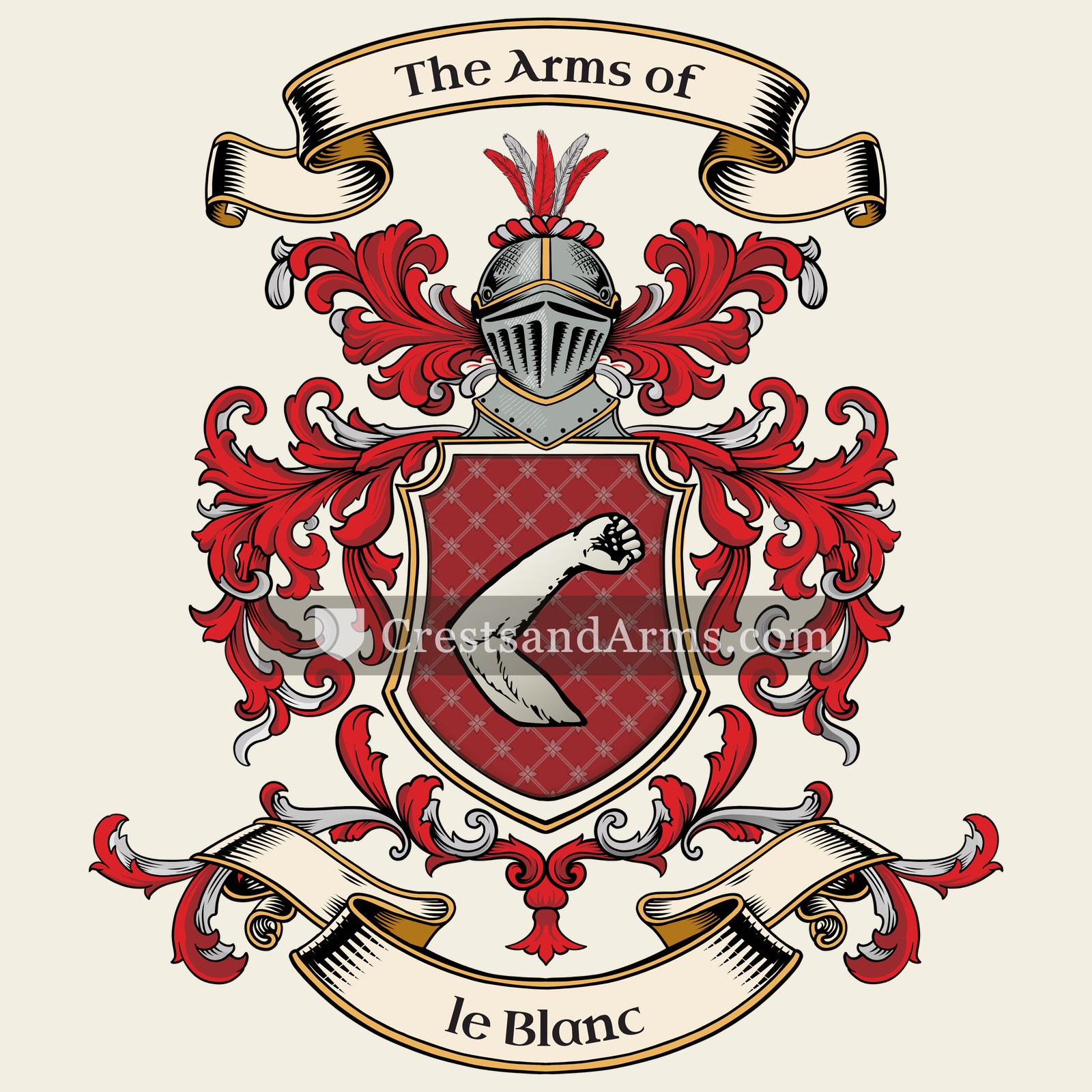
armA person of action, industrious and laborious
Colours
Red (Gules)Means: Military strength
Silver (Argent)Means: Peace and sincerity
Historical info
Source
J. B. Rietstap, Armorial Général, Gouda: G. B. van Goor Zonen, 1884–87
Blazon (the actual original written record)
“De gu. au bras arm., mouv. de sen., tenant une épée d'arg., garnie d'or, accostée de deux fleurs-de-lis d'or.”
Ile-de-FranceIle-de-France, c. 1775
Digital archive packCoat of arms PNG, gold border print PDF, vector SVG and the certificate of authenticity. Sent to your email in minutes.
Map of Italy showing where the le Blanc arms are recorded
The le Blanc arms were recorded in Ile-de-France, c. 1775.
Ile-de-France is the country around Paris, and proximity to the court mattered. Families who served the crown were rewarded with land near it, and land near the capital carried arms almost as a matter of course.
This is where the arms were entered in the register. Families often moved to other parts of the country, so the same name can turn up in more than one region.
The body that granted and recorded arms in Italy in this period.
Alvise Giovanni Mocenigo
Sovereign of the period
Alvise Giovanni Mocenigo
1763–1778
Reigning in France when the le Blanc arms are first recorded.
How Arms Worked in Italy
In the Italian states, coats of arms were often used by noble families to show their status and history. These symbols were passed down through the generations to all legitimate male descendants. Younger branches of a family usually kept the original design but sometimes added small changes to distinguish their specific line from the main branch.
Granting authority
Various local rulers and city governments controlled the use of coats of arms across the different Italian states.
How they got arms
Families often assumed their own arms or received them as official grants from local lords, popes, or city councils.
Where arms were recorded
Arms were recorded in local city archives or private family books rather than in one single national register.
The family's standing
Recorded among the armigerous families of Ile-de-France.
Origin & History of the le Blanc Family in Italy
The surname Le Blanc originated as a descriptive nickname in medieval France, used to identify individuals with fair hair or a pale complexion. While the name is deeply rooted in French history, its presence in Italy emerged through centuries of migration, trade, and shifting borders. By the time members of the family were documented in the Ile-de-France region in 1775, the name had already spread across various European territories as families moved to seek new economic opportunities or follow military campaigns. In Italy, the name often underwent slight linguistic adjustments to fit local dialects, yet it maintained its core identity as a marker of the family’s northern origins. This movement reflects the broader patterns of European history where families transitioned from small rural communities to becoming part of the diverse social fabric of major urban centers.
Coat of Arms & Family Crest Details
Symbols on this shield
chevronProtection, and faithful service completed
chiefAuthority, wisdom and dominion
cinquefoilHope and joy
eagleNobility, strength and a keen mind
Colours
Blue (Azure)Means: Loyalty and truth
Gold (Or)Means: Generosity
Black (Sable)Means: Constancy
Historical info
Source
Sir Bernard Burke, The General Armory of England, Scotland, Ireland and Wales, London: Harrison & Sons, 1884
Blazon (the actual original written record)
“Az. a chev. betw. three cinquefoils or, on a chief of the second an eagle displ. sa. ducally crowned gold”
MiddlesexCharterhouse Square · Middlesex, c. 1753
Digital archive packCoat of arms PNG, gold border print PDF, vector SVG and the certificate of authenticity. Sent to your email in minutes.
Map of England showing where the le Blanc arms are recorded
The le Blanc arms were recorded in Middlesex, c. 1753.
Middlesex was the county around London, and City money flowed straight into it. Merchants and officials bought estates within reach of the capital, and a new estate brought a coat of arms with it.
This is where the arms were entered in the register. Families often moved to other parts of the country, so the same name can turn up in more than one region.
The body that granted and recorded arms in England in this period.
George II of Great Britain
Sovereign of the period
George II of Great Britain
1727–1760
Reigning in France when the le Blanc arms are first recorded.
How Arms Worked in England
English heraldry allowed arms to be shared by all legitimate descendants of the original owner. These symbols were treated as personal property that moved through the generations to all children. While the eldest son kept the original design, other family members could use the same shield without needing to change it or register their own unique versions.
Granting authority
The College of Arms in London has regulated the use of coats of arms throughout England and Wales since 1484.
How they got arms
Families typically obtained their coats of arms through a formal grant from the Crown or by proving their ancient right to them.
Where arms were recorded
All official coats of arms are recorded in the registers kept at the College of Arms, which date back to the fifteenth century.
The family's standing
Recorded among the armigerous families of Middlesex.
Origin & History of the le Blanc Family in England
The surname Le Blanc originated as a descriptive nickname in France, likely used to identify someone with fair hair or a pale complexion. By the time the name appeared in the historical records of Middlesex in 1753, it had already traveled across the English Channel, carried by families seeking new opportunities or fleeing religious and political unrest. During the eighteenth century, London and its surrounding areas served as a major destination for these migrants, who often integrated into the local economy as skilled artisans, merchants, or professionals. These early Le Blanc families in England frequently adapted to their new environment while maintaining their distinct cultural identity. Over time, the name became firmly established within the English social fabric, reflecting the broader history of migration that shaped the population of the region during the Georgian era.
Related Branches & Arms
Root word
blancus
A Germanic term meaning white or fair-haired.
This name
le BlancRefers to a person with a pale complexion or light-colored hair.
also spelled
Leblan
Le Blan
Blanc
Blanke
Blanch
Related arms
Blancsame arms
Brissonsimilar arms
Blanc (le) de Châteauvillardvariant spelling
Blanc (le) de Guenguéretvariant spelling
Documented Sources
J. B. Rietstap, Armorial Général, Gouda: G. B. van Goor Zonen, 1884–87
Dauzat, Albert. Les noms de famille de France. 1949
Morlet, Marie-Thérèse. Dictionnaire étymologique des noms de famille. 1991
Archives départementales d'Ille-et-Vilaine. Série E, État civil et registres paroissiaux
Digital archive packCoat of arms PNG, gold border print PDF, vector SVG and the certificate of authenticity. Sent to your email in minutes.


 chevronProtection, and faithful service completed
 chiefAuthority, wisdom and dominion
 cinquefoilHope and joy
 eagleNobility, strength and a keen mind
 chevronProtection, and faithful service completed
 chiefAuthority, wisdom and dominion
 cinquefoilHope and joy
 eagleNobility, strength and a keen mind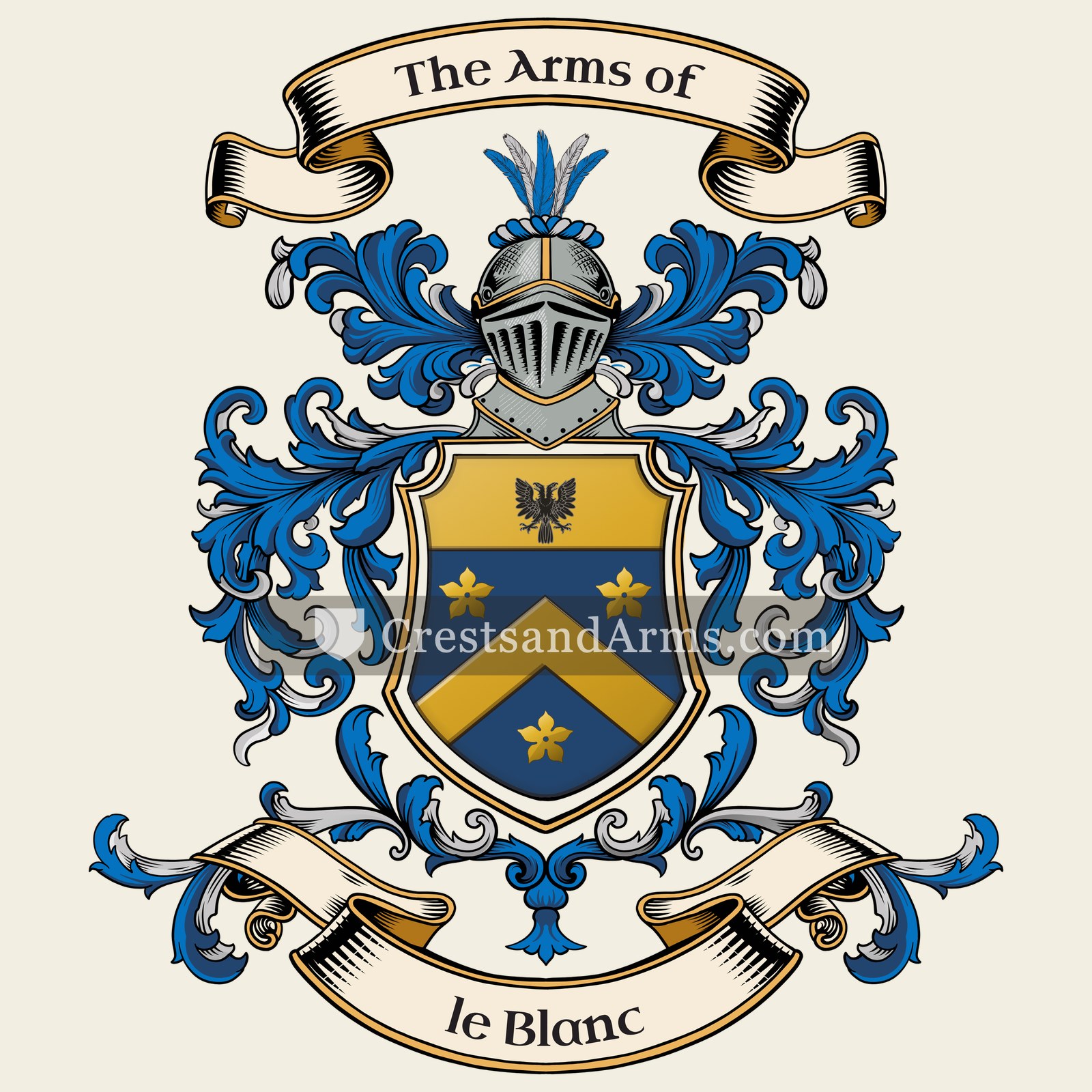


 armA person of action, industrious and laborious