A record of documented arms, meaning and origin, researched for the Lea family lines. Documented in 3 countries.
Reg. 4156 · French, J–L
Coat of Arms & Family Crest Details
Symbols on this shield
paleMilitary strength, and a fortified defence
crescentHonour by the sovereign, and the second son
lionCourage, strength and royalty
Colours
Silver (Argent)Means: Peace and sincerity
Black (Sable)Means: Constancy
Gold (Or)Means: Generosity
Historical info
Source
J. B. Rietstap, Armorial Général, Gouda: G. B. van Goor Zonen, 1884–87
Blazon (the actual original written record)
“D'arg. au pal de sa., ch. de trois croiss. d'or et accosté de deux têtes de léopard du sec. C.: une licorne d'arg. semée de gouttes de sa., coll. d'un double trècheur fleur. et c.-fleur. de gu. S.: deux lions de sin., arm. et lamp. de gu., coll. de couronnes d'or, auxquelles est attaché un lien du même. D.: IN SE IPSO TOTUS TERES.”
Francec. 1757
Digital archive packCoat of arms PNG, gold border print PDF, vector SVG and the certificate of authenticity. Sent to your email in minutes.
Map of France showing where the Lea arms are recorded
The Lea arms were recorded in France, c. 1757.
Arms such as these were typically recorded in Bretagne.
More families held coats of arms in Bretagne than anywhere else in France. The land was divided into many small estates rather than a few large ones, so far more households counted as gentry, and each needed a shield of its own to be told apart.
This is where the arms were entered in the register. Families often moved to other parts of the country, so the same name can turn up in more than one region.
The body that granted and recorded arms in France in this period.
Louis XV of France
Sovereign of the period
Louis XV of France
1715–1774
Reigning in France when the Lea arms are first recorded.
How Arms Worked in France
In France, a coat of arms was a mark of honor that passed down through the male line to all legitimate descendants. Families often used the same shield without changes to show their shared heritage. If a branch wanted to stand out, they could add a small mark to their shield to show their specific place in the family tree.
Granting authority
The Juge d'armes de France acted as the official authority that regulated and verified coats of arms across the country.
How they got arms
Families typically inherited their arms from ancestors, though they could also receive them through royal grants or by proving their noble status.
Where arms were recorded
Coats of arms were officially recorded in the Armorial Général de France, which began its main collection in the year 1696.
The family's standing
Recorded among the armigerous families of France.
Origin & History of the Lea Family in France
The name Lea, often appearing in historical documents as Leas or Leat, holds deep roots in the rugged landscape of Bretagne, France. By the mid-eighteenth century, families bearing this name were well-established within the region, living as part of the local agricultural and maritime communities. During this period, the name was closely tied to the linguistic traditions of the Breton people, who maintained a distinct cultural identity separate from the rest of France. Families in this area frequently worked as skilled laborers or small-scale farmers, contributing to the local economy of the coastal provinces. The presence of the Lea name in 1757 suggests that these ancestors were deeply integrated into the parish life of the time, where local church records served as the primary way to track births, marriages, and deaths. As these families navigated the social shifts of pre-revolutionary France, they remained anchored to the traditions and geography of their Breton homeland.
Coat of Arms & Family Crest Details
Symbols on this shield
fessThe military belt, and readiness to serve
lionCourage, strength and royalty
Colours
Silver (Argent)Means: Peace and sincerity
Red (Gules)Means: Military strength
Blue (Azure)Means: Loyalty and truth
Historical info
Source
Sir Bernard Burke, The General Armory of England, Scotland, Ireland and Wales, London: Harrison & Sons, 1884
Blazon (the actual original written record)
“Ar. a fesse gu. betw. three leopards' faces az”
BuckinghamBuckingham, c. 1620
Digital archive packCoat of arms PNG, gold border print PDF, vector SVG and the certificate of authenticity. Sent to your email in minutes.
Map of England showing where the Lea arms are recorded
The Lea arms were recorded in Buckingham, c. 1620.
Buckinghamshire was quiet farming country on the road out of London. Court officials and lawyers bought manors there within easy reach of the capital, and a manor was the usual reason to take arms.
This is where the arms were entered in the register. Families often moved to other parts of the country, so the same name can turn up in more than one region.
The body that granted and recorded arms in England in this period.
James VI and I
Sovereign of the period
James VI and I
1603–1625
Reigning in France when the Lea arms are first recorded.
How Arms Worked in England
English heraldry allowed arms to be shared by all legitimate descendants of the original owner. These symbols were treated as personal property that moved through the generations to all children. While the eldest son kept the original design, other family members could use the same shield without needing to change it or register their own unique versions.
Granting authority
The College of Arms in London has regulated the use of coats of arms throughout England and Wales since 1484.
How they got arms
Families typically obtained their coats of arms through a formal grant from the Crown or by proving their ancient right to them.
Where arms were recorded
All official coats of arms are recorded in the registers kept at the College of Arms, which date back to the fifteenth century.
The family's standing
Recorded among the armigerous families of Buckingham.
Origin & History of the Lea Family in England
The surname Lea is a locative name, meaning it was originally used to describe people who lived near a meadow or a clearing in the woods. The word comes from the Old English term "leah," which refers to an open space in a forest. By the early 17th century, the name was well-established across various English counties, including Buckinghamshire. Records confirm that members of the Lea family were living in the town of Buckingham by 1620, where they were likely involved in the local agricultural or trade life of the region. During this period, families often took their names from the specific landscape features near their homes. Because the name describes such a common geographical feature, it emerged independently in many different parts of England rather than coming from a single ancestor. This makes the history of the name a reflection of how early English people identified themselves through the land they worked and the villages they called home.
Coat of Arms & Family Crest Details
Symbols on this shield
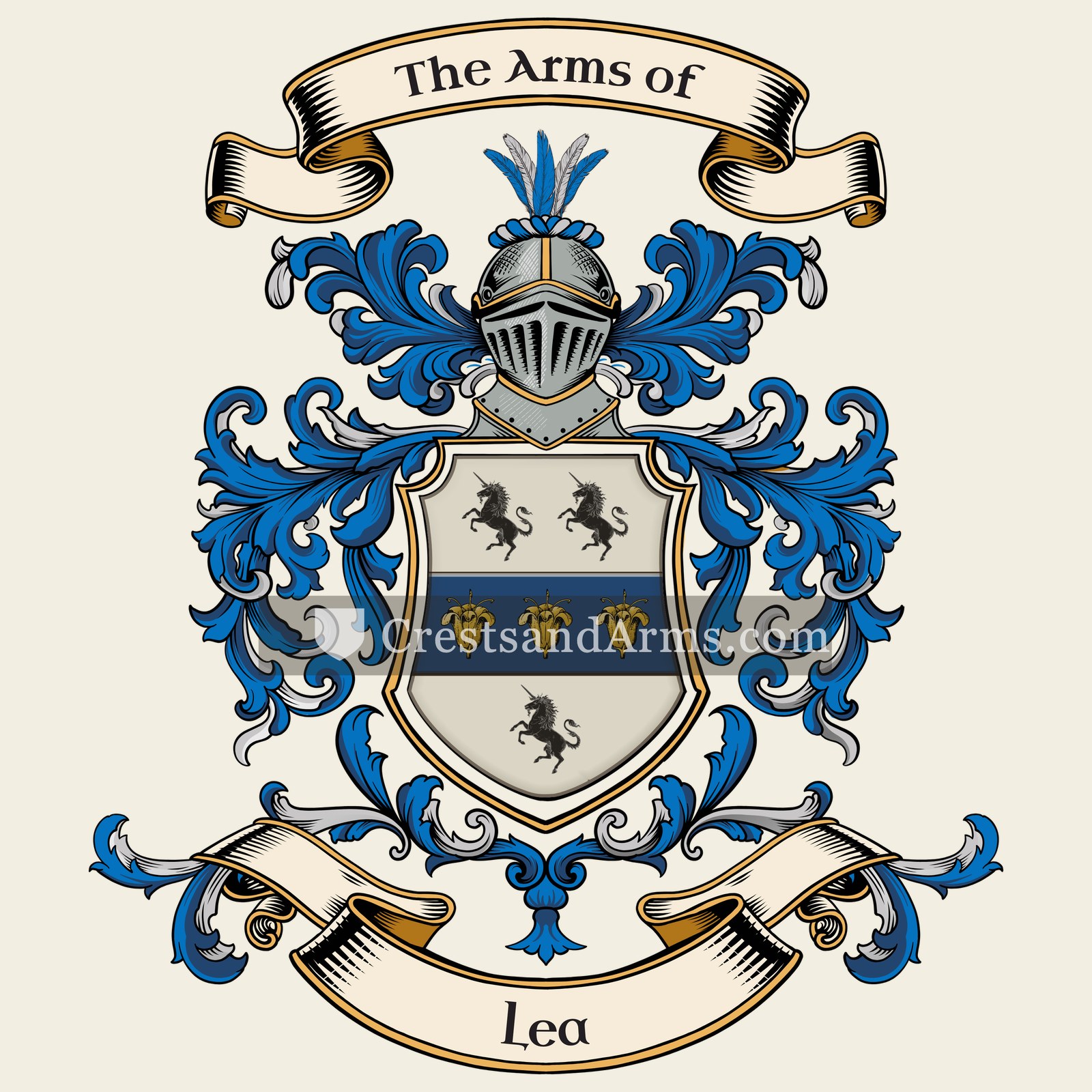
fessThe military belt, and readiness to serve
unicornPurity, and extreme courage in defence of honour
lilyPurity and the promise of resurrection
Colours
Silver (Argent)Means: Peace and sincerity
Blue (Azure)Means: Loyalty and truth
Black (Sable)Means: Constancy
Gold (Or)Means: Generosity
Historical info
Source
Sir Bernard Burke, The General Armory of England, Scotland, Ireland and Wales, London: Harrison & Sons, 1884
Blazon (the actual original written record)
“Ar. on a fess az. betw. three unicorns' heads couped sa. armed or, as many lilies of the last”
KildareKildare, c. 1619
Digital archive packCoat of arms PNG, gold border print PDF, vector SVG and the certificate of authenticity. Sent to your email in minutes.
Map of Ireland showing where the Lea arms are recorded
The Lea arms were recorded in Kildare, c. 1619.
Kildare was flat grazing country close to Dublin, taken early by Norman families. Being near the seat of government meant being near where arms were recorded, which is why so many Kildare names appear.
This is where the arms were entered in the register. Families often moved to other parts of the country, so the same name can turn up in more than one region.
The body that granted and recorded arms in Ireland in this period.
James VI and I
Sovereign of the period
James VI and I
1603–1625
Reigning in France when the Lea arms are first recorded.
How Arms Worked in Ireland
The Ulster King of Arms granted coats of arms to individuals who proved their social standing and good character. These symbols were typically inherited by all legitimate descendants of the original holder. If a family branch wanted a unique look, they could apply for a specific change to their design through the office to ensure their identity remained distinct.
Granting authority
The Ulster King of Arms acted as the official body that regulated and issued all coats of arms throughout Ireland.
How they got arms
Families obtained their arms through formal grants issued by the office after proving their eligibility and paying the required fees.
Where arms were recorded
All official grants were recorded in the registers held by the Ulster King of Arms starting from the year 1552.
The family's standing
Recorded among the armigerous families of Kildare.
Origin & History of the Lea Family in Ireland
The surname Lea has deep roots in Ireland that trace back to the early seventeenth century, particularly within County Kildare. By 1619, records confirm that members of the family were already established in this region, likely as part of the shifting social and land-holding patterns of the era. The name itself is often linked to the Old English word for a meadow or a clearing, suggesting that the family’s ancestors may have been associated with specific landscapes or agricultural lands. As they settled in Kildare, the family became part of the local community during a time of significant transition for the island. Over the following decades, the name became woven into the local history of the area, reflecting the broader movement of families who settled and built lives in the Irish midlands.
Related Branches & Arms
Root word
Leo
Latin word meaning lion or brave animal.
This name
LeaDerived from a topographical term for someone living near a meadow or clearing.
also spelled
Lee
Lay
Leigh
Legh
Related arms
Leevariant spelling
Leghvariant spelling
Leighvariant spelling
Dixonrecorded with Lea, same area
Documented Sources
J. B. Rietstap, Armorial Général, Gouda: G. B. van Goor Zonen, 1884–87
Archives départementales du Finistère, Registres paroissiaux et d'état civil, 1757
Gautier, Hervé, Histoire de la Bretagne, 1993
Le Gallo, Yves, Le Finistère de la Préhistoire à nos jours, 1991
Digital archive packCoat of arms PNG, gold border print PDF, vector SVG and the certificate of authenticity. Sent to your email in minutes.


 paleMilitary strength, and a fortified defence
 crescentHonour by the sovereign, and the second son
 lionCourage, strength and royalty
 paleMilitary strength, and a fortified defence
 crescentHonour by the sovereign, and the second son
 lionCourage, strength and royalty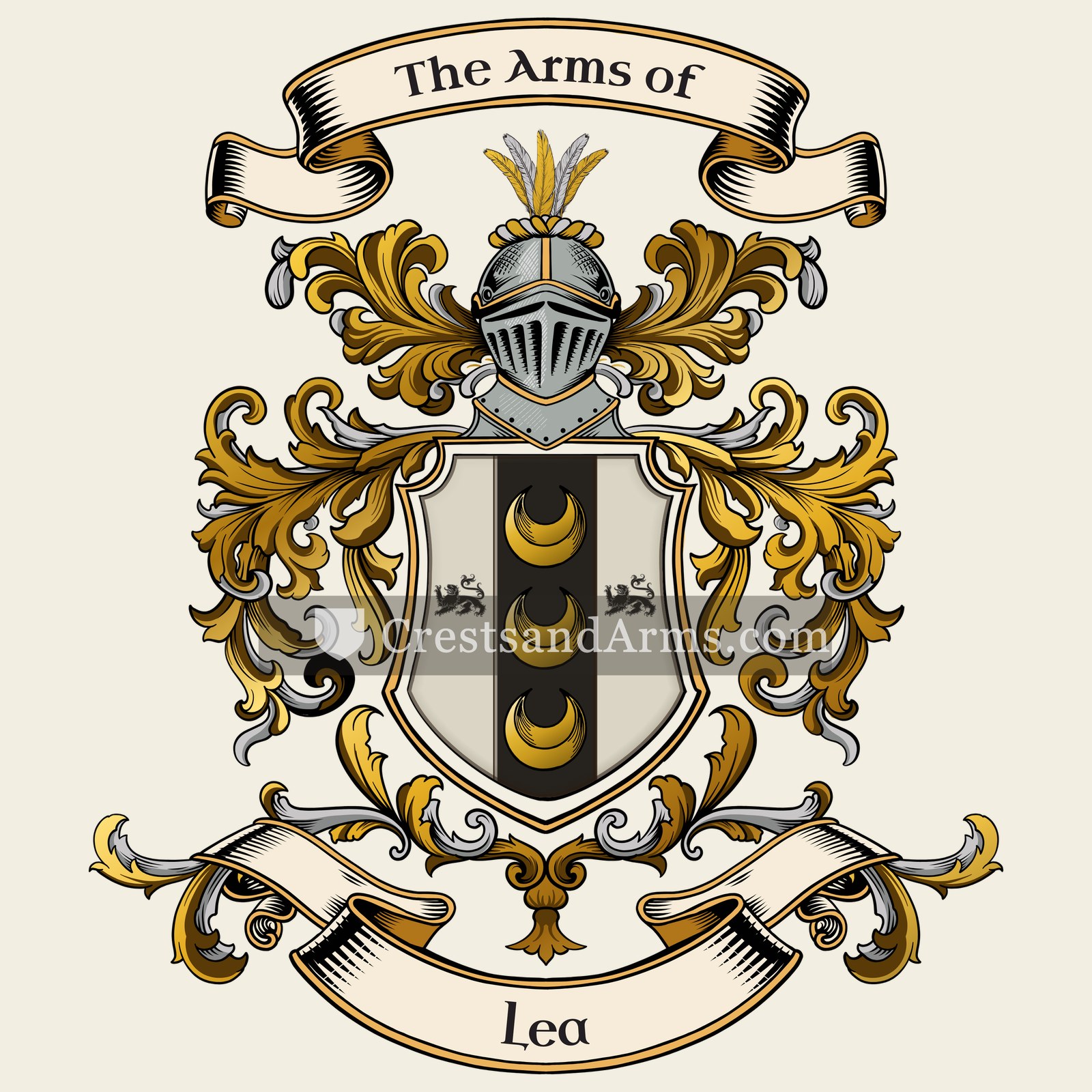


 fessThe military belt, and readiness to serve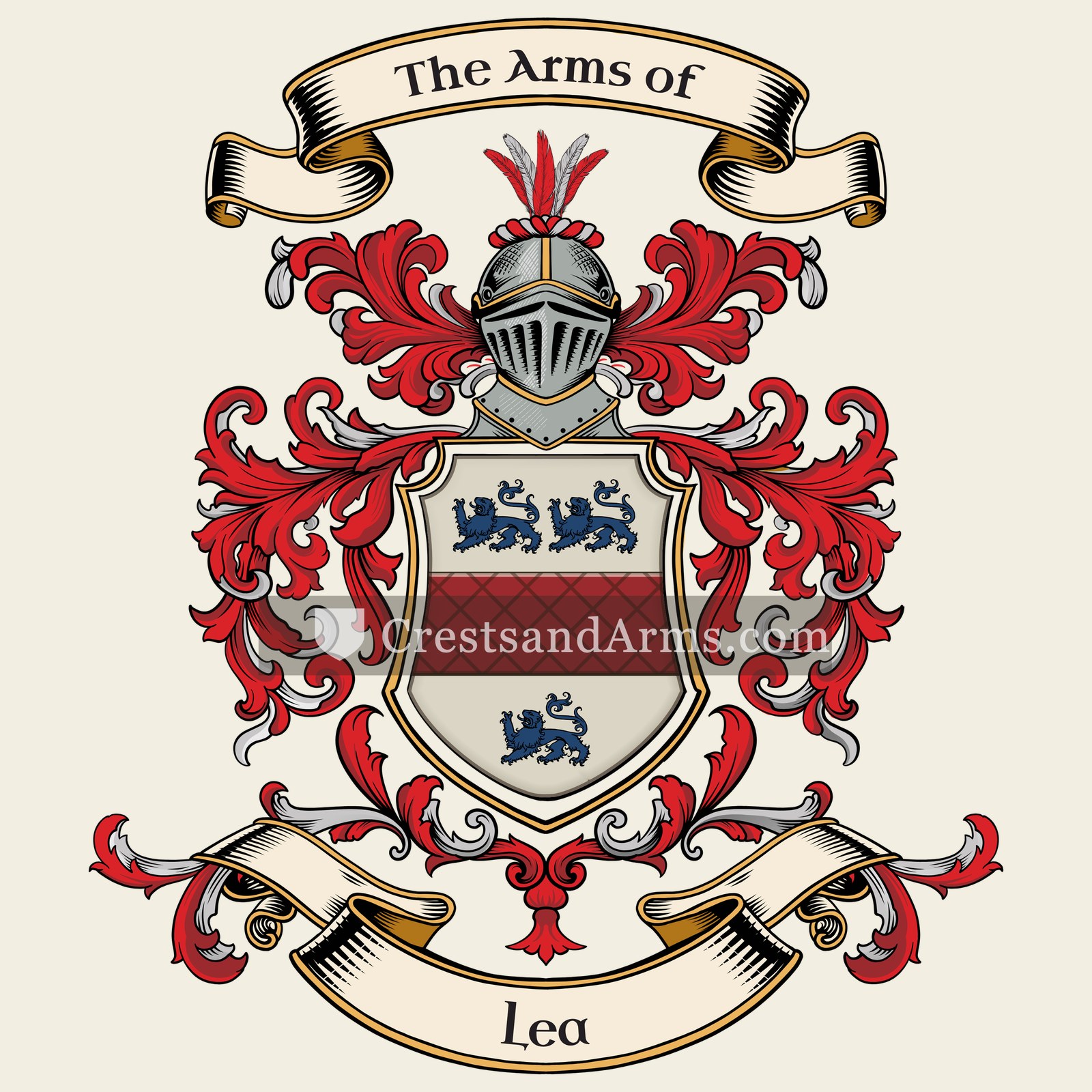


 unicornPurity, and extreme courage in defence of honour
 lilyPurity and the promise of resurrection