Map of England showing where the Leake arms are recorded
The Leake arms were recorded in London, c. 1620.
This is where the arms were entered in the register. Families often moved to other parts of the country, so the same name can turn up in more than one region.
The body that granted and recorded arms in England in this period.
James VI and I
Sovereign of the period
James VI and I
1603–1625
Reigning in England when the Leake arms are first recorded.
How Arms Worked in England
English heraldry allowed arms to be shared by all legitimate descendants of the original owner. These symbols were treated as personal property that moved through the generations to all children. While the eldest son kept the original design, other family members could use the same shield without needing to change it or register their own unique versions.
Granting authority
The College of Arms in London has regulated the use of coats of arms throughout England and Wales since 1484.
How they got arms
Families typically obtained their coats of arms through a formal grant from the Crown or by proving their ancient right to them.
Where arms were recorded
All official coats of arms are recorded in the registers kept at the College of Arms, which date back to the fifteenth century.
The family's standing
Recorded among the armigerous families of England.
Origin & History of the Leake Family in England
The surname Leake originates from the Old English word "lece," which referred to a stream or a boggy area of land. Families who took this name often lived near these natural water features, making it a topographical name that helped neighbors identify where someone resided. By the early 17th century, the name was well-established across various English counties, reflecting the movement of people toward growing urban centers. Records confirm that members of the Leake family were active in London by 1620, a time when the city was a bustling hub of trade and migration. These early residents were part of a period of significant social change, as families increasingly moved from rural villages to the capital to pursue new opportunities in commerce and professional life. This transition helped the name spread beyond its original regional roots and become a permanent fixture in the history of London.
Coat of Arms & Family Crest Details
Symbols on this shield
saltireResolution, and St Andrew's cross
cross symbolChristian faith and service
lionCourage, strength and royalty
Colours
Gold (Or)Means: Generosity
Black (Sable)Means: Constancy
Historical info
Source
Sir Bernard Burke, The General Armory of England, Scotland, Ireland and Wales, London: Harrison & Sons, 1884
Blazon (the actual original written record)
“Or, a saltire flory, in chief a lion pass. sa”
GermanySouthwark, c. 1765
Digital archive packCoat of arms PNG, gold border print PDF, vector SVG and the certificate of authenticity. Sent to your email in minutes.
Map of Germany showing where the Leake arms are recorded
The Leake arms were recorded in Southwark, c. 1765.
Arms such as these were typically recorded in Bavaria.
Bavaria was a country of old landed families and walled market towns. Estates passed down the same line for centuries, and both the landowners and the leading townsmen kept arms, which is why so many Bavarian names sit in the registers.
This is where the arms were entered in the register. Families often moved to other parts of the country, so the same name can turn up in more than one region.
The body that granted and recorded arms in Germany in this period.
Francis I, Holy Roman Emperor
Sovereign of the period
Francis I, Holy Roman Emperor
1745–1765
Reigning in England when the Leake arms are first recorded.
How Arms Worked in Germany
In the Holy Roman Empire, coats of arms were often granted to individuals by the Emperor or his representatives. These arms were then passed down through the generations to all legitimate descendants of the original holder. Younger branches of a family usually kept the same shield design without needing to change it, as the arms belonged to the entire lineage.
Granting authority
The Holy Roman Emperor held the sole power to grant new coats of arms throughout his vast imperial territories.
How they got arms
Families typically obtained their coats of arms through a formal imperial grant or by proving their noble status to the authorities.
Where arms were recorded
These grants were officially recorded in the Imperial Chancery registers, which began keeping formal records of such honors during the Middle Ages.
The family's standing
Recorded among the armigerous families of Germany.
Origin & History of the Leake Family in Germany
The family name Leake, while often associated with English origins, has a distinct historical presence in the German region of Bavaria. By the mid-18th century, records confirm that members of the family were established within the Bavarian landscape, a time when the region was transitioning through significant political and social shifts under the Electorate of Bavaria. Families with this name during this era were typically tied to the agrarian economy or local trade guilds, which were the primary drivers of community life in small towns and rural parishes. Because surnames in this part of Europe often evolved from descriptions of a person's trade or their proximity to a specific geographic landmark, the name likely served as a way to distinguish families within their local villages. As the family lived through the late 1700s in Bavaria, they were part of a society deeply influenced by the traditions of the Holy Roman Empire, where record-keeping was managed primarily through church registers and local administrative censuses.
Related Branches & Arms
Root word
læcc
Old English term for a stream or a boggy watercourse.
This name
LeakeA topographical name for someone who lived near a stream, brook, or marshy land.
also spelled
Leack
Leeke
Leacke
Related arms
Leekvariant spelling
Leekevariant spelling
Lekevariant spelling
Documented Sources
Sir Bernard Burke, The General Armory of England, Scotland, Ireland and Wales, London: Harrison & Sons, 1884
Bardsley, Charles Wareing. A Dictionary of English and Welsh Surnames. 1901
Reaney, P.H. A Dictionary of British Surnames. 1958
The National Archives, Kew. State Papers Domestic, James I. 1620
Digital archive packCoat of arms PNG, gold border print PDF, vector SVG and the certificate of authenticity. Sent to your email in minutes.


 saltireResolution, and St Andrew's cross
 cantonA mark of honour granted by the sovereign
 ringFidelity, and a promise kept
 towerGrandeur and solidity, and a stronghold defended
 saltireResolution, and St Andrew's cross
 cantonA mark of honour granted by the sovereign
 ringFidelity, and a promise kept
 towerGrandeur and solidity, and a stronghold defended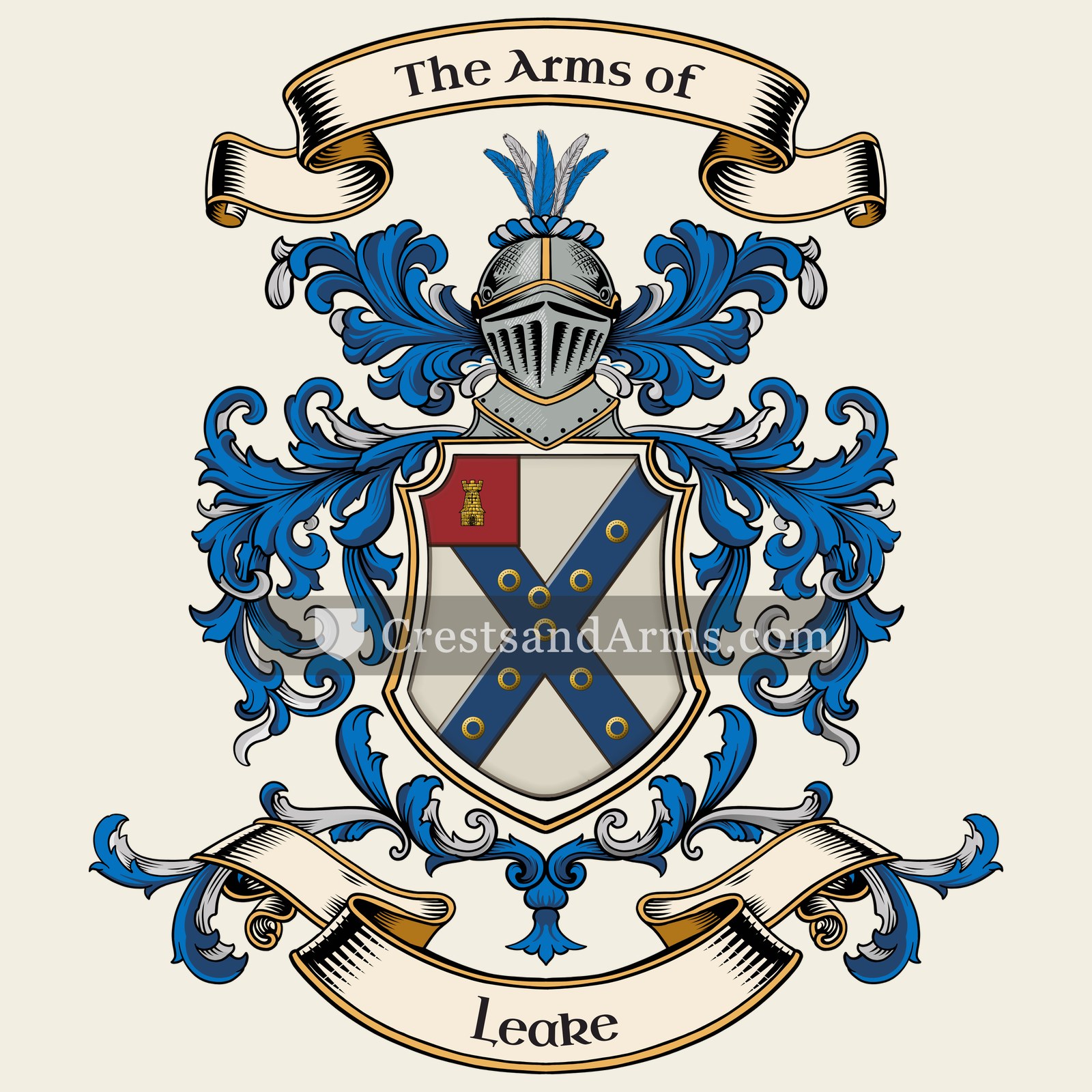


 cross symbolChristian faith and service
 lionCourage, strength and royalty