Map of Italy showing where the Leanza arms are recorded
The Leanza arms were recorded in Naples, c. 1775.
Naples was the largest city in Italy and the seat of a kingdom. Its noble houses were numerous, and the kingdom kept formal lists of the families entitled to arms, which is why so many appear in the records.
This is where the arms were entered in the register. Families often moved to other parts of the country, so the same name can turn up in more than one region.
The body that granted and recorded arms in Italy in this period.
Alvise Giovanni Mocenigo
Sovereign of the period
Alvise Giovanni Mocenigo
1763–1778
Reigning in Italy when the Leanza arms are first recorded.
How Arms Worked in Italy
In the Italian states, coats of arms were often used by noble families to show their status and history. These symbols were passed down through the generations to all legitimate male descendants. Younger branches of a family usually kept the original design but sometimes added small changes to distinguish their specific line from the main branch.
Granting authority
Various local rulers and city governments controlled the use of coats of arms across the different Italian states.
How they got arms
Families often assumed their own arms or received them as official grants from local lords, popes, or city councils.
Where arms were recorded
Arms were recorded in local city archives or private family books rather than in one single national register.
The family's standing
Recorded among the armigerous families of Naples.
Origin & History of the Leanza Family in Italy
The family name Leanza is deeply rooted in the cultural landscape of southern Italy, with documented records confirming their presence in the vibrant city of Naples by 1775. During this period, Naples served as a major intellectual and economic hub under the Bourbon monarchy, attracting families who were often involved in local commerce, artisan trades, or the administrative services of the kingdom. The name itself is thought to be a regional variation linked to local dialects, likely evolving from nicknames or descriptive terms used to identify individuals within their specific communities. As the family established itself in the urban environment of Naples, they became part of the complex social fabric of the eighteenth century, navigating the shifting political tides of a city that was then one of the most populous and influential capitals in Europe. Through these early generations, the Leanza family contributed to the growth and daily life of the region, leaving behind a legacy that remains tied to the history of the Italian south.
Leanza Meaning & Related Branches
Root word
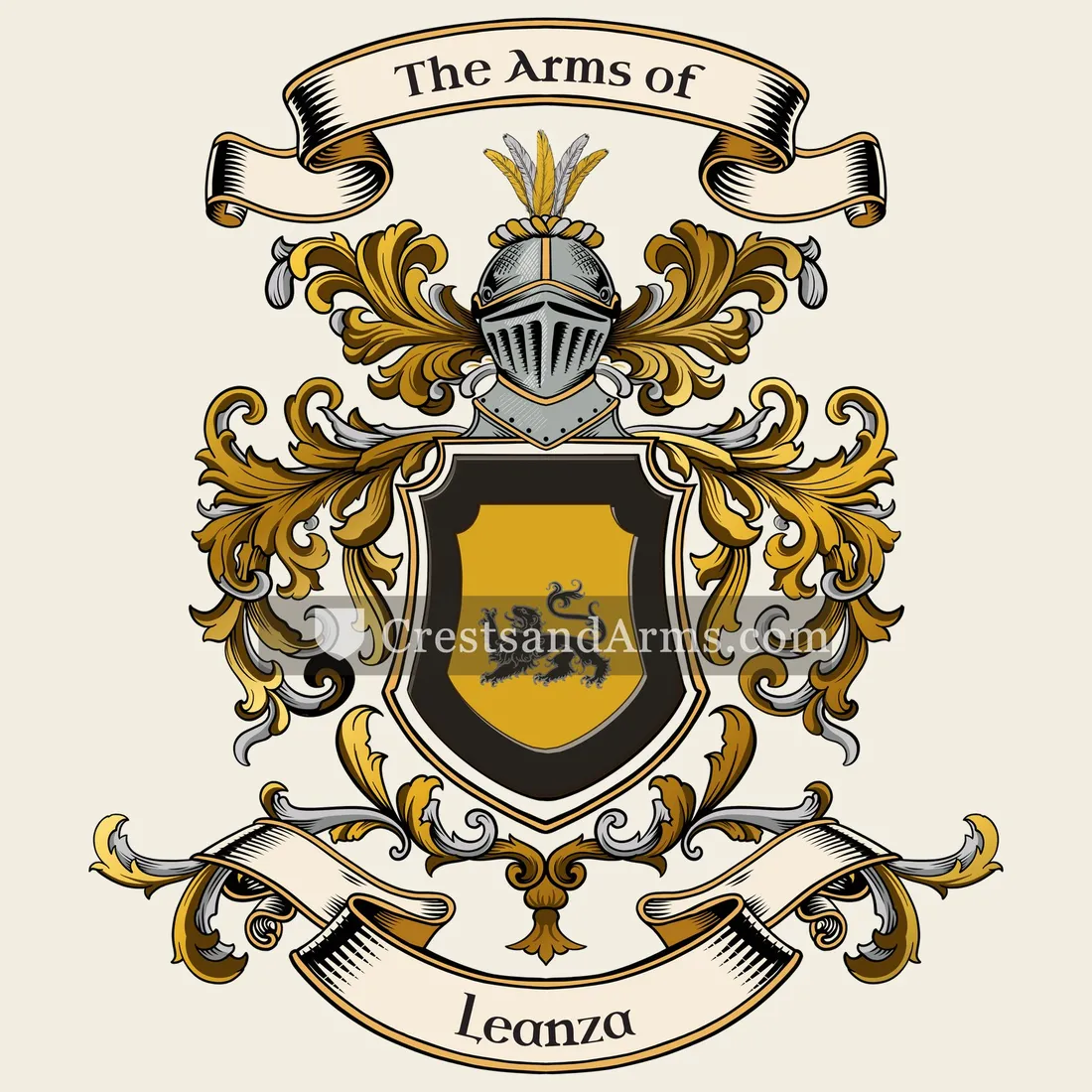
Leo
Latin word meaning lion, representing strength and courage.
This name
LeanzaA diminutive form indicating a descendant or person associated with a lion.
Documented Sources
J. B. Rietstap, Armorial Général, Gouda: G. B. van Goor Zonen, 1884–87
Archivio di Stato di Napoli, Stato Civile della Restaurazione
Colletta, Pietro, Storia del Reame di Napoli dal 1734 sino al 1825, 1834
De Seta, Cesare, Napoli, 1981
Digital archive packCoat of arms PNG, gold border print PDF, vector SVG and the certificate of authenticity. Sent to your email in minutes.


 lionCourage, strength and royalty
 lionCourage, strength and royalty