Map of France showing where the Leber arms are recorded
The Leber arms were recorded in Paris, c. 1663.
This is where the arms were entered in the register. Families often moved to other parts of the country, so the same name can turn up in more than one region.
The body that granted and recorded arms in France in this period.
Louis XIV of France
Sovereign of the period
Louis XIV of France
1643–1715
Reigning in France when the Leber arms are first recorded.
How Arms Worked in France
In France, a coat of arms was a mark of honor that passed down through the male line to all legitimate descendants. Families often used the same shield without changes to show their shared heritage. If a branch wanted to stand out, they could add a small mark to their shield to show their specific place in the family tree.
Granting authority
The Juge d'armes de France acted as the official authority that regulated and verified coats of arms across the country.
How they got arms
Families typically inherited their arms from ancestors, though they could also receive them through royal grants or by proving their noble status.
Where arms were recorded
Coats of arms were officially recorded in the Armorial Général de France, which began its main collection in the year 1696.
The family's standing
Recorded among the armigerous families of France.
Origin & History of the Leber Family in France
The family name Leber carries a deep history rooted in the social fabric of seventeenth-century France. By the year 1663, records confirm that members of the Leber family were established residents of Paris. During this era, the name was often associated with individuals who held roles in trade or local administration within the bustling capital. The structure of the name suggests it may have originated as a descriptive nickname, potentially referring to a person’s physical traits or their specific occupation within the community. As the family navigated the complex hierarchies of the French monarchy, they became part of the growing urban middle class that helped define the city during the reign of King Louis XIV. Their presence in Paris during this time highlights a period of significant cultural and economic development in France, where families like the Lebers contributed to the daily life and stability of the nation.
Meaning of the Leber family crest colors & symbols
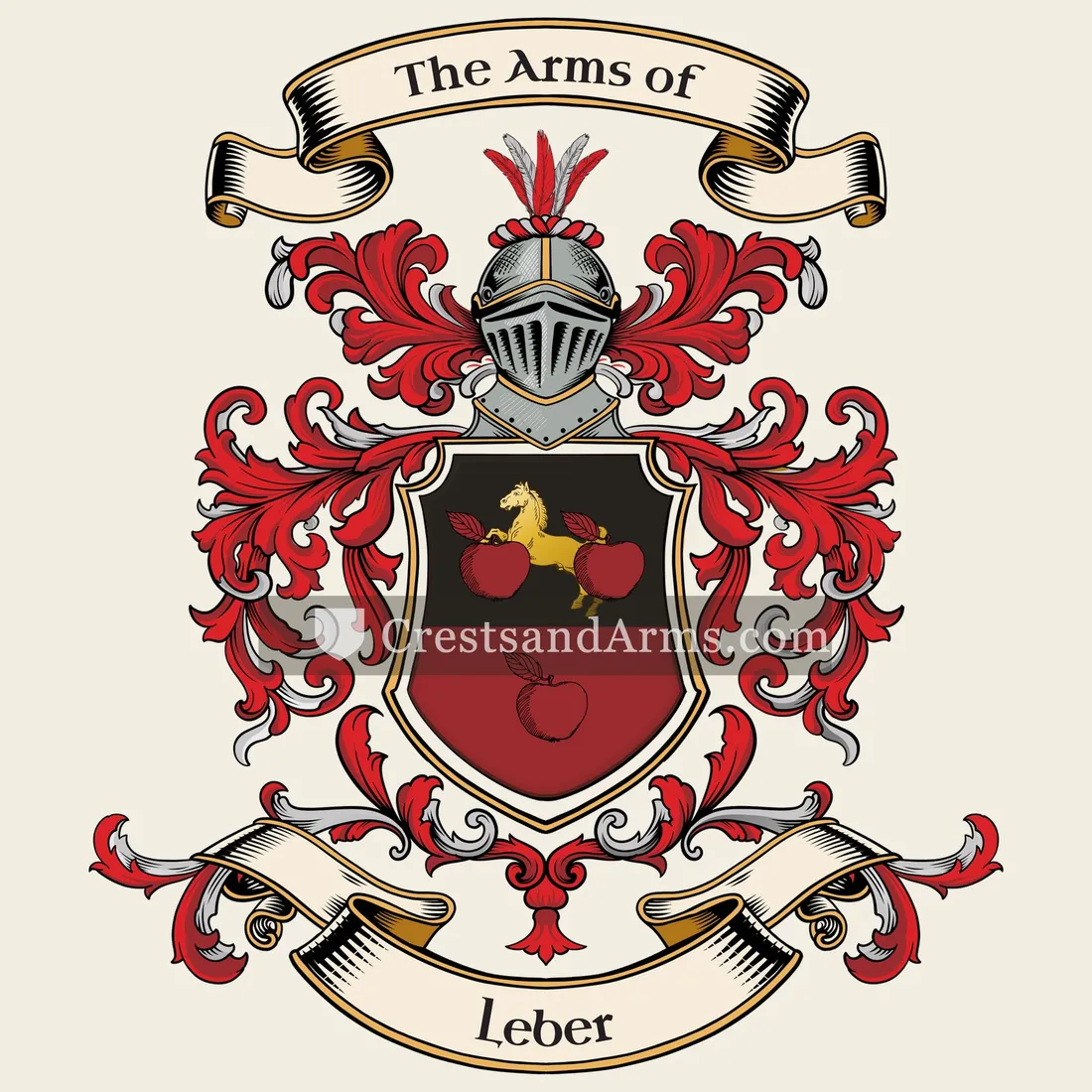
Symbols on this shield
applePeace, plenty and long-standing settlement
horseReadiness to serve king and country
Colours
Black (Sable)Means: Constancy
Red (Gules)Means: Military strength
Gold (Or)Means: Generosity
Historical info
Source
J. B. Rietstap, Armorial Général, Gouda: G. B. van Goor Zonen, 1884–87
Blazon (the actual original written record)
“Coupé: au 1 de sa. à un cheval naiss. d'or. mouv. du coupé, bridé de gu.; au 2 parti: a. cinq points de gu., équipollés à quatre d'or; b. d'or à trois pommes de gu., la queue en bas, 2 et 1. Cq. cour. C.: un More iss., tort. d'or; entre deux prob., coupées alt. d'or et de sa., qu'il empoigne de ses mains. L. d'or et de sa.”
SilesiaSilesia, c. 1765
Digital archive packCoat of arms PNG, gold border print PDF, vector SVG and the certificate of authenticity. Sent to your email in minutes.
Map of Germany showing where the Leber arms are recorded
The Leber arms were recorded in Silesia, c. 1765.
Silesia was farming country in the east of the German lands, held in large estates by families who stayed put for generations. Owning land was what entitled a family to arms, so the region fills a good deal of the register.
This is where the arms were entered in the register. Families often moved to other parts of the country, so the same name can turn up in more than one region.
The body that granted and recorded arms in Germany in this period.
Francis I, Holy Roman Emperor
Sovereign of the period
Francis I, Holy Roman Emperor
1745–1765
Reigning in France when the Leber arms are first recorded.
How Arms Worked in Germany
In the Holy Roman Empire, coats of arms were often granted to individuals by the Emperor or his representatives. These arms were then passed down through the generations to all legitimate descendants of the original holder. Younger branches of a family usually kept the same shield design without needing to change it, as the arms belonged to the entire lineage.
Granting authority
The Holy Roman Emperor held the sole power to grant new coats of arms throughout his vast imperial territories.
How they got arms
Families typically obtained their coats of arms through a formal imperial grant or by proving their noble status to the authorities.
Where arms were recorded
These grants were officially recorded in the Imperial Chancery registers, which began keeping formal records of such honors during the Middle Ages.
The family's standing
Recorded among the armigerous families of Silesia.
Origin & History of the Leber Family in Germany
The surname Leber is rooted in the German language and likely originated as a descriptive nickname or a professional identifier. In Middle High German, the word *leber* refers to the liver, which was historically associated with the seat of courage and vitality in medieval thought. It is probable that the name was first given to a person known for their bold or spirited personality. By the mid-eighteenth century, the family had established a notable presence in the region of Silesia. Records from 1765 confirm that members of the Leber family were living and working within this territory, which was a vibrant center of trade and agriculture at the time. These early ancestors were part of the social fabric of the Prussian lands, contributing to the local economy and community life during a period of significant regional development.
Leber Meaning & Related Branches
Root word
Le Bel
Old French term meaning the beautiful or the handsome one.
This name
LeberA descriptive nickname originally used to identify a person of attractive physical appearance.
also spelled
Leberr
Leberre
Leberh
Documented Sources
J. B. Rietstap, Armorial Général, Gouda: G. B. van Goor Zonen, 1884–87
Archives Nationales, Minutier central des notaires de Paris
Boudet, Marcel, Les familles parisiennes au XVIIe siècle, 1924
Lefebvre, Georges, La vie quotidienne à Paris sous Louis XIV, 1957
Digital archive packCoat of arms PNG, gold border print PDF, vector SVG and the certificate of authenticity. Sent to your email in minutes.


 crescentHonour by the sovereign, and the second son
 crescentHonour by the sovereign, and the second son



 applePeace, plenty and long-standing settlement
 horseReadiness to serve king and country