Map of Belgium showing where the le Clercq arms are recorded
The le Clercq arms were recorded in Malines, c. 1737.
This is where the arms were entered in the register. Families often moved to other parts of the country, so the same name can turn up in more than one region.
The body that granted and recorded arms in Belgium in this period.
Charles VI, Holy Roman Emperor
Sovereign of the period
Charles VI, Holy Roman Emperor
1711–1740
Reigning in Belgium when the le Clercq arms are first recorded.
How Arms Worked in Belgium
In Belgium, a coat of arms is considered personal property that is passed down through the male line to legitimate descendants. Families often use the same shield design across generations to show their shared heritage. If a branch of the family wants to change the design, they must apply for an official update to their specific version of the arms.
Granting authority
The Conseil héraldique is the official body that regulates and approves all coats of arms in Belgium.
How they got arms
Families obtain their coats of arms through formal royal grants or by confirming their historical right to use existing designs.
Where arms were recorded
All approved coats of arms are officially recorded in the public registers of the Conseil héraldique since 1844.
The family's standing
Recorded among the armigerous families of Belgium.
Origin & History of the le Clercq Family in Belgium
The name Le Clercq is a classic occupational surname that originated in the Middle Ages, derived from the French word for a clerk or a member of the clergy. In the context of the Southern Netherlands, which is modern-day Belgium, the name reflects a time when families were often identified by the professional roles they performed within their local communities. By the early 18th century, the family had established a notable presence in the city of Malines, also known as Mechelen. Records from 1737 confirm that members of the Le Clercq family were active participants in the social and civic life of this historic city. During this period, Malines served as a significant administrative and religious hub, providing a stable environment for families to settle and grow. The presence of the family in such a prominent location suggests they were well-integrated into the urban fabric of the region, likely contributing to the local trade or administrative sectors that defined the city at that time.
Meaning of the le Clercq family crest colors & symbols
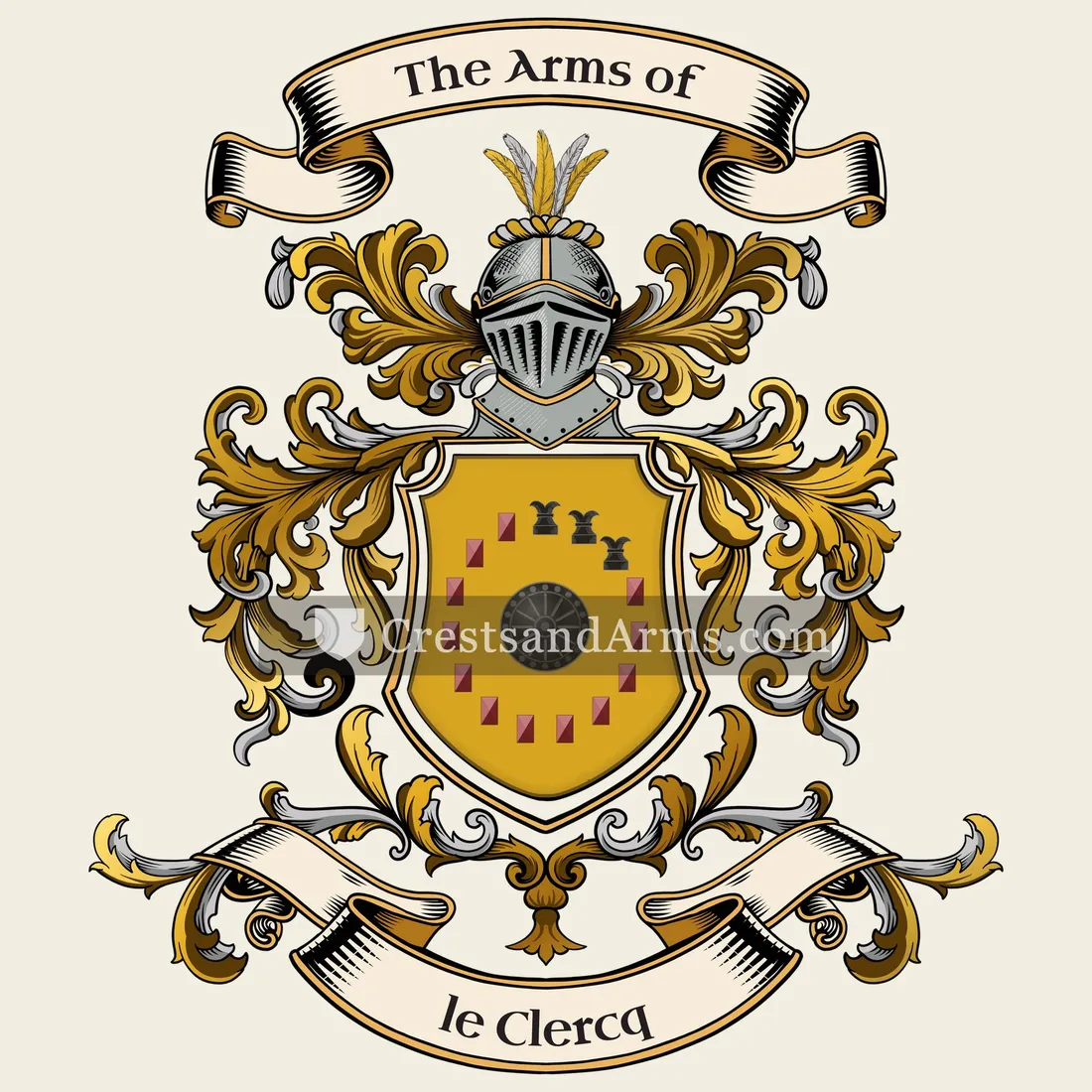
Symbols on this shield
roundelA coin, and one who has been to the crusades
chess rookStrategy, and the defence of a position
billetThe sealed letter, and a message delivered
Colours
Gold (Or)Means: Generosity
Black (Sable)Means: Constancy
Red (Gules)Means: Military strength
Historical info
Source
J. B. Rietstap, Armorial Général, Gouda: G. B. van Goor Zonen, 1884–87
Blazon (the actual original written record)
“D'or à un tourt. de sa., acc. de trois rocs d'échiquier du même, le tout acc. de dix-neuf bill. de gu., posées 5, 4, 4, 2 et 4.”
ArtoisArtois, c. 1663
Digital archive packCoat of arms PNG, gold border print PDF, vector SVG and the certificate of authenticity. Sent to your email in minutes.
Map of France showing where the le Clercq arms are recorded
The le Clercq arms were recorded in Artois, c. 1663.
Artois lay on the disputed ground between France and the Low Countries and was fought over for centuries. Families there held their land under arms, and a shield was how a fighting household was known.
This is where the arms were entered in the register. Families often moved to other parts of the country, so the same name can turn up in more than one region.
The body that granted and recorded arms in France in this period.
Louis XIV of France
Sovereign of the period
Louis XIV of France
1643–1715
Reigning in Belgium when the le Clercq arms are first recorded.
How Arms Worked in France
In France, a coat of arms was a mark of honor that passed down through the male line to all legitimate descendants. Families often used the same shield without changes to show their shared heritage. If a branch wanted to stand out, they could add a small mark to their shield to show their specific place in the family tree.
Granting authority
The Juge d'armes de France acted as the official authority that regulated and verified coats of arms across the country.
How they got arms
Families typically inherited their arms from ancestors, though they could also receive them through royal grants or by proving their noble status.
Where arms were recorded
Coats of arms were officially recorded in the Armorial Général de France, which began its main collection in the year 1696.
The family's standing
Recorded among the armigerous families of Artois.
Origin & History of the le Clercq Family in France
The surname Le Clercq is deeply rooted in the linguistic and social landscape of medieval France, originating as a descriptive term for a clerk or a member of the clergy. Because the Catholic Church played a central role in record-keeping and education during the Middle Ages, many individuals who served in administrative or religious capacities adopted this name to reflect their professional status. By the mid-17th century, the family established a notable presence in the province of Artois, a region in northern France known for its complex history of shifting borders and cultural exchange between French and Flemish influences. Records confirm that members of the Le Clercq family were active in this area by 1663, living through a period when Artois was transitioning from Spanish rule to become a permanent part of the French kingdom. This geographic placement suggests that the family was well-integrated into the local social fabric of the region, likely participating in the agricultural or merchant activities that defined life in the northern provinces during the reign of King Louis XIV.
Meaning of the le Clercq family crest colors & symbols
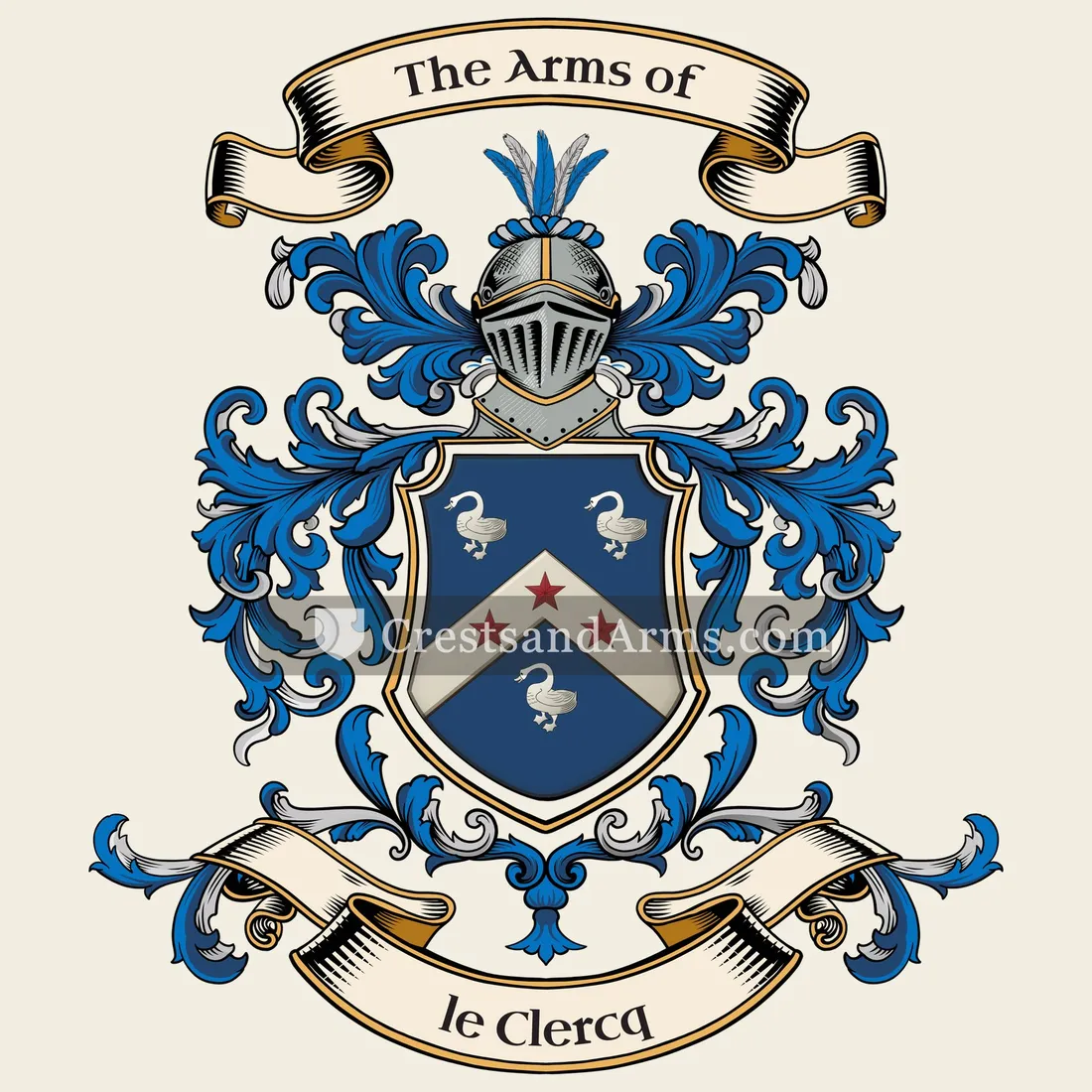
Symbols on this shield
chevronProtection, and faithful service completed
mulletThe third son, and a divine quality from above
swanGrace, light and the poet's art
Colours
Blue (Azure)Means: Loyalty and truth
Silver (Argent)Means: Peace and sincerity
Red (Gules)Means: Military strength
Historical info
Source
J. B. Rietstap, Armorial Général, Gouda: G. B. van Goor Zonen, 1884–87
Blazon (the actual original written record)
“D'azur au chev. d'arg., ch. de trois étoiles de gu. et acc. de trois cygnes démembrés du sec.”
Netherlandsc. 1815
Digital archive packCoat of arms PNG, gold border print PDF, vector SVG and the certificate of authenticity. Sent to your email in minutes.
Map of Netherlands showing where the le Clercq arms are recorded
The le Clercq arms were recorded in Netherlands, c. 1815.
Arms such as these were typically recorded in Friesland.
Friesland was low, wet country on the northern coast of the Netherlands, farmed by families who had held the same land for centuries. Free landholders were unusually common there, and a free landholder could carry arms.
This is where the arms were entered in the register. Families often moved to other parts of the country, so the same name can turn up in more than one region.
Region
Friesland
First recorded
1815
Granting Authority for the le Clercq Arms
Hoge Raad van Adel
Photograph made by me · CC BY-SA 3.0
The body that granted and recorded arms in Netherlands in this period.
William I of the Netherlands
Sovereign of the period
William I of the Netherlands
1815–1840
Reigning in Belgium when the le Clercq arms are first recorded.
How Arms Worked in Netherlands
In the Netherlands, coats of arms were often used by noble families and those who held specific public offices. These arms were passed down through the generations to legitimate descendants. Younger branches of a family usually kept the original design without needing to add special marks. This system ensured that the family identity remained clear and consistent over many years.
Granting authority
The Hoge Raad van Adel is the official body that regulates and manages noble titles and coats of arms in the Netherlands.
How they got arms
Families typically obtained their coats of arms through official royal grants or by proving their long-standing historical use of the symbols.
Where arms were recorded
Coats of arms are officially recorded in the registers held by the Hoge Raad van Adel, which began its work in 1814.
The family's standing
Recorded among the armigerous families of Netherlands.
Origin & History of the le Clercq Family in Netherlands
The name Le Clercq originates from the Old French word for a clerk or a scholar, which historically referred to someone who could read and write or served in a religious role. While the name has deep roots in France and Belgium, its presence in the Netherlands became more prominent during the late eighteenth and early nineteenth centuries. By 1815, records confirm that members of the Le Clercq family were established in the province of Friesland. During this period, the Netherlands underwent significant administrative changes, including the formal registration of surnames under the Napoleonic civil code. Families like the Le Clercqs often moved across borders due to shifting political boundaries and the search for new economic opportunities in the northern provinces. Their settlement in Friesland reflects a broader pattern of migration where families brought their trade skills and professional backgrounds into new Dutch communities.
le Clercq Meaning & Related Branches
Root word
Clericus
A member of the clergy or a learned person in Latin.
This name
le ClercqRefers to a person who served as a clerk, scribe, or member of the church.
also spelled
Clercq
Clercqe
Clercqh
le Klerk
Related arms
Veldemansimilar arms
Verguette d'Albansimilar arms
Documented Sources
J. B. Rietstap, Armorial Général, Gouda: G. B. van Goor Zonen, 1884–87
Stadsarchief Mechelen, Bevolkingsregisters en parochieregisters van Mechelen
Rijksarchief te België, Registers van de Burgerlijke Stand en de Parochieregisters
Debrabandere, Frans, Woordenboek van de familienamen in België en Noord-Frankrijk, 2003
Dauzat, Albert, Dictionnaire étymologique des noms de famille et prénoms de France, 1951
Digital archive packCoat of arms PNG, gold border print PDF, vector SVG and the certificate of authenticity. Sent to your email in minutes.


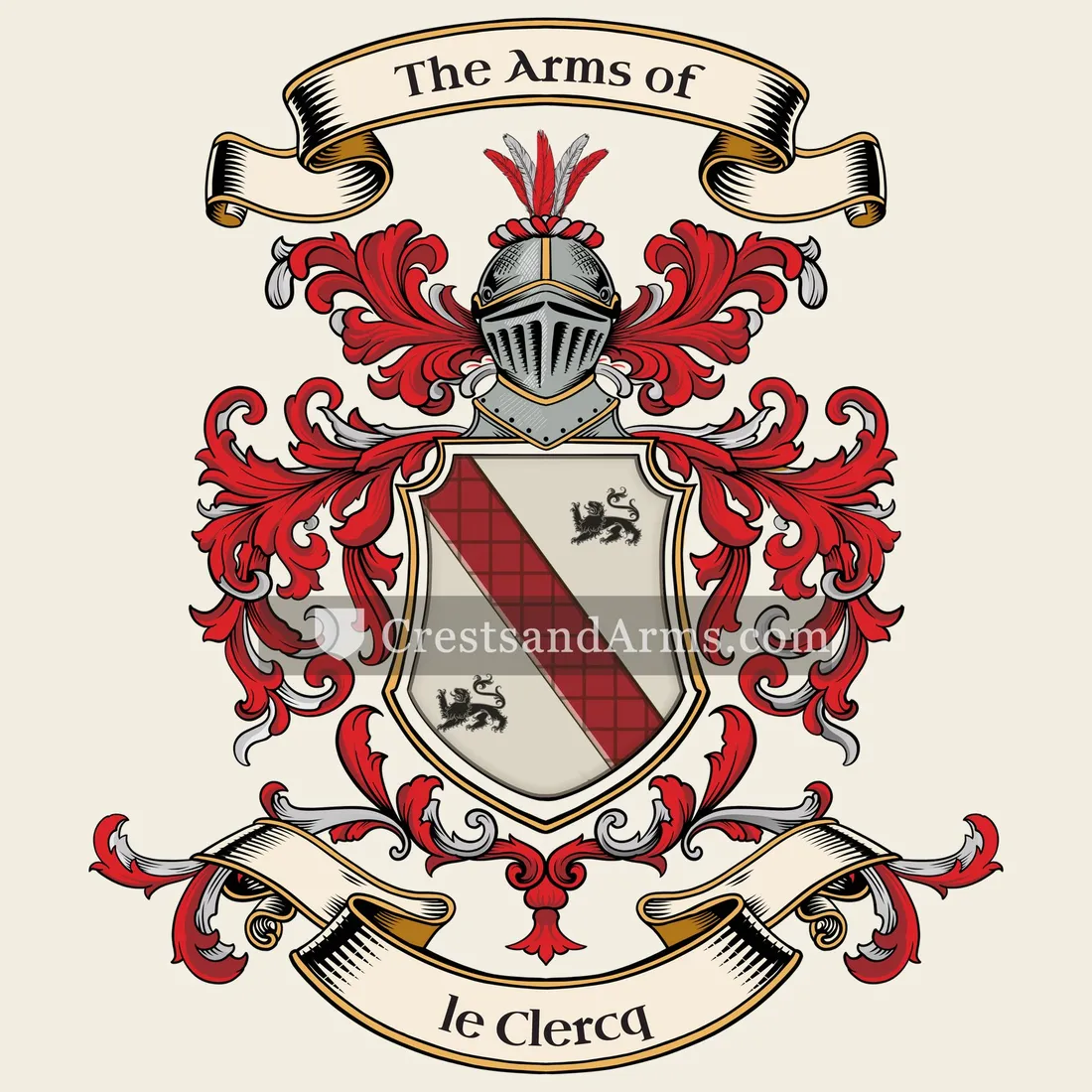
 bendDefence, and the scarf of a commander
 lionCourage, strength and royalty
 bendDefence, and the scarf of a commander
 lionCourage, strength and royalty


 roundelA coin, and one who has been to the crusades
 chess rookStrategy, and the defence of a position
 billetThe sealed letter, and a message delivered


 chevronProtection, and faithful service completed
 mulletThe third son, and a divine quality from above
 swanGrace, light and the poet's art