Map of Ireland showing where the Leech arms are recorded
The Leech arms were recorded in Cork, c. 1645.
Cork was the largest county in Ireland, with a great harbour and a wide farming hinterland. Both English settlers and older Irish families held land there, and holding land is what brought a family into the records.
This is where the arms were entered in the register. Families often moved to other parts of the country, so the same name can turn up in more than one region.
The body that granted and recorded arms in Ireland in this period.
Charles I of England
Sovereign of the period
Charles I of England
1625–1649
Reigning in Ireland when the Leech arms are first recorded.
How Arms Worked in Ireland
The Ulster King of Arms granted coats of arms to individuals who proved their social standing and good character. These symbols were typically inherited by all legitimate descendants of the original holder. If a family branch wanted a unique look, they could apply for a specific change to their design through the office to ensure their identity remained distinct.
Granting authority
The Ulster King of Arms acted as the official body that regulated and issued all coats of arms throughout Ireland.
How they got arms
Families obtained their arms through formal grants issued by the office after proving their eligibility and paying the required fees.
Where arms were recorded
All official grants were recorded in the registers held by the Ulster King of Arms starting from the year 1552.
The family's standing
Recorded among the armigerous families of Cork.
Origin & History of the Leech Family in Ireland
The surname Leech has deep roots in Ireland, particularly within County Cork, where records confirm the family’s presence as early as 1645. The name itself is occupational, derived from the Middle English word *leche*, which referred to a physician or a healer. In the context of seventeenth-century Ireland, families bearing this name were often associated with the medical profession, serving as practitioners who used traditional herbal remedies and early surgical techniques. As the family established itself in the Cork region, they became part of the shifting social landscape during a time of significant political upheaval. Over the generations, the Leech family integrated into the local community, transitioning from their initial roles as healers to become landowners and active participants in the economic life of southern Ireland. Their history reflects the broader movement of families who settled in the province of Munster and helped shape the regional identity of Cork through their professional contributions and long-term residency.
Meaning of the Leech family crest colors & symbols
Symbols on this shield
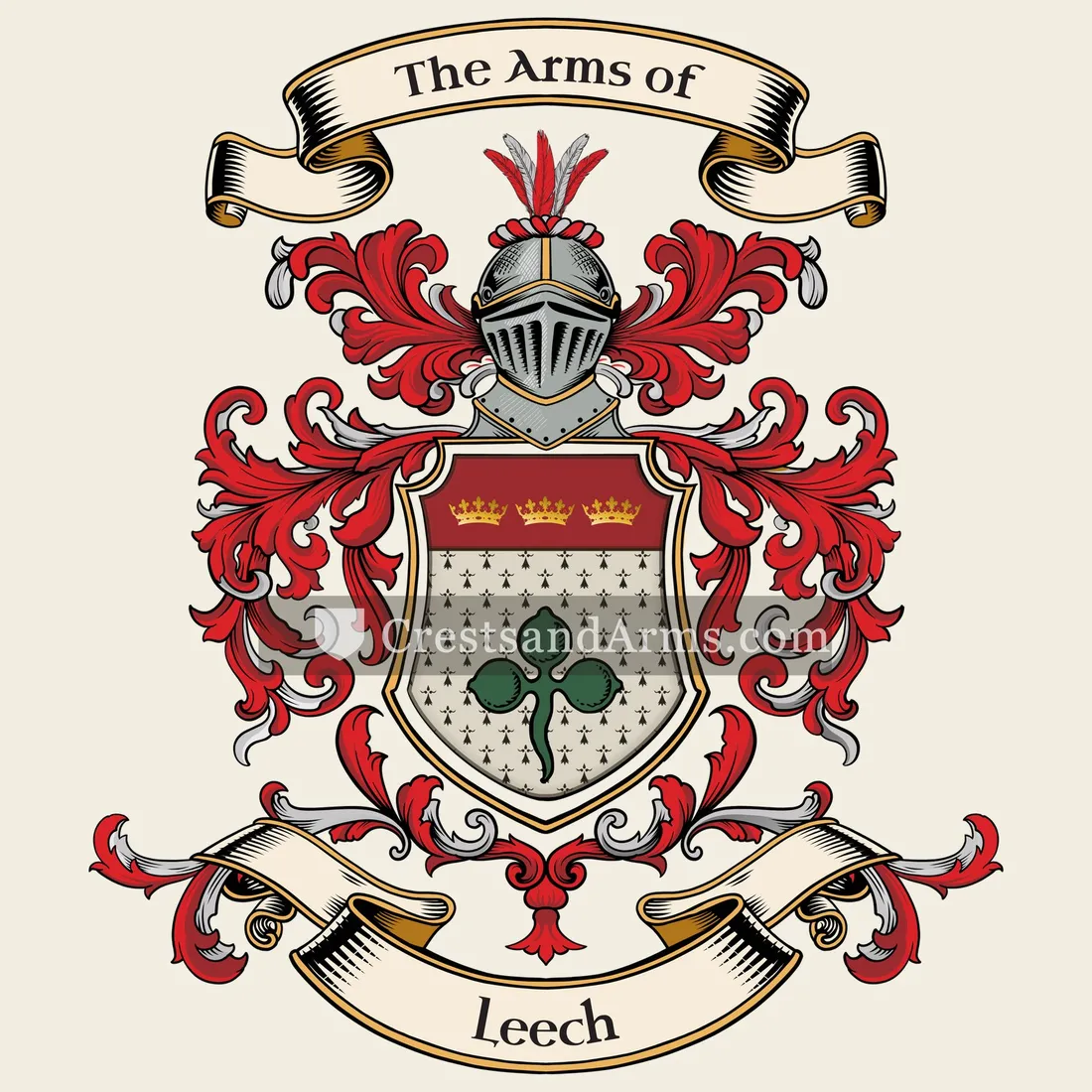
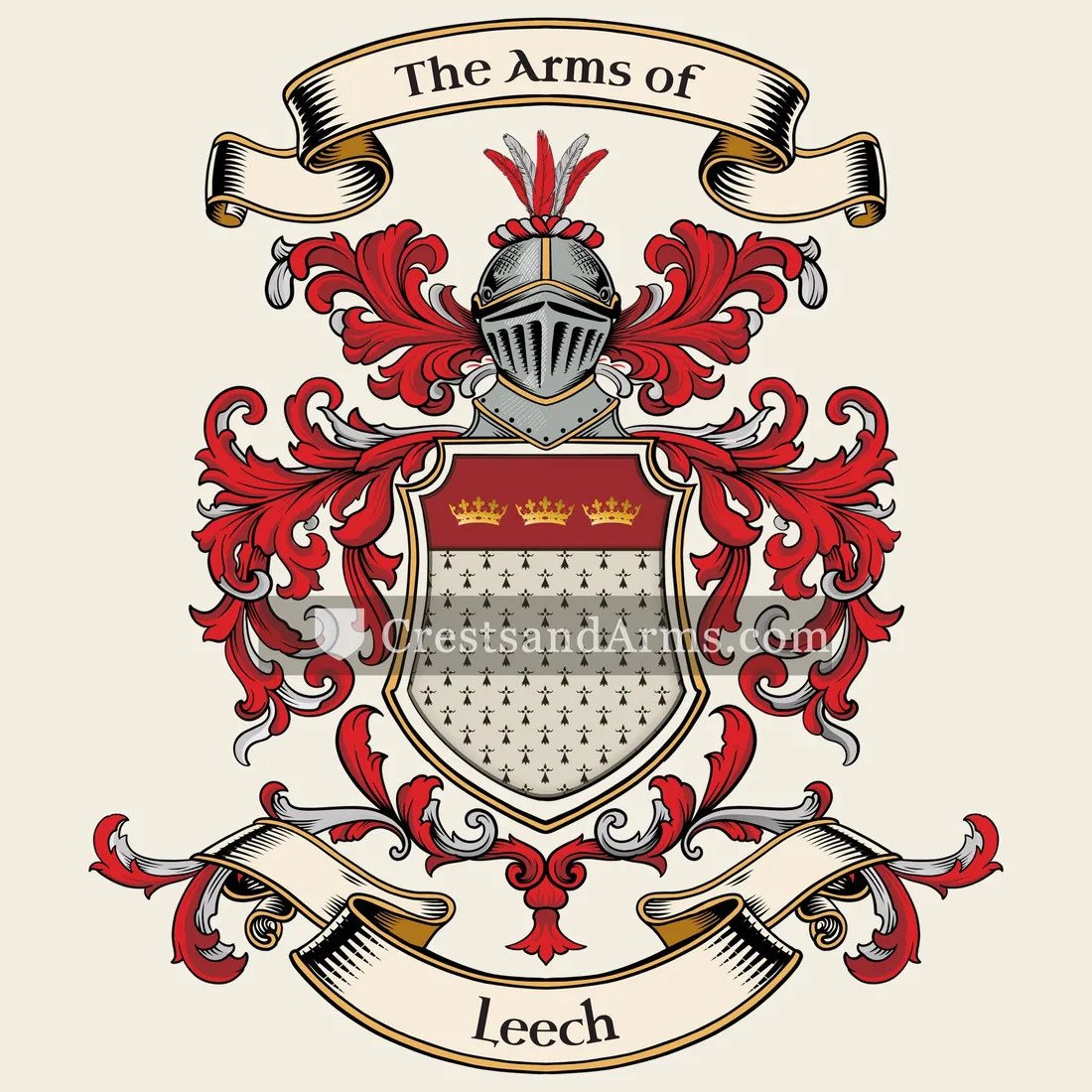
chiefAuthority, wisdom and dominion
crownSovereignty, authority and just reward
Colours
ErmineMeans: Dignity
Red (Gules)Means: Military strength
Gold (Or)Means: Generosity
Historical info
Source
Sir Bernard Burke, The General Armory of England, Scotland, Ireland and Wales, London: Harrison & Sons, 1884
Blazon (the actual original written record)
“Erm. on a chief dancettée gu. three ducal coronets or”
KentKent, c. 1620
Digital archive packCoat of arms PNG, gold border print PDF, vector SVG and the certificate of authenticity. Sent to your email in minutes.
Map of England showing where the Leech arms are recorded
The Leech arms were recorded in Kent, c. 1620.
Kent sits between London and the short crossing to Europe, and the trade passing through made it wealthy. Merchant families bought land with that money, and it was landowners who took coats of arms.
This is where the arms were entered in the register. Families often moved to other parts of the country, so the same name can turn up in more than one region.
The body that granted and recorded arms in England in this period.
James VI and I
Sovereign of the period
James VI and I
1603–1625
Reigning in Ireland when the Leech arms are first recorded.
How Arms Worked in England
English heraldry allowed arms to be shared by all legitimate descendants of the original owner. These symbols were treated as personal property that moved through the generations to all children. While the eldest son kept the original design, other family members could use the same shield without needing to change it or register their own unique versions.
Granting authority
The College of Arms in London has regulated the use of coats of arms throughout England and Wales since 1484.
How they got arms
Families typically obtained their coats of arms through a formal grant from the Crown or by proving their ancient right to them.
Where arms were recorded
All official coats of arms are recorded in the registers kept at the College of Arms, which date back to the fifteenth century.
The family's standing
Recorded among the armigerous families of Kent.
Origin & History of the Leech Family in England
The surname Leech is an occupational name that originated in medieval England. It was traditionally given to individuals who practiced medicine or served as healers, as the word was a common term for a physician during the Middle Ages. By the time the family was firmly established in Kent in 1620, the name had been in use for several centuries across various English counties. Families with this name often lived in rural communities where they provided essential healthcare services to their neighbors. As record-keeping became more formal in the seventeenth century, the presence of the Leech family in Kent suggests they were part of a stable and settled population during a period of significant social change. Their history reflects the broader evolution of English surnames, which transitioned from simple descriptions of a person’s trade to permanent family identifiers passed down through generations.
Meaning of the Leech family crest colors & symbols
Symbols on this shield
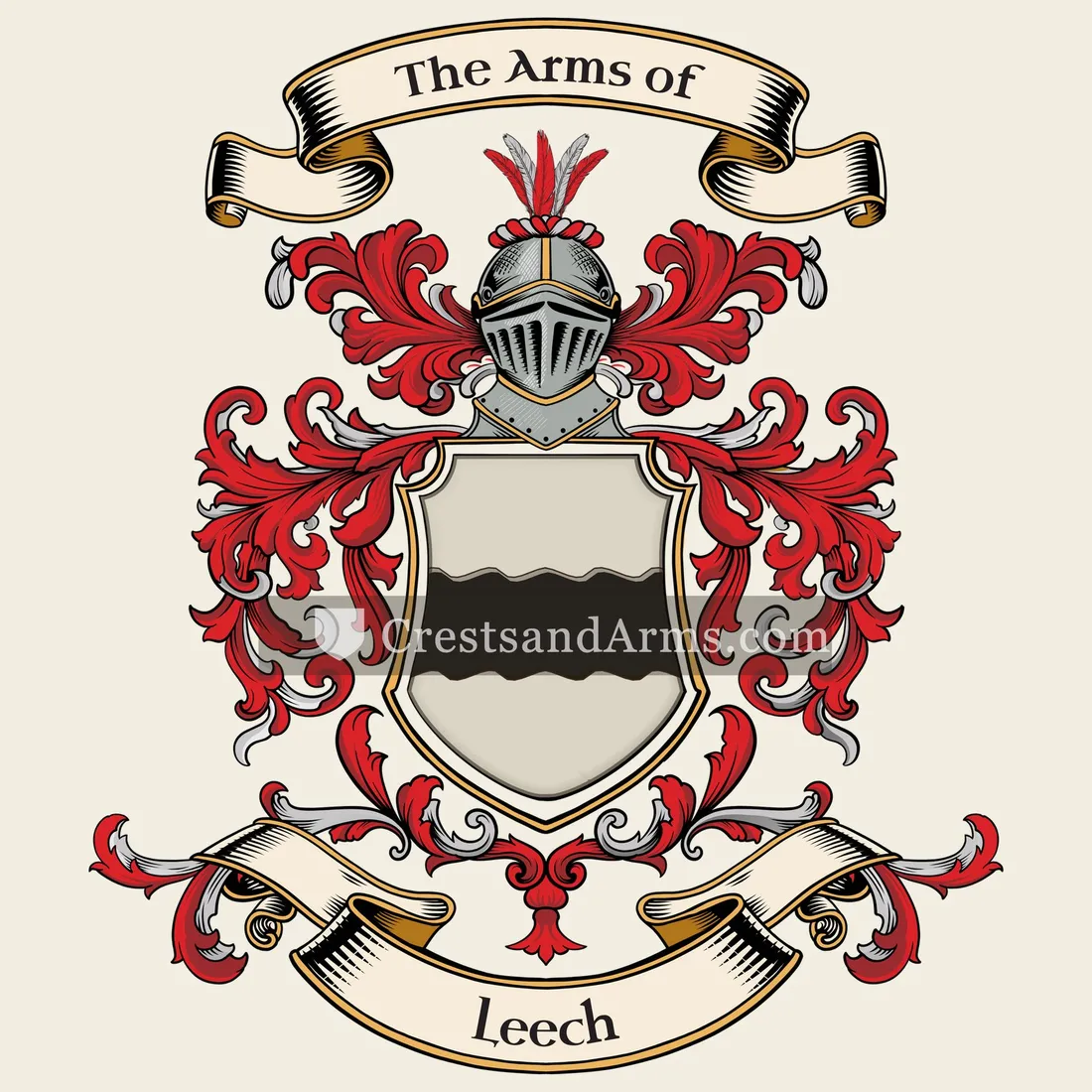
fessThe military belt, and readiness to serve
Colours
Silver (Argent)Means: Peace and sincerity
Black (Sable)Means: Constancy
Historical info
Source
Sir Bernard Burke, The General Armory of England, Scotland, Ireland and Wales, London: Harrison & Sons, 1884
Blazon (the actual original written record)
“Ar. a fesse wavy sa”
Scotlandc. 1748
Digital archive packCoat of arms PNG, gold border print PDF, vector SVG and the certificate of authenticity. Sent to your email in minutes.
Map of Scotland showing where the Leech arms are recorded
The Leech arms were recorded in Scotland, c. 1748.
Arms such as these were typically recorded in Edinburgh.
Edinburgh was the seat of Scotland's government, its courts and its heralds. Families with business there settled nearby, and being close to where arms were recorded is exactly why so many of them appear.
This is where the arms were entered in the register. Families often moved to other parts of the country, so the same name can turn up in more than one region.
The body that granted and recorded arms in Scotland in this period.
George II of Great Britain
Sovereign of the period
George II of Great Britain
1727–1760
Reigning in Ireland when the Leech arms are first recorded.
How Arms Worked in Scotland
Scottish heraldry is unique because it treats a coat of arms as a piece of personal property protected by law. Only one person can own a specific design at any given time. When a family grows, the head keeps the original shield while other relatives must apply for their own distinct version with slight changes to prove their specific identity.
Granting authority
The Court of the Lord Lyon acts as the official body that regulates and controls all heraldic matters throughout Scotland.
How they got arms
Individuals obtain a legal right to their arms through a formal petition process that confirms their identity and family connection.
Where arms were recorded
All valid coats of arms are officially entered into the Public Register of All Arms and Bearings starting from 1672.
The family's standing
Recorded among the armigerous families of Scotland.
Origin & History of the Leech Family in Scotland
The surname Leech originates from the Middle English word for a physician or a healer. In Scotland, the name was often associated with those who practiced traditional medicine or herbal healing in local communities. By the mid-eighteenth century, the family had established a notable presence in Edinburgh. Records confirm that members of the Leech family were living and working in the city by 1748. During this period, Edinburgh was a major center for the Scottish Enlightenment and a hub for medical study. It is likely that the family members residing there were part of the growing professional class that contributed to the city's reputation for science and education. As the name became more common in the region, it transitioned from a descriptive title for a healer into a permanent family name passed down through generations.
Leech Meaning & Related Branches
Root word
Léice
Old Irish term for a healer or medical practitioner.
This name
LeechAn occupational surname denoting a physician or someone skilled in medicinal arts.
also spelled
Leche
Leach
Leachman
Related arms
Leachvariant spelling
Lechevariant spelling
Leitchvariant spelling
Documented Sources
Sir Bernard Burke, The General Armory of England, Scotland, Ireland and Wales, London: Harrison & Sons, 1884
MacLysaght, Edward, The Surnames of Ireland, 1985
National Archives of Ireland, Civil Survey of the County of Cork, 1654–1656
O'Hart, John, Irish Pedigrees; or, The Origin and Stem of the Irish Nation, 1892
Digital archive packCoat of arms PNG, gold border print PDF, vector SVG and the certificate of authenticity. Sent to your email in minutes.


 chiefAuthority, wisdom and dominion
 trefoilPerpetuity, and the Trinity
 crownSovereignty, authority and just reward
 chiefAuthority, wisdom and dominion
 trefoilPerpetuity, and the Trinity
 crownSovereignty, authority and just reward




 fessThe military belt, and readiness to serve