Map of France showing where the Lefebvre arms are recorded
The Lefebvre arms were recorded in Flandre, c. 1663.
Flandre grew rich on cloth, and its towns were among the busiest in Europe. Merchant families bought land with their profits and took arms to go with it, so trade put as many names in the registers here as land did.
This is where the arms were entered in the register. Families often moved to other parts of the country, so the same name can turn up in more than one region.
The body that granted and recorded arms in France in this period.
Louis XIV of France
Sovereign of the period
Louis XIV of France
1643–1715
Reigning in France when the Lefebvre arms are first recorded.
How Arms Worked in France
In France, a coat of arms was a mark of honor that passed down through the male line to all legitimate descendants. Families often used the same shield without changes to show their shared heritage. If a branch wanted to stand out, they could add a small mark to their shield to show their specific place in the family tree.
Granting authority
The Juge d'armes de France acted as the official authority that regulated and verified coats of arms across the country.
How they got arms
Families typically inherited their arms from ancestors, though they could also receive them through royal grants or by proving their noble status.
Where arms were recorded
Coats of arms were officially recorded in the Armorial Général de France, which began its main collection in the year 1696.
The family's standing
Recorded among the armigerous families of Flandre.
Origin & History of the Lefebvre Family in France
The surname Lefebvre is a classic example of a name derived from a professional trade in medieval France. It comes from the Old French word *fèvre*, which means blacksmith or ironworker. Because metalworking was essential to every village for creating tools and horseshoes, the name appeared independently in many different regions as people were identified by their craft. By the time records place members of the family in the region of Flandre during the mid-1600s, the name had already been established for centuries as a common identifier for families connected to the forge. Living in the northern territories of France, these early ancestors were part of a hardworking population that helped shape the local economy through their specialized skills. The name serves as a historical link to the daily life and labor of the common people who built the foundations of French society.
Coat of Arms & Family Crest Details
Symbols on this shield
greyhoundCourage, vigilance and loyalty
Colours
Blue (Azure)Means: Loyalty and truth
Silver (Argent)Means: Peace and sincerity
Historical info
Source
J. B. Rietstap, Armorial Général, Gouda: G. B. van Goor Zonen, 1884–87
Blazon (the actual original written record)
“D'azur à un lévrier ramp. d'arg., coll. de gu., bouclé d'or.”
Belgiumc. 1725
Digital archive packCoat of arms PNG, gold border print PDF, vector SVG and the certificate of authenticity. Sent to your email in minutes.
Map of Belgium showing where the Lefebvre arms are recorded
The Lefebvre arms were recorded in Belgium, c. 1725.
Arms such as these were typically recorded in Brabant.
Brabant lay at the heart of the Low Countries, where the trade routes met. Its towns were wealthy and its landowners many, and both kinds of family kept arms, which is why the region is so heavily represented.
This is where the arms were entered in the register. Families often moved to other parts of the country, so the same name can turn up in more than one region.
The body that granted and recorded arms in Belgium in this period.
Charles VI, Holy Roman Emperor
Sovereign of the period
Charles VI, Holy Roman Emperor
1711–1740
Reigning in France when the Lefebvre arms are first recorded.
How Arms Worked in Belgium
In Belgium, a coat of arms is considered personal property that is passed down through the male line to legitimate descendants. Families often use the same shield design across generations to show their shared heritage. If a branch of the family wants to change the design, they must apply for an official update to their specific version of the arms.
Granting authority
The Conseil héraldique is the official body that regulates and approves all coats of arms in Belgium.
How they got arms
Families obtain their coats of arms through formal royal grants or by confirming their historical right to use existing designs.
Where arms were recorded
All approved coats of arms are officially recorded in the public registers of the Conseil héraldique since 1844.
The family's standing
Recorded among the armigerous families of Belgium.
Origin & History of the Lefebvre Family in Belgium
The surname Lefebvre originates from the Old French term *le febvre*, which translates to "the smith" or "the craftsman who works with iron." In the context of early Belgian history, this name served as an occupational identifier for individuals who played a vital role in the local economy and village infrastructure. By the year 1725, records confirm that families bearing this name were well-established within the Duchy of Brabant. During this period, the region was a center for trade and agriculture, and those named Lefebvre were often integrated into the social fabric of rural communities as essential metalworkers. As the family grew in Brabant, they became part of the broader demographic shifts that defined the Low Countries, moving from simple trade roles into the diverse professional and civic life of the region. This transition helped the name persist through generations, marking the family as a foundational part of the local history in what is now modern-day Belgium.
Coat of Arms & Family Crest Details
Symbols on this shield
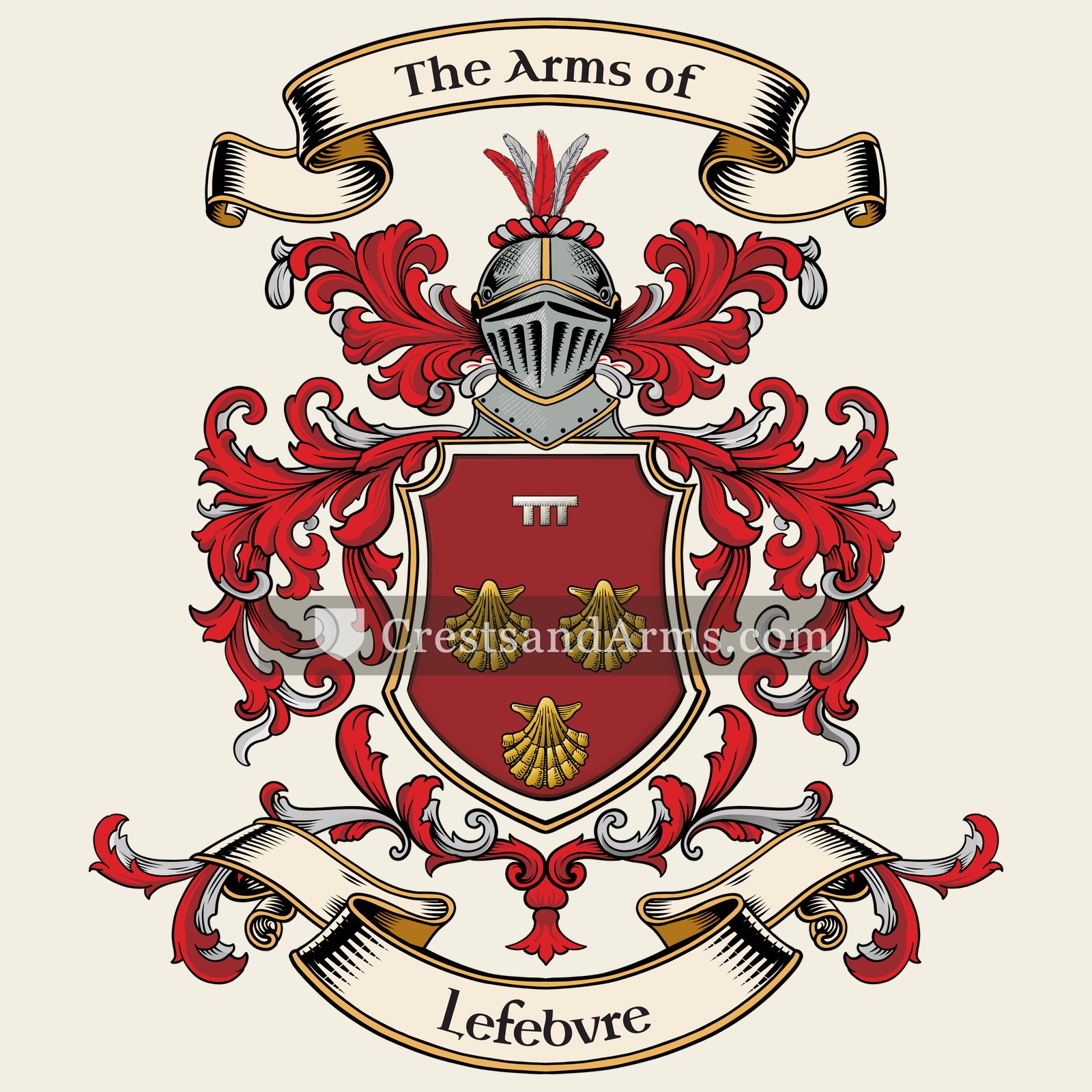
labelThe eldest son, during his father's life
escallopThe pilgrim's shell, and a long journey made
Colours
Red (Gules)Means: Military strength
Gold (Or)Means: Generosity
Silver (Argent)Means: Peace and sincerity
Historical info
Source
Sir Bernard Burke, The General Armory of England, Scotland, Ireland and Wales, London: Harrison & Sons, 1884
Blazon (the actual original written record)
“Gu. three escallops or, in chief a label of three points ar”
EnglandSeigneur, c. 1393
Digital archive packCoat of arms PNG, gold border print PDF, vector SVG and the certificate of authenticity. Sent to your email in minutes.
Map of England showing where the Lefebvre arms are recorded
The Lefebvre arms were recorded in Seigneur, c. 1393.
Arms such as these were typically recorded in York.
Yorkshire is the largest of the English counties, and it held more gentry families than any other. Land there was split among a great many households rather than a few, so a great many of them carried arms.
This is where the arms were entered in the register. Families often moved to other parts of the country, so the same name can turn up in more than one region.
The body that granted and recorded arms in England in this period.
Richard II of England
Sovereign of the period
Richard II of England
1377–1399
Reigning in France when the Lefebvre arms are first recorded.
How Arms Worked in England
English heraldry allowed arms to be shared by all legitimate descendants of the original owner. These symbols were treated as personal property that moved through the generations to all children. While the eldest son kept the original design, other family members could use the same shield without needing to change it or register their own unique versions.
Granting authority
The College of Arms in London has regulated the use of coats of arms throughout England and Wales since 1484.
How they got arms
Families typically obtained their coats of arms through a formal grant from the Crown or by proving their ancient right to them.
Where arms were recorded
All official coats of arms are recorded in the registers kept at the College of Arms, which date back to the fifteenth century.
The family's standing
Recorded among the armigerous families of England.
Origin & History of the Lefebvre Family in England
The name Lefebvre originated in France as a professional title for a blacksmith, which was a vital trade in medieval society. By the late fourteenth century, individuals bearing this name had crossed the English Channel to establish themselves in northern England. Historical records confirm that members of the family were living in the city of York by 1393. During this period, York was a major center for trade and craftsmanship, making it an ideal location for skilled metalworkers to settle. These early settlers likely integrated into the local economy by providing essential ironwork for the growing urban population. Over time, the spelling of the name often shifted to adapt to English pronunciation and record-keeping practices, yet it remained a clear indicator of the family’s ancestral connection to the craft of the forge.
Related Branches & Arms
Root word
Faber
A Latin term referring to a craftsman, smith, or maker.
This name
LefebvreAn occupational surname for a blacksmith or metalworker.
also spelled
Lefebure
Lefebre
Lefevr
Lefever
Lefevre
Related arms
Bacotsimilar arms
Diriex de Rivièresimilar arms
Fabre de Roussacsimilar arms
Febvre (le) d'Argencévariant spelling
Documented Sources
J. B. Rietstap, Armorial Général, Gouda: G. B. van Goor Zonen, 1884–87
Dauzat, Albert, Dictionnaire étymologique des noms et prénoms de France, 1951
Morlet, Marie-Thérèse, Dictionnaire étymologique des noms de famille, 1991
Archives départementales du Nord, Registres paroissiaux et état civil, 1663
Digital archive packCoat of arms PNG, gold border print PDF, vector SVG and the certificate of authenticity. Sent to your email in minutes.


 chevronProtection, and faithful service completed
 mulletThe third son, and a divine quality from above
 acornAntiquity and strength from small beginnings
 chevronProtection, and faithful service completed
 mulletThe third son, and a divine quality from above
 acornAntiquity and strength from small beginnings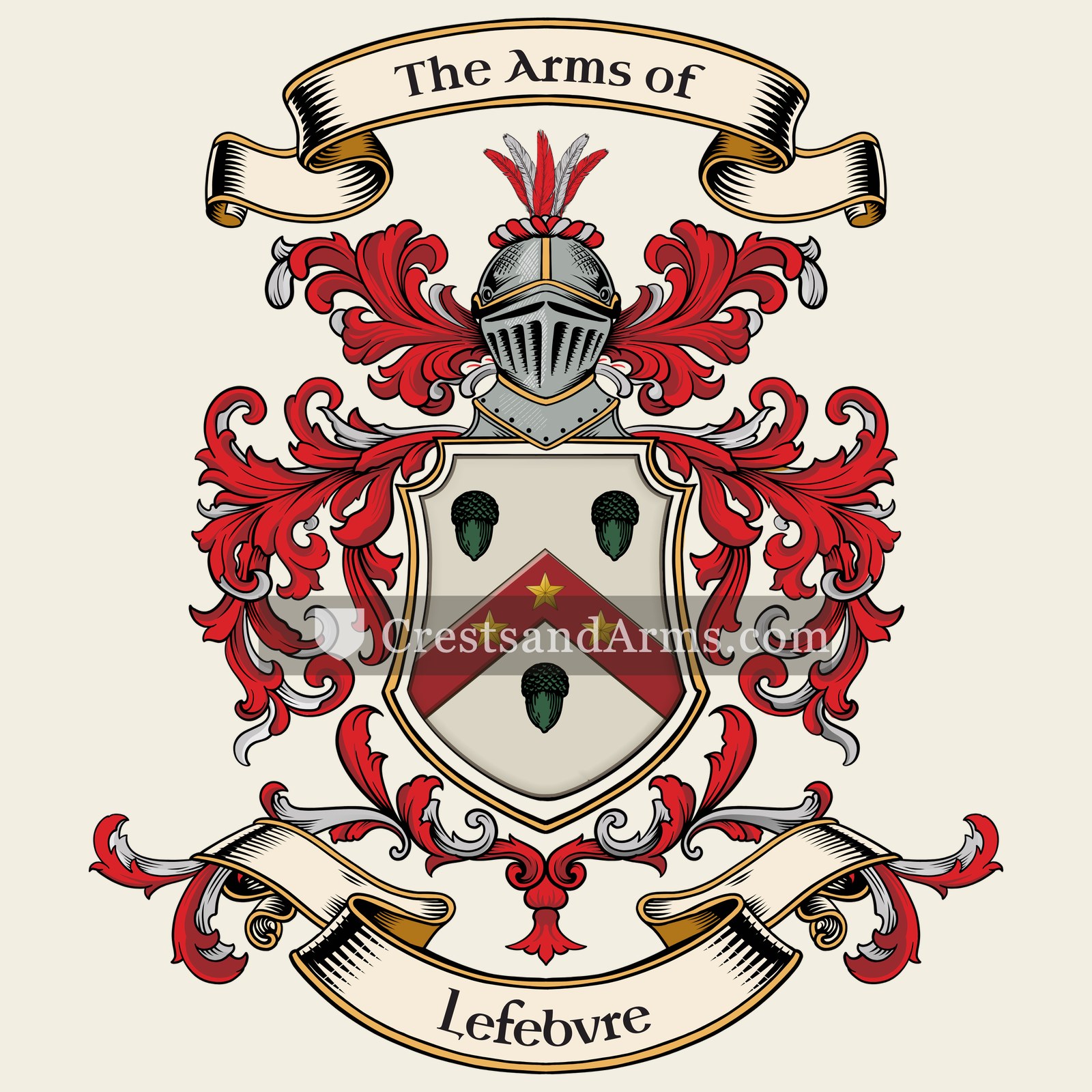


 greyhoundCourage, vigilance and loyalty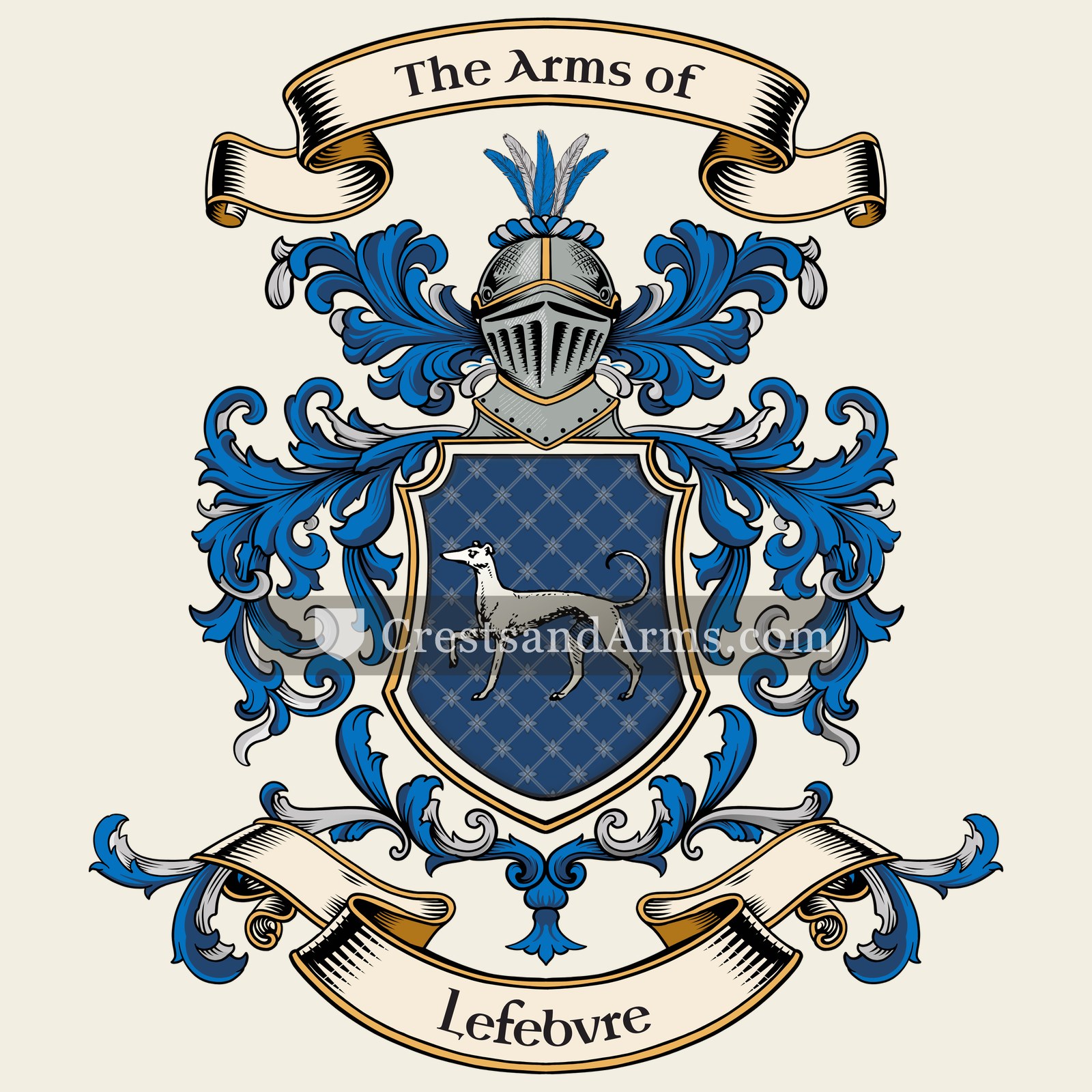


 labelThe eldest son, during his father's life
 escallopThe pilgrim's shell, and a long journey made