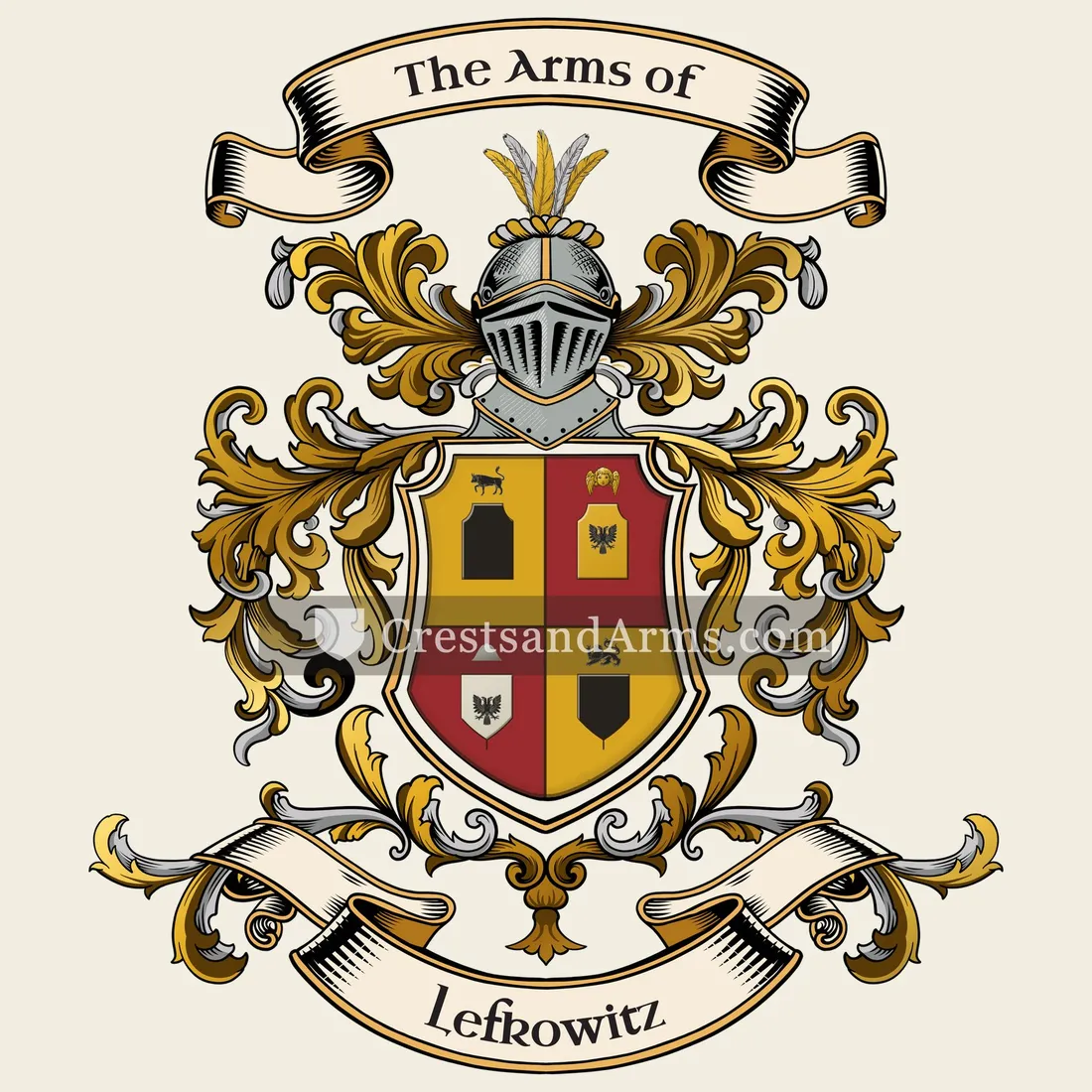
A record of documented arms, meaning and origin, researched for the Lefkowitz family of Austria.
Reg. 1887 · Austrian, J–L
Meaning of the Lefkowitz family crest colors & symbols
Symbols on this shield
mountThe ground held, and steadfastness upon it
bullValour and generosity
cherubDivine protection over the innocent
eagleNobility, strength and a keen mind
lionCourage, strength and royalty
Colours
Gold (Or)Means: Generosity
Red (Gules)Means: Military strength
Black (Sable)Means: Constancy
Silver (Argent)Means: Peace and sincerity
Historical info
Source
J. B. Rietstap, Armorial Général, Gouda: G. B. van Goor Zonen, 1884–87
Blazon (the actual original written record)
“Parti d'un trait, coupé de deux autres, qui font six quartiers: au 1 d'or à un rencontre de buffle de sa., bouclé d'or (Pernstein); au 2 de gu. à un ange iss., mouv. du coupé, chevelé et hab. d'or, ailé de sin., les mains appuyées sur le coupé (Sagan); au 3 d'azur à un rocher de trois pics d'arg. en p., surm. de trois étoiles d'or, 2 et 1 (Sternstein); au 4 d'azur au lion d'or, cour. du même (armes de concession); au 5 d'or à trois pals de sa. (symbole prétendu de la dignité de prince du St.-Empire); au 6 d'or à une aigle de sa., ch. sur la poitrine d'un croiss. supp. une croisette et s'étendant en demi-cercles treflés sur les ailes, le tout d'arg. (duché de Glogau). Sur le tout éc.: a et d. d'arg., au chef de gu. (Popel de Lobkowitz); b. et c. d'arg. à l'aigle de sa., bq., m. et cour. d'or, posée en bande, ch. sur la poitrine d'un croiss. d'or, s'étendant en demi-cercles treflés sur les ailes (Zerotin). Quatre cq. cour. C.: 1° une plume d'autruche d'arg., sortant d'un tuyau de gu. (Popel de Lobkowitz); 2° le rencontre du 1 (Pernstein); 3° six banderoles d'arg. bordées de gu., attachées à des hampes de gu., 3 à dextre et 3 à sen. (Sternstein); 4° un écran en forme d'éventail échiq. de gu. et d'arg., sommé de trois plumes de paon au nat. (cimier des armes de concession du 4e quartier). L. de gu., d'arg., de sa., d'or et d'azur. D.: POPEL SEM, POPEL BUDU (Cendre je suis, cendre je serai). Manteau de pourpre, doublé d'herm., frangé et houppé d'or, sommé d'une couronne princière”
Austriac. 1624
Digital archive packCoat of arms PNG, gold border print PDF, vector SVG and the certificate of authenticity. Sent to your email in minutes.
Map of Austria showing where the Lefkowitz arms are recorded
The Lefkowitz arms were recorded in Austria, c. 1624.
Arms such as these were typically recorded in Tyrol.
Tyrol was mountain country in western Austria, where the valleys were held by families who had been there a very long time. Old tenure counted for more than money, and old families carried arms.
This is where the arms were entered in the register. Families often moved to other parts of the country, so the same name can turn up in more than one region.
Region
Tyrol
First recorded
1624
Granting Authority for the Lefkowitz Arms
Imperial and Royal chancery
Sodacan · CC BY-SA 3.0
The body that granted and recorded arms in Austria in this period.
Ferdinand II, Holy Roman Emperor
Sovereign of the period
Ferdinand II, Holy Roman Emperor
1619–1637
Reigning in Austria when the Lefkowitz arms are first recorded.
How Arms Worked in Austria
Austrian coats of arms were often linked directly to noble titles granted by the Emperor. These symbols belonged to the entire family line rather than just one individual. When a family grew, new branches kept the original design without needing to change it. This system allowed all members of a noble house to share the same identity across many generations.
Granting authority
The Imperial and Royal chancery managed all heraldic matters and controlled the official granting of arms throughout the Austrian lands.
How they got arms
Families typically received their arms through a formal imperial decree that often accompanied the elevation of a person to noble status.
Where arms were recorded
Official records of these grants were kept in the Imperial Register of Nobility which began its formal documentation process in 1453.
The family's standing
Recorded among the armigerous families of Austria.
Origin & History of the Lefkowitz Family in Austria
The surname Lefkowitz is a patronymic name that originates from the Slavic word "Lev," meaning lion. In the context of Jewish naming traditions, this often served as a reference to the biblical Tribe of Judah, which is historically symbolized by a lion. By the early 17th century, members of the family were documented living in the Tyrol region of the Alps. During this period, the family likely moved westward from Eastern Europe, settling into the unique cultural landscape of the Austrian mountains. As they integrated into these new communities, the name evolved to reflect the local linguistic influences of the region while maintaining its original meaning. This transition highlights the mobility of families during the 1600s as they navigated changing borders and sought new opportunities across Central Europe.
Lefkowitz Meaning & Related Branches
Root word
Lev
The Hebrew word for heart.
This name
LefkowitzA patronymic surname meaning son of the Levite, referring to a member of the priestly tribe.
also spelled
Lobkowicz
Lobkowits
Lobkowic
Lobkovits
Documented Sources
J. B. Rietstap, Armorial Général, Gouda: G. B. van Goor Zonen, 1884–87
Kohn, David. Die Geschichte der Juden in Tirol. 1913
Lederer, Zdenek. Ghetto Theresienstadt. 1953
Tiroler Landesarchiv. Judenakten der Statthalterei in Innsbruck. 1624–1750
Digital archive packCoat of arms PNG, gold border print PDF, vector SVG and the certificate of authenticity. Sent to your email in minutes.


 mountThe ground held, and steadfastness upon it
 bullValour and generosity
 cherubDivine protection over the innocent
 eagleNobility, strength and a keen mind
 lionCourage, strength and royalty