Map of Britain showing where the Legard arms are recorded
The Legard arms were recorded in Yorkshire, c. 1660.
This is where the arms were entered in the register. Families often moved to other parts of the country, so the same name can turn up in more than one region.
The body that granted and recorded arms in Britain in this period.
Charles II of England
Sovereign of the period
Charles II of England
1660–1685
Reigning in Britain when the Legard arms are first recorded.
How Arms Worked in Britain
English heraldry allowed arms to be shared by all legitimate descendants of the original owner. These symbols were treated as personal property that moved through the generations to all children. While the eldest son kept the original design, other family members could use the same shield without needing to change it or register their own unique versions.
Granting authority
The College of Arms in London has regulated the use of coats of arms throughout England and Wales since 1484.
How they got arms
Families typically obtained their coats of arms through a formal grant from the Crown or by proving their ancient right to them.
Where arms were recorded
All official coats of arms are recorded in the registers kept at the College of Arms, which date back to the fifteenth century.
The family's standing
Recorded among the armigerous families of Yorkshire.
Origin & History of the Legard Family in Britain
The Legard family established a significant presence in Yorkshire by the mid-seventeenth century, rooting themselves deeply in the social and political landscape of Northern England. While the name likely originated from older roots, the family became prominent figures in the region during the Restoration period of 1660. They were known as members of the landed gentry, often managing large estates and participating in local governance. Their influence grew through strategic marriages and their commitment to the agricultural development of the Yorkshire countryside. Over time, the family became synonymous with the history of the East Riding, where they maintained their ancestral homes and served as influential landowners for generations. This long-standing connection to the land helped the Legard name endure as a fixture of Yorkshire society throughout the centuries.
Coat of Arms & Family Crest Details
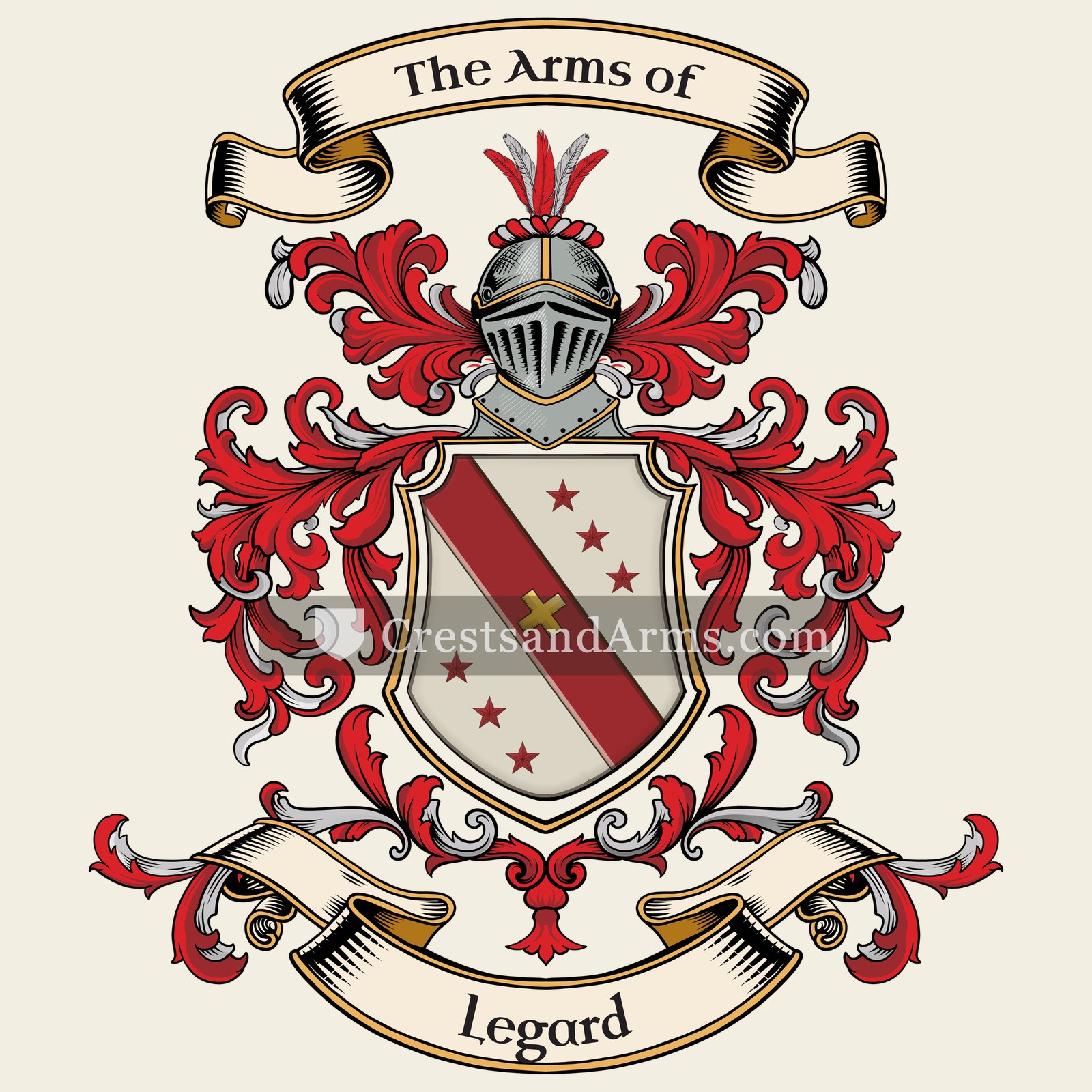
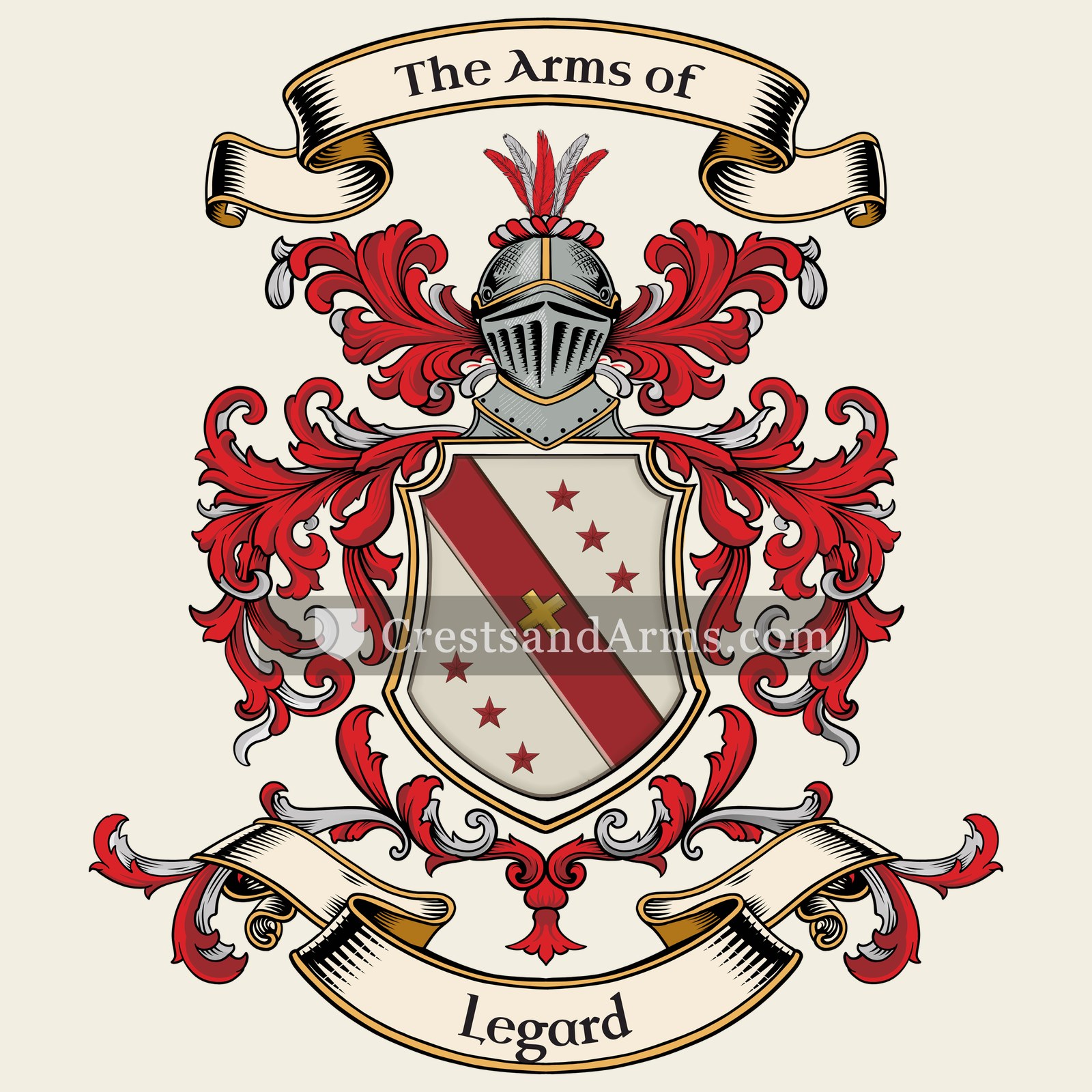
Symbols on this shield
bendDefence, and the scarf of a commander
cross symbolChristian faith and service
mulletThe third son, and a divine quality from above
Colours
Silver (Argent)Means: Peace and sincerity
Red (Gules)Means: Military strength
Gold (Or)Means: Generosity
Historical info
Source
Sir Bernard Burke, The General Armory of England, Scotland, Ireland and Wales, London: Harrison & Sons, 1884
Blazon (the actual original written record)
“Ar. on a bend betw. six mullets pierced gu. a cross pattée or”
YorkGanton · York, c. 1620
Digital archive packCoat of arms PNG, gold border print PDF, vector SVG and the certificate of authenticity. Sent to your email in minutes.
Map of England showing where the Legard arms are recorded
The Legard arms were recorded in York, c. 1620.
Yorkshire is the largest of the English counties, and it held more gentry families than any other. Land there was split among a great many households rather than a few, so a great many of them carried arms.
This is where the arms were entered in the register. Families often moved to other parts of the country, so the same name can turn up in more than one region.
The body that granted and recorded arms in England in this period.
James VI and I
Sovereign of the period
James VI and I
1603–1625
Reigning in Britain when the Legard arms are first recorded.
How Arms Worked in England
English heraldry allowed arms to be shared by all legitimate descendants of the original owner. These symbols were treated as personal property that moved through the generations to all children. While the eldest son kept the original design, other family members could use the same shield without needing to change it or register their own unique versions.
Granting authority
The College of Arms in London has regulated the use of coats of arms throughout England and Wales since 1484.
How they got arms
Families typically obtained their coats of arms through a formal grant from the Crown or by proving their ancient right to them.
Where arms were recorded
All official coats of arms are recorded in the registers kept at the College of Arms, which date back to the fifteenth century.
The family's standing
Recorded among the armigerous families of York.
Origin & History of the Legard Family in England
The Legard family established a significant presence in Yorkshire during the early seventeenth century, anchoring their history in the social and economic life of Northern England. By 1620, the family was well-settled in the region, particularly around the city of York, where they began to build a reputation as prominent landowners and local leaders. The name itself is thought to have roots in the older French language, likely arriving in Britain following the Norman influence that reshaped English naming conventions centuries earlier. As the family grew in influence, they became deeply connected to the governance and development of the East Riding of Yorkshire. Their transition from local residents to established gentry allowed them to play a vital role in the regional administration of the county during a period of great political change in England.
Related Branches & Arms
Root word
le gard
Old French for the guard or the watchman.
This name
LegardAn occupational surname for someone who served as a guardian or a watchman.
also spelled
Legart
Laggard
Leggert
Related arms
Craikrecorded with Legard, same area
Documented Sources
J. B. Rietstap, Armorial Général, Gouda: G. B. van Goor Zonen, 1884–87
Burke, John, A Genealogical and Heraldic History of the Commoners of Great Britain and Ireland, 1836
Clay, John William, Dugdale's Visitation of Yorkshire, with Additions, 1899
East Riding Archives, Legard of Ganton Papers, DDLE
Digital archive packCoat of arms PNG, gold border print PDF, vector SVG and the certificate of authenticity. Sent to your email in minutes.


 bendDefence, and the scarf of a commander
 cross symbolChristian faith and service
 mulletThe third son, and a divine quality from above
 bendDefence, and the scarf of a commander
 cross symbolChristian faith and service
 mulletThe third son, and a divine quality from above