Map of France showing where the Legere arms are recorded
The Legere arms were recorded in Paris, c. 1663.
This is where the arms were entered in the register. Families often moved to other parts of the country, so the same name can turn up in more than one region.
The body that granted and recorded arms in France in this period.
Louis XIV of France
Sovereign of the period
Louis XIV of France
1643–1715
Reigning in France when the Legere arms are first recorded.
How Arms Worked in France
In France, a coat of arms was a mark of honor that passed down through the male line to all legitimate descendants. Families often used the same shield without changes to show their shared heritage. If a branch wanted to stand out, they could add a small mark to their shield to show their specific place in the family tree.
Granting authority
The Juge d'armes de France acted as the official authority that regulated and verified coats of arms across the country.
How they got arms
Families typically inherited their arms from ancestors, though they could also receive them through royal grants or by proving their noble status.
Where arms were recorded
Coats of arms were officially recorded in the Armorial Général de France, which began its main collection in the year 1696.
The family's standing
Recorded among the armigerous families of France.
Origin & History of the Legere Family in France
The surname Legere originates from the French word *léger*, which translates to light or nimble. In medieval France, this name was often used as a descriptive nickname for a person who was quick on their feet or possessed a carefree personality. By the mid-17th century, the family had established a notable presence in Paris, as evidenced by records from 1663. During this period, Paris was the bustling center of French political and cultural life under the reign of King Louis XIV. Families living in the capital at this time were often part of the growing urban middle class, which included skilled artisans, merchants, and minor officials. Because the name was rooted in a common personality trait, it likely emerged independently in different regions before becoming a fixed family name in the city. The presence of the Legere family in the heart of France during the 1660s suggests they were integrated into the social fabric of a rapidly modernizing nation.
Coat of Arms & Family Crest Details
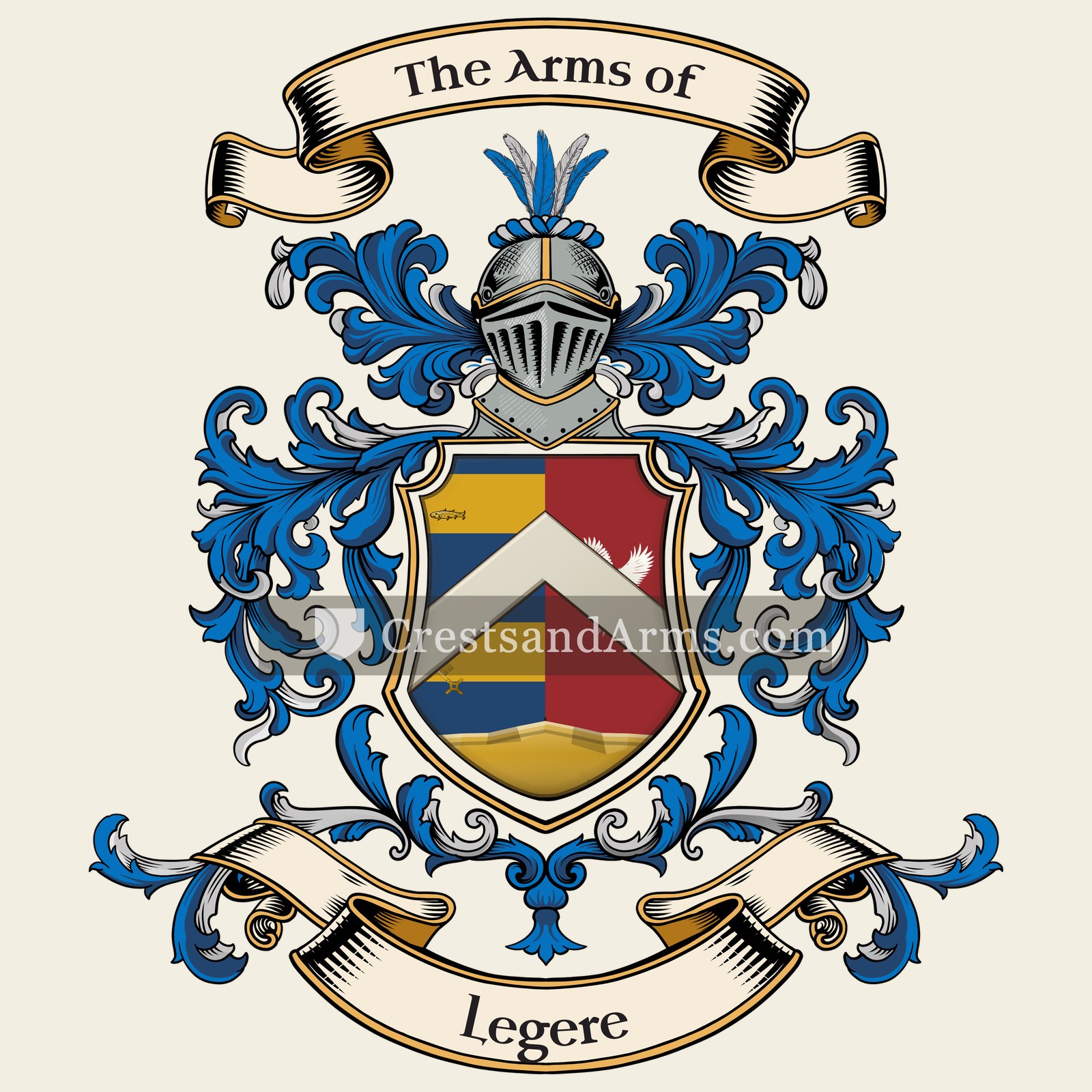
Symbols on this shield
chevronProtection, and faithful service completed
fessThe military belt, and readiness to serve
saltireResolution, and St Andrew's cross
mountThe ground held, and steadfastness upon it
fishA true and generous mind, and Christian faith
keyGuardianship, and the office of a steward
heronPatience and quiet watchfulness
Colours
Blue (Azure)Means: Loyalty and truth
Red (Gules)Means: Military strength
Silver (Argent)Means: Peace and sincerity
Gold (Or)Means: Generosity
Historical info
Source
J. B. Rietstap, Armorial Général, Gouda: G. B. van Goor Zonen, 1884–87
Blazon (the actual original written record)
“d'azur sur gu., au chev. d'arg., br. sur la division; l'azur ch. à dextre de deux fasces d'or, et sen. d'une pique d'or en barre et d'une clé du même en bande, passées en saut.; le gu. ch. d'une grue d'arg. avec sa vigilance d'or, posée sur un tertre d'or. C.: la grue. L.: d'arg. et d'azur.”
Germanyc. 1765
Digital archive packCoat of arms PNG, gold border print PDF, vector SVG and the certificate of authenticity. Sent to your email in minutes.
Map of Germany showing where the Legere arms are recorded
The Legere arms were recorded in Germany, c. 1765.
Arms such as these were typically recorded in Bavaria.
Bavaria was a country of old landed families and walled market towns. Estates passed down the same line for centuries, and both the landowners and the leading townsmen kept arms, which is why so many Bavarian names sit in the registers.
This is where the arms were entered in the register. Families often moved to other parts of the country, so the same name can turn up in more than one region.
The body that granted and recorded arms in Germany in this period.
Francis I, Holy Roman Emperor
Sovereign of the period
Francis I, Holy Roman Emperor
1745–1765
Reigning in France when the Legere arms are first recorded.
How Arms Worked in Germany
In the Holy Roman Empire, coats of arms were often granted to individuals by the Emperor or his representatives. These arms were then passed down through the generations to all legitimate descendants of the original holder. Younger branches of a family usually kept the same shield design without needing to change it, as the arms belonged to the entire lineage.
Granting authority
The Holy Roman Emperor held the sole power to grant new coats of arms throughout his vast imperial territories.
How they got arms
Families typically obtained their coats of arms through a formal imperial grant or by proving their noble status to the authorities.
Where arms were recorded
These grants were officially recorded in the Imperial Chancery registers, which began keeping formal records of such honors during the Middle Ages.
The family's standing
Recorded among the armigerous families of Germany.
Origin & History of the Legere Family in Germany
The family name Legere carries a rich history that reflects the social shifts of eighteenth-century Bavaria. By 1765, records confirm that members of the family were already established within the Bavarian region. During this era, the name was often associated with families living in rural or semi-urban communities where local record-keeping began to track residents more closely for taxation and church membership. Because Bavaria was a collection of distinct territories under the Holy Roman Empire at the time, the Legere family likely navigated a society defined by strict social hierarchies and agricultural traditions. As the family grew, they became part of the local fabric of the region, contributing to the development of their specific towns through trade, craftsmanship, or farming. This early presence in Southern Germany suggests that the family was well-integrated into the local culture long before the major political shifts that would eventually reshape the German landscape in the following century.
Related Branches & Arms
Root word
Levis
Latin term meaning light in weight or nimble.
This name
LegereA nickname for a person who was physically agile or light-footed.
also spelled
Legere
Leje
Ledger
Leiger
Documented Sources
J. B. Rietstap, Armorial Général, Gouda: G. B. van Goor Zonen, 1884–87
Dauzat, Albert. Dictionnaire étymologique des noms de famille et prénoms de France. 1951
Archives Nationales de France, Minutier central des notaires de Paris
Digital archive packCoat of arms PNG, gold border print PDF, vector SVG and the certificate of authenticity. Sent to your email in minutes.


 fessThe military belt, and readiness to serve
 fireZeal and purification
 crescentHonour by the sovereign, and the second son
 fessThe military belt, and readiness to serve
 fireZeal and purification
 crescentHonour by the sovereign, and the second son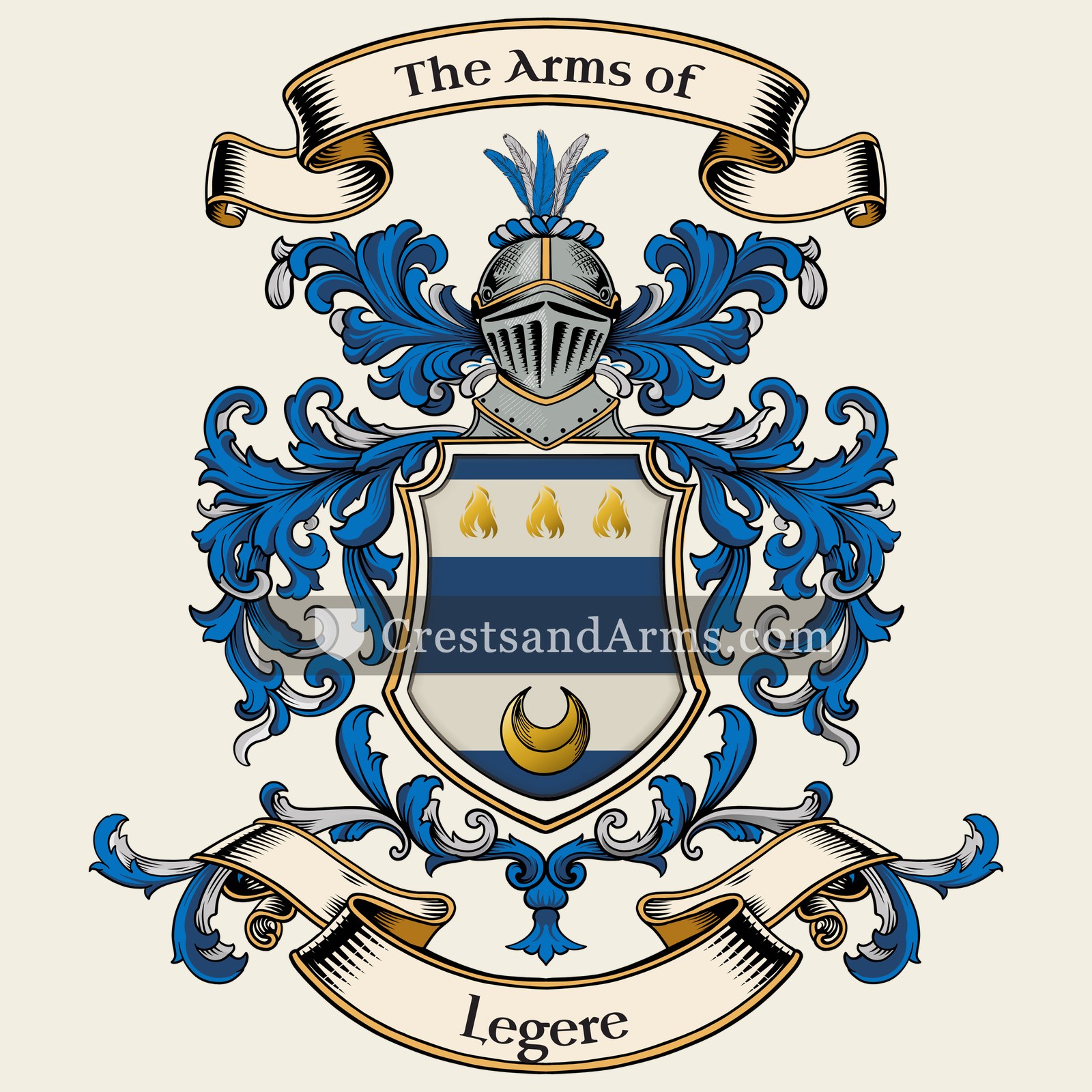


 chevronProtection, and faithful service completed
 saltireResolution, and St Andrew's cross
 mountThe ground held, and steadfastness upon it
 fishA true and generous mind, and Christian faith
 keyGuardianship, and the office of a steward
 heronPatience and quiet watchfulness