A record of documented arms, meaning and origin, researched for the Leigh family lines. Documented in 3 countries.
Reg. 6346 · Britain, J–L
Coat of Arms & Family Crest Details
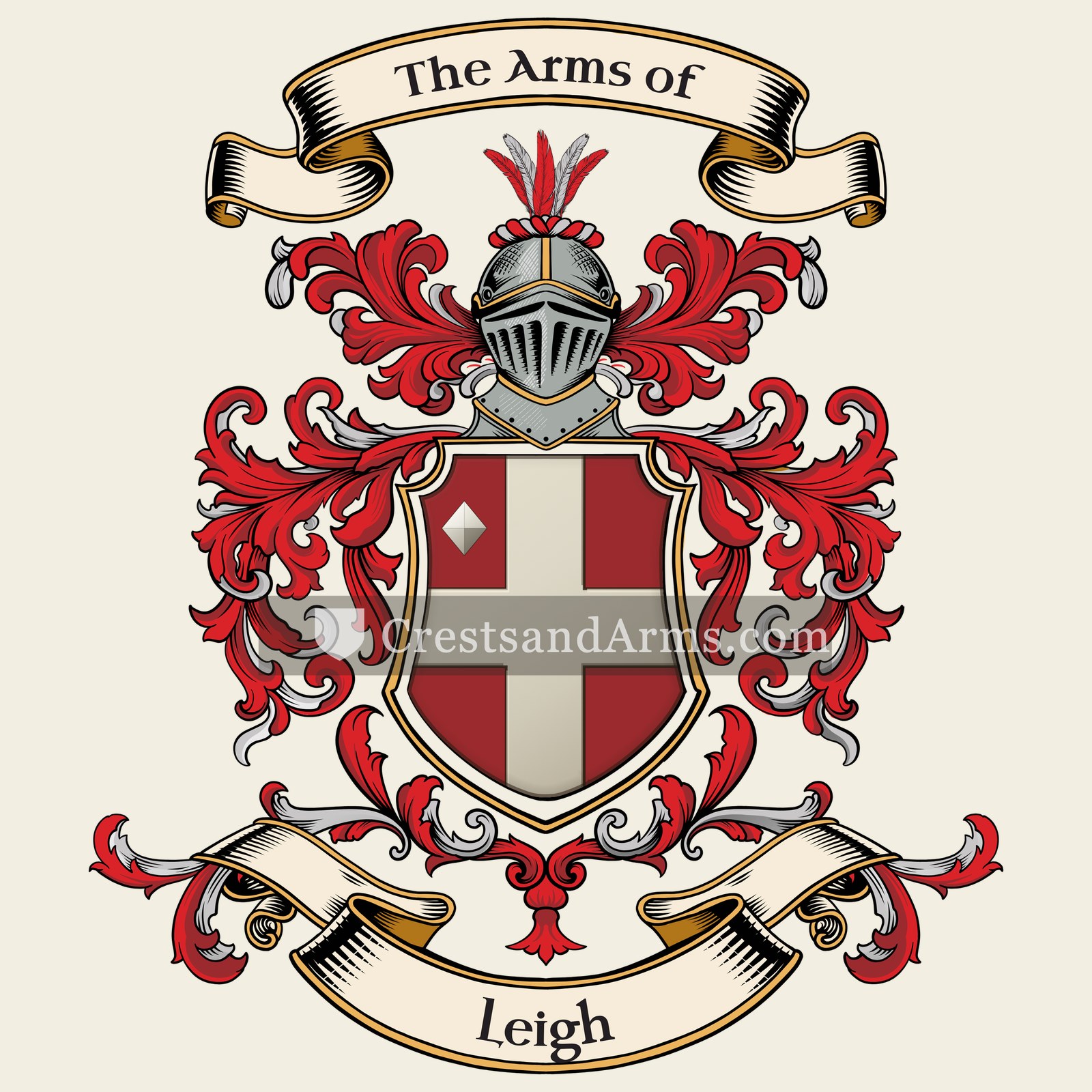
Symbols on this shield
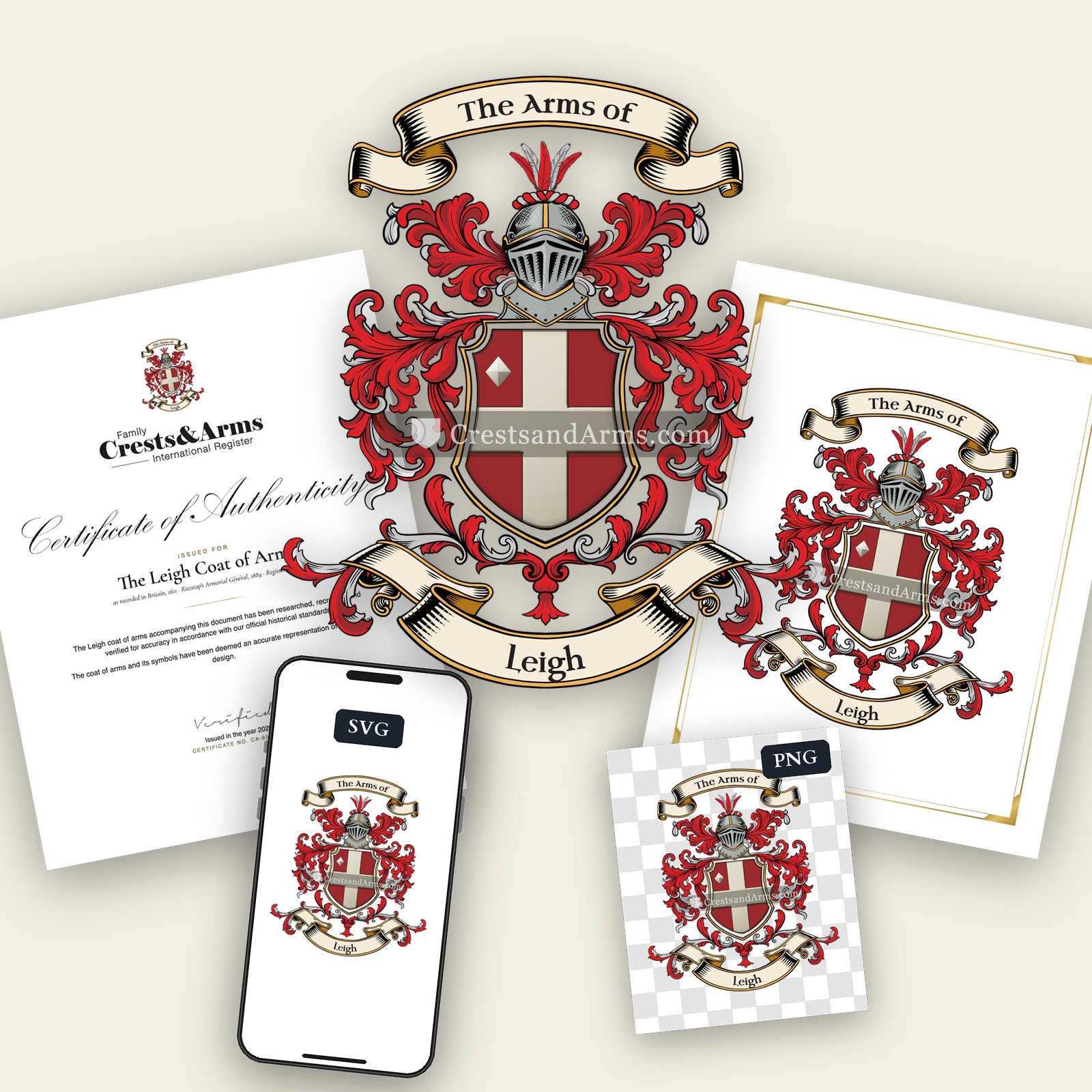
cross symbolChristian faith and service
lozengeHonour and nobility, and the arms of a woman
Colours
Red (Gules)Means: Military strength
Silver (Argent)Means: Peace and sincerity
Historical info
Source
J. B. Rietstap, Armorial Général, Gouda: G. B. van Goor Zonen, 1884–87
Blazon (the actual original written record)
“De gu. à la croix engr. d'arg., acc. au 1 d'une los. du même. C.: une tête et col de licorne d'arg., acornée et crinée d'or. S.: deux licornes d'arg., accornées, crinées et onglées d'or, coll. chacun d'une couronne de gu., à laquelle est suspendu un écusson aux armes de Brydges, qui sont d'arg. à la croix de sa., ch. d'une tête de léopard d'or. D.: TOUT VIENT DE DIEU.”
Britainc. 1611
Digital archive packCoat of arms PNG, gold border print PDF, vector SVG and the certificate of authenticity. Sent to your email in minutes.
Map of Britain showing where the Leigh arms are recorded
The Leigh arms were recorded in Britain, c. 1611.
Arms such as these were typically recorded in Kent.
Kent sits between London and the short crossing to Europe, and the trade passing through made it wealthy. Merchant families bought land with that money, and it was landowners who took coats of arms.
This is where the arms were entered in the register. Families often moved to other parts of the country, so the same name can turn up in more than one region.
The body that granted and recorded arms in Britain in this period.
James VI and I
Sovereign of the period
James VI and I
1603–1625
Reigning in Britain when the Leigh arms are first recorded.
How Arms Worked in Britain
English heraldry allowed arms to be shared by all legitimate descendants of the original owner. These symbols were treated as personal property that moved through the generations to all children. While the eldest son kept the original design, other family members could use the same shield without needing to change it or register their own unique versions.
Granting authority
The College of Arms in London has regulated the use of coats of arms throughout England and Wales since 1484.
How they got arms
Families typically obtained their coats of arms through a formal grant from the Crown or by proving their ancient right to them.
Where arms were recorded
All official coats of arms are recorded in the registers kept at the College of Arms, which date back to the fifteenth century.
The family's standing
Recorded among the armigerous families of Britain.
Origin & History of the Leigh Family in Britain
The surname Leigh is a topographical name, meaning it was originally given to people who lived near a meadow or a forest clearing. The word comes from the Old English term "leah," which describes an open space in a wooded area. By the time the name became established in Kent during the early 17th century, it had already been used for generations across various parts of England. Families often adopted these names to identify themselves based on their local landscape. As these individuals moved or expanded their landholdings, the name traveled with them, eventually becoming a common fixture in the records of southern England by 1611. This transition from a simple description of a person’s home to a formal family name reflects how English surnames evolved during the medieval and early modern periods.
Coat of Arms & Family Crest Details
Symbols on this shield
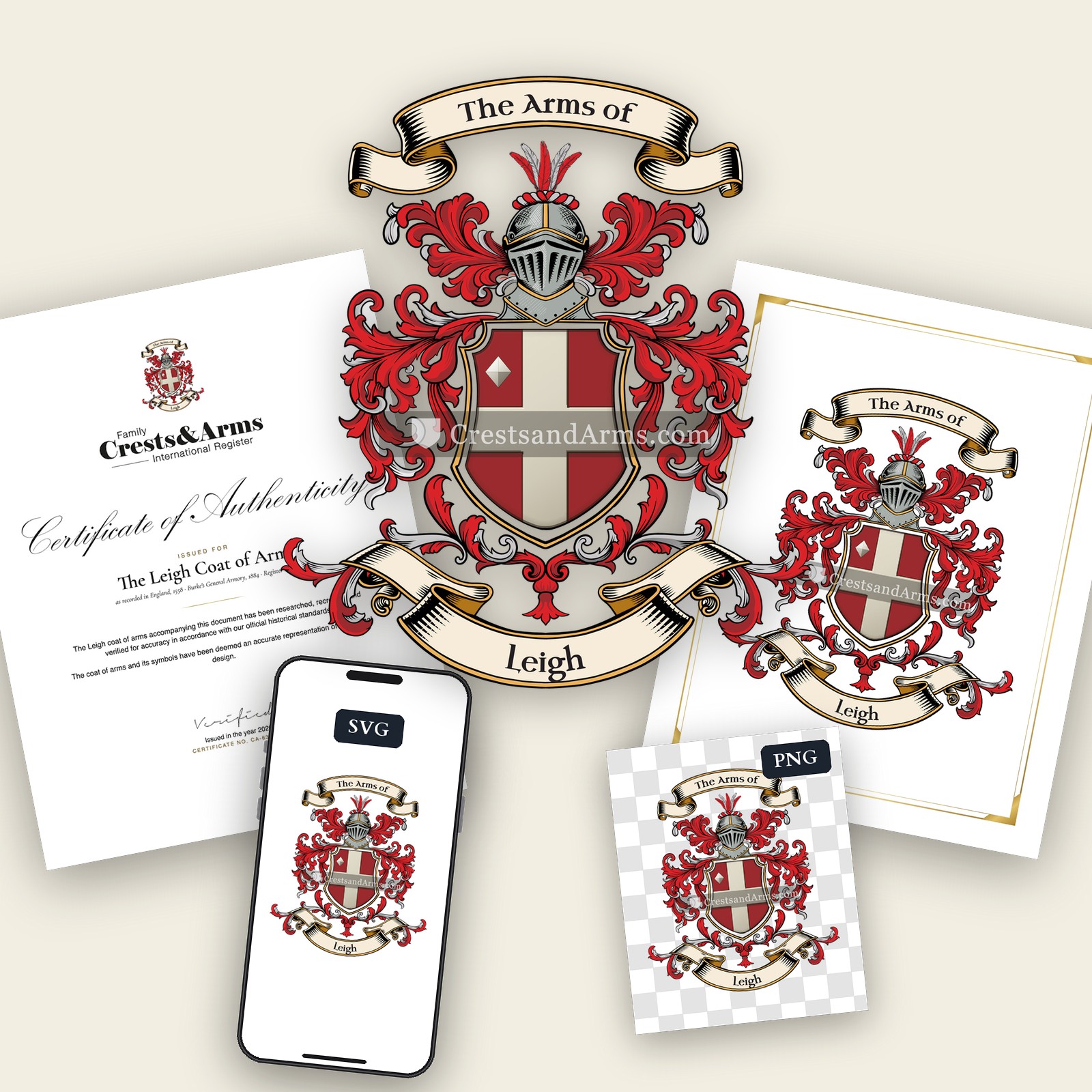
cross symbolChristian faith and service
lozengeHonour and nobility, and the arms of a woman
Colours
Red (Gules)Means: Military strength
Silver (Argent)Means: Peace and sincerity
Historical info
Source
Sir Bernard Burke, The General Armory of England, Scotland, Ireland and Wales, London: Harrison & Sons, 1884
Blazon (the actual original written record)
“Gu. a cross engr. ar. in the 1st quarter a lozenge of the second”
GloucesterGloucester, c. 1558
Digital archive packCoat of arms PNG, gold border print PDF, vector SVG and the certificate of authenticity. Sent to your email in minutes.
Map of England showing where the Leigh arms are recorded
The Leigh arms were recorded in Gloucester, c. 1558.
Gloucestershire had good farmland, a cloth trade in its valleys and a river carrying goods to Bristol. All three made money, and money bought the estates that brought arms with them.
This is where the arms were entered in the register. Families often moved to other parts of the country, so the same name can turn up in more than one region.
The body that granted and recorded arms in England in this period.
Mary I
Sovereign of the period
Mary I
1553–1558
Reigning in Britain when the Leigh arms are first recorded.
How Arms Worked in England
English heraldry allowed arms to be shared by all legitimate descendants of the original owner. These symbols were treated as personal property that moved through the generations to all children. While the eldest son kept the original design, other family members could use the same shield without needing to change it or register their own unique versions.
Granting authority
The College of Arms in London has regulated the use of coats of arms throughout England and Wales since 1484.
How they got arms
Families typically obtained their coats of arms through a formal grant from the Crown or by proving their ancient right to them.
Where arms were recorded
All official coats of arms are recorded in the registers kept at the College of Arms, which date back to the fifteenth century.
The family's standing
Recorded among the armigerous families of Gloucester.
Origin & History of the Leigh Family in England
The surname Leigh is a classic English topographic name, which means it was originally given to people who lived near a meadow or a forest clearing. The word itself comes from the Old English term leah, describing an open space in a wooded area. By the time the name became established in Gloucester around 1558, it had already been used for centuries to identify families living in rural landscapes across the country. During the mid-16th century, the Leigh family in Gloucester was part of a growing class of citizens who were increasingly documented in local parish registers as England began to formalize how it tracked births, marriages, and deaths. These early members of the family were likely involved in the local trade and agricultural life that defined the region during the reign of Queen Elizabeth I. As the family settled into their community, the name served as a permanent link to the specific geography of their home, marking them as people of the land.
Coat of Arms & Family Crest Details
Symbols on this shield
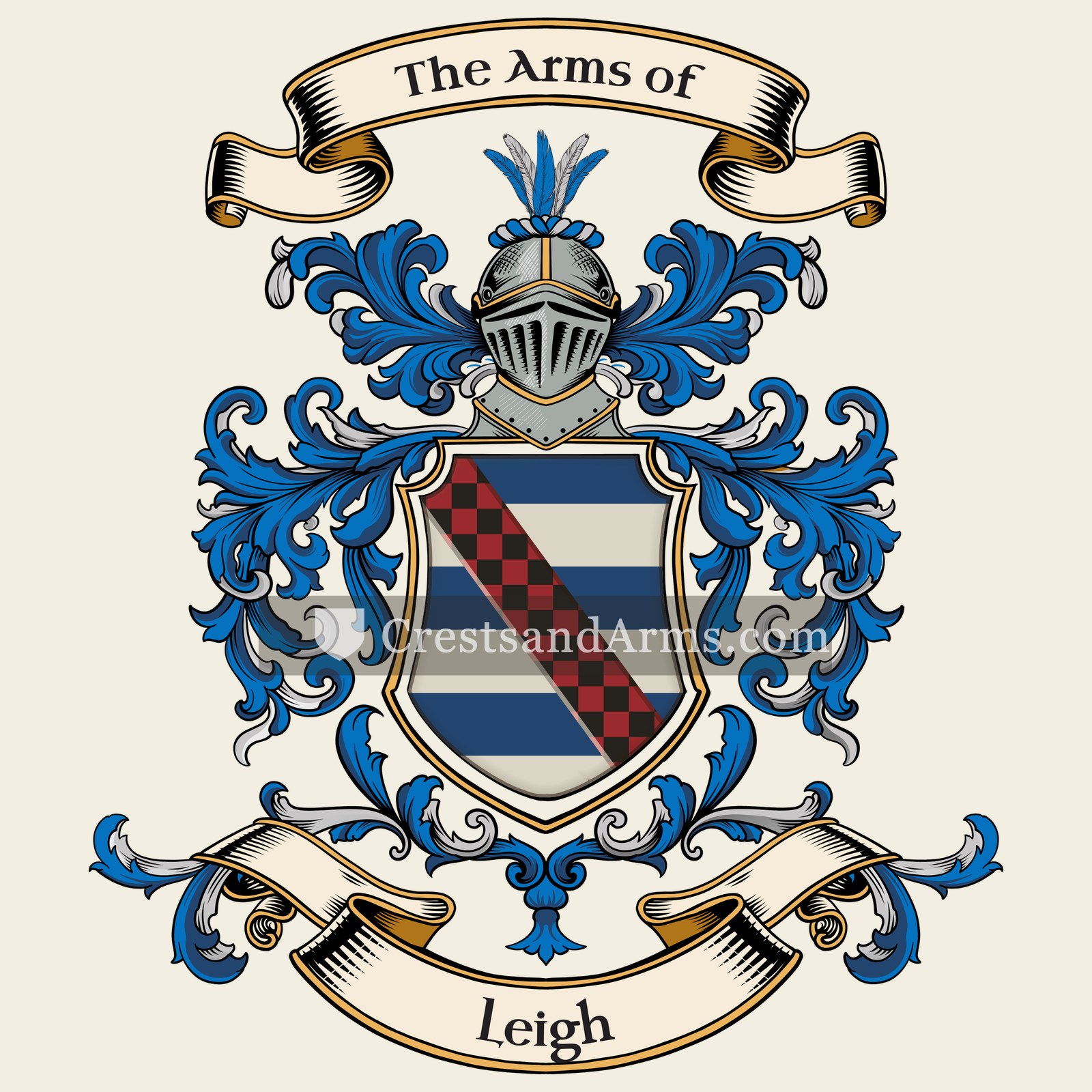
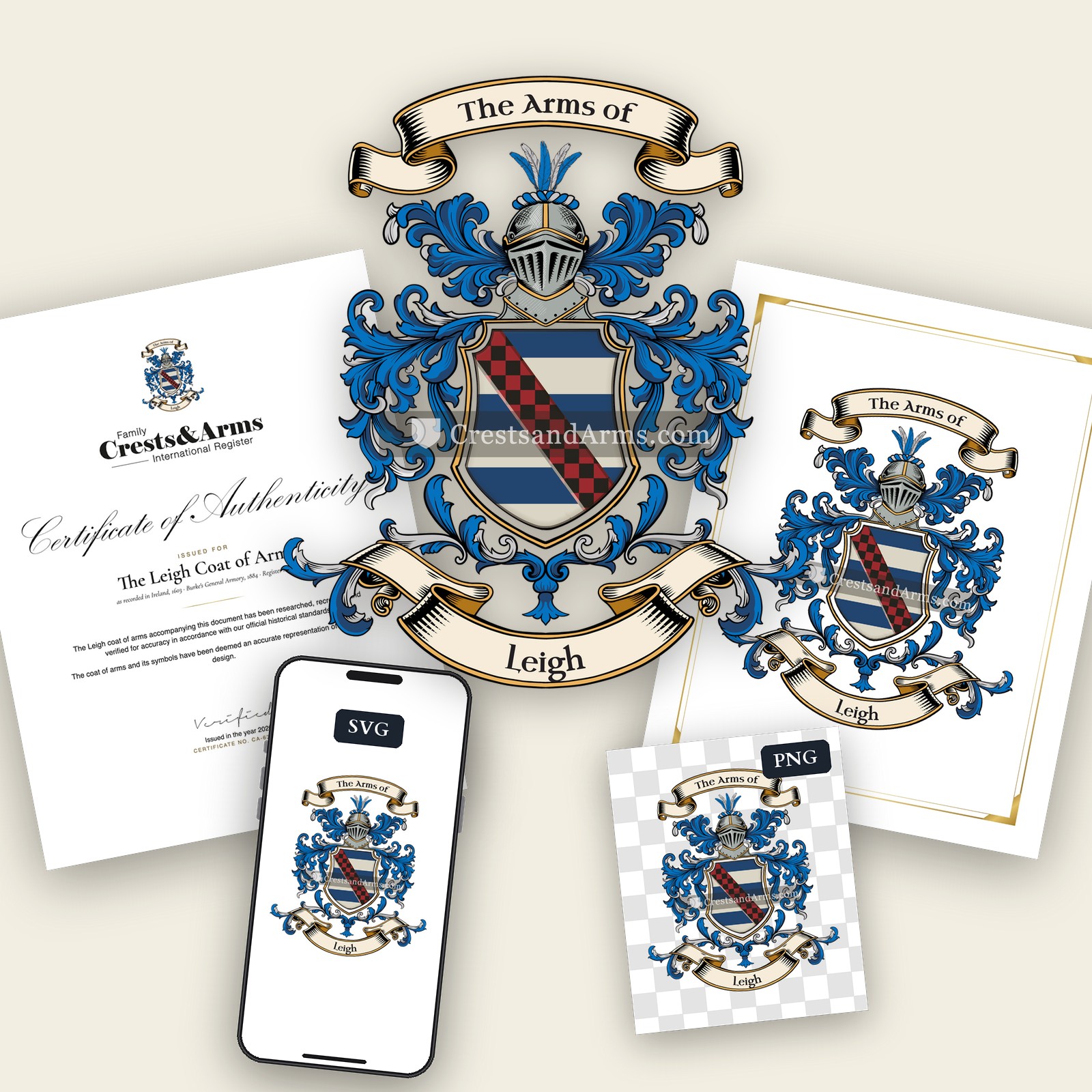
bendDefence, and the scarf of a commander
Colours
Silver (Argent)Means: Peace and sincerity
Red (Gules)Means: Military strength
Blue (Azure)Means: Loyalty and truth
Historical info
Source
Sir Bernard Burke, The General Armory of England, Scotland, Ireland and Wales, London: Harrison & Sons, 1884
Blazon (the actual original written record)
“Barry of six ar. and az. a bend compony counter-compony or and gu”
Irelandc. 1603
Digital archive packCoat of arms PNG, gold border print PDF, vector SVG and the certificate of authenticity. Sent to your email in minutes.
Map of Ireland showing where the Leigh arms are recorded
The Leigh arms were recorded in Ireland, c. 1603.
Arms such as these were typically recorded in Dublin.
Dublin was the seat of government in Ireland and the place where grants were sought and recorded. Families with business at the castle or the courts settled nearby, and settling there put their arms on record.
This is where the arms were entered in the register. Families often moved to other parts of the country, so the same name can turn up in more than one region.
The body that granted and recorded arms in Ireland in this period.
Elizabeth I of England
Sovereign of the period
Elizabeth I of England
1558–1603
Reigning in Britain when the Leigh arms are first recorded.
How Arms Worked in Ireland
The Ulster King of Arms granted coats of arms to individuals who proved their social standing and good character. These symbols were typically inherited by all legitimate descendants of the original holder. If a family branch wanted a unique look, they could apply for a specific change to their design through the office to ensure their identity remained distinct.
Granting authority
The Ulster King of Arms acted as the official body that regulated and issued all coats of arms throughout Ireland.
How they got arms
Families obtained their arms through formal grants issued by the office after proving their eligibility and paying the required fees.
Where arms were recorded
All official grants were recorded in the registers held by the Ulster King of Arms starting from the year 1552.
The family's standing
Recorded among the armigerous families of Ireland.
Origin & History of the Leigh Family in Ireland
The family name Leigh arrived in Ireland during a period of significant political transition at the dawn of the seventeenth century. Records confirm that members of the family were established in Dublin by 1603, which was the same year that King James I ascended to the throne and the Nine Years' War concluded. This timing suggests that the family likely moved to Ireland as part of the broader administrative and military shifts occurring under the new English government. Settling in the capital city provided the family with access to legal and mercantile circles, allowing them to integrate into the developing urban society of Dublin. Over the following decades, the name became associated with the professional class, as members of the family took on roles in local governance and trade. Their presence in the city during this era reflects the movement of people across the Irish Sea as the two kingdoms became more closely linked under a single crown.
Leigh Meaning & Related Branches
Root word
leah
an old english term for a forest clearing or meadow
This name
Leigha topographic surname for someone who lived near a woodland clearing or pasture
also spelled
Ley
Lee
Legh
Leye
Related arms
Leesame arms
Leghsame arms
Leyvariant spelling
Leavariant spelling
Documented Sources
J. B. Rietstap, Armorial Général, Gouda: G. B. van Goor Zonen, 1884–87
Reaney, P.H., A Dictionary of English Surnames, 1991
Hanks, Patrick, Dictionary of American Family Names, 2003
Kent Archives, Quarter Sessions Records, Q/S/1611
Digital archive packCoat of arms PNG, gold border print PDF, vector SVG and the certificate of authenticity. Sent to your email in minutes.


 cross symbolChristian faith and service
 lozengeHonour and nobility, and the arms of a woman
 cross symbolChristian faith and service
 lozengeHonour and nobility, and the arms of a woman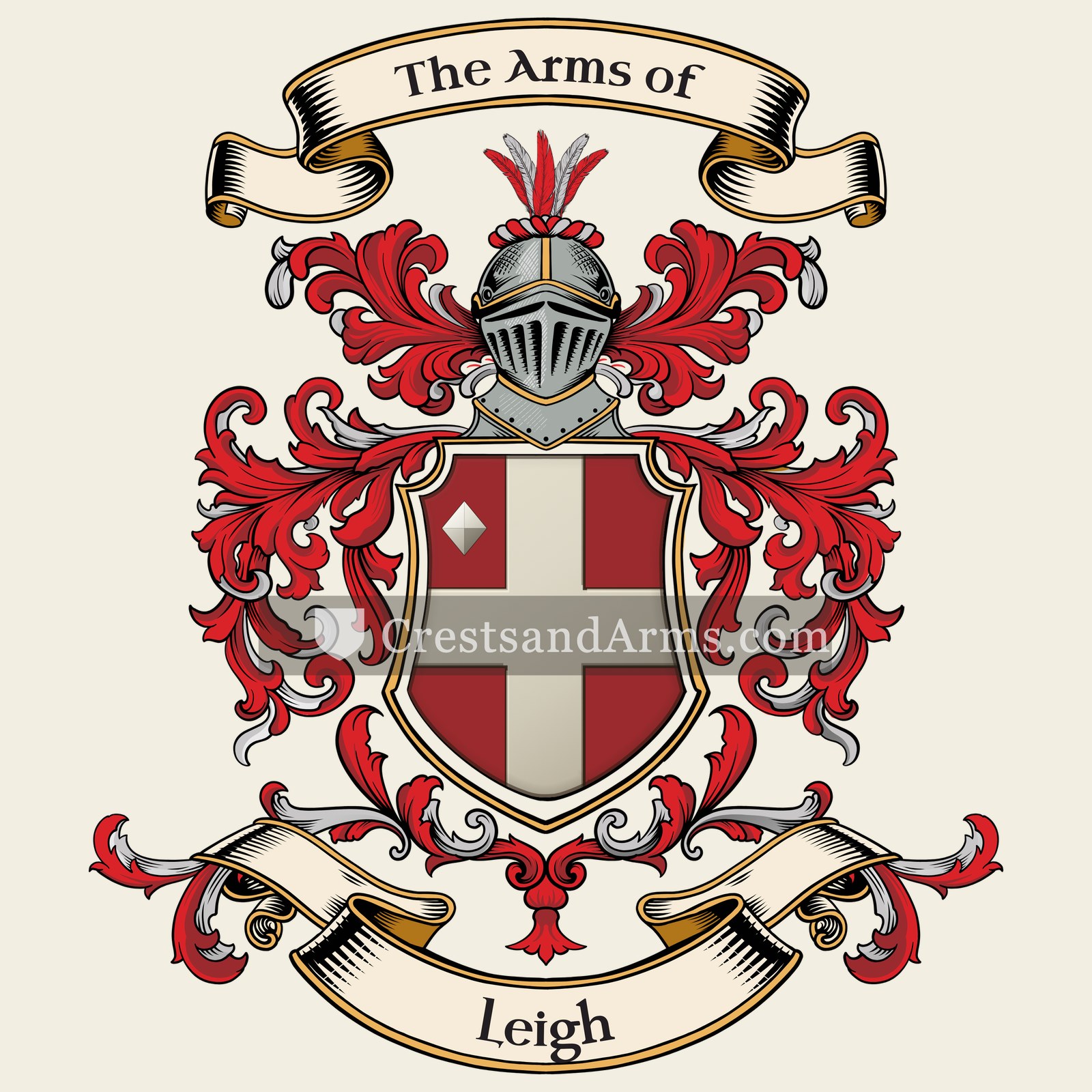



 bendDefence, and the scarf of a commander