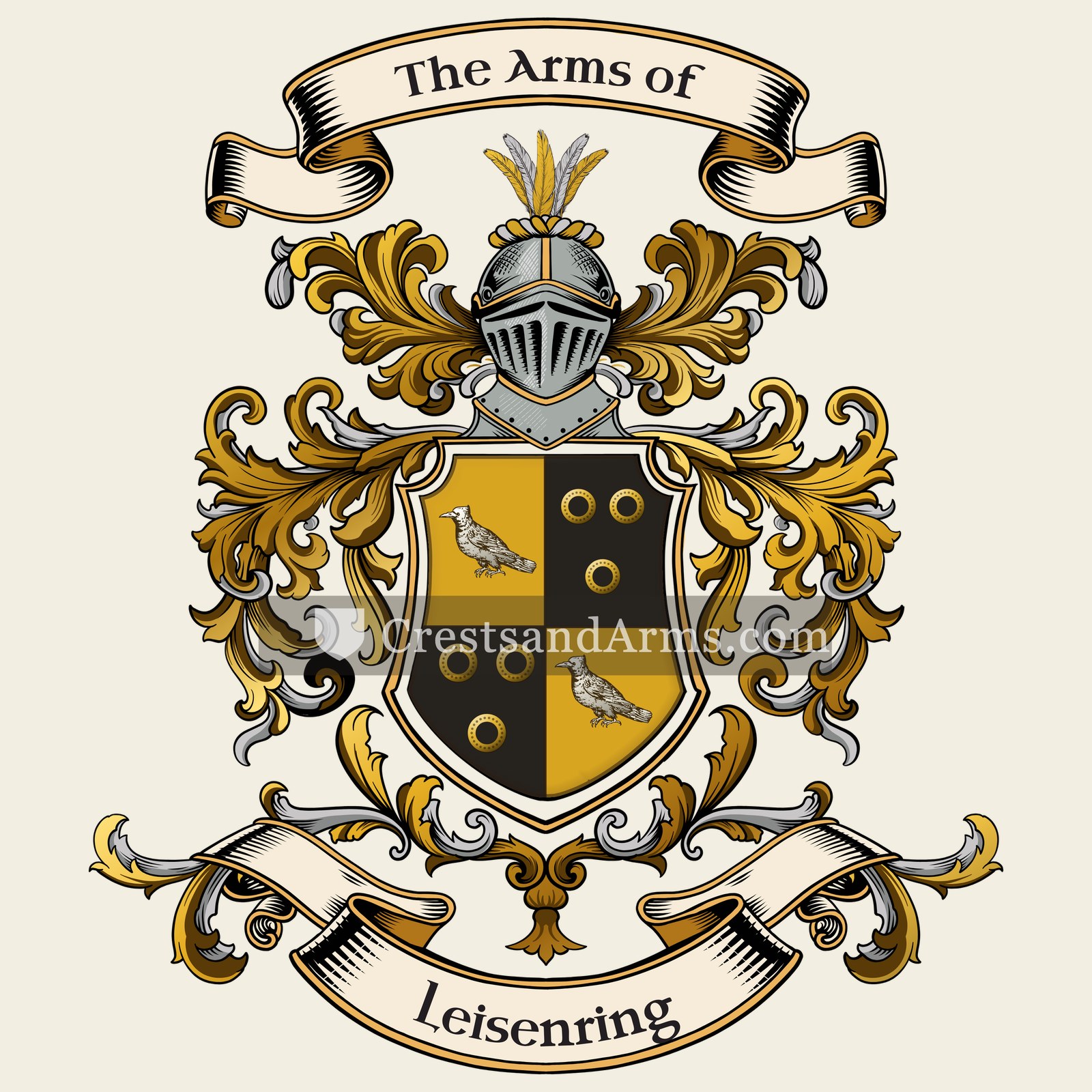
A record of documented arms, meaning and origin, researched for the Leisenring family of Germany.
Reg. 0071 · German, J–L
Coat of Arms & Family Crest Details
Symbols on this shield
cross symbolChristian faith and service
dovePeace, love and the Holy Spirit
ringFidelity, and a promise kept
Colours
Gold (Or)Means: Generosity
Black (Sable)Means: Constancy
Silver (Argent)Means: Peace and sincerity
Historical info
Source
J. B. Rietstap, Armorial Général, Gouda: G. B. van Goor Zonen, 1884–87
Blazon (the actual original written record)
“Ec.: aux 1 et 4 d'or à une colombe d'arg., tenant en son bec une bague d'or; au 2 de sa. à trois bagues d'or, châtonnées de rubis, celle en p. renv.; au 3 de sa. à trois annelets entrelacés d'or, 2 et 1. Cq. cour. C.: une croix pattée d'or; entre un vol, coupé alt. d'or et de sa. L. d'or et de sa. - (Rec. de nob., 30 juillet 1847 et 14 janv. 1848.) D'arg. à une bague d'or, châtonnée d'un rubis; le champ chapé-ployé de gu., ch. à dextre et à sen. d'une cornière d'arg. Cq. cour. C.: un griffon ramp. d'arg., tenant de sa patte dextre un bâton”
GermanyBade, c. 1630
Digital archive packCoat of arms PNG, gold border print PDF, vector SVG and the certificate of authenticity. Sent to your email in minutes.
Map of Germany showing where the Leisenring arms are recorded
The Leisenring arms were recorded in Bade, c. 1630.
This is where the arms were entered in the register. Families often moved to other parts of the country, so the same name can turn up in more than one region.
The body that granted and recorded arms in Germany in this period.
Ferdinand II, Holy Roman Emperor
Sovereign of the period
Ferdinand II, Holy Roman Emperor
1619–1637
Reigning in Germany when the Leisenring arms are first recorded.
How Arms Worked in Germany
In the Holy Roman Empire, coats of arms were often granted to individuals by the Emperor or his representatives. These arms were then passed down through the generations to all legitimate descendants of the original holder. Younger branches of a family usually kept the same shield design without needing to change it, as the arms belonged to the entire lineage.
Granting authority
The Holy Roman Emperor held the sole power to grant new coats of arms throughout his vast imperial territories.
How they got arms
Families typically obtained their coats of arms through a formal imperial grant or by proving their noble status to the authorities.
Where arms were recorded
These grants were officially recorded in the Imperial Chancery registers, which began keeping formal records of such honors during the Middle Ages.
The family's standing
Recorded among the armigerous families of Germany.
Origin & History of the Leisenring Family in Germany
The family name Leisenring originates from the southwestern region of Germany known as Baden. Historical records confirm that members of the family were established in this area by 1630. The name itself is likely topographic or descriptive in nature, which was common for surnames developing in Germanic regions during the seventeenth century. Families in Baden at this time often lived in small agricultural communities where they were deeply connected to the local landscape and regional governance. As the Thirty Years' War caused significant upheaval across the German states during the early 1600s, many families in the Baden region faced great instability. Despite these challenges, the Leisenring family maintained their presence in the area, eventually contributing to the local history of the region before later generations began to migrate further afield.
Related Branches & Arms
Root word
Leisenring
Derived from the Middle High German leise meaning track or path.
This name
LeisenringAn occupational or topographic name referring to someone who lived near a specific path or track.
also spelled
Leuchsenringh
Leuchsenringe
Loichsenring
Documented Sources
J. B. Rietstap, Armorial Général, Gouda: G. B. van Goor Zonen, 1884–87
Brechenmacher, Josef Karlmann. Etymologisches Wörterbuch der deutschen Familiennamen. 1957
General State Archives of Karlsruhe (Generallandesarchiv Karlsruhe), Kirchenbücher der evangelischen Pfarreien in Baden. 1630–1700
Heintze, Albert. Die deutschen Familiennamen: geschichtlich, geographisch, sprachlich. 1903
Digital archive packCoat of arms PNG, gold border print PDF, vector SVG and the certificate of authenticity. Sent to your email in minutes.


 cross symbolChristian faith and service
 dovePeace, love and the Holy Spirit
 ringFidelity, and a promise kept
 cross symbolChristian faith and service
 dovePeace, love and the Holy Spirit
 ringFidelity, and a promise kept