Map of France showing where the Leisner arms are recorded
The Leisner arms were recorded in Normandie, c. 1663.
Normandie held a dense crowd of knightly families on some of the best farmland in France. Its men had fought and settled abroad for generations, and a family that sent sons to war needed a shield they could be recognised by.
This is where the arms were entered in the register. Families often moved to other parts of the country, so the same name can turn up in more than one region.
The body that granted and recorded arms in France in this period.
Louis XIV of France
Sovereign of the period
Louis XIV of France
1643–1715
Reigning in France when the Leisner arms are first recorded.
How Arms Worked in France
In France, a coat of arms was a mark of honor that passed down through the male line to all legitimate descendants. Families often used the same shield without changes to show their shared heritage. If a branch wanted to stand out, they could add a small mark to their shield to show their specific place in the family tree.
Granting authority
The Juge d'armes de France acted as the official authority that regulated and verified coats of arms across the country.
How they got arms
Families typically inherited their arms from ancestors, though they could also receive them through royal grants or by proving their noble status.
Where arms were recorded
Coats of arms were officially recorded in the Armorial Général de France, which began its main collection in the year 1696.
The family's standing
Recorded among the armigerous families of Normandie.
Origin & History of the Leisner Family in France
The history of the Leisner family name is deeply rooted in the cultural landscape of seventeenth-century Normandy. By 1663, records confirm that members of the family were firmly established in this region of northern France. The name itself likely evolved from older Germanic or regional linguistic roots, reflecting the movement of people across European borders during a time of significant social change. Families in Normandy during this era were often involved in local agriculture, trade, or craft guilds, which helped them integrate into the fabric of village life. As these early ancestors settled into their communities, they helped shape the local identity through their work and daily interactions. Over time, the name became a distinct marker of their heritage, carrying the legacy of those who first established the family line in the coastal provinces of France.
Leisner Meaning & Related Branches
Root word
Lais
A person originating from the region of Laon in France.
This name
LeisnerA locative surname denoting an individual who hailed from the city of Laon.
also spelled
Lesnerak
Documented Sources
J. B. Rietstap, Armorial Général, Gouda: G. B. van Goor Zonen, 1884–87
Archives départementales de la Seine-Maritime, Registres paroissiaux et d'état civil
Boudet, Marcel, Histoire de la Normandie et de ses familles, 1924
Le Maho, Jacques, Les origines de la colonisation en Normandie, 1998
Digital archive packCoat of arms PNG, gold border print PDF, vector SVG and the certificate of authenticity. Sent to your email in minutes.


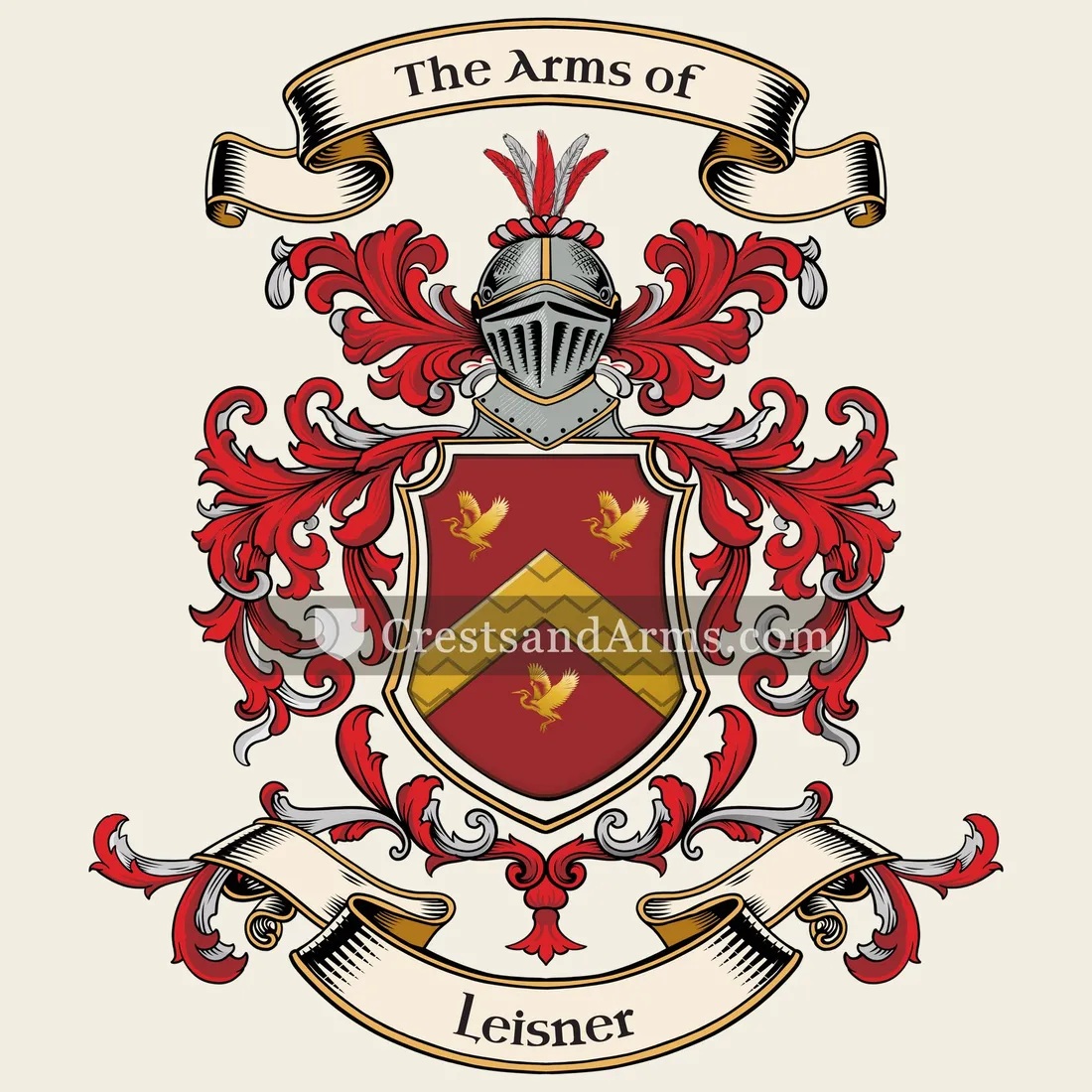
 chevronProtection, and faithful service completed
 heronPatience and quiet watchfulness
 chevronProtection, and faithful service completed
 heronPatience and quiet watchfulness