Map of France showing where the Lemoine arms are recorded
The Lemoine arms were recorded in Lorraine, c. 1558.
Lorraine sat on the border between France and the German lands, and border country bred soldiers. Families here held small estates and served in arms, and a fighting man was exactly the sort who carried a shield of his own.
This is where the arms were entered in the register. Families often moved to other parts of the country, so the same name can turn up in more than one region.
The body that granted and recorded arms in France in this period.
Henry II of France
Sovereign of the period
Henry II of France
1547–1559
Reigning in France when the Lemoine arms are first recorded.
How Arms Worked in France
In France, a coat of arms was a mark of honor that passed down through the male line to all legitimate descendants. Families often used the same shield without changes to show their shared heritage. If a branch wanted to stand out, they could add a small mark to their shield to show their specific place in the family tree.
Granting authority
The Juge d'armes de France acted as the official authority that regulated and verified coats of arms across the country.
How they got arms
Families typically inherited their arms from ancestors, though they could also receive them through royal grants or by proving their noble status.
Where arms were recorded
Coats of arms were officially recorded in the Armorial Général de France, which began its main collection in the year 1696.
The family's standing
Recorded among the armigerous families of Lorraine.
Origin & History of the Lemoine Family in France
The surname Lemoine originated in France as a descriptive nickname derived from the Old French word for a monk. During the medieval period, such names were often given to individuals who lived near a monastery, worked for one, or perhaps displayed a serious and pious personality. By the middle of the sixteenth century, the family established a notable presence in the Lorraine region, which was a strategically important territory located between the Kingdom of France and the Holy Roman Empire. Life in Lorraine during 1558 was defined by a complex mix of local traditions and the influence of the powerful Duchy of Lorraine. As the family settled into this borderland, they became part of a society that was transitioning through the cultural shifts of the Renaissance. The name Lemoine eventually spread across various French provinces, reflecting the movement of families who sought new opportunities in trade, agriculture, and local administration during the early modern era.
Coat of Arms & Family Crest Details
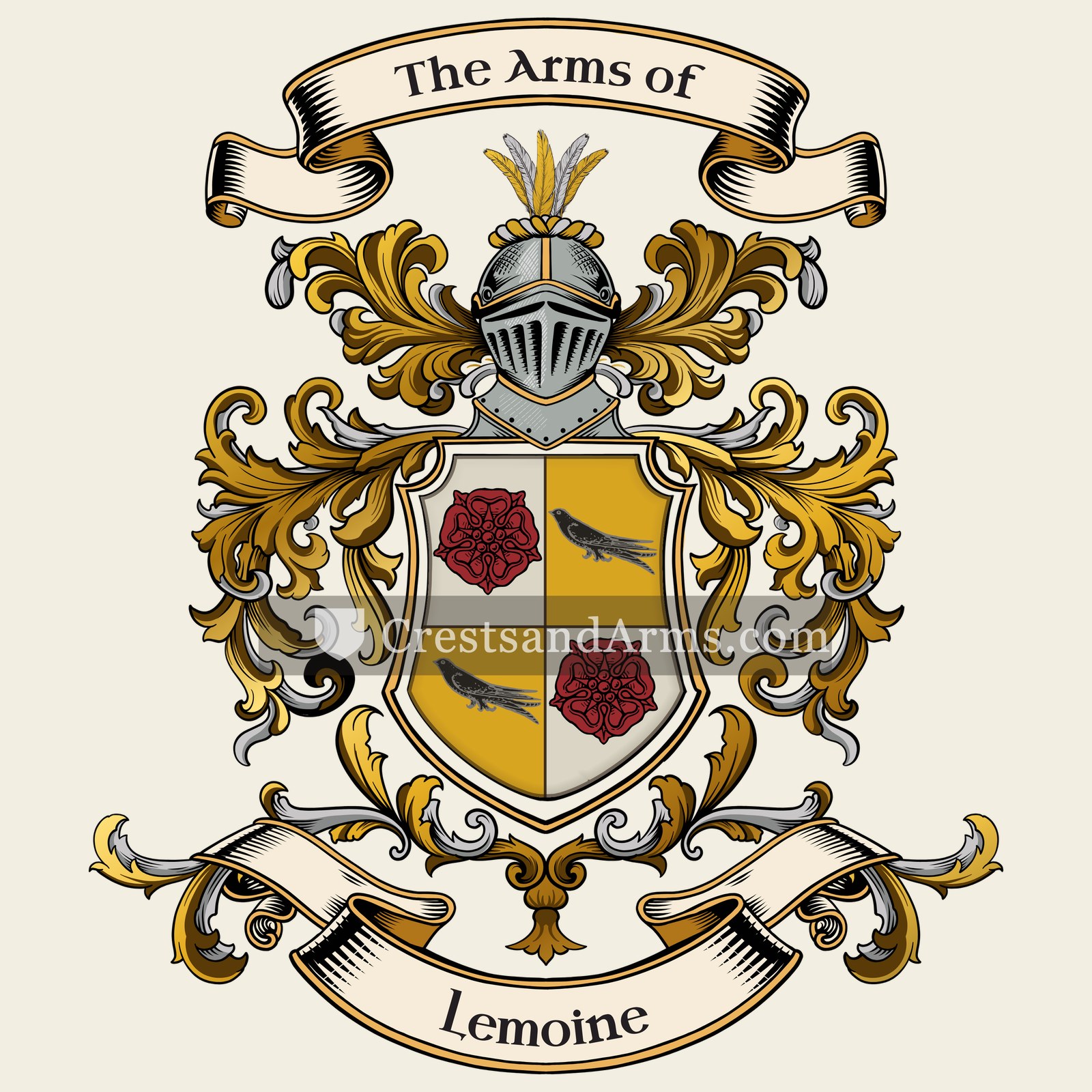
Symbols on this shield
roseThe seventh son, and beauty with grace
martletA younger son, who must win his own land
Colours
Silver (Argent)Means: Peace and sincerity
Gold (Or)Means: Generosity
Red (Gules)Means: Military strength
Black (Sable)Means: Constancy
Historical info
Source
J. B. Rietstap, Armorial Général, Gouda: G. B. van Goor Zonen, 1884–87
Blazon (the actual original written record)
“Parti d'un trait, coupé de deux autres, qui font six quartiers: aux 1, 4 et 5 d'arg. à une rose de gu., bout. d'or, barbée de sin.: aux 2, 3 et 6 d'or à une merlette de sa. C.: une rose de l'écu, tigée et feuillée de sin.”
BelgiumVerviers, c. 1737
Digital archive packCoat of arms PNG, gold border print PDF, vector SVG and the certificate of authenticity. Sent to your email in minutes.
Map of Belgium showing where the Lemoine arms are recorded
The Lemoine arms were recorded in Verviers, c. 1737.
This is where the arms were entered in the register. Families often moved to other parts of the country, so the same name can turn up in more than one region.
The body that granted and recorded arms in Belgium in this period.
Charles VI, Holy Roman Emperor
Sovereign of the period
Charles VI, Holy Roman Emperor
1711–1740
Reigning in France when the Lemoine arms are first recorded.
How Arms Worked in Belgium
In Belgium, a coat of arms is considered personal property that is passed down through the male line to legitimate descendants. Families often use the same shield design across generations to show their shared heritage. If a branch of the family wants to change the design, they must apply for an official update to their specific version of the arms.
Granting authority
The Conseil héraldique is the official body that regulates and approves all coats of arms in Belgium.
How they got arms
Families obtain their coats of arms through formal royal grants or by confirming their historical right to use existing designs.
Where arms were recorded
All approved coats of arms are officially recorded in the public registers of the Conseil héraldique since 1844.
The family's standing
Recorded among the armigerous families of Belgium.
Origin & History of the Lemoine Family in Belgium
The surname Lemoine is a classic example of a name derived from a person’s occupation or status in medieval society. It originates from the Old French word "moine," which means monk. In the context of Belgian history, the name became firmly established in the eastern regions, particularly in the industrial hub of Verviers. By 1737, records confirm that members of the Lemoine family were active participants in the local community of Verviers. During this period, the city was rapidly growing due to its famous wool and textile trade. Families like the Lemoines often settled in these areas to work in the skilled crafts that defined the region. Over time, the name transitioned from a descriptive label for a religious figure into a permanent hereditary surname that reflects the deep roots of the family within the Walloon landscape.
Related Branches & Arms
Root word
Moine
A religious person living in a monastery or monk.
This name
LemoineDerived from the definite article le and the noun for monk, denoting a monk.
also spelled
Lemoigne
Lemoyne
Lemoin
Lemoyn
Related arms
Lemoignevariant spelling
le Moisnevariant spelling
le Moynevariant spelling
Moine (le) - Anjouvariant spelling
Documented Sources
J. B. Rietstap, Armorial Général, Gouda: G. B. van Goor Zonen, 1884–87
Dauzat, Albert. Dictionnaire étymologique des noms et prénoms de France. 1951
Miquel, Pierre. Les Guerres de Religion. 1980
Archives départementales de Meurthe-et-Moselle, Série B: Cours et juridictions
Digital archive packCoat of arms PNG, gold border print PDF, vector SVG and the certificate of authenticity. Sent to your email in minutes.


 harpWell-tuned governance and love of music
 harpWell-tuned governance and love of music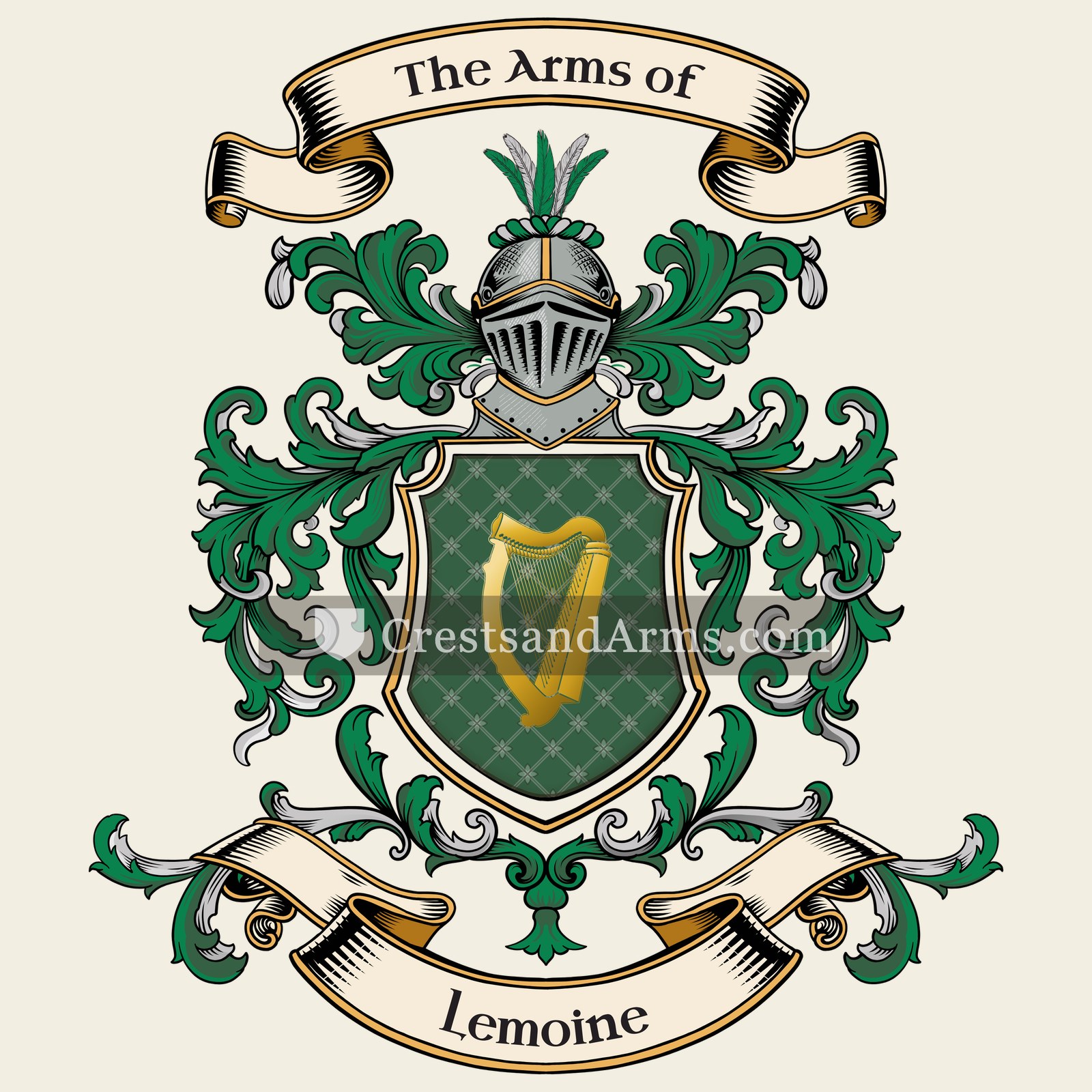


 roseThe seventh son, and beauty with grace
 martletA younger son, who must win his own land