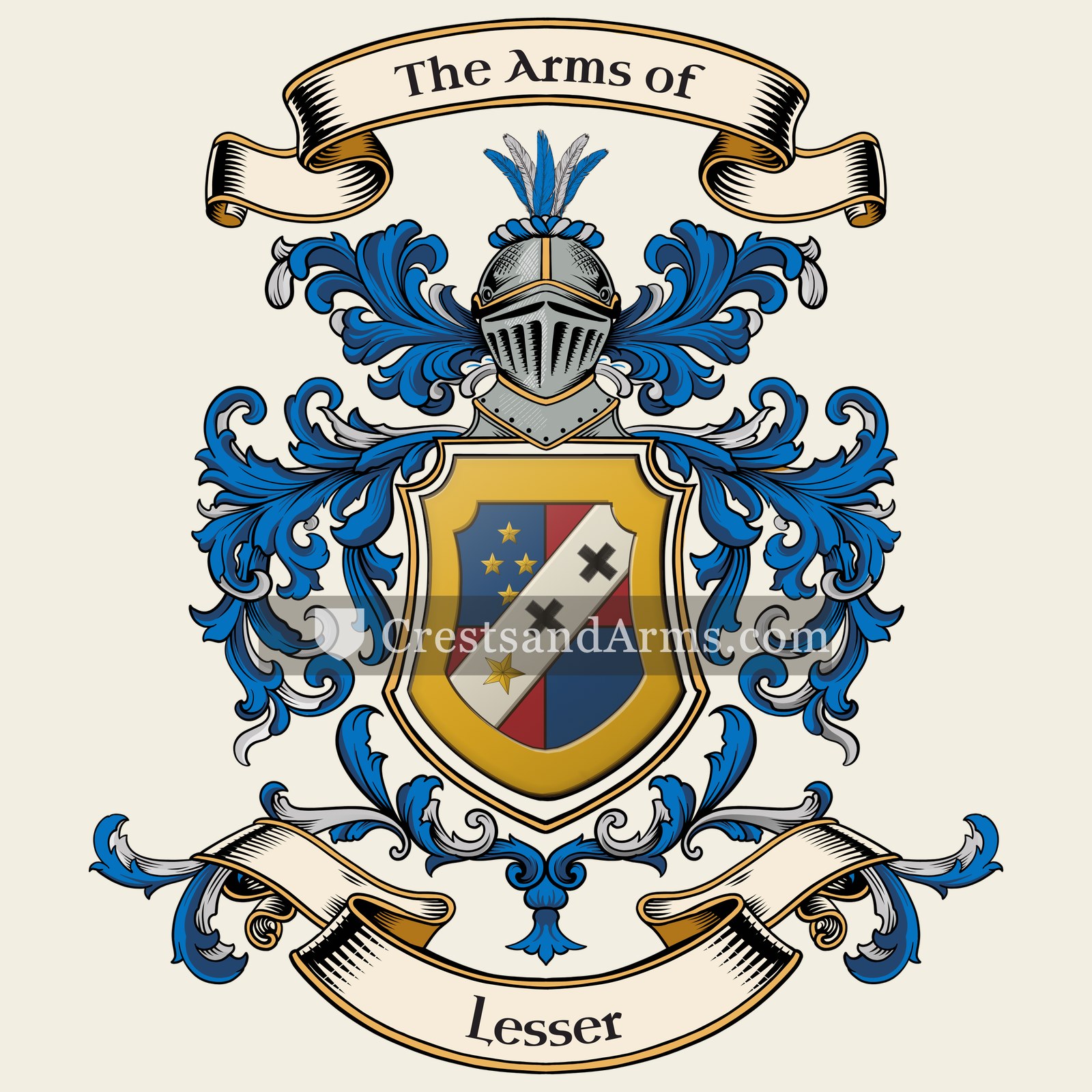
A record of documented arms, meaning and origin, researched for the Lesser family of Poland.
Reg. 6349 · Polish, J–L
Coat of Arms & Family Crest Details
Symbols on this shield
cross symbolChristian faith and service
mulletThe third son, and a divine quality from above
Colours
Blue (Azure)Means: Loyalty and truth
Red (Gules)Means: Military strength
Silver (Argent)Means: Peace and sincerity
Gold (Or)Means: Generosity
Black (Sable)Means: Constancy
Historical info
Source
J. B. Rietstap, Armorial Général, Gouda: G. B. van Goor Zonen, 1884–87
Blazon (the actual original written record)
“Ec., d'azur à quatre étoiles d'or, 1, 2 et 1, et de gu. plein; à la barre d'arg., br. sur les écartelures et ch. de deux croix potencées de sa., 1 en haut et 1 en bas. L'écu bordé d'or. Sur le tout de sa. à une étoile d'or.”
SaxonyVarsovie · Saxony, c. 1876
Digital archive packCoat of arms PNG, gold border print PDF, vector SVG and the certificate of authenticity. Sent to your email in minutes.
Map of Poland showing where the Lesser arms are recorded
The Lesser arms were recorded in Saxony, c. 1876.
Saxony had mines, trade and old landed families all at once. Silver made some fortunes and land held others, and both sorts of family kept arms, which is why Saxon names appear so often in the registers.
This is where the arms were entered in the register. Families often moved to other parts of the country, so the same name can turn up in more than one region.
Region
Saxony
Town
Varsovie
First recorded
1876
Granting Authority for the Lesser Arms
Ennoblement by the Sejm
Author: Olek Remesz · CC BY-SA 3.0
The body that granted and recorded arms in Poland in this period.
How Arms Worked in Poland
Polish noble families shared a single coat of arms across many different surnames, creating large clans rather than individual designs. These symbols were held collectively by all members of the clan regardless of their specific family name. When a new family joined the nobility, they were adopted into an existing clan and began using that group's established shield.
Granting authority
The Sejm, which was the Polish parliament, held the power to grant noble status and the right to bear arms.
How they got arms
Families typically received their coat of arms through a formal act of ennoblement granted by the Sejm for distinguished service.
Where arms were recorded
These grants were officially recorded in the Crown Metrica, which served as the central archive for state documents starting in the sixteenth century.
The family's standing
Recorded among the armigerous families of Saxony.
Origin & History of the Lesser Family in Poland
The surname Lesser is rooted in the Germanic linguistic tradition, where it functioned as a descriptive nickname or a patronymic identifier. In the context of Saxony, the name likely emerged from the Middle High German word "lēser," which referred to a person who gathered or collected items, such as a grape harvester or a gleaner in the fields. By the time your ancestors were established in Saxony in 1876, the name had become a stable family identifier passed down through generations. During this period, the region was part of the German Empire, a time of significant industrial growth and social change. Families like yours often lived in small agricultural or craft-based communities before moving toward the urban centers that defined the late nineteenth century. The name reflects a history tied to the land and the common trades that supported the local economy of the Saxon heartland.
Related Branches & Arms
Root word
Lazarus
Derived from the Hebrew name Eleazar meaning God has helped.
This name
LesserA surname indicating descent from an ancestor named Lazar or a diminutive form of the name.
also spelled
Lessar
Related arms
Berneauxrecorded with Lesser, same area
Buchholzrecorded with Lesser, same area
Grzedzinskirecorded with Lesser, same area
Documented Sources
J. B. Rietstap, Armorial Général, Gouda: G. B. van Goor Zonen, 1884–87
Bahlow, Hans, Deutsches Namenlexikon: Familien- und Vornamen nach Ursprung und Sinn erklärt, 1967
Heintze, Albert, Die deutschen Familien-Namen: geschichtlich, geographisch, sprachlich, 1903


 cross symbolChristian faith and service
 mulletThe third son, and a divine quality from above
 cross symbolChristian faith and service
 mulletThe third son, and a divine quality from above