Map of France showing where the Lesueur arms are recorded
The Lesueur arms were recorded in Orleanais, c. 1663.
Orleanais lay on the Loire around Orleans, close enough to Paris for court money to reach it. Officials and lawyers who did well bought estates there, and an estate brought a coat of arms with it.
This is where the arms were entered in the register. Families often moved to other parts of the country, so the same name can turn up in more than one region.
The body that granted and recorded arms in France in this period.
Louis XIV of France
Sovereign of the period
Louis XIV of France
1643–1715
Reigning in France when the Lesueur arms are first recorded.
How Arms Worked in France
In France, a coat of arms was a mark of honor that passed down through the male line to all legitimate descendants. Families often used the same shield without changes to show their shared heritage. If a branch wanted to stand out, they could add a small mark to their shield to show their specific place in the family tree.
Granting authority
The Juge d'armes de France acted as the official authority that regulated and verified coats of arms across the country.
How they got arms
Families typically inherited their arms from ancestors, though they could also receive them through royal grants or by proving their noble status.
Where arms were recorded
Coats of arms were officially recorded in the Armorial Général de France, which began its main collection in the year 1696.
The family's standing
Recorded among the armigerous families of Orleanais.
Origin & History of the Lesueur Family in France
The surname Lesueur is a classic example of a French occupational name that emerged during the Middle Ages. It is derived from the Old French word "suere," which referred to a shoemaker or a cobbler. By the time the family was firmly established in the Orléanais region in 1663, the name had become a well-recognized identifier for those whose ancestors earned their living by crafting leather goods. During this period, the Orléanais was a vital agricultural and trade hub, and families like the Lesueurs often played steady roles in the local economy of the Loire Valley. The name reflects a time when surnames were frequently chosen based on the specific trade a person practiced, helping to distinguish individuals within growing village communities. As the family put down roots in this central French province, they became part of the social fabric that defined rural life under the French monarchy.
Coat of Arms & Family Crest Details
Symbols on this shield
mulletThe third son, and a divine quality from above
Colours
Blue (Azure)Means: Loyalty and truth
Silver (Argent)Means: Peace and sincerity
Historical info
Source
J. B. Rietstap, Armorial Général, Gouda: G. B. van Goor Zonen, 1884–87
Blazon (the actual original written record)
“D'azur à trois étoiles d'arg.”
BelgiumTournaisis, c. 1737
Digital archive packCoat of arms PNG, gold border print PDF, vector SVG and the certificate of authenticity. Sent to your email in minutes.
Map of Belgium showing where the Lesueur arms are recorded
The Lesueur arms were recorded in Tournaisis, c. 1737.
This is where the arms were entered in the register. Families often moved to other parts of the country, so the same name can turn up in more than one region.
The body that granted and recorded arms in Belgium in this period.
Charles VI, Holy Roman Emperor
Sovereign of the period
Charles VI, Holy Roman Emperor
1711–1740
Reigning in France when the Lesueur arms are first recorded.
How Arms Worked in Belgium
In Belgium, a coat of arms is considered personal property that is passed down through the male line to legitimate descendants. Families often use the same shield design across generations to show their shared heritage. If a branch of the family wants to change the design, they must apply for an official update to their specific version of the arms.
Granting authority
The Conseil héraldique is the official body that regulates and approves all coats of arms in Belgium.
How they got arms
Families obtain their coats of arms through formal royal grants or by confirming their historical right to use existing designs.
Where arms were recorded
All approved coats of arms are officially recorded in the public registers of the Conseil héraldique since 1844.
The family's standing
Recorded among the armigerous families of Belgium.
Origin & History of the Lesueur Family in Belgium
The surname Lesueur is a classic example of a descriptive name that originated in medieval France before spreading into the neighboring regions of Belgium. The name is derived from the Old French word *sueur*, which refers to a shoemaker or a cobbler. By the time the family established a documented presence in the Tournaisis region in 1737, the name had already been in use for several centuries across various French-speaking territories. Families bearing this name in the Tournai area were typically part of the local artisan or merchant classes who played a vital role in the economic life of the city. As they settled in this border region, they integrated into the local community while maintaining the linguistic and cultural traditions of their ancestors. Their presence in the historical records of the eighteenth century highlights how families moved across borders for work and trade, eventually becoming a permanent part of the Belgian social landscape.
Coat of Arms & Family Crest Details
Symbols on this shield
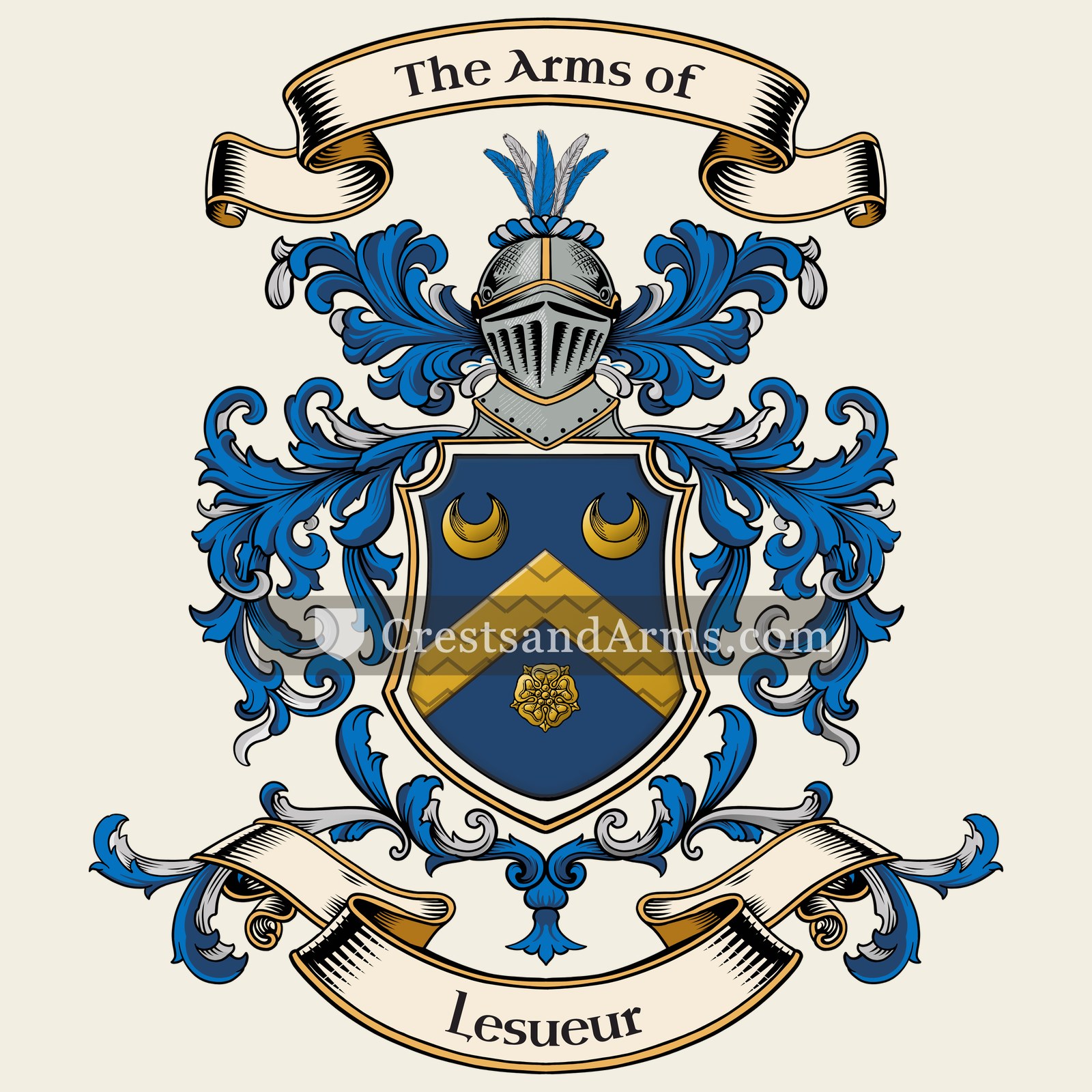
chevronProtection, and faithful service completed
crescentHonour by the sovereign, and the second son
roseThe seventh son, and beauty with grace
Colours
Blue (Azure)Means: Loyalty and truth
Gold (Or)Means: Generosity
Historical info
Source
Sir Bernard Burke, The General Armory of England, Scotland, Ireland and Wales, London: Harrison & Sons, 1884
Blazon (the actual original written record)
“Az. a chev. betw. two crescents in chief and a rose in base or”
JerseyGrouville, c. 1688
Digital archive packCoat of arms PNG, gold border print PDF, vector SVG and the certificate of authenticity. Sent to your email in minutes.
The body that granted and recorded arms in Jersey in this period.
James II of England
Sovereign of the period
James II of England
1685–1688
Reigning in France when the Lesueur arms are first recorded.
How Arms Worked in Jersey
Arms in the Channel Islands were granted and recorded by the College of Arms in London, under the same law of arms as England. They could be used by all legitimate descendants of the original owner: the eldest son kept the original design, and other family members used the same shield without registering a version of their own.
Granting authority
The College of Arms in London has regulated the use of coats of arms for Jersey and the other Channel Islands since 1484.
How they got arms
Families typically obtained their coats of arms through a formal grant from the Crown or by proving their ancient right to them.
Where arms were recorded
All official coats of arms are recorded in the registers kept at the College of Arms, which date back to the fifteenth century.
The family's standing
Recorded among the armigerous families of Jersey.
Origin & History of the Lesueur Family in Jersey
The Lesueur family has deep roots in the Channel Island of Jersey, where they established a lasting presence by the late seventeenth century. Records confirm that members of the family were settled in the parish of Grouville by 1688, living as part of a close-knit agricultural community. The name itself is of French origin, derived from the word *sueur*, which historically referred to a shoemaker or a cobbler. Over generations, the Lesueurs became deeply integrated into the island's unique legal and social framework, often serving as local officials or managing small landholdings. Their life in Grouville was defined by the rhythms of the sea and the soil, reflecting the broader experience of Jersey families who maintained strong cultural ties to Normandy while developing a distinct identity under the British Crown.
Related Branches & Arms
Root word
sueur
Old French term for a shoemaker or cobbler.
This name
LesueurAn occupational surname identifying a person who worked as a shoemaker.
also spelled
Lesuer
le Suer
Lesueuer
Related arms
Oosterlincksame arms
Bouchu de Lessart de Loisysimilar arms
Charlemagnesimilar arms
Sueur (le) d'Ecquetotvariant spelling
Documented Sources
J. B. Rietstap, Armorial Général, Gouda: G. B. van Goor Zonen, 1884–87
Dauzat, Albert. Dictionnaire étymologique des noms et prénoms de France. 1951
Morlet, Marie-Thérèse. Dictionnaire étymologique des noms de famille. 1991
Archives départementales du Loiret. Registres paroissiaux et d'état civil. 1663
Digital archive packCoat of arms PNG, gold border print PDF, vector SVG and the certificate of authenticity. Sent to your email in minutes.


 roseThe seventh son, and beauty with grace
 roseThe seventh son, and beauty with grace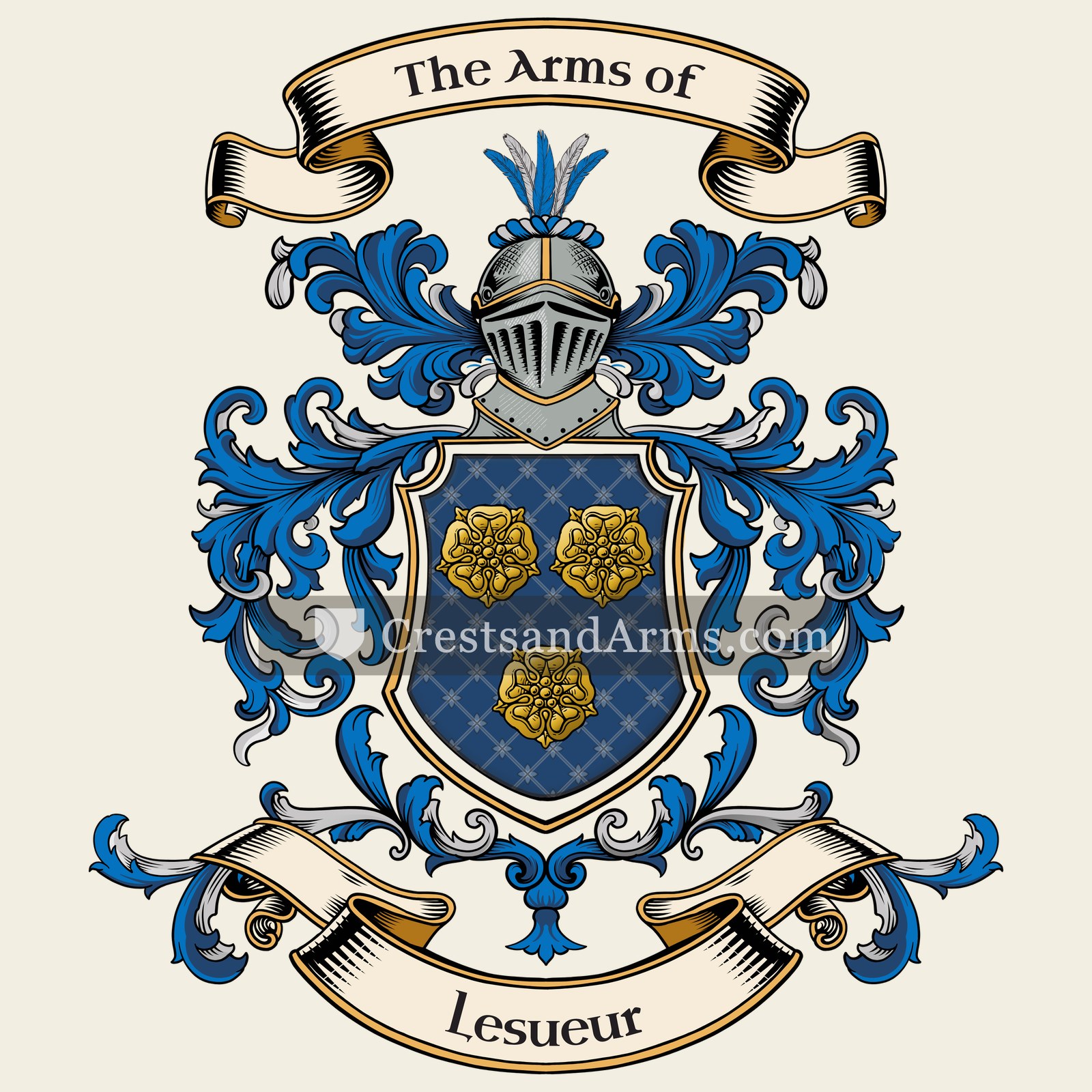


 mulletThe third son, and a divine quality from above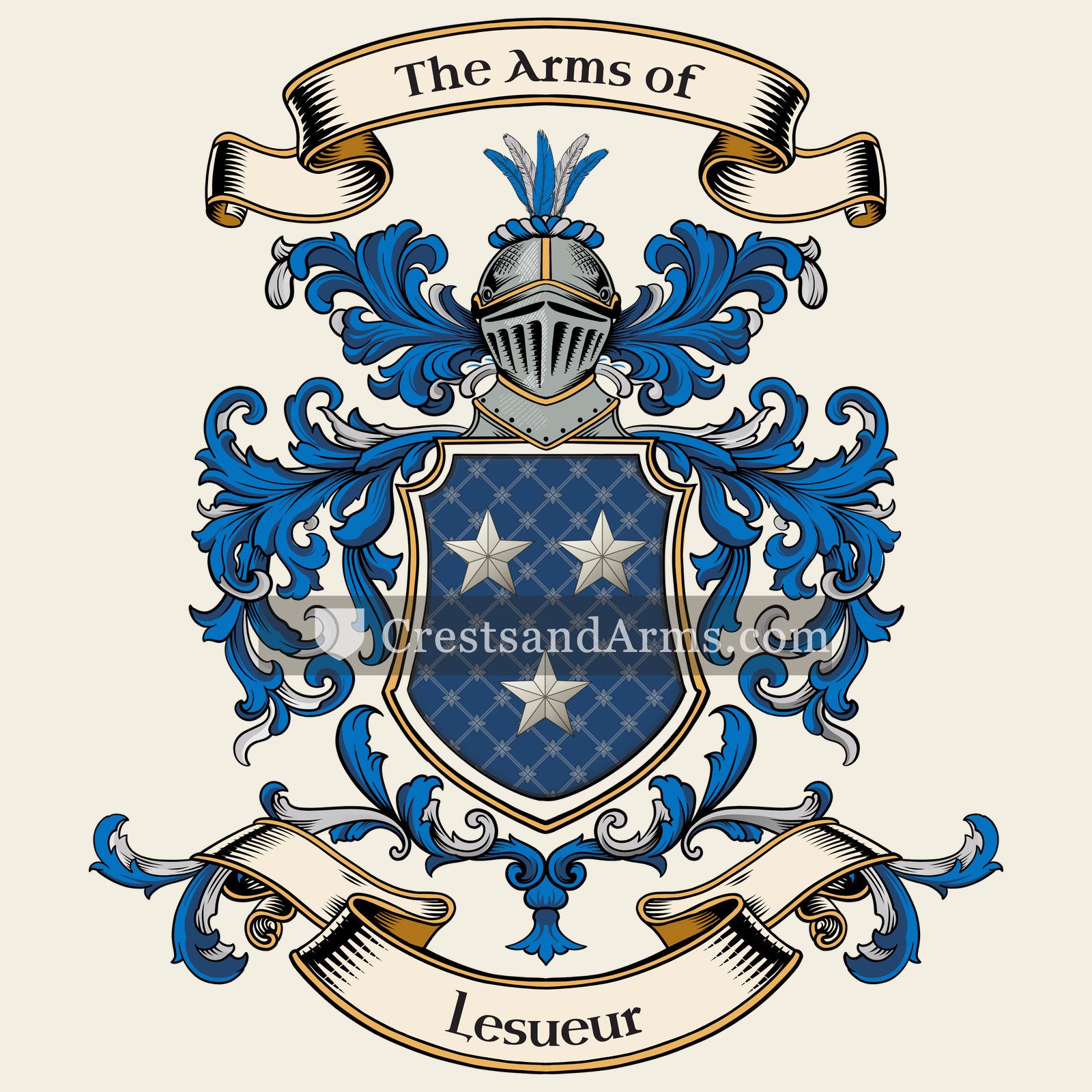


 chevronProtection, and faithful service completed
 crescentHonour by the sovereign, and the second son