Map of Italy showing where the Leuzzi arms are recorded
The Leuzzi arms were recorded in Bologne, c. 1775.
This is where the arms were entered in the register. Families often moved to other parts of the country, so the same name can turn up in more than one region.
The body that granted and recorded arms in Italy in this period.
Alvise Giovanni Mocenigo
Sovereign of the period
Alvise Giovanni Mocenigo
1763–1778
Reigning in Italy when the Leuzzi arms are first recorded.
How Arms Worked in Italy
In the Italian states, coats of arms were often used by noble families to show their status and history. These symbols were passed down through the generations to all legitimate male descendants. Younger branches of a family usually kept the original design but sometimes added small changes to distinguish their specific line from the main branch.
Granting authority
Various local rulers and city governments controlled the use of coats of arms across the different Italian states.
How they got arms
Families often assumed their own arms or received them as official grants from local lords, popes, or city councils.
Where arms were recorded
Arms were recorded in local city archives or private family books rather than in one single national register.
The family's standing
Recorded among the armigerous families of Italy.
Origin & History of the Leuzzi Family in Italy
The Leuzzi family name traces its roots to the vibrant cultural landscape of Northern Italy, with documented evidence placing family members in the city of Bologna by 1775. During this period, Bologna served as a major intellectual and commercial hub, and families like the Leuzzis were often integrated into the local urban economy as skilled tradespeople or members of the professional class. The name itself is thought to be a variation of regional naming patterns common in the Emilia-Romagna region, where surnames frequently evolved from personal nicknames or descriptive terms related to a person's character or local identity. By settling in a city renowned for its ancient university and trade guilds, the early Leuzzi family likely benefited from the social stability and economic growth that defined eighteenth-century Bologna. This historical presence suggests that the family was part of the steady migration and urbanization that shaped the demographic character of the region during the late Enlightenment era.
Leuzzi Meaning & Related Branches
Root word
Leo
Latin term for lion representing strength and courage.
This name
LeuzziA patronymic or diminutive form derived from the name Leo, indicating descendant of the lion.
also spelled
Lootsee
Lutsee
Documented Sources
J. B. Rietstap, Armorial Général, Gouda: G. B. van Goor Zonen, 1884–87
Archivio di Stato di Bologna, Stato civile della Restaurazione, Registri parrocchiali, 1775
Fucile, R., Dizionario dei cognomi italiani, 2012
Istituto Nazionale di Statistica, Cognomi d'Italia: Storia e diffusione, 2005
Digital archive packCoat of arms PNG, gold border print PDF, vector SVG and the certificate of authenticity. Sent to your email in minutes.


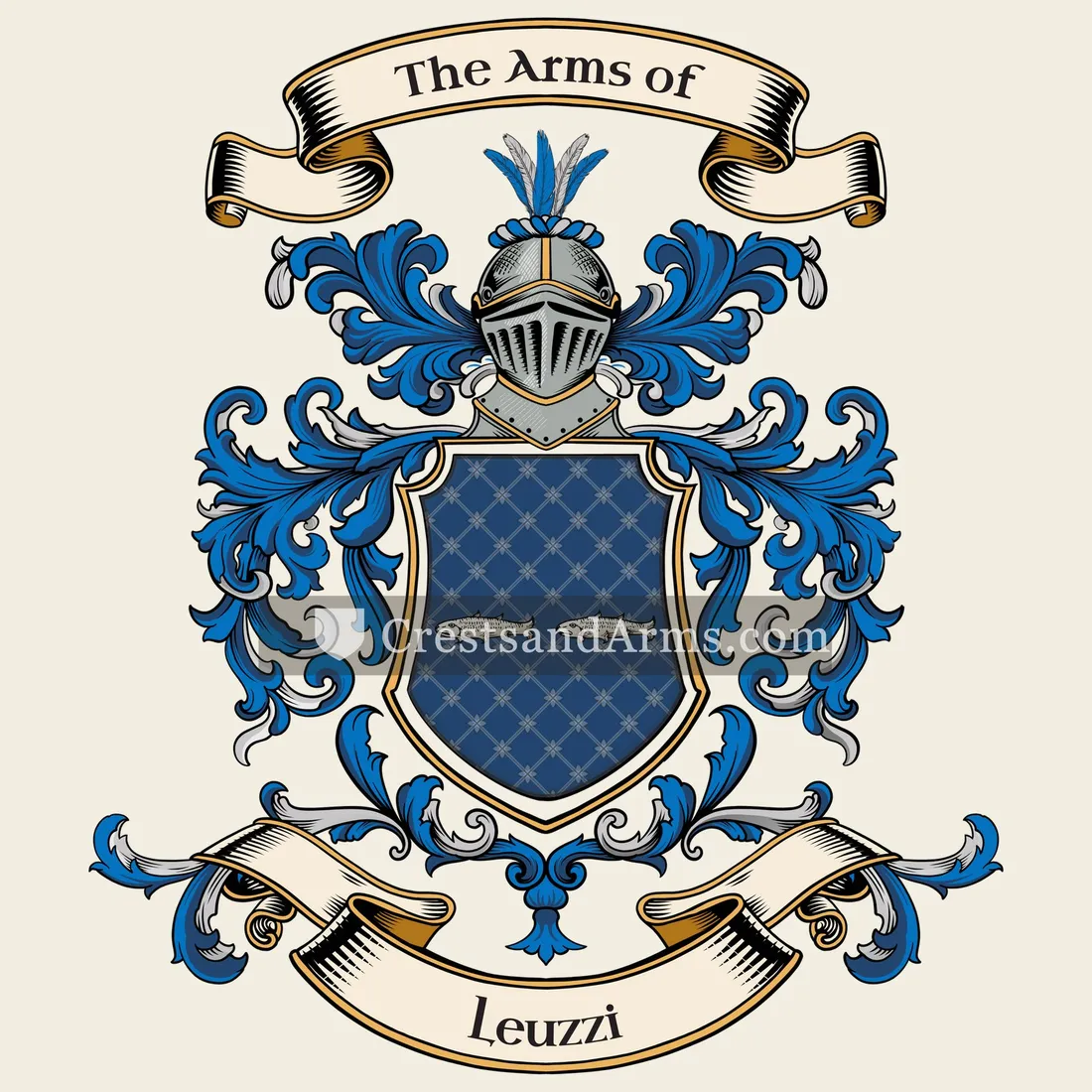
 fishA true and generous mind, and Christian faith
 fishA true and generous mind, and Christian faith