Map of Germany showing where the Ley arms are recorded
The Ley arms were recorded in Westphalia, c. 1765.
Westphalia was a land of small estates and fortified farmhouses in western Germany. Its families were numerous and not especially rich, but each held its own ground, and holding ground was what brought arms.
This is where the arms were entered in the register. Families often moved to other parts of the country, so the same name can turn up in more than one region.
The body that granted and recorded arms in Germany in this period.
Francis I, Holy Roman Emperor
Sovereign of the period
Francis I, Holy Roman Emperor
1745–1765
Reigning in Germany when the Ley arms are first recorded.
How Arms Worked in Germany
In the Holy Roman Empire, coats of arms were often granted to individuals by the Emperor or his representatives. These arms were then passed down through the generations to all legitimate descendants of the original holder. Younger branches of a family usually kept the same shield design without needing to change it, as the arms belonged to the entire lineage.
Granting authority
The Holy Roman Emperor held the sole power to grant new coats of arms throughout his vast imperial territories.
How they got arms
Families typically obtained their coats of arms through a formal imperial grant or by proving their noble status to the authorities.
Where arms were recorded
These grants were officially recorded in the Imperial Chancery registers, which began keeping formal records of such honors during the Middle Ages.
The family's standing
Recorded among the armigerous families of Westphalia.
Origin & History of the Ley Family in Germany
The surname Ley is deeply rooted in the linguistic history of the German Rhineland and Westphalia. In the local dialects of these regions, the word "Ley" or "Lei" historically referred to a rocky outcrop, a slate cliff, or a prominent stone formation. Families who adopted this name often lived near such geological landmarks, which served as natural boundaries or significant points of reference in the landscape. By the time records place the family in Westphalia during the mid-eighteenth century, the name had already been established for generations as a way to identify people by their connection to the rugged terrain of their home. This naming tradition reflects a time when a person’s identity was closely tied to the specific physical environment where they worked and raised their families. As the population moved and grew, the name traveled with them, preserving a link to the stony hillsides of their ancestral origins.
Meaning of the Ley family crest colors & symbols
Symbols on this shield
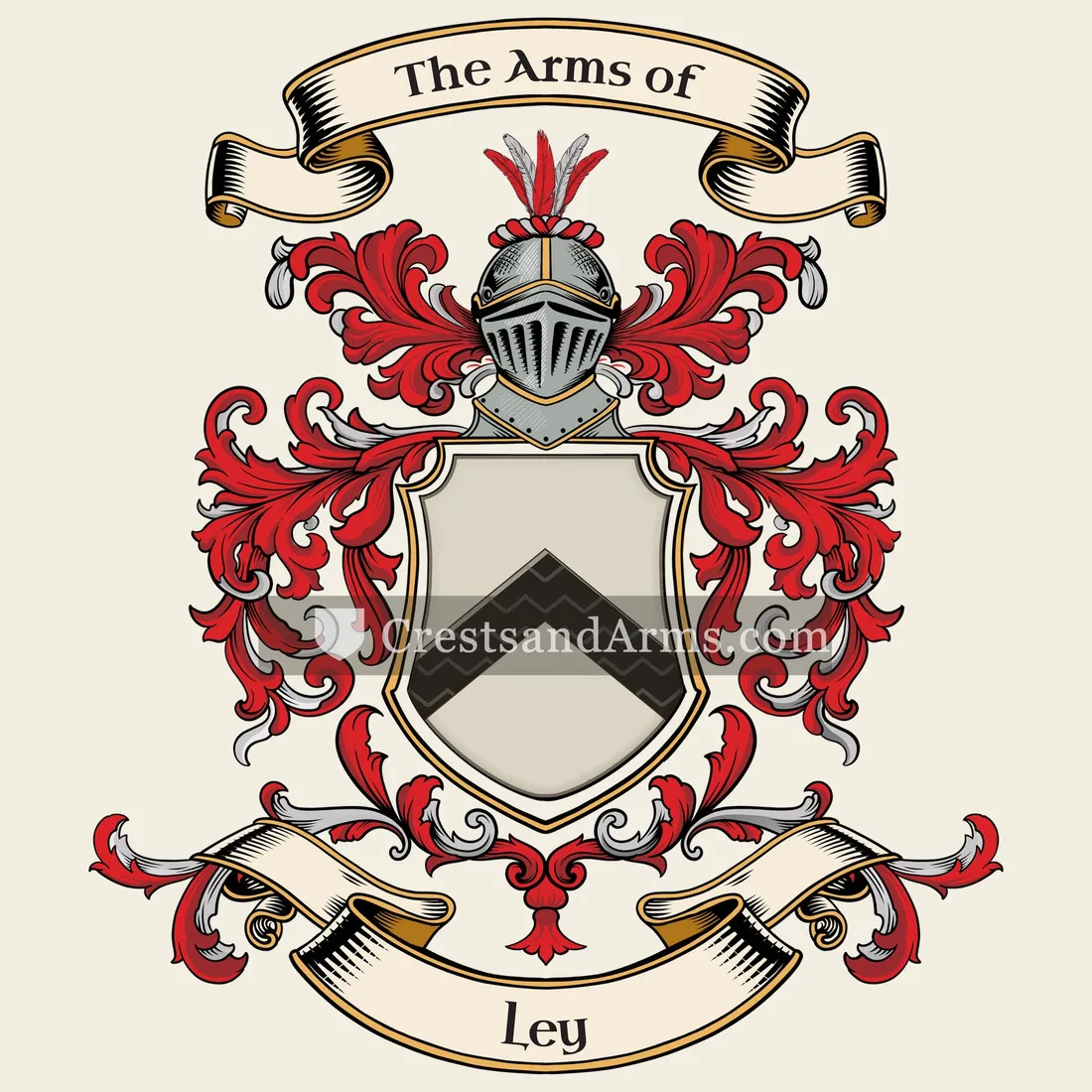
chevronProtection, and faithful service completed
Colours
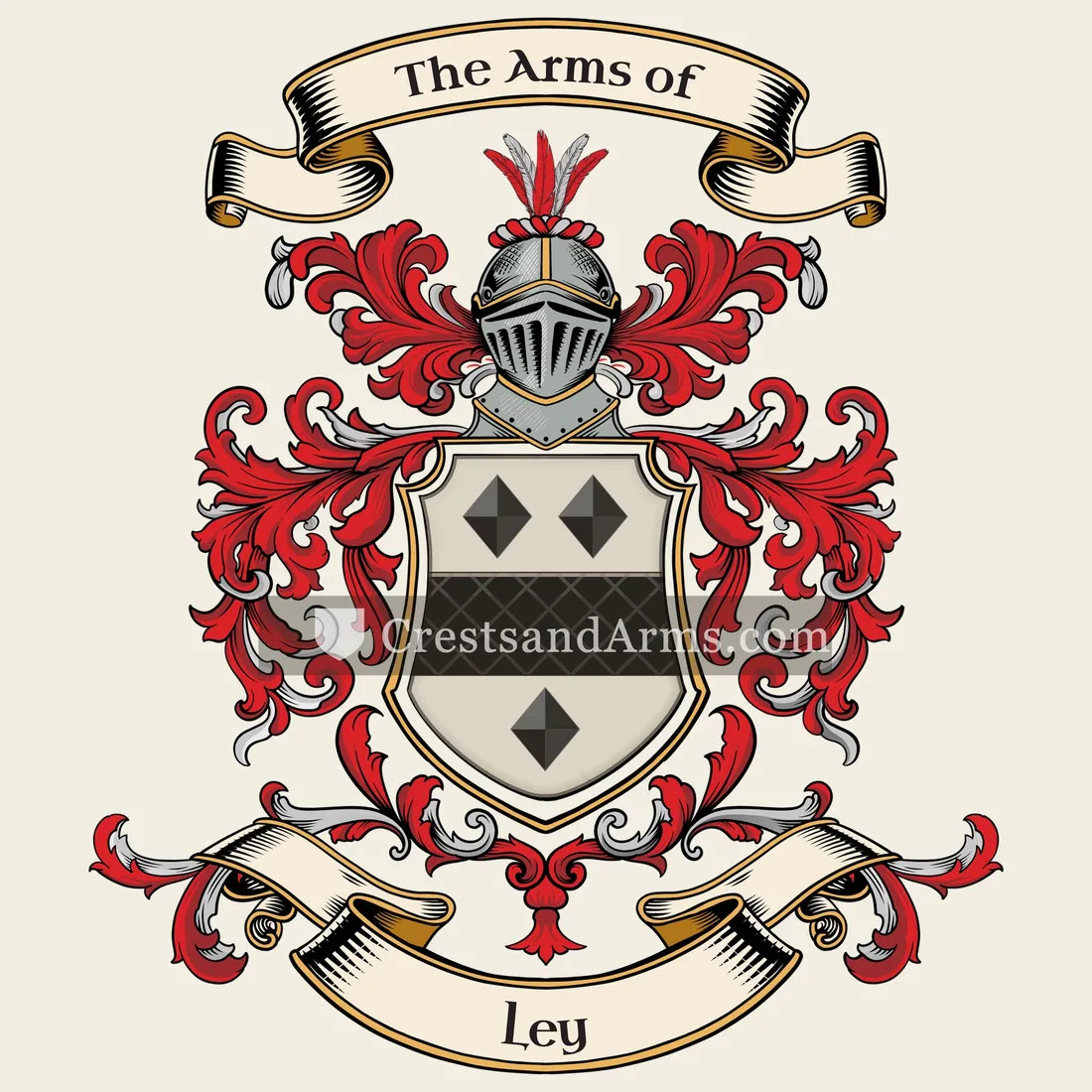
Silver (Argent)Means: Peace and sincerity
Black (Sable)Means: Constancy
Historical info
Source
J. B. Rietstap, Armorial Général, Gouda: G. B. van Goor Zonen, 1884–87
Blazon (the actual original written record)
“D'arg. au chev. de sa., acc. de trois têtes de phoque du même. C.: un lion assis d'or, la patte dextre levée. S.: à dextre un lion d'arg., semé de trèfles de sin.; à sen. un lion de gu., sem. de bes. d'or. D.: VINCENDO VICTUS.”
Britainc. 1619
Digital archive packCoat of arms PNG, gold border print PDF, vector SVG and the certificate of authenticity. Sent to your email in minutes.
Map of Britain showing where the Ley arms are recorded
The Ley arms were recorded in Britain, c. 1619.
Arms such as these were typically recorded in Kent.
Kent sits between London and the short crossing to Europe, and the trade passing through made it wealthy. Merchant families bought land with that money, and it was landowners who took coats of arms.
This is where the arms were entered in the register. Families often moved to other parts of the country, so the same name can turn up in more than one region.
The body that granted and recorded arms in Britain in this period.
James VI and I
Sovereign of the period
James VI and I
1603–1625
Reigning in Germany when the Ley arms are first recorded.
How Arms Worked in Britain
English heraldry allowed arms to be shared by all legitimate descendants of the original owner. These symbols were treated as personal property that moved through the generations to all children. While the eldest son kept the original design, other family members could use the same shield without needing to change it or register their own unique versions.
Granting authority
The College of Arms in London has regulated the use of coats of arms throughout England and Wales since 1484.
How they got arms
Families typically obtained their coats of arms through a formal grant from the Crown or by proving their ancient right to them.
Where arms were recorded
All official coats of arms are recorded in the registers kept at the College of Arms, which date back to the fifteenth century.
The family's standing
Recorded among the armigerous families of Britain.
Origin & History of the Ley Family in Britain
The surname Ley is an ancient topographical name that likely originated to describe someone who lived near a meadow or a clearing in the woods. In Old English, the word "leah" referred to an open space, and over many centuries, this term evolved into the modern spelling of the family name. By the early 17th century, the Ley family had established a notable presence in the county of Kent. Records from 1619 confirm that members of the family were settled in this region, where they were likely involved in the agricultural life that defined the local economy at the time. As the family grew, they became part of the local social fabric, participating in the parish systems and trade networks that were essential to life in southern England during the Stuart period. This early history reflects a steady connection to the land and the gradual development of the family name as a distinct identifier within the community.
Meaning of the Ley family crest colors & symbols
Symbols on this shield
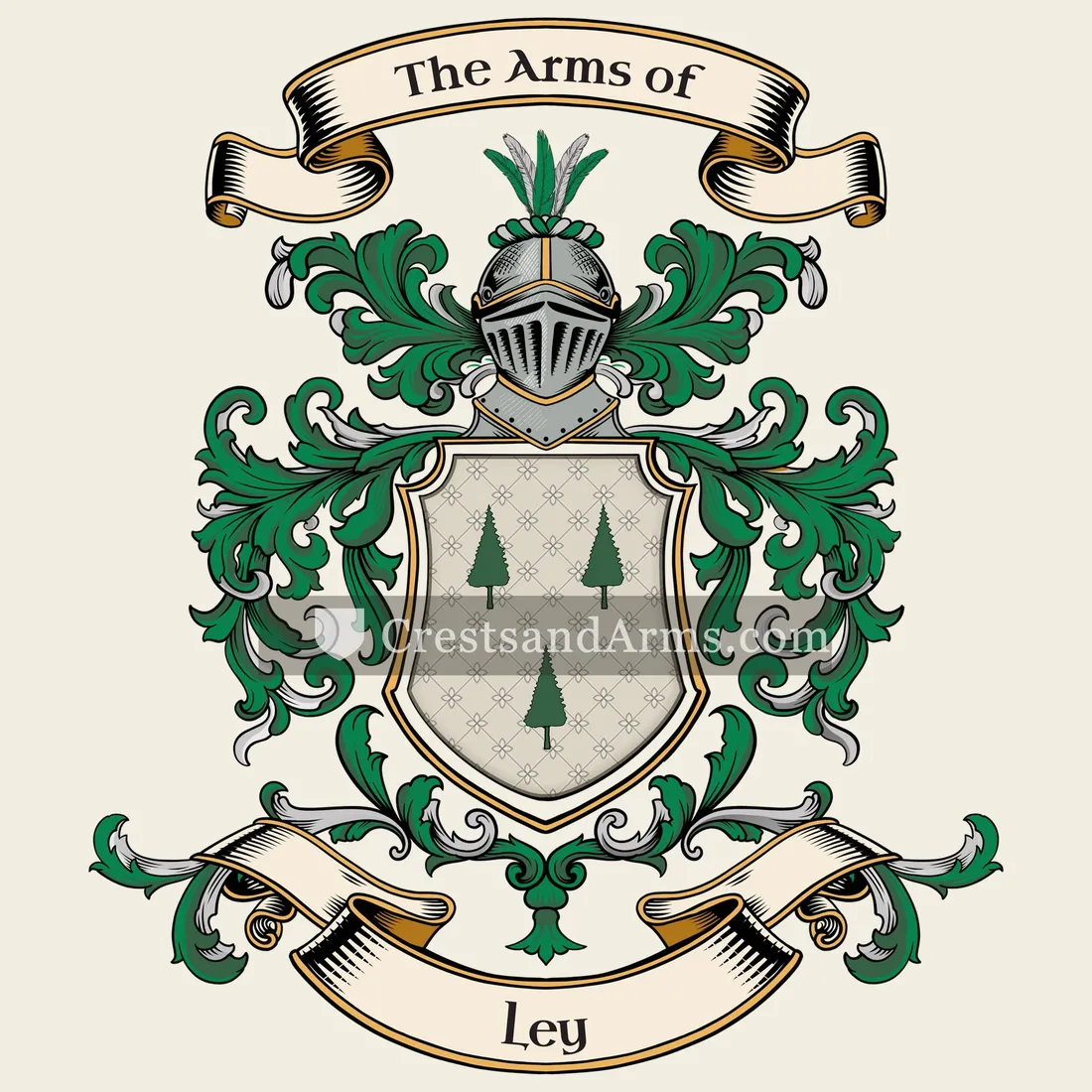
pine treeSteadfastness through every season
Colours
Silver (Argent)Means: Peace and sincerity
Green (Vert)Means: Hope
Historical info
Source
Sir Bernard Burke, The General Armory of England, Scotland, Ireland and Wales, London: Harrison & Sons, 1884
Blazon (the actual original written record)
“Ar. three pine trees vert”
CornwallTrevorgan Vean · Cornwall, c. 1620
Digital archive packCoat of arms PNG, gold border print PDF, vector SVG and the certificate of authenticity. Sent to your email in minutes.
Map of England showing where the Ley arms are recorded
The Ley arms were recorded in Cornwall, c. 1620.
Cornwall was a county apart, with its own language and its own tight-knit gentry. Tin and the sea made money there, and families who made it bought land, which is what brought arms with it.
This is where the arms were entered in the register. Families often moved to other parts of the country, so the same name can turn up in more than one region.
The body that granted and recorded arms in England in this period.
James VI and I
Sovereign of the period
James VI and I
1603–1625
Reigning in Germany when the Ley arms are first recorded.
How Arms Worked in England
English heraldry allowed arms to be shared by all legitimate descendants of the original owner. These symbols were treated as personal property that moved through the generations to all children. While the eldest son kept the original design, other family members could use the same shield without needing to change it or register their own unique versions.
Granting authority
The College of Arms in London has regulated the use of coats of arms throughout England and Wales since 1484.
How they got arms
Families typically obtained their coats of arms through a formal grant from the Crown or by proving their ancient right to them.
Where arms were recorded
All official coats of arms are recorded in the registers kept at the College of Arms, which date back to the fifteenth century.
The family's standing
Recorded among the armigerous families of Cornwall.
Origin & History of the Ley Family in England
The surname Ley is deeply rooted in the landscape of medieval England, where it functioned as a topographical name for families living near a meadow or a tract of open land. The word itself derives from the Old English term *leah*, which described a clearing in a forest or a piece of pasture. By the time the name became firmly established in the records of Cornwall during the early 17th century, it had already been used for generations to identify people by their connection to the local terrain. Families bearing this name were often part of the rural working class, deeply integrated into the agricultural life of the southwestern counties. Their presence in Cornwall by 1620 reflects a long history of settlement in the region, where the name evolved alongside the shifting linguistic patterns of the English countryside. These early ancestors were likely farmers or tradespeople whose identity was defined by the specific fields and clearings they cultivated for centuries.
Ley Meaning & Related Branches
Root word
Loh
A clearing or open space in a forest or woodland.
This name
LeyA topographic name for someone who lived near a forest clearing or a stony hillside.
also spelled
Leigh
Leighs
Leys
Lay
Lee
Related arms
Leevariant spelling
Leighvariant spelling
Leeghvariant spelling
Leeysvariant spelling
Documented Sources
J. B. Rietstap, Armorial Général, Gouda: G. B. van Goor Zonen, 1884–87
Bahlow, Hans, Deutsches Namenlexikon: Familien- und Vornamen nach Ursprung und Sinn erklärt, 1967
Gottschald, Max, Deutsche Namenkunde: Unsere Familiennamen nach ihrer Entstehung und Bedeutung, 1971
Landesarchiv Nordrhein-Westfalen, Kirchenbücher der evangelischen und katholischen Kirchengemeinden in Westfalen, 1765
Digital archive packCoat of arms PNG, gold border print PDF, vector SVG and the certificate of authenticity. Sent to your email in minutes.


 fessThe military belt, and readiness to serve
 lozengeHonour and nobility, and the arms of a woman
 fessThe military belt, and readiness to serve
 lozengeHonour and nobility, and the arms of a woman


 chevronProtection, and faithful service completed


 pine treeSteadfastness through every season