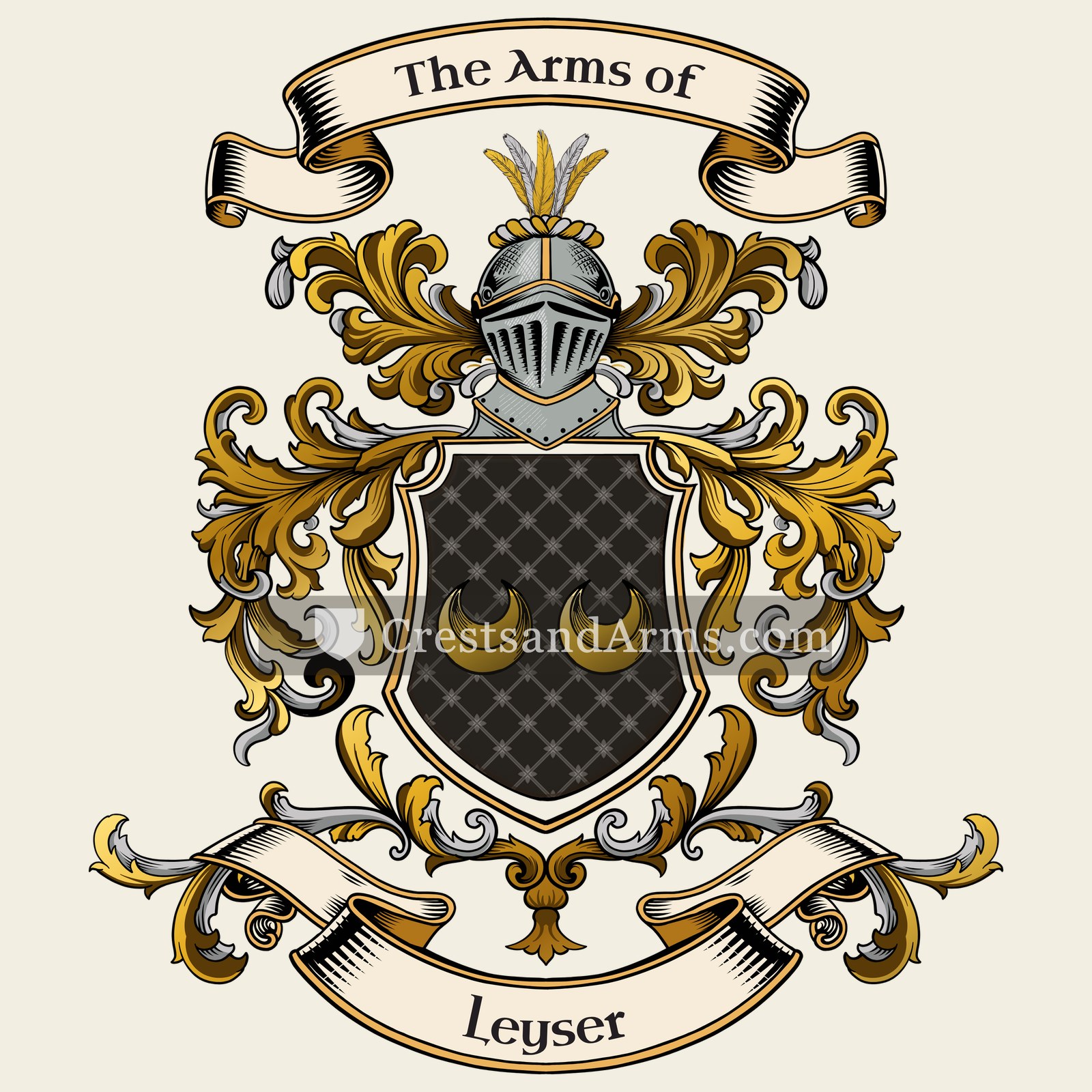
A record of documented arms, meaning and origin, researched for the Leyser family of Germany.
Reg. 7979 · German, J–L
Coat of Arms & Family Crest Details
Symbols on this shield
crescentHonour by the sovereign, and the second son
Colours
Black (Sable)Means: Constancy
Gold (Or)Means: Generosity
Historical info
Source
J. B. Rietstap, Armorial Général, Gouda: G. B. van Goor Zonen, 1884–87
Blazon (the actual original written record)
“De sa. à deux croiss. figurés adossés d'or. Deux cq. cour., portant chacune comme cimier un panache de pl. d'aut. de sa., ch. des croiss. de l'écu. S.: deux lions reg. d'or [V. Friesen-Leyser.]”
SaxonySaxony, c. 1590
Digital archive packCoat of arms PNG, gold border print PDF, vector SVG and the certificate of authenticity. Sent to your email in minutes.
Map of Germany showing where the Leyser arms are recorded
The Leyser arms were recorded in Saxony, c. 1590.
Saxony had mines, trade and old landed families all at once. Silver made some fortunes and land held others, and both sorts of family kept arms, which is why Saxon names appear so often in the registers.
This is where the arms were entered in the register. Families often moved to other parts of the country, so the same name can turn up in more than one region.
The body that granted and recorded arms in Germany in this period.
Emperor Rudolf II
Sovereign of the period
Emperor Rudolf II
1576–1612
Reigning in Germany when the Leyser arms are first recorded.
How Arms Worked in Germany
In the Holy Roman Empire, coats of arms were often granted to individuals by the Emperor or his representatives. These arms were then passed down through the generations to all legitimate descendants of the original holder. Younger branches of a family usually kept the same shield design without needing to change it, as the arms belonged to the entire lineage.
Granting authority
The Holy Roman Emperor held the sole power to grant new coats of arms throughout his vast imperial territories.
How they got arms
Families typically obtained their coats of arms through a formal imperial grant or by proving their noble status to the authorities.
Where arms were recorded
These grants were officially recorded in the Imperial Chancery registers, which began keeping formal records of such honors during the Middle Ages.
The family's standing
Recorded among the armigerous families of Saxony.
Origin & History of the Leyser Family in Germany
The family name Leyser emerged as a distinct surname in the German region of Saxony during the late sixteenth century. Historical records confirm that members of the family were well-established in this area by 1590, often associated with the academic and religious life of the period. The name itself is thought to be a variation of the Middle High German word for a pasture or a meadow, suggesting that the family’s earliest ancestors may have been landowners or farmers who took their name from the landscape they inhabited. As the family grew in prominence, many members became influential figures in the Lutheran Church and the University of Wittenberg. This transition from rural life to intellectual circles helped solidify the name within the social structure of Saxony, allowing the family to maintain a consistent presence in regional records for several generations.
Related Branches & Arms
Root word
Lazarus
Derived from the Hebrew name Eleazar meaning God has helped.
This name
LeyserA German patronymic surname indicating descent from a person named Lazarus.
also spelled
Leiser
Leyserr
Leiserr
Layser
Documented Sources
J. B. Rietstap, Armorial Général, Gouda: G. B. van Goor Zonen, 1884–87
Leyser, Polycarp. Oratio de vita et obitis Polycarpi Leyseri. 1610
Stammler, Wolfgang. Die deutsche Literatur des Mittelalters: Verfasserlexikon. 1933
Sächsisches Staatsarchiv, Bestand 10024 (Geheimer Rat)
Universitätsarchiv Wittenberg, Matrikel der Universität Wittenberg
Digital archive packCoat of arms PNG, gold border print PDF, vector SVG and the certificate of authenticity. Sent to your email in minutes.


 crescentHonour by the sovereign, and the second son
 crescentHonour by the sovereign, and the second son