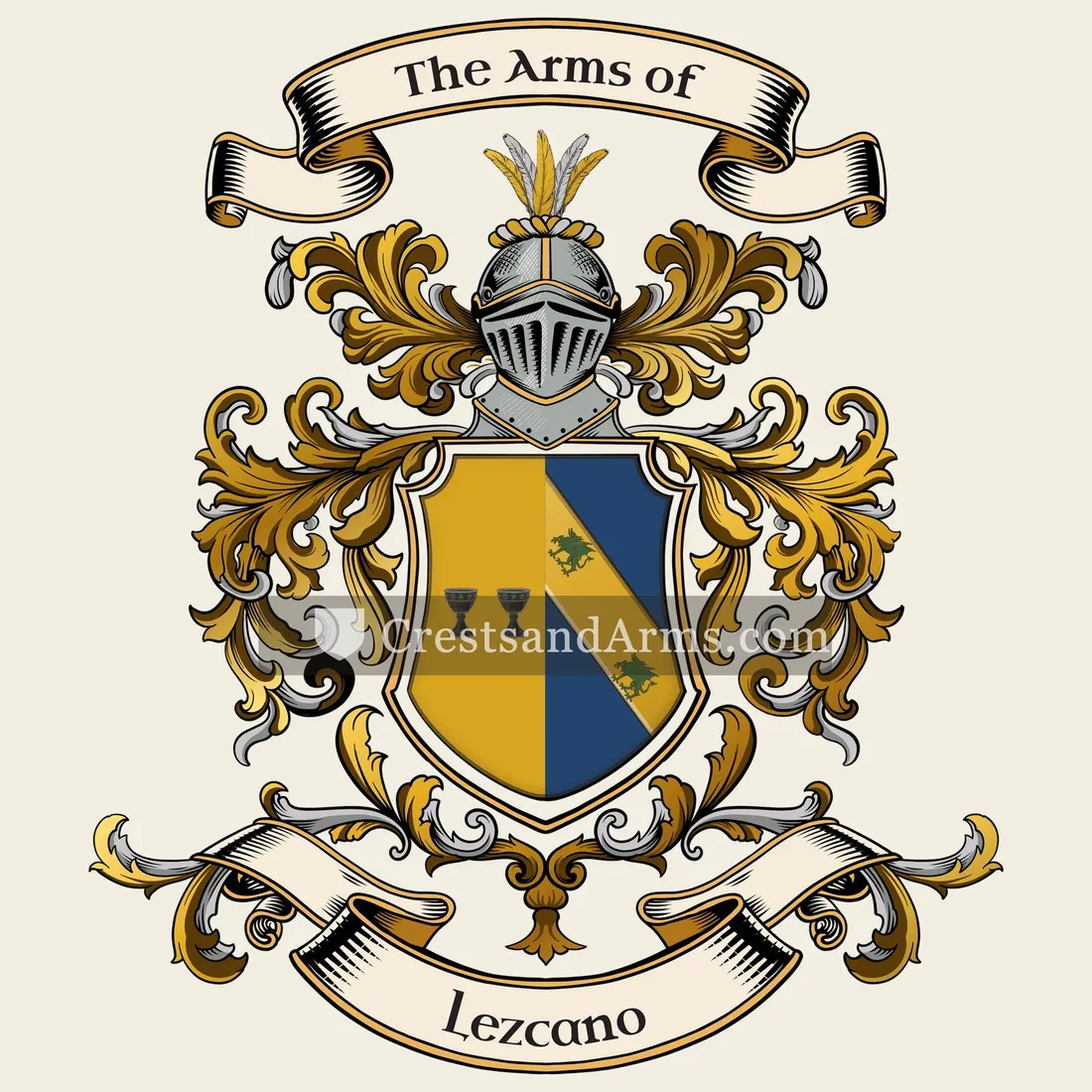
A record of documented arms, meaning and origin, researched for the Lezcano family of Spain.
Reg. 3377 · Spanish, J–L
Meaning of the Lezcano family crest colors & symbols
Symbols on this shield
bendDefence, and the scarf of a commander
cupFaith, office, and a trust discharged
dragonA most valiant defender of treasure
Colours
Gold (Or)Means: Generosity
Blue (Azure)Means: Loyalty and truth
Black (Sable)Means: Constancy
Green (Vert)Means: Hope
Historical info
Source
J. B. Rietstap, Armorial Général, Gouda: G. B. van Goor Zonen, 1884–87
Blazon (the actual original written record)
“Parti: au 1 d'or à cinq panelles de sin., les tiges en haut, 2 et 1, acc. en p. de deux chaudières accostées de sa.: au 2 d'azur à la bande d'or, engoulée de deux têtes de dragon de sin.”
AragonAragon, c. 1722
Digital archive packCoat of arms PNG, gold border print PDF, vector SVG and the certificate of authenticity. Sent to your email in minutes.
Map of Spain showing where the Lezcano arms are recorded
The Lezcano arms were recorded in Aragon, c. 1722.
Aragon was mountain and river country in north-eastern Spain, with a strong tradition of small independent landholders. A great many families counted as gentry there, and each one needed a shield to be told apart.
This is where the arms were entered in the register. Families often moved to other parts of the country, so the same name can turn up in more than one region.
The body that granted and recorded arms in Spain in this period.
Philip V of Spain
Sovereign of the period
Philip V of Spain
1714–1724
Reigning in Spain when the Lezcano arms are first recorded.
How Arms Worked in Spain
In Spain, a coat of arms was considered a form of property that belonged to the entire family line. These arms were passed down from a father to all his children equally. Younger branches of the family usually kept the original design without needing to add any special marks to distinguish their specific line.
Granting authority
The Cronista Rey de Armas was the official body that regulated and granted coats of arms throughout Spain.
How they got arms
Families often obtained their arms through royal grants or by proving their noble status to the official heraldic authority.
Where arms were recorded
Coats of arms were officially recorded in the registers of the Cronista Rey de Armas starting in 1496.
The family's standing
Recorded among the armigerous families of Aragon.
Origin & History of the Lezcano Family in Spain
The surname Lezcano is rooted in the northern regions of Spain, with historical evidence placing the family in the Kingdom of Aragon by the early 18th century. The name is widely considered to be of Basque origin, likely derived from the words "lez" and "cano," which together suggest a geographical connection to a flat or level area near a mountain slope. During the 1700s, families bearing this name were often involved in the agricultural and administrative life of their local communities. As members of the family moved across the Iberian Peninsula, they integrated into the social fabric of various provinces, maintaining their identity through land ownership and participation in parish life. By 1722, the presence of the Lezcano family in Aragon reflects the broader patterns of migration and settlement that defined the era, as families sought new opportunities in the fertile valleys and growing towns of the region.
Lezcano Meaning & Related Branches
Root word
Lezcano
Basque toponymic suffix meaning place of or location of.
This name
LezcanoDerived from the Basque place name Lezkano, referring to a specific location or settlement.
also spelled
Leseano
Lezeanno
Leseanno
Documented Sources
J. B. Rietstap, Armorial Général, Gouda: G. B. van Goor Zonen, 1884–87
Mendizábal, Juan Carlos, Diccionario etimológico de apellidos vascos, 1998
Archivo de la Corona de Aragón, Registros de la Real Audiencia de Aragón, 1722
Faure, Roberto, Diccionario de apellidos españoles, 2001
Digital archive packCoat of arms PNG, gold border print PDF, vector SVG and the certificate of authenticity. Sent to your email in minutes.


 bendDefence, and the scarf of a commander
 cupFaith, office, and a trust discharged
 dragonA most valiant defender of treasure
 bendDefence, and the scarf of a commander
 cupFaith, office, and a trust discharged
 dragonA most valiant defender of treasure