Map of France showing where the Libre arms are recorded
The Libre arms were recorded in Auvergne, c. 1663.
Auvergne was mountain country in the middle of France, poor in money but thick with old families. Estates were small and held for a very long time, and long tenure counted for more than wealth when it came to arms.
This is where the arms were entered in the register. Families often moved to other parts of the country, so the same name can turn up in more than one region.
The body that granted and recorded arms in France in this period.
Louis XIV of France
Sovereign of the period
Louis XIV of France
1643–1715
Reigning in France when the Libre arms are first recorded.
How Arms Worked in France
In France, a coat of arms was a mark of honor that passed down through the male line to all legitimate descendants. Families often used the same shield without changes to show their shared heritage. If a branch wanted to stand out, they could add a small mark to their shield to show their specific place in the family tree.
Granting authority
The Juge d'armes de France acted as the official authority that regulated and verified coats of arms across the country.
How they got arms
Families typically inherited their arms from ancestors, though they could also receive them through royal grants or by proving their noble status.
Where arms were recorded
Coats of arms were officially recorded in the Armorial Général de France, which began its main collection in the year 1696.
The family's standing
Recorded among the armigerous families of Auvergne.
Origin & History of the Libre Family in France
The family name Libre traces its roots to the rugged landscape of the Auvergne region in central France, where records confirm the family was established by 1663. During the seventeenth century, this mountainous area was defined by a mix of volcanic terrain and isolated rural communities, which often shaped the identities of the families living there. The name itself likely originated as a descriptive term, potentially reflecting the status or personal characteristics of an early ancestor in a society governed by complex feudal ties. As the family settled into the local parish life of Auvergne, they became part of the agricultural and social fabric of the province. Over the following decades, the Libre family maintained their presence in the region, navigating the challenges of life under the French monarchy and the shifting economic conditions of the rural highlands. By remaining in this specific geographic pocket, the early members of the family helped establish a lineage that persisted through generations of local history.
Meaning of the Libre family crest colors & symbols
Symbols on this shield
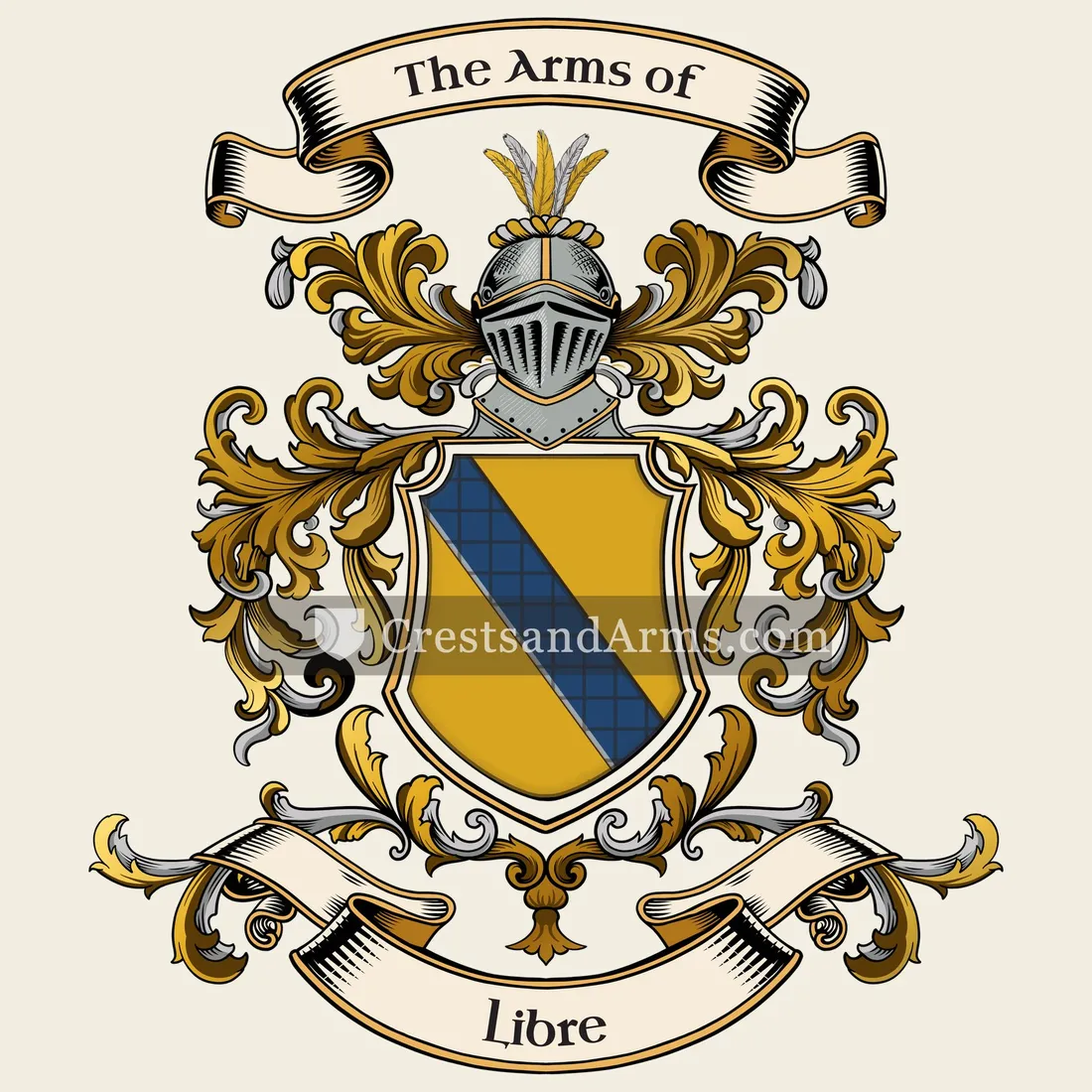
bendDefence, and the scarf of a commander
Colours
Gold (Or)Means: Generosity
Blue (Azure)Means: Loyalty and truth
Historical info
Source
J. B. Rietstap, Armorial Général, Gouda: G. B. van Goor Zonen, 1884–87
Blazon (the actual original written record)
“D'or à la bande d'azur.”
ItalyBologne, c. 1775
Digital archive packCoat of arms PNG, gold border print PDF, vector SVG and the certificate of authenticity. Sent to your email in minutes.
Map of Italy showing where the Libre arms are recorded
The Libre arms were recorded in Bologne, c. 1775.
This is where the arms were entered in the register. Families often moved to other parts of the country, so the same name can turn up in more than one region.
The body that granted and recorded arms in Italy in this period.
Alvise Giovanni Mocenigo
Sovereign of the period
Alvise Giovanni Mocenigo
1763–1778
Reigning in France when the Libre arms are first recorded.
How Arms Worked in Italy
In the Italian states, coats of arms were often used by noble families to show their status and history. These symbols were passed down through the generations to all legitimate male descendants. Younger branches of a family usually kept the original design but sometimes added small changes to distinguish their specific line from the main branch.
Granting authority
Various local rulers and city governments controlled the use of coats of arms across the different Italian states.
How they got arms
Families often assumed their own arms or received them as official grants from local lords, popes, or city councils.
Where arms were recorded
Arms were recorded in local city archives or private family books rather than in one single national register.
The family's standing
Recorded among the armigerous families of Italy.
Origin & History of the Libre Family in Italy
The family name Libre traces its roots to the vibrant intellectual and social landscape of eighteenth-century Italy. By 1775, records confirm that members of the family were well-established in the city of Bologna. During this period, Bologna was a major center for education and trade, serving as a hub for families who valued academic achievement and civic participation. The name itself suggests a connection to the concept of liberty or freedom, which was a common theme for families rising in prominence during the Enlightenment era. As residents of a city famous for its ancient university, the early Libre family likely moved within circles that prioritized literacy, legal studies, and the arts. Their presence in the city during the late 1700s places them at the heart of a transformative time in Italian history, where families often defined their legacy through their contributions to the local community and their engagement with the shifting political tides of the region.
Libre Meaning & Related Branches
Root word
Liber
Latin term meaning free, independent, or unrestricted.
This name
LibreA descriptive surname historically used to denote a person who was free rather than a serf.
also spelled
Libry
Lybri
Libree
Documented Sources
J. B. Rietstap, Armorial Général, Gouda: G. B. van Goor Zonen, 1884–87
Archives départementales du Puy-de-Dôme, Registres paroissiaux et d'état civil, Collection communale
Fournier, Gabriel, Le peuplement rural en Basse-Auvergne durant le haut Moyen Âge, 1962
Pérot, Jacques, Histoire de l'Auvergne, 1994
Digital archive packCoat of arms PNG, gold border print PDF, vector SVG and the certificate of authenticity. Sent to your email in minutes.


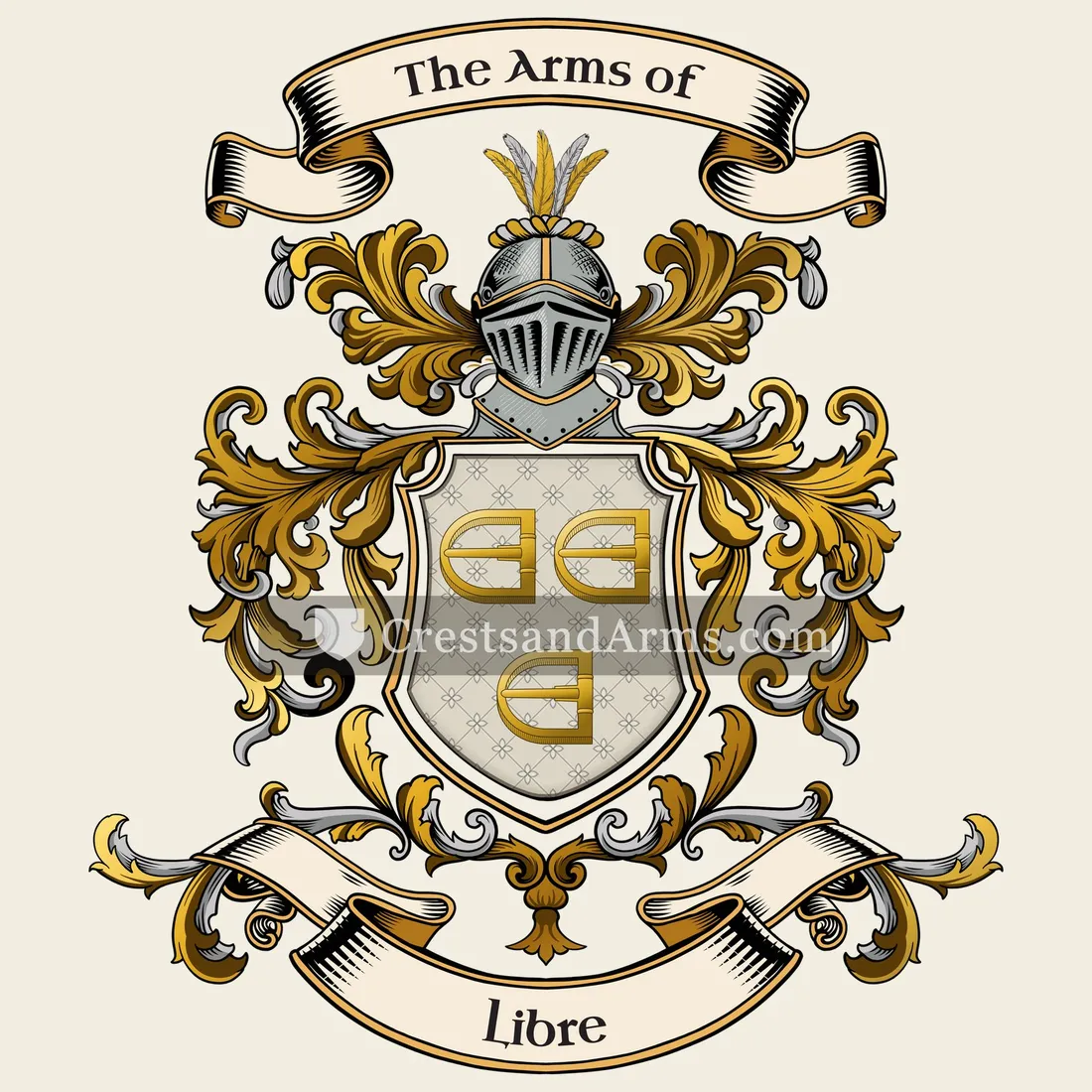
 buckleFidelity, and a bond firmly held
 buckleFidelity, and a bond firmly held


 bendDefence, and the scarf of a commander