Map of Germany showing where the Lichtenberg arms are recorded
The Lichtenberg arms were recorded in Westphalia, c. 1765.
Westphalia was a land of small estates and fortified farmhouses in western Germany. Its families were numerous and not especially rich, but each held its own ground, and holding ground was what brought arms.
This is where the arms were entered in the register. Families often moved to other parts of the country, so the same name can turn up in more than one region.
The body that granted and recorded arms in Germany in this period.
Francis I, Holy Roman Emperor
Sovereign of the period
Francis I, Holy Roman Emperor
1745–1765
Reigning in Germany when the Lichtenberg arms are first recorded.
How Arms Worked in Germany
In the Holy Roman Empire, coats of arms were often granted to individuals by the Emperor or his representatives. These arms were then passed down through the generations to all legitimate descendants of the original holder. Younger branches of a family usually kept the same shield design without needing to change it, as the arms belonged to the entire lineage.
Granting authority
The Holy Roman Emperor held the sole power to grant new coats of arms throughout his vast imperial territories.
How they got arms
Families typically obtained their coats of arms through a formal imperial grant or by proving their noble status to the authorities.
Where arms were recorded
These grants were officially recorded in the Imperial Chancery registers, which began keeping formal records of such honors during the Middle Ages.
The family's standing
Recorded among the armigerous families of Westphalia.
Origin & History of the Lichtenberg Family in Germany
The name Lichtenberg is a topographic surname, meaning it was originally derived from the physical landscape where a family lived. In German, the name combines the words "licht," meaning bright or clear, and "berg," meaning mountain or hill. This suggests that the earliest ancestors to carry this name likely resided near a prominent, sunlit hill or a clearing on a wooded slope. By the time members of the family were documented in the Westphalia region in 1765, the name had already been established for generations across various German-speaking territories. During this period, families often moved between rural villages and growing towns to find work in agriculture or local trades. The presence of the Lichtenberg family in Westphalia during the mid-18th century reflects the broader movement of people across the Holy Roman Empire as they sought stable communities and land to cultivate. Because the name is tied to common geographical features, it emerged independently in several different regions, creating a history that is deeply connected to the diverse German landscape.
Coat of Arms & Family Crest Details
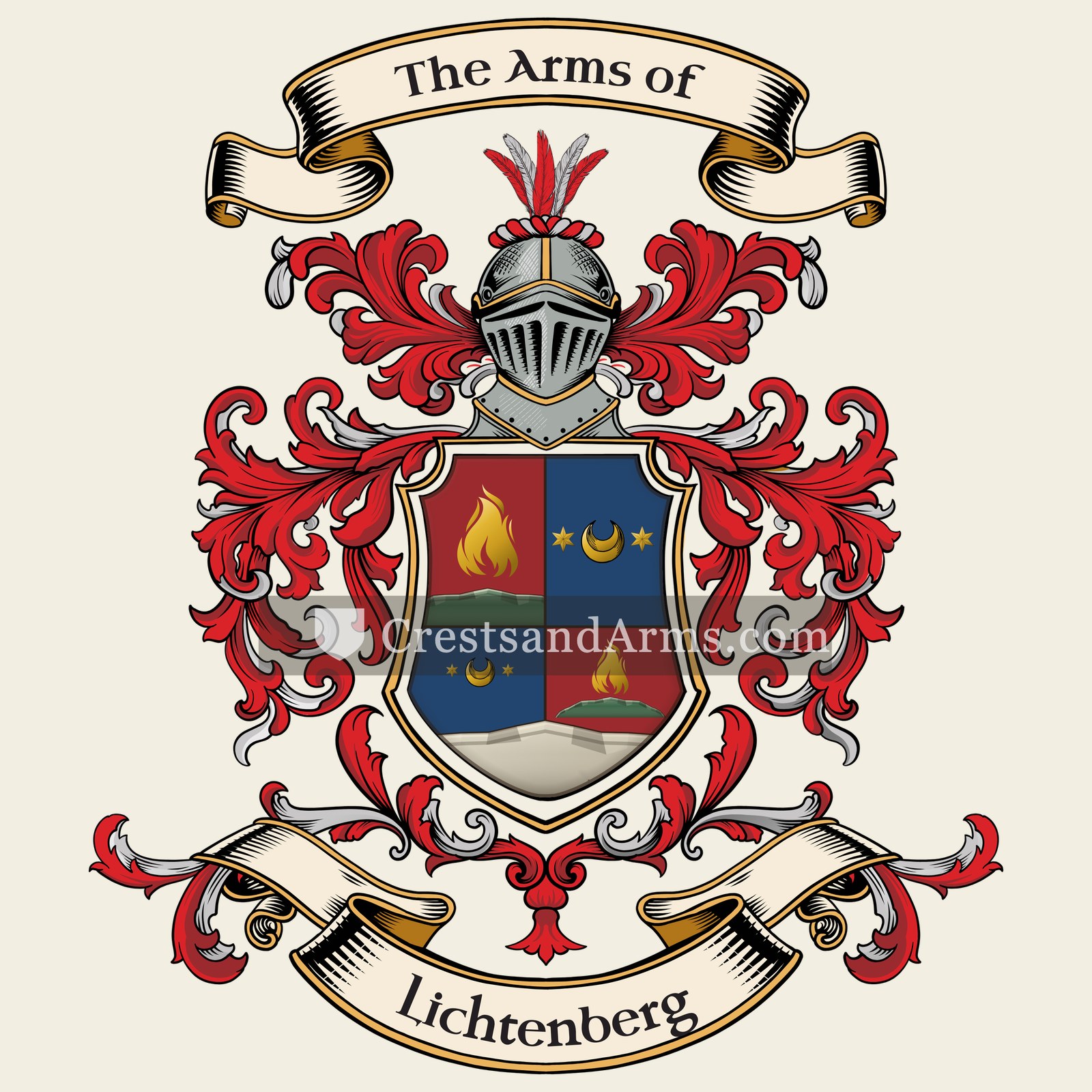
Symbols on this shield
mountThe ground held, and steadfastness upon it
fireZeal and purification
crescentHonour by the sovereign, and the second son
starThe celestial goddess, and nobility
Colours
Red (Gules)Means: Military strength
Blue (Azure)Means: Loyalty and truth
Silver (Argent)Means: Peace and sincerity
Green (Vert)Means: Hope
Gold (Or)Means: Generosity
Historical info
Source
J. B. Rietstap, Armorial Général, Gouda: G. B. van Goor Zonen, 1884–87
Blazon (the actual original written record)
“Ec.: aux 1 et 4 de gu. a un mont d'arg., mouv. de la p., sommé d'une flamme d'or; aux 2 et 3 d'azur à un croiss. tourné d'or, accosté de deux étoiles du même. Cq. cour. C.: une chandelle d'arg., allumée d'or; entre un vol d'arg., chaque aile ch. d'une étoile d'or.”
Denmarkc. 1739
Digital archive packCoat of arms PNG, gold border print PDF, vector SVG and the certificate of authenticity. Sent to your email in minutes.
Map of Denmark showing where the Lichtenberg arms are recorded
The Lichtenberg arms were recorded in Denmark, c. 1739.
Arms such as these were typically recorded in Sjaælland.
Zealand held the Danish court, the crown's offices and Copenhagen itself. Families who served the king kept estates within reach of it, and royal service was the ordinary route to a coat of arms.
This is where the arms were entered in the register. Families often moved to other parts of the country, so the same name can turn up in more than one region.
The body that granted and recorded arms in Denmark in this period.
Christian VI of Denmark
Sovereign of the period
Christian VI of Denmark
1730–1746
Reigning in Germany when the Lichtenberg arms are first recorded.
How Arms Worked in Denmark
Danish heraldry during this period was closely tied to noble status and royal favor rather than being open to all citizens. Arms were typically granted by the monarch to individuals, and these symbols were then shared by all members of the noble house. If a family line died out, the right to use those specific arms ended with them.
Granting authority
The Danish royal chancery held the power to issue and regulate official coats of arms for the kingdom.
How they got arms
Families usually received their arms through a formal royal grant that confirmed their noble status and rights.
Where arms were recorded
These grants were officially recorded in the Danish Royal Chancery records starting in the sixteenth century.
The family's standing
Recorded among the armigerous families of Denmark.
Origin & History of the Lichtenberg Family in Denmark
The history of the Lichtenberg family in Denmark begins to emerge clearly in the mid-eighteenth century, particularly within the region of Sjælland. By 1739, members of the family were already established in the area, marking their transition into the local social and administrative landscape. The name itself suggests a German origin, which was common for families moving into Denmark during this period of cultural exchange between the two regions. As these early family members settled in Sjælland, they often integrated into the professional classes, serving in roles that allowed them to influence local commerce and land management. Their presence in the Danish records from this time highlights a period of upward mobility where families of foreign descent could secure a stable footing in Danish society through hard work and strategic social connections. This era served as the foundation for the family to grow and eventually spread across various parts of the country.
Coat of Arms & Family Crest Details
Symbols on this shield
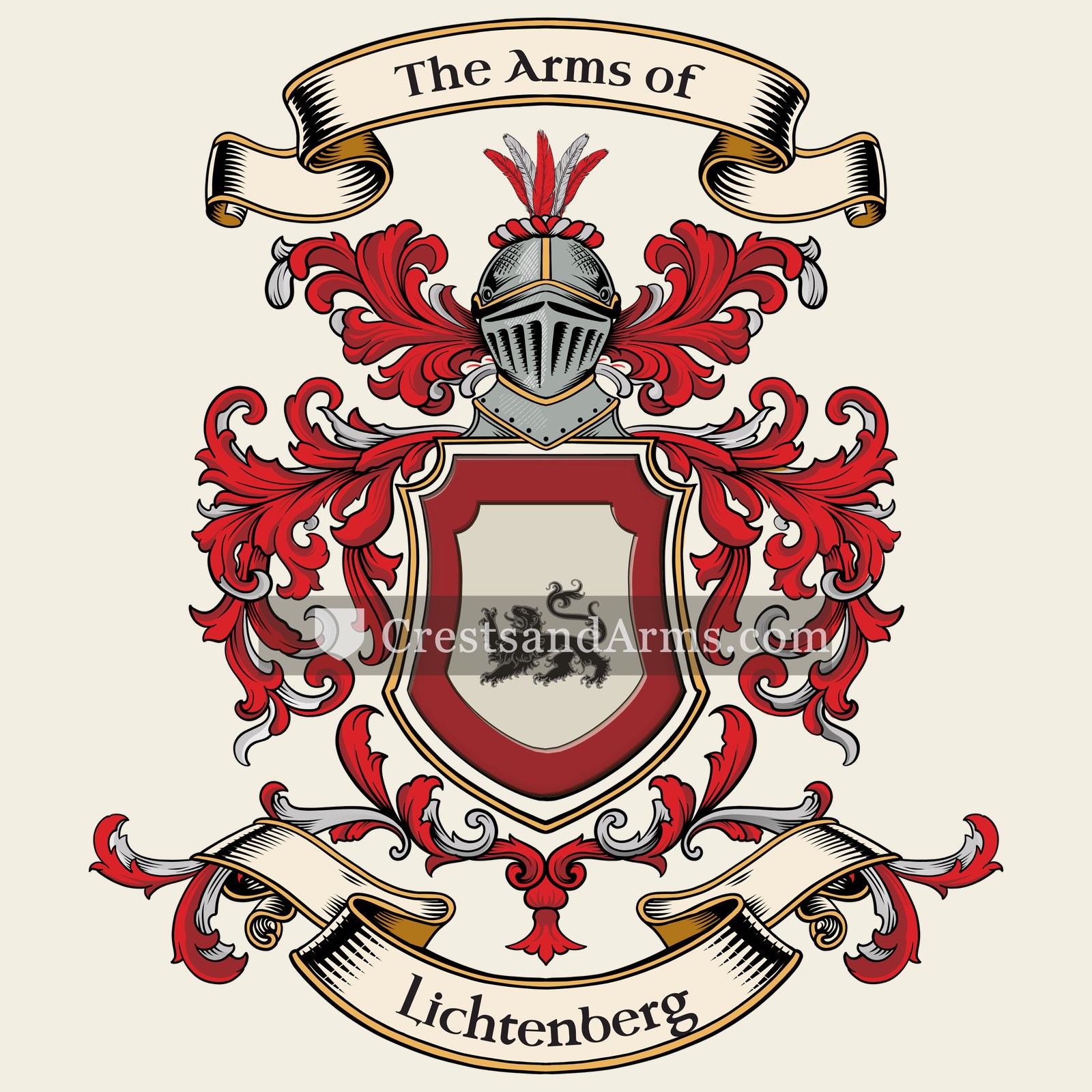
lionCourage, strength and royalty
Colours
Silver (Argent)Means: Peace and sincerity
Red (Gules)Means: Military strength
Black (Sable)Means: Constancy
Historical info
Source
J. B. Rietstap, Armorial Général, Gouda: G. B. van Goor Zonen, 1884–87
Blazon (the actual original written record)
“D'arg. au lion de sa.; à la bord. de gu. C.: une tête et col de cygne d'arg.”
AlsaceAlsace, c. 1663
Digital archive packCoat of arms PNG, gold border print PDF, vector SVG and the certificate of authenticity. Sent to your email in minutes.
Map of France showing where the Lichtenberg arms are recorded
The Lichtenberg arms were recorded in Alsace, c. 1663.
Alsace lay between France and the German lands and belonged to both at different times. Its families held small estates and served whichever side ruled, and men who served in arms carried arms of their own.
This is where the arms were entered in the register. Families often moved to other parts of the country, so the same name can turn up in more than one region.
The body that granted and recorded arms in France in this period.
Louis XIV of France
Sovereign of the period
Louis XIV of France
1643–1715
Reigning in Germany when the Lichtenberg arms are first recorded.
How Arms Worked in France
In France, a coat of arms was a mark of honor that passed down through the male line to all legitimate descendants. Families often used the same shield without changes to show their shared heritage. If a branch wanted to stand out, they could add a small mark to their shield to show their specific place in the family tree.
Granting authority
The Juge d'armes de France acted as the official authority that regulated and verified coats of arms across the country.
How they got arms
Families typically inherited their arms from ancestors, though they could also receive them through royal grants or by proving their noble status.
Where arms were recorded
Coats of arms were officially recorded in the Armorial Général de France, which began its main collection in the year 1696.
The family's standing
Recorded among the armigerous families of Alsace.
Origin & History of the Lichtenberg Family in France
The name Lichtenberg finds its historical roots in the Alsace region, a territory that has long served as a cultural bridge between France and Germany. By 1663, records confirm that members of the family were firmly established in this area, living through a period when Alsace was transitioning toward French administration under the reign of Louis XIV. The name itself is derived from the German words for bright or shining mountain, suggesting that the family’s ancestors likely originated from a specific geographic location or a fortified hilltop site. During the seventeenth century, families in Alsace often navigated a complex landscape of shifting borders and local customs. As the region became more integrated into the French kingdom, the Lichtenbergs became part of the local social fabric, contributing to the agricultural and civic life of the Alsatian countryside. Their presence in the 1663 records highlights a time when the family was already well-integrated into the local community, maintaining their identity while adapting to the evolving political landscape of eastern France.
Lichtenberg Meaning & Related Branches
Root word
Licht and Berg
Light or bright and a mountain or hill.
This name
LichtenbergA topographic name for someone who lived on a bright or light-colored hill.
also spelled
Lichtenburg
Lychtenberg
Liktenberg
Related arms
Calcum dit Lohausensimilar arms
Documented Sources
J. B. Rietstap, Armorial Général, Gouda: G. B. van Goor Zonen, 1884–87
Bahlow, Hans, Deutsches Namenlexikon: Familien- und Vornamen nach Ursprung und Sinn erklärt, 1967
Heintze, Albert, Die deutschen Familien-Namen: geschichtlich, geographisch, sprachlich, 1903
Landesarchiv Nordrhein-Westfalen, Kirchenbücher der evangelischen und katholischen Gemeinden in Westfalen, 1765
Digital archive packCoat of arms PNG, gold border print PDF, vector SVG and the certificate of authenticity. Sent to your email in minutes.


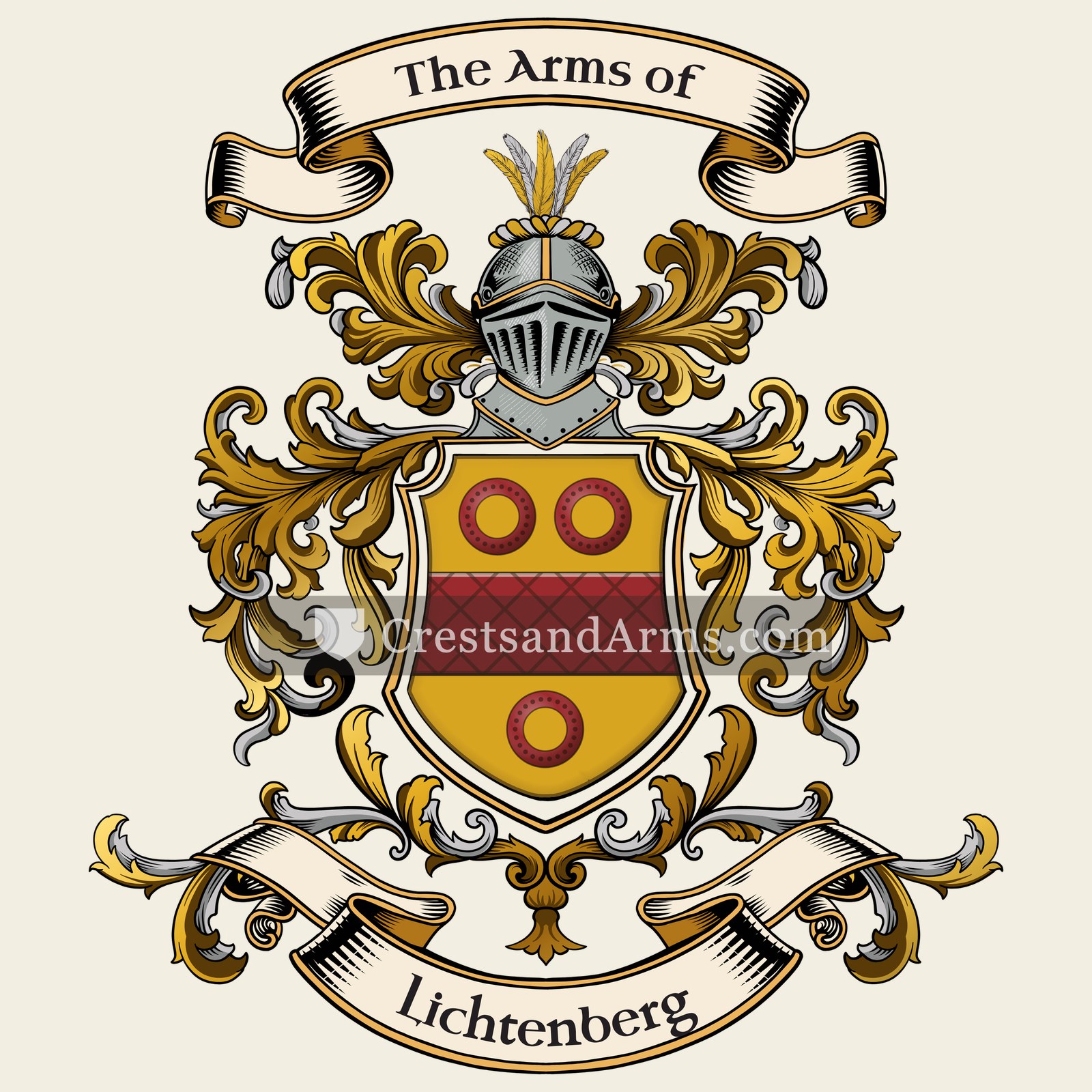
 fessThe military belt, and readiness to serve
 ringFidelity, and a promise kept
 fessThe military belt, and readiness to serve
 ringFidelity, and a promise kept


 mountThe ground held, and steadfastness upon it
 fireZeal and purification
 crescentHonour by the sovereign, and the second son
 starThe celestial goddess, and nobility


 lionCourage, strength and royalty