A record of documented arms, meaning and origin, researched for the Lien family lines. Documented in 2 countries.
Reg. 3440 · German, J–L
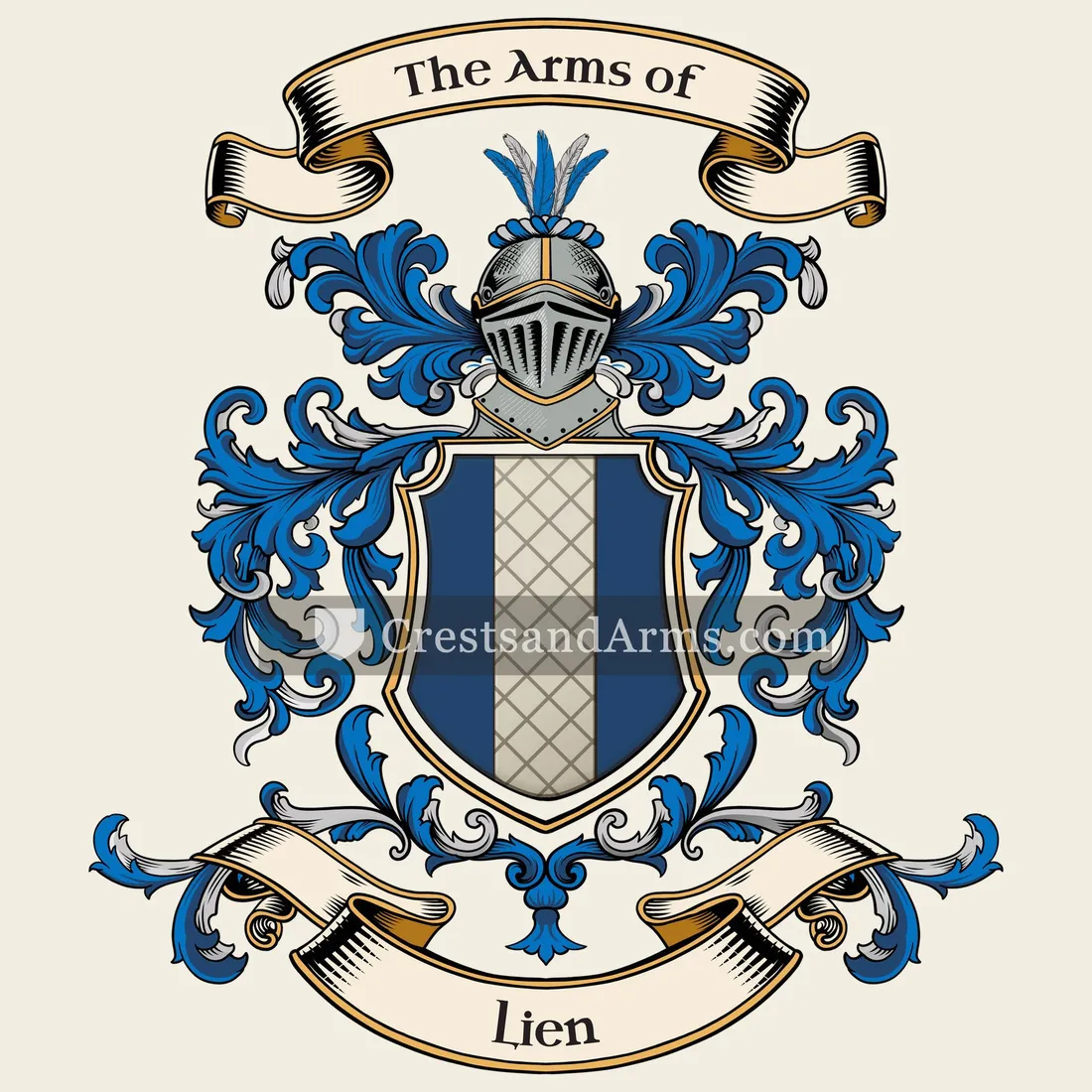
Meaning of the Lien family crest colors & symbols
Symbols on this shield
paleMilitary strength, and a fortified defence
Colours
Blue (Azure)Means: Loyalty and truth
Silver (Argent)Means: Peace and sincerity
Historical info
Source
J. B. Rietstap, Armorial Général, Gouda: G. B. van Goor Zonen, 1884–87
Blazon (the actual original written record)
“D'azur au pal d'arg. C.: une tête et col de chien braque d'arg., languée de gu., coll. d'azur, bordé et bouclé du même; entre un vol d'azur, chaque aile ch. de sept coeurs d'arg., 2, 2, 2 et 1. S.: deux chiens braque reg. d'arg., coll. d'azur, bordé et bouclé d'or, ornés d'ailes pareilles à celles du cimier; tenant chacun une bannière bordée d'or, celle à dextre aux armes de l'écu, celle à sen. de gu. à la fasce d'or. D.: UNITAS. Manteau de pourpre, doublé d'herm., sommé d'une couronne princière.”
GermanyBade, c. 1653
Digital archive packCoat of arms PNG, gold border print PDF, vector SVG and the certificate of authenticity. Sent to your email in minutes.
Map of Germany showing where the Lien arms are recorded
The Lien arms were recorded in Bade, c. 1653.
This is where the arms were entered in the register. Families often moved to other parts of the country, so the same name can turn up in more than one region.
The body that granted and recorded arms in Germany in this period.
Ferdinand III, Holy Roman Emperor
Sovereign of the period
Ferdinand III, Holy Roman Emperor
1637–1657
Reigning in Germany when the Lien arms are first recorded.
How Arms Worked in Germany
In the Holy Roman Empire, coats of arms were often granted to individuals by the Emperor or his representatives. These arms were then passed down through the generations to all legitimate descendants of the original holder. Younger branches of a family usually kept the same shield design without needing to change it, as the arms belonged to the entire lineage.
Granting authority
The Holy Roman Emperor held the sole power to grant new coats of arms throughout his vast imperial territories.
How they got arms
Families typically obtained their coats of arms through a formal imperial grant or by proving their noble status to the authorities.
Where arms were recorded
These grants were officially recorded in the Imperial Chancery registers, which began keeping formal records of such honors during the Middle Ages.
The family's standing
Recorded among the armigerous families of Germany.
Origin & History of the Lien Family in Germany
The family name Lien finds its roots in the southwestern region of Germany, specifically within the historic territory of Baden. By the year 1653, records confirm that members of the family were already established in this area, which was then a patchwork of small states and independent towns. During the mid-seventeenth century, life in Baden was heavily influenced by the aftermath of the Thirty Years' War, a period that reshaped local communities and forced many families to settle in new agricultural or trade-based roles. The name itself likely evolved as a regional variation of common Germanic or Alemannic naming traditions, serving as a way to identify individuals within their local parish or village. As the family grew, they became part of the social fabric of the Rhine valley, contributing to the local workforce and participating in the religious and civic life of their communities during a time of significant reconstruction and cultural change.
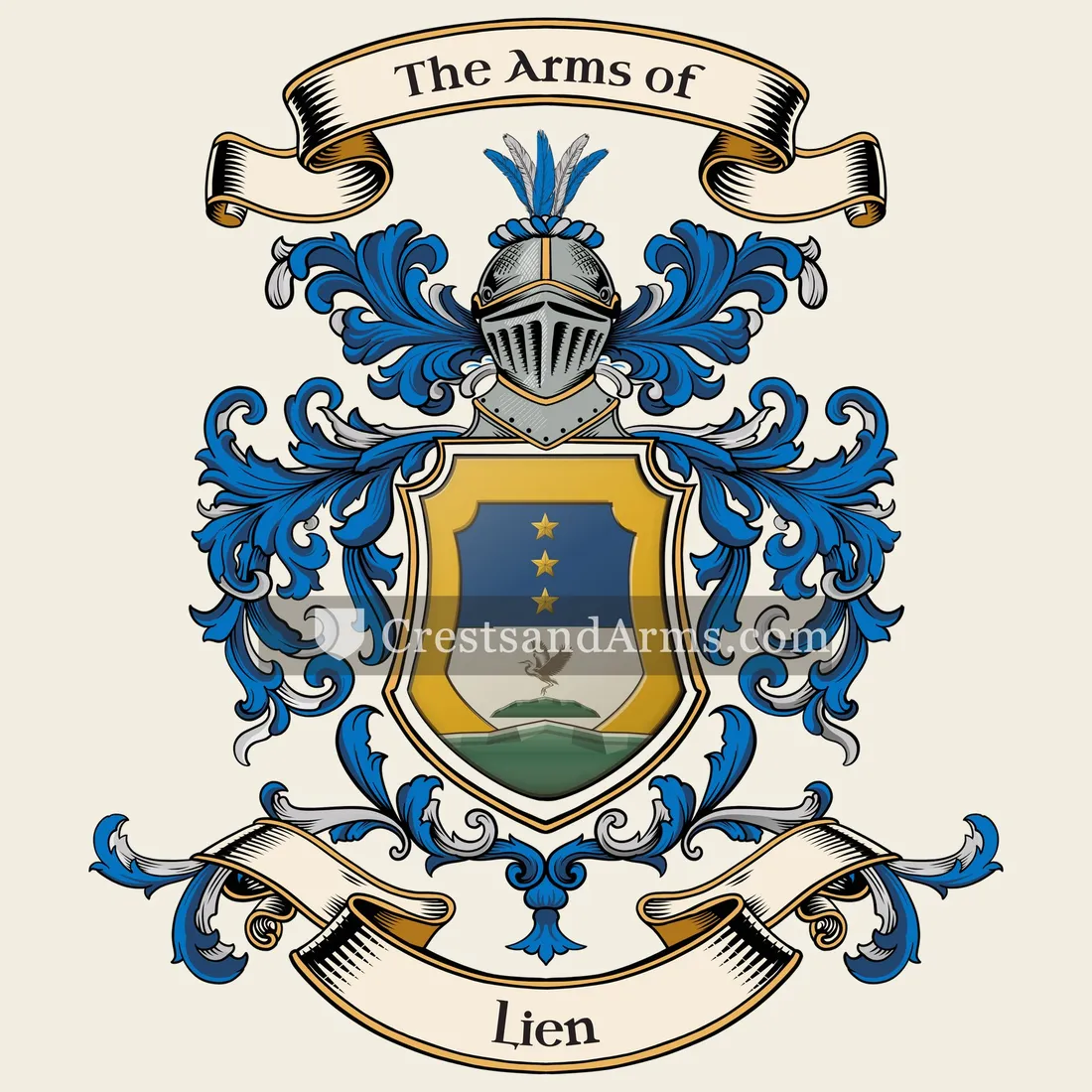
Meaning of the Lien family crest colors & symbols
Symbols on this shield
mountThe ground held, and steadfastness upon it
mulletThe third son, and a divine quality from above
heronPatience and quiet watchfulness
Colours
Blue (Azure)Means: Loyalty and truth
Silver (Argent)Means: Peace and sincerity
Gold (Or)Means: Generosity
Green (Vert)Means: Hope
Historical info
Source
J. B. Rietstap, Armorial Général, Gouda: G. B. van Goor Zonen, 1884–87
Blazon (the actual original written record)
“Coupé: au 1 d'azur à trois étoiles d'or, rangées en fasce; au 2 d'arg. à une grue avec sa vigilance, au nat., posée sur une terrasse de sin. L'écu bordé d'or. Cq. cour. C.: trois pl. d'aut., une d'arg. entre deux d'azur. L. d'arg. et d'azur. S.: deux aigles reg. de sa., languées de gu., bq., m. et cour. d'or.”
Francec. 1786
Digital archive packCoat of arms PNG, gold border print PDF, vector SVG and the certificate of authenticity. Sent to your email in minutes.
Map of France showing where the Lien arms are recorded
The Lien arms were recorded in France, c. 1786.
Arms such as these were typically recorded in Bretagne.
More families held coats of arms in Bretagne than anywhere else in France. The land was divided into many small estates rather than a few large ones, so far more households counted as gentry, and each needed a shield of its own to be told apart.
This is where the arms were entered in the register. Families often moved to other parts of the country, so the same name can turn up in more than one region.
The body that granted and recorded arms in France in this period.
Louis XVI of France
Sovereign of the period
Louis XVI of France
1774–1791
Reigning in Germany when the Lien arms are first recorded.
How Arms Worked in France
In France, a coat of arms was a mark of honor that passed down through the male line to all legitimate descendants. Families often used the same shield without changes to show their shared heritage. If a branch wanted to stand out, they could add a small mark to their shield to show their specific place in the family tree.
Granting authority
The Juge d'armes de France acted as the official authority that regulated and verified coats of arms across the country.
How they got arms
Families typically inherited their arms from ancestors, though they could also receive them through royal grants or by proving their noble status.
Where arms were recorded
Coats of arms were officially recorded in the Armorial Général de France, which began its main collection in the year 1696.
The family's standing
Recorded among the armigerous families of France.
Origin & History of the Lien Family in France
The family name Lien finds its roots in the historical province of Bretagne, where members of the family were documented as early as 1786. In this region of northwestern France, surnames often evolved from local geography, occupations, or descriptive nicknames used by neighbors to identify individuals in small, tight-knit rural communities. During the late 18th century, the people of Bretagne maintained a distinct cultural identity that was separate from the rest of the country, characterized by the use of the Breton language and strong ties to the land. Families like the Liens were typically involved in the agricultural or maritime trades that defined the coastal economy of the era. As the French Revolution approached in the final years of the 18th century, the family lived through a period of intense social change that eventually led to more standardized record-keeping across all French provinces. These early records from Bretagne provide a window into a time when the family was firmly established within the local social fabric of the region.
Lien Meaning & Related Branches
Root word
Leonhard
Derived from Germanic elements meaning lion and brave or hardy.
This name
LienA shortened form of the name Leonard, signifying a brave and strong-hearted individual.
also spelled
Leien
Leyne
Leine
Lien
Layen
Documented Sources
J. B. Rietstap, Armorial Général, Gouda: G. B. van Goor Zonen, 1884–87
Badisches Generallandesarchiv, Kirchenbücher der Pfarrei (Parish Registers), 1653
Breunig, Charles, The Age of Revolution and Reaction, 1789-1849, 1970
Krebs, Friedrich, Die badischen Auswanderer im 17. und 18. Jahrhundert, 1968
Digital archive packCoat of arms PNG, gold border print PDF, vector SVG and the certificate of authenticity. Sent to your email in minutes.


 paleMilitary strength, and a fortified defence
 paleMilitary strength, and a fortified defence


 mountThe ground held, and steadfastness upon it
 mulletThe third son, and a divine quality from above
 heronPatience and quiet watchfulness