Map of Germany showing where the Liendo arms are recorded
The Liendo arms were recorded in Swabia, c. 1765.
Swabia was broken into a great many small territories in southern Germany, and each had its own landowners and its own leading townsmen. That fragmentation produced an unusual number of families with arms.
This is where the arms were entered in the register. Families often moved to other parts of the country, so the same name can turn up in more than one region.
The body that granted and recorded arms in Germany in this period.
Francis I, Holy Roman Emperor
Sovereign of the period
Francis I, Holy Roman Emperor
1745–1765
Reigning in Germany when the Liendo arms are first recorded.
How Arms Worked in Germany
In the Holy Roman Empire, coats of arms were often granted to individuals by the Emperor or his representatives. These arms were then passed down through the generations to all legitimate descendants of the original holder. Younger branches of a family usually kept the same shield design without needing to change it, as the arms belonged to the entire lineage.
Granting authority
The Holy Roman Emperor held the sole power to grant new coats of arms throughout his vast imperial territories.
How they got arms
Families typically obtained their coats of arms through a formal imperial grant or by proving their noble status to the authorities.
Where arms were recorded
These grants were officially recorded in the Imperial Chancery registers, which began keeping formal records of such honors during the Middle Ages.
The family's standing
Recorded among the armigerous families of Swabia.
Origin & History of the Liendo Family in Germany
The history of the Liendo family in Germany is rooted in the cultural landscape of the Swabian region during the middle of the eighteenth century. By 1765, records confirm that members of the family were established residents in this area, which was known for its distinct linguistic traditions and agricultural society. During this period, Swabia was a collection of smaller territories within the Holy Roman Empire, and families often held strong ties to their local parishes and village communities. The name likely evolved through local dialects, reflecting the way families were identified by their neighbors or their specific place of origin within the Swabian Jura mountains. As members of a hardworking class, the early Liendo ancestors were part of a stable social structure that relied on craftsmanship and farming to survive the economic pressures of the time. Their presence in the region highlights a history of endurance and adaptation as they navigated the changing political borders of central Europe.
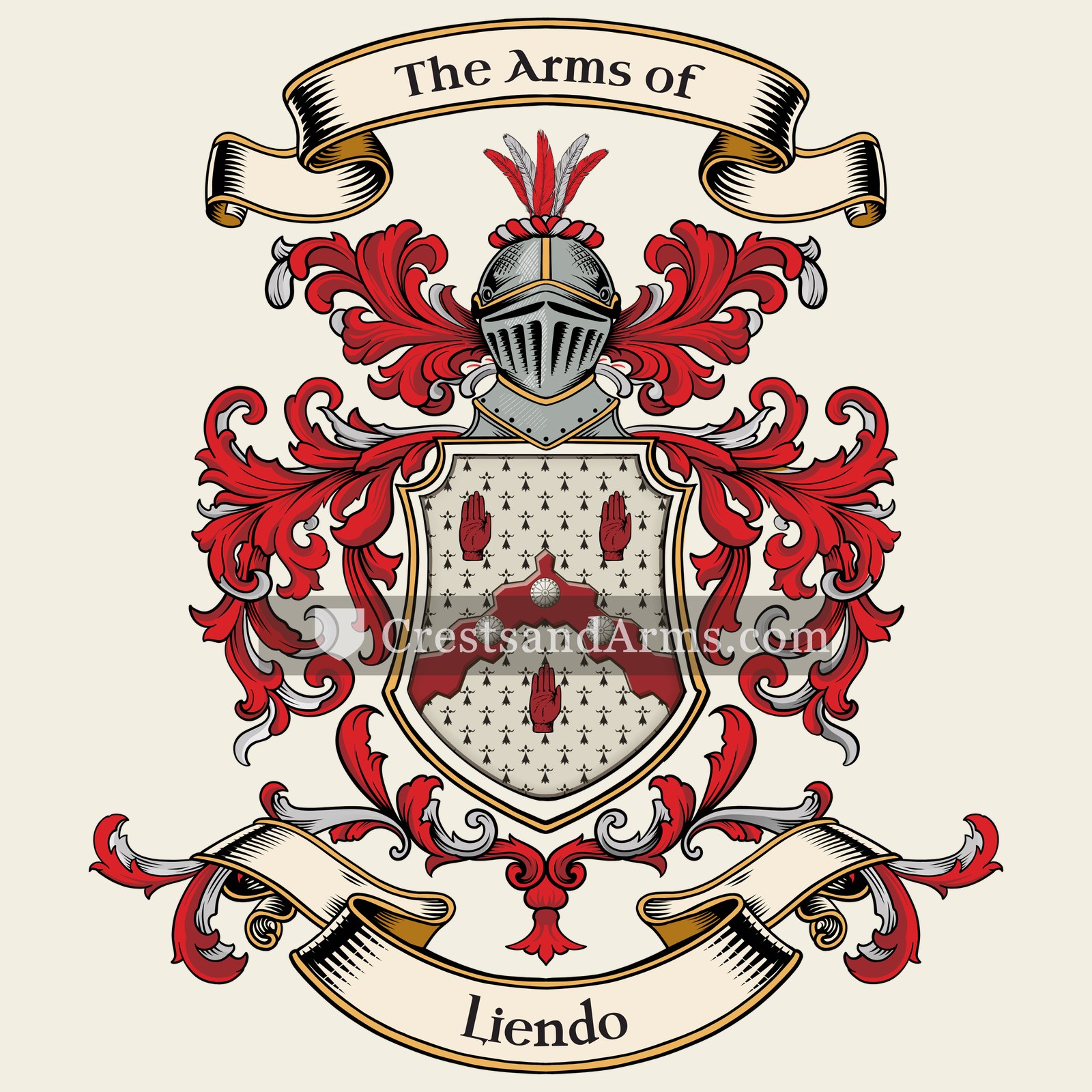
Coat of Arms & Family Crest Details
Symbols on this shield
chevronProtection, and faithful service completed
handFaith, sincerity and justice
roundelA coin, and one who has been to the crusades
Colours
ErmineMeans: Dignity
Red (Gules)Means: Military strength
Silver (Argent)Means: Peace and sincerity
Historical info
Source
Sir Bernard Burke, The General Armory of England, Scotland, Ireland and Wales, London: Harrison & Sons, 1884
Blazon (the actual original written record)
“Erm. on a chev. dovetailed betw. three sinister hands couped at the wrist gu. as many fountains”
CumberlandIngwell · Cumberland, c. 1620
Digital archive packCoat of arms PNG, gold border print PDF, vector SVG and the certificate of authenticity. Sent to your email in minutes.
Map of England showing where the Liendo arms are recorded
The Liendo arms were recorded in Cumberland, c. 1620.
Cumberland was rough border country in the north-west, facing Scotland across a disputed line. Its families held land in return for keeping it defended, and men who fought carried shields of their own.
This is where the arms were entered in the register. Families often moved to other parts of the country, so the same name can turn up in more than one region.
The body that granted and recorded arms in England in this period.
James VI and I
Sovereign of the period
James VI and I
1603–1625
Reigning in Germany when the Liendo arms are first recorded.
How Arms Worked in England
English heraldry allowed arms to be shared by all legitimate descendants of the original owner. These symbols were treated as personal property that moved through the generations to all children. While the eldest son kept the original design, other family members could use the same shield without needing to change it or register their own unique versions.
Granting authority
The College of Arms in London has regulated the use of coats of arms throughout England and Wales since 1484.
How they got arms
Families typically obtained their coats of arms through a formal grant from the Crown or by proving their ancient right to them.
Where arms were recorded
All official coats of arms are recorded in the registers kept at the College of Arms, which date back to the fifteenth century.
The family's standing
Recorded among the armigerous families of Cumberland.
Origin & History of the Liendo Family in England
The history of the Liendo family in England begins in the early seventeenth century, specifically within the rugged landscapes of Cumberland. By 1620, records indicate that members of the family had established a presence in this northern region, which was then a place defined by its proximity to the Scottish border and its distinct local customs. During this period, families in Cumberland often lived in small, tight-knit communities where they relied on agriculture and trade to survive the harsh northern climate. The arrival of the Liendo name in this area suggests a history of migration or movement, perhaps linked to the shifting economic conditions of the time. While the name itself carries roots that likely trace back to continental Europe, its appearance in English parish records from this era highlights how families integrated into the local social fabric of the seventeenth century. These early ancestors were part of a changing England, navigating a life centered on parish duties, local land use, and the challenges of living in a border territory.
Related Branches & Arms
Root word
Linde
A type of deciduous tree known as the linden or lime tree.
This name
LiendoA topographic name for someone who lived near a prominent linden tree or grove.
also spelled
Lyndow
Lindowe
Lindau
Lyndowe
Documented Sources
J. B. Rietstap, Armorial Général, Gouda: G. B. van Goor Zonen, 1884–87
Staatsarchiv Ludwigsburg, Kirchenbücher der evangelischen Kirchengemeinden in Württemberg, 1765
Brechenmacher, Josef Karlmann, Etymologisches Wörterbuch der deutschen Familiennamen, 1957
Lang, Albert, Die Geschichte der schwäbischen Landbevölkerung im 18. Jahrhundert, 1982
Digital archive packCoat of arms PNG, gold border print PDF, vector SVG and the certificate of authenticity. Sent to your email in minutes.


 branchPeace, and new growth
 leafHappiness and abundance
 branchPeace, and new growth
 leafHappiness and abundance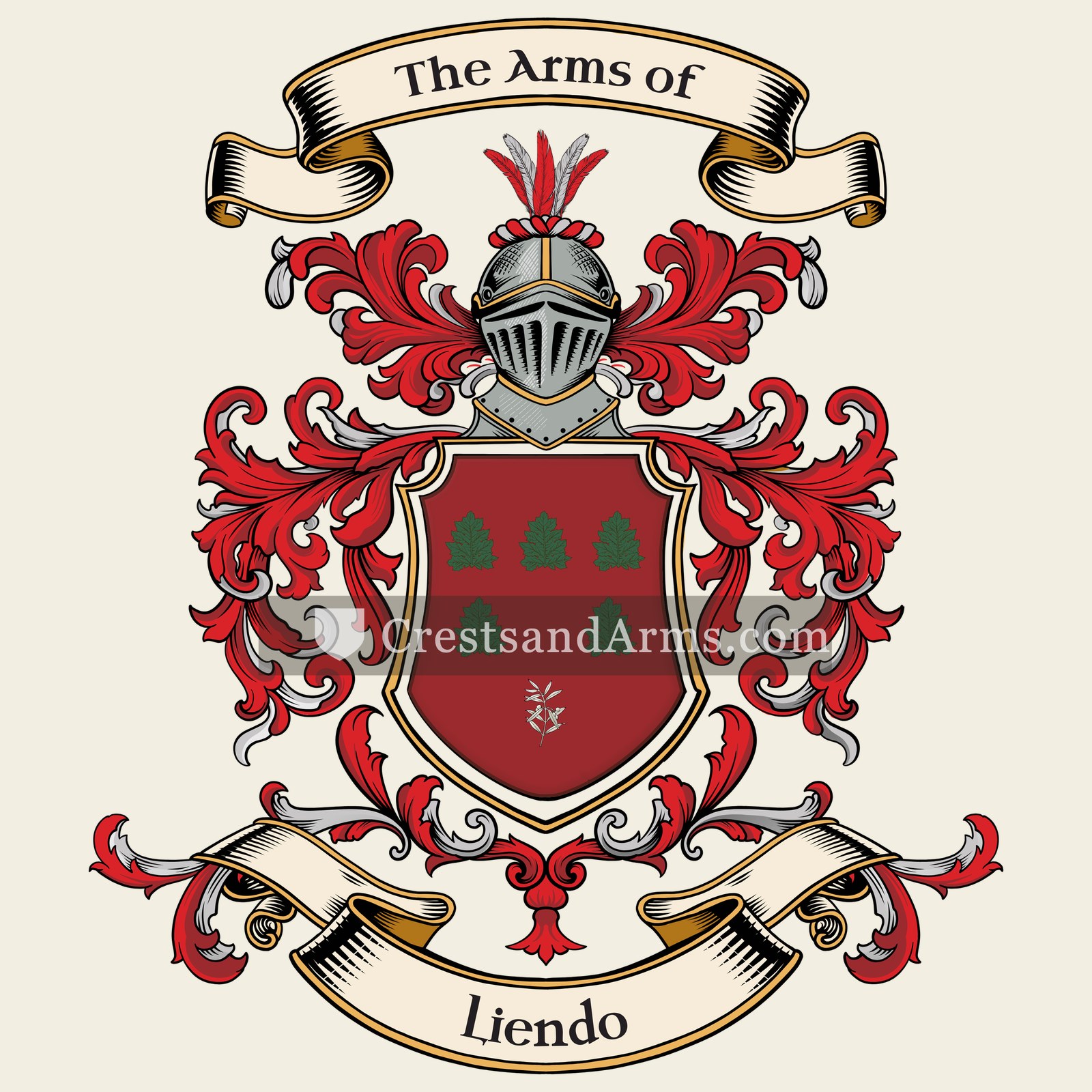


 chevronProtection, and faithful service completed
 handFaith, sincerity and justice
 roundelA coin, and one who has been to the crusades