Map of Belgium showing where the Limper arms are recorded
The Limper arms were recorded in Friesland, c. 1737.
Friesland was low, wet country on the northern coast of the Netherlands, farmed by families who had held the same land for centuries. Free landholders were unusually common there, and a free landholder could carry arms.
This is where the arms were entered in the register. Families often moved to other parts of the country, so the same name can turn up in more than one region.
The body that granted and recorded arms in Belgium in this period.
Charles VI, Holy Roman Emperor
Sovereign of the period
Charles VI, Holy Roman Emperor
1711–1740
Reigning in Belgium when the Limper arms are first recorded.
How Arms Worked in Belgium
In Belgium, a coat of arms is considered personal property that is passed down through the male line to legitimate descendants. Families often use the same shield design across generations to show their shared heritage. If a branch of the family wants to change the design, they must apply for an official update to their specific version of the arms.
Granting authority
The Conseil héraldique is the official body that regulates and approves all coats of arms in Belgium.
How they got arms
Families obtain their coats of arms through formal royal grants or by confirming their historical right to use existing designs.
Where arms were recorded
All approved coats of arms are officially recorded in the public registers of the Conseil héraldique since 1844.
The family's standing
Recorded among the armigerous families of Friesland.
Origin & History of the Limper Family in Belgium
The family name Limper has deep roots in the northern region of the Netherlands known as Friesland. Historical records confirm that members of the family were living in this area as early as 1737. During the eighteenth century, Friesland was a distinct province with its own language and strong maritime traditions. Families in this region often lived in small, tight-knit farming or fishing communities near the North Sea coast. The name itself likely evolved from local dialects, possibly describing a person who walked with a noticeable gait or someone who lived near a specific landmark. Because the Frisian people placed great importance on keeping detailed church and civil registries, the family was able to maintain a clear presence in the local records as they navigated the economic and social changes of the era.
Related Branches & Arms
Root word
limp
Middle English or Germanic term referring to a soft or flexible state.
This name
LimperAn occupational or descriptive surname for someone who walked with a noticeable limp.
also spelled
Lempere
Lempar
Lempeer
Documented Sources
J. B. Rietstap, Armorial Général, Gouda: G. B. van Goor Zonen, 1884–87
Tresoar (Fries Historisch en Letterkundig Centrum), Doop-, trouw-, begraaf- en lidmatenregisters (DTB) van Friesland
AlleFriezen, Burgerlijke Stand van Friesland
Digital archive packCoat of arms PNG, gold border print PDF, vector SVG and the certificate of authenticity. Sent to your email in minutes.


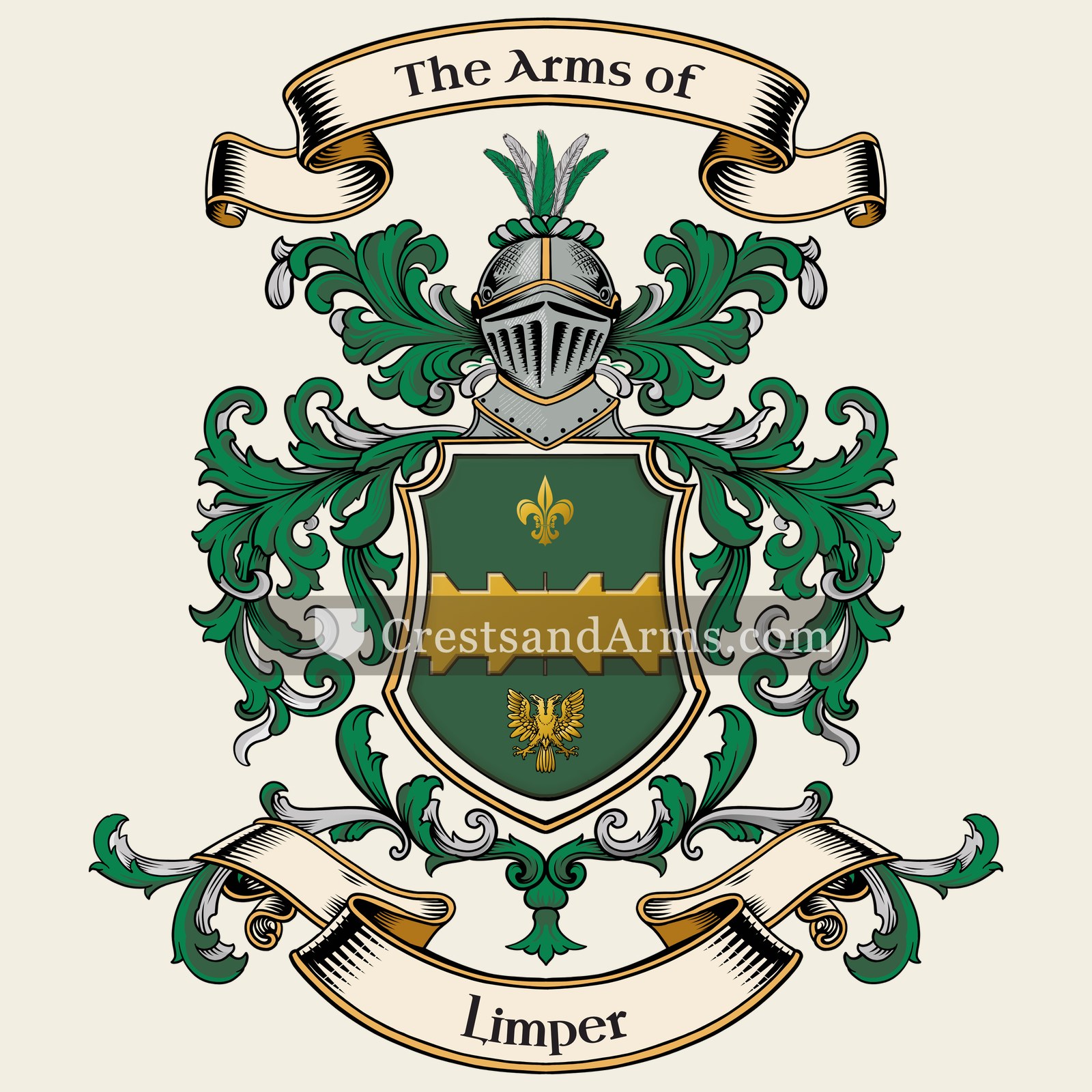
 fessThe military belt, and readiness to serve
 fleur de lisPurity, light, and the sixth son
 eagleNobility, strength and a keen mind
 fessThe military belt, and readiness to serve
 fleur de lisPurity, light, and the sixth son
 eagleNobility, strength and a keen mind