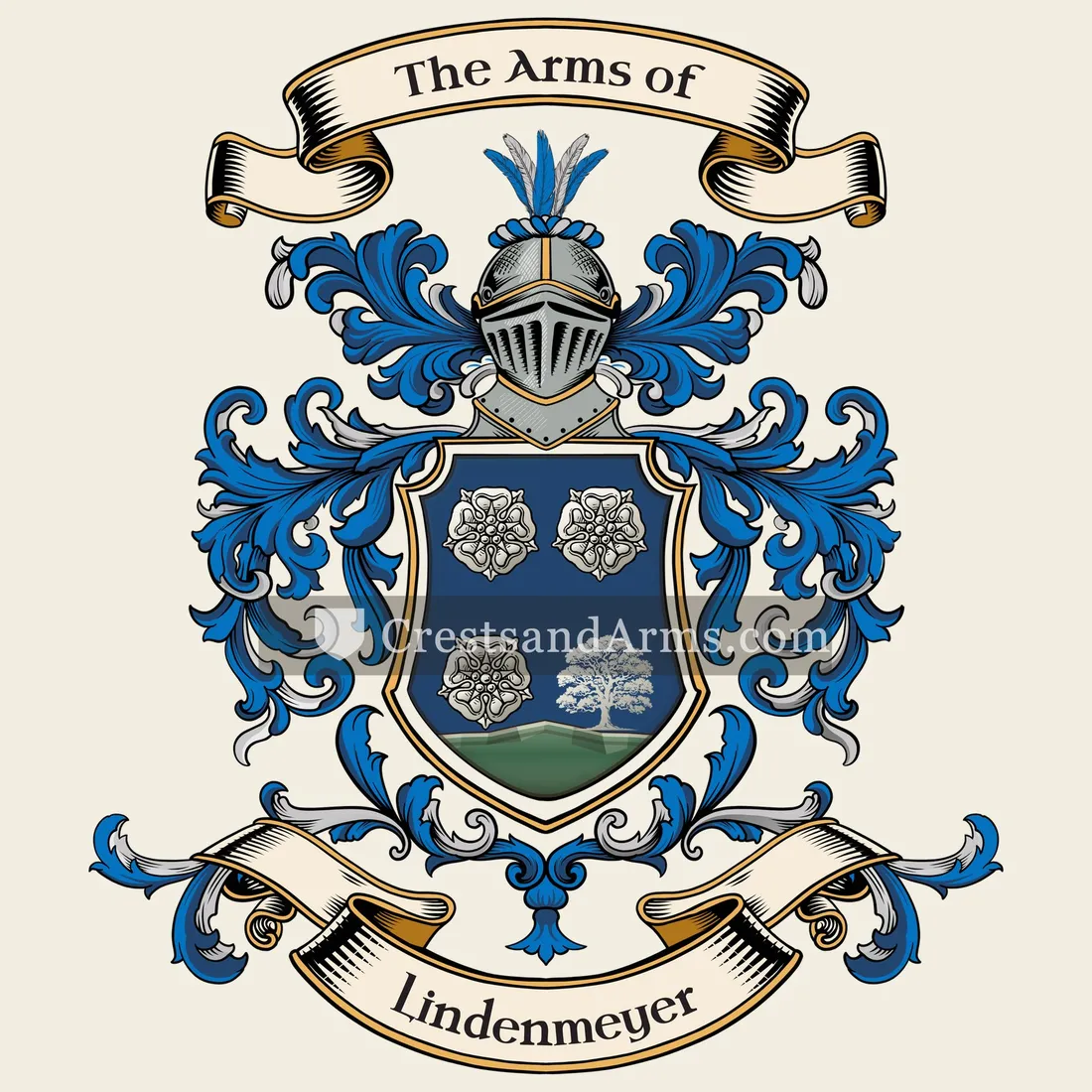
A record of documented arms, meaning and origin, researched for the Lindenmeyer family of Switzerland.
Reg. 1148 · Swiss, J–L
Meaning of the Lindenmeyer family crest colors & symbols
Symbols on this shield
mountThe ground held, and steadfastness upon it
roseThe seventh son, and beauty with grace
treeLife, endurance and deep roots
Colours
Blue (Azure)Means: Loyalty and truth
Green (Vert)Means: Hope
Silver (Argent)Means: Peace and sincerity
Historical info
Source
J. B. Rietstap, Armorial Général, Gouda: G. B. van Goor Zonen, 1884–87
Blazon (the actual original written record)
“D'azur à un paysan, posé de front sur une terrasse de sin., hab. d'or, rebr. d'azur, au rabat du même, coiffé d'un bonnet de sa., tenant de sa main dextre trois roses, une d'arg. entre deux de gu., tigées de sin., et de sa sen. un arbre arr. au nat. C.: le paysan, iss. L. d'or et d'azur.”
SwitzerlandBâle, c. 1745
Digital archive packCoat of arms PNG, gold border print PDF, vector SVG and the certificate of authenticity. Sent to your email in minutes.
Map of Switzerland showing where the Lindenmeyer arms are recorded
The Lindenmeyer arms were recorded in Bâle, c. 1745.
This is where the arms were entered in the register. Families often moved to other parts of the country, so the same name can turn up in more than one region.
The body that granted and recorded arms in Switzerland in this period.
How Arms Worked in Switzerland
In Switzerland, coats of arms were not restricted to the nobility and were often adopted by common citizens and families. These symbols were passed down through generations to show family identity. When branches of a family grew, they often changed small details of the design to distinguish their own line from the original group.
Granting authority
Cantonal and civic authorities managed the use of coats of arms within their specific regions and local jurisdictions.
How they got arms
Families typically assumed their own coats of arms based on local custom rather than receiving them from a central monarch.
Where arms were recorded
Arms were recorded in various cantonal and civic registers starting from the fourteenth century throughout the Swiss region.
The family's standing
Recorded among the armigerous families of Switzerland.
Origin & History of the Lindenmeyer Family in Switzerland
The surname Lindenmeyer is a topographic name that originated in the German-speaking regions of Europe. It is composed of two parts: "Linden," which refers to the linden or lime tree, and "Meyer," which historically identified a steward, a bailiff, or a tenant farmer who managed land for a landlord. Families carrying this name often lived near a prominent linden tree, which served as a common landmark or a central meeting place in early rural villages. By 1745, records confirm that members of the Lindenmeyer family were established in the city of Bâle, now known as Basel, Switzerland. During this era, the city functioned as a major hub for trade and craftsmanship along the Rhine River. Families like the Lindenmeyers likely integrated into the local economy as skilled workers or merchants, benefiting from the city's reputation as a center for printing, silk manufacturing, and banking.
Lindenmeyer Meaning & Related Branches
Root word
Linde and Meier
Linden tree and a steward or overseer of land.
This name
LindenmeyerAn occupational surname for a steward who managed an estate near a linden tree.
also spelled
Lindenmayer
Lyndenmeyer
Lindenmeier
Related arms
Lindenmayervariant spelling
Lindenmayrvariant spelling
Documented Sources
J. B. Rietstap, Armorial Général, Gouda: G. B. van Goor Zonen, 1884–87
Bahlow, Hans, Deutsches Namenlexikon: Familien- und Vornamen nach Ursprung und Sinn erklärt, 1967
Heintze, Albert, Die deutschen Familiennamen: geschichtlich, geographisch, sprachlich, 1903
Staatsarchiv Basel-Stadt, Bürgerverzeichnisse und Einwohnerregister
Digital archive packCoat of arms PNG, gold border print PDF, vector SVG and the certificate of authenticity. Sent to your email in minutes.


 mountThe ground held, and steadfastness upon it
 roseThe seventh son, and beauty with grace
 treeLife, endurance and deep roots
 mountThe ground held, and steadfastness upon it
 roseThe seventh son, and beauty with grace
 treeLife, endurance and deep roots