Map of Spain showing where the Linehan arms are recorded
The Linehan arms were recorded in Aragon, c. 1722.
Aragon was mountain and river country in north-eastern Spain, with a strong tradition of small independent landholders. A great many families counted as gentry there, and each one needed a shield to be told apart.
This is where the arms were entered in the register. Families often moved to other parts of the country, so the same name can turn up in more than one region.
The body that granted and recorded arms in Spain in this period.
Philip V of Spain
Sovereign of the period
Philip V of Spain
1714–1724
Reigning in Spain when the Linehan arms are first recorded.
How Arms Worked in Spain
In Spain, a coat of arms was considered a form of property that belonged to the entire family line. These arms were passed down from a father to all his children equally. Younger branches of the family usually kept the original design without needing to add any special marks to distinguish their specific line.
Granting authority
The Cronista Rey de Armas was the official body that regulated and granted coats of arms throughout Spain.
How they got arms
Families often obtained their arms through royal grants or by proving their noble status to the official heraldic authority.
Where arms were recorded
Coats of arms were officially recorded in the registers of the Cronista Rey de Armas starting in 1496.
The family's standing
Recorded among the armigerous families of Aragon.
Origin & History of the Linehan Family in Spain
The surname Linehan is traditionally associated with the Gaelic lineage of Ireland, specifically originating from the County Cork region as an anglicized version of the name Ó Luineacháin. While the family is deeply rooted in Irish history, members of the lineage also established a notable presence in continental Europe during the eighteenth century. Historical records confirm that individuals bearing this name were living in the Kingdom of Aragon by 1722. During this era, many families of Irish descent moved to Spain to serve in the military or to pursue administrative roles within the Spanish Empire. These migrants often integrated into local society while maintaining their distinct cultural heritage. This movement highlights the significant international mobility of Irish families during the early modern period as they sought new opportunities across the European continent.
Linehan Meaning & Related Branches
Root word
O'Lionnain
Derived from the Gaelic word for a small cloak or mantle.
This name
LinehanAn Irish surname meaning descendant of the little cloaked one.
also spelled
Linyan
Linnan
Documented Sources
J. B. Rietstap, Armorial Général, Gouda: G. B. van Goor Zonen, 1884–87
O'Hart, John, Irish Pedigrees; or, The Origin and Stem of the Irish Nation, 1892
Archivo General de Simancas, Secretaría de Guerra, Hojas de Servicios de Militares, 1722
Digital archive packCoat of arms PNG, gold border print PDF, vector SVG and the certificate of authenticity. Sent to your email in minutes.


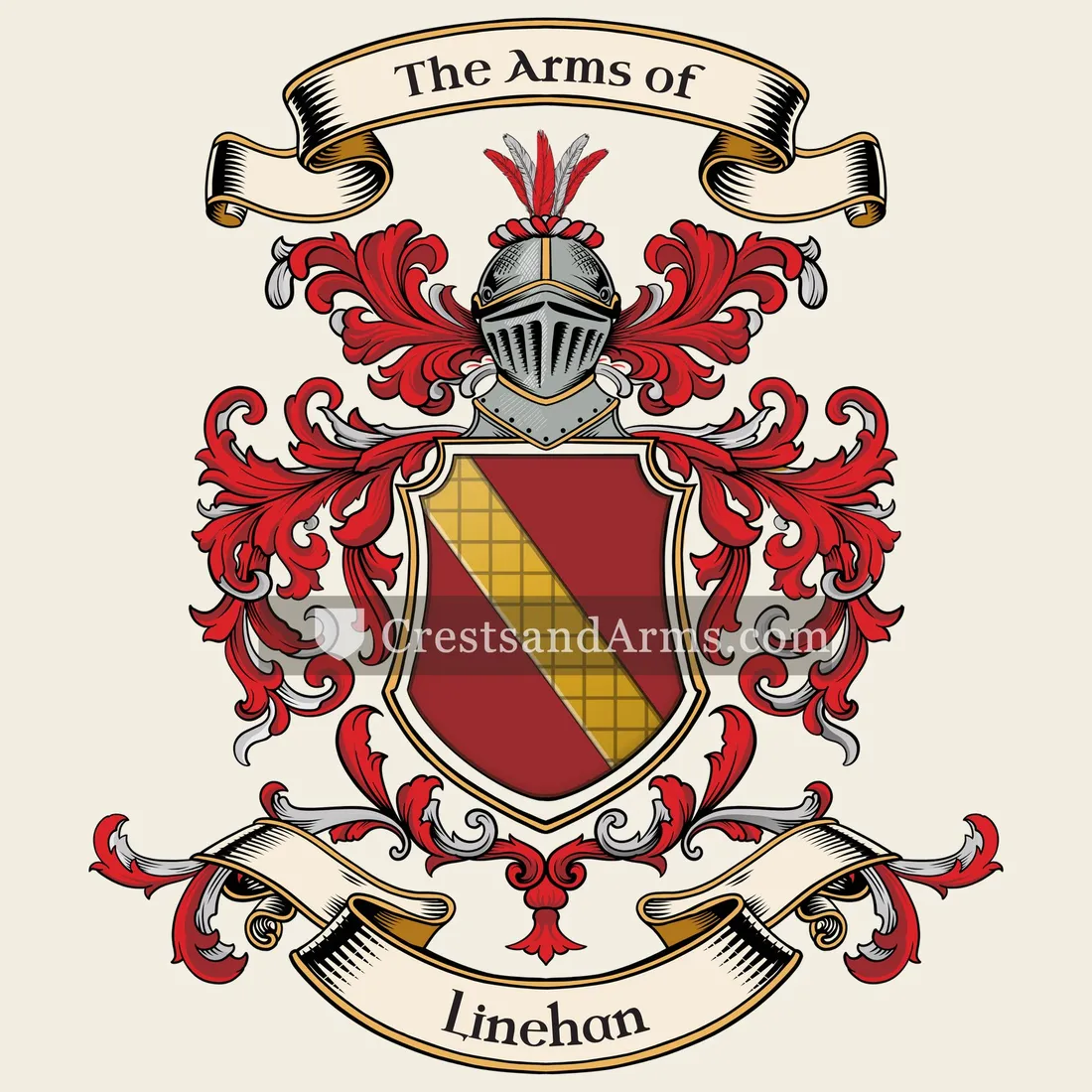
 bendDefence, and the scarf of a commander
 bendDefence, and the scarf of a commander