Map of Netherlands showing where the Lipps arms are recorded
The Lipps arms were recorded in Netherlands, c. 1815.
Arms such as these were typically recorded in Friesland.
Friesland was low, wet country on the northern coast of the Netherlands, farmed by families who had held the same land for centuries. Free landholders were unusually common there, and a free landholder could carry arms.
This is where the arms were entered in the register. Families often moved to other parts of the country, so the same name can turn up in more than one region.
Region
Friesland
First recorded
1815
Granting Authority for the Lipps Arms
Hoge Raad van Adel
Photograph made by me · CC BY-SA 3.0
The body that granted and recorded arms in Netherlands in this period.
William I of the Netherlands
Sovereign of the period
William I of the Netherlands
1815–1840
Reigning in Netherlands when the Lipps arms are first recorded.
How Arms Worked in Netherlands
In the Netherlands, coats of arms were often used by noble families and those who held specific public offices. These arms were passed down through the generations to legitimate descendants. Younger branches of a family usually kept the original design without needing to add special marks. This system ensured that the family identity remained clear and consistent over many years.
Granting authority
The Hoge Raad van Adel is the official body that regulates and manages noble titles and coats of arms in the Netherlands.
How they got arms
Families typically obtained their coats of arms through official royal grants or by proving their long-standing historical use of the symbols.
Where arms were recorded
Coats of arms are officially recorded in the registers held by the Hoge Raad van Adel, which began its work in 1814.
The family's standing
Recorded among the armigerous families of Netherlands.
Origin & History of the Lipps Family in Netherlands
The surname Lipps traces its roots in the Netherlands to the northern province of Friesland, where records confirm the family was established by 1815. The name likely originated as a patronymic, which means it was derived from a shortened version of the name Philippus. During the early nineteenth century, the Napoleonic administration in the Netherlands required all citizens to register permanent surnames for tax and military purposes. Before this time, many families in rural Friesland used informal naming patterns, but the formalization of the Lipps name helped solidify the family identity within the local community. As the family settled into Frisian life, they became part of the regional social fabric, living through a period of significant political transition as the Netherlands emerged as a unified kingdom. This era marked a shift toward modern record-keeping, allowing historians to track the movement and growth of the Lipps family as they integrated into the Dutch population.
Meaning of the Lipps family crest colors & symbols
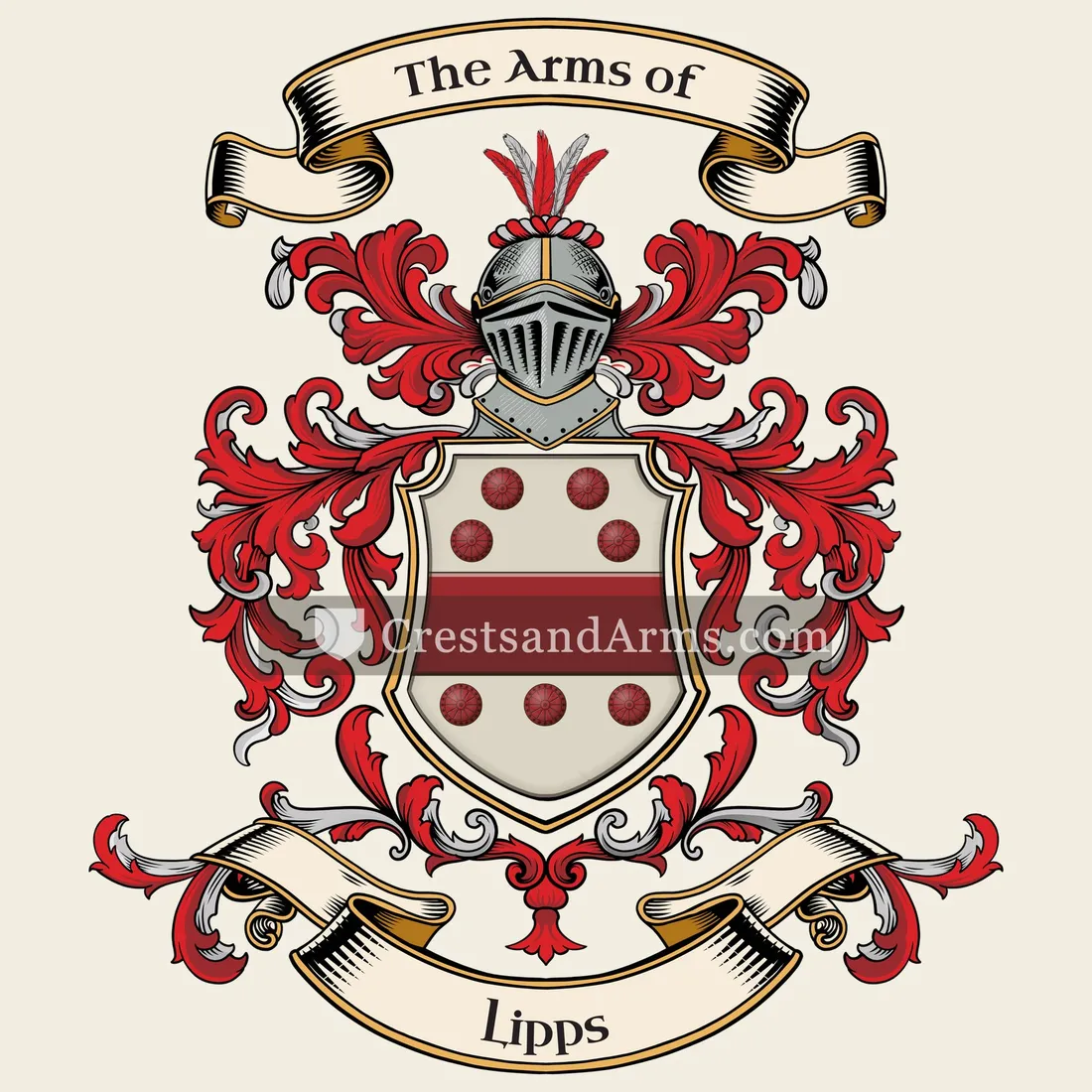
Symbols on this shield
knightChivalry and service in arms
Colours
Blue (Azure)Means: Loyalty and truth
Silver (Argent)Means: Peace and sincerity
Historical info
Source
J. B. Rietstap, Armorial Général, Gouda: G. B. van Goor Zonen, 1884–87
Blazon (the actual original written record)
“Parti d'azur et d'arg; à un homme iss., hab. de l'un en l'autre, cour. d'or, supp. de sa main dextre étendue une fleur-de-lis d'or, la sen. appuyée sur sa hanche. C.: une massue d'azur, la tête en haut, supp. une étoile d'arg; entre deux prob., coupées alt. d'arg. et d'azur. L. d'arg. et d'azur.”
BavariaBavaria, c. 1822
Digital archive packCoat of arms PNG, gold border print PDF, vector SVG and the certificate of authenticity. Sent to your email in minutes.
Map of Germany showing where the Lipps arms are recorded
The Lipps arms were recorded in Bavaria, c. 1822.
Bavaria was a country of old landed families and walled market towns. Estates passed down the same line for centuries, and both the landowners and the leading townsmen kept arms, which is why so many Bavarian names sit in the registers.
This is where the arms were entered in the register. Families often moved to other parts of the country, so the same name can turn up in more than one region.
The body that granted and recorded arms in Germany in this period.
Frederick William III of Prussia
Sovereign of the period
Frederick William III of Prussia
1797–1840
Reigning in Netherlands when the Lipps arms are first recorded.
How Arms Worked in Germany
Prussian heraldry was strictly tied to social rank and noble status rather than being a free choice for every citizen. These symbols were treated as permanent family property that moved through the generations to all legitimate heirs. If a family branch wanted to change their design to stand out, they had to apply for official permission to alter their specific version of the shield.
Granting authority
The Prussian Heroldsamt acted as the central state office that managed and strictly controlled all noble titles and coats of arms.
How they got arms
Families usually obtained their arms through formal royal grants or by proving their long-standing noble status to the state authorities.
Where arms were recorded
All official coats of arms were kept in the rolls of the Prussian Heroldsamt, which functioned from 1706 until 1918.
The family's standing
Recorded among the armigerous families of Bavaria.
Origin & History of the Lipps Family in Germany
The surname Lipps is a patronymic name, which means it evolved from the given name Philipp. In the German-speaking regions, names were often shortened or modified to create nicknames, and Lipps emerged as a common variation of Philippus or Philipp. By the early 19th century, families bearing this name were well-established in the southern German state of Bavaria. Records confirm that members of the Lipps family were living in this region by 1822, likely working as farmers or skilled tradespeople within the local village structures. During this period, Bavaria was undergoing significant social and political changes following the Napoleonic Wars, and families were increasingly tied to specific parishes through birth, marriage, and death registers. These early ancestors were part of a stable, agrarian society where the name Lipps became a permanent fixture in the local community records of the Bavarian countryside.
Lipps Meaning & Related Branches
Root word
Philippus
Derived from the Greek word meaning friend of horses.
This name
LippsA patronymic surname indicating descent from a person named Philip.
also spelled
Lyps
Lipps
Documented Sources
J. B. Rietstap, Armorial Général, Gouda: G. B. van Goor Zonen, 1884–87
Tresoar, Burgerlijke Stand Friesland, 1811-1950
Nederlandse Familienamenbank, Lipps
Meertens Instituut, Nederlandse Familienamen
Digital archive packCoat of arms PNG, gold border print PDF, vector SVG and the certificate of authenticity. Sent to your email in minutes.


 fessThe military belt, and readiness to serve
 roundelA coin, and one who has been to the crusades
 fessThe military belt, and readiness to serve
 roundelA coin, and one who has been to the crusades


 knightChivalry and service in arms